
5.0 Rating
Request A Free Estimate
Affordable solar panels have revolutionized home energy in recent years, making clean power accessible to more homeowners than ever before. If you’re looking for the most budget-friendly solar options in 2024, here’s what you need to know:
| Affordable Solar Panel Facts | Details |
|---|---|
| Average Cost Range | $2.36-$2.89 per watt |
| Most Affordable Brands | AXITEC, LONGi, Jinko Solar, Canadian Solar, Trina Solar |
| Federal Tax Credit | 30% of total system cost |
| Typical System Cost | $18,000-$20,000 before incentives |
| Potential Savings | Up to $42,000 over 25 years |
| Price Decline | From $4/watt in 2013 to under $1/watt today |
The days when solar power was only for the wealthy are long gone. Modern manufacturing advances have driven prices to record lows, with solar module prices reaching an unprecedented $0.096 per watt in 2024 according to BloombergNEF. This dramatic price drop has transformed solar from a luxury investment into a practical money-saving solution for average homeowners.
While premium solar panels can cost upwards of $3.00 per watt, today’s affordable options deliver solid performance at prices between $2.36-$2.89 per watt. These budget-friendly panels still come with robust warranties (typically 10-12 years for product defects and 25 years for performance) and efficiency ratings between 18-21%.
For homeowners tired of unpredictable utility bills, affordable solar panels offer a path to energy independence with predictable costs. The upfront investment is further reduced by the federal solar tax credit, which covers 30% of your installation costs, along with various state incentives and rebates that can lower the price even more.
I’m Rob Raffa, CEO of Sunergy Solutions LLC, and I’ve helped hundreds of homeowners across the Northeast transition to affordable solar panels that maximize long-term savings while minimizing upfront costs.
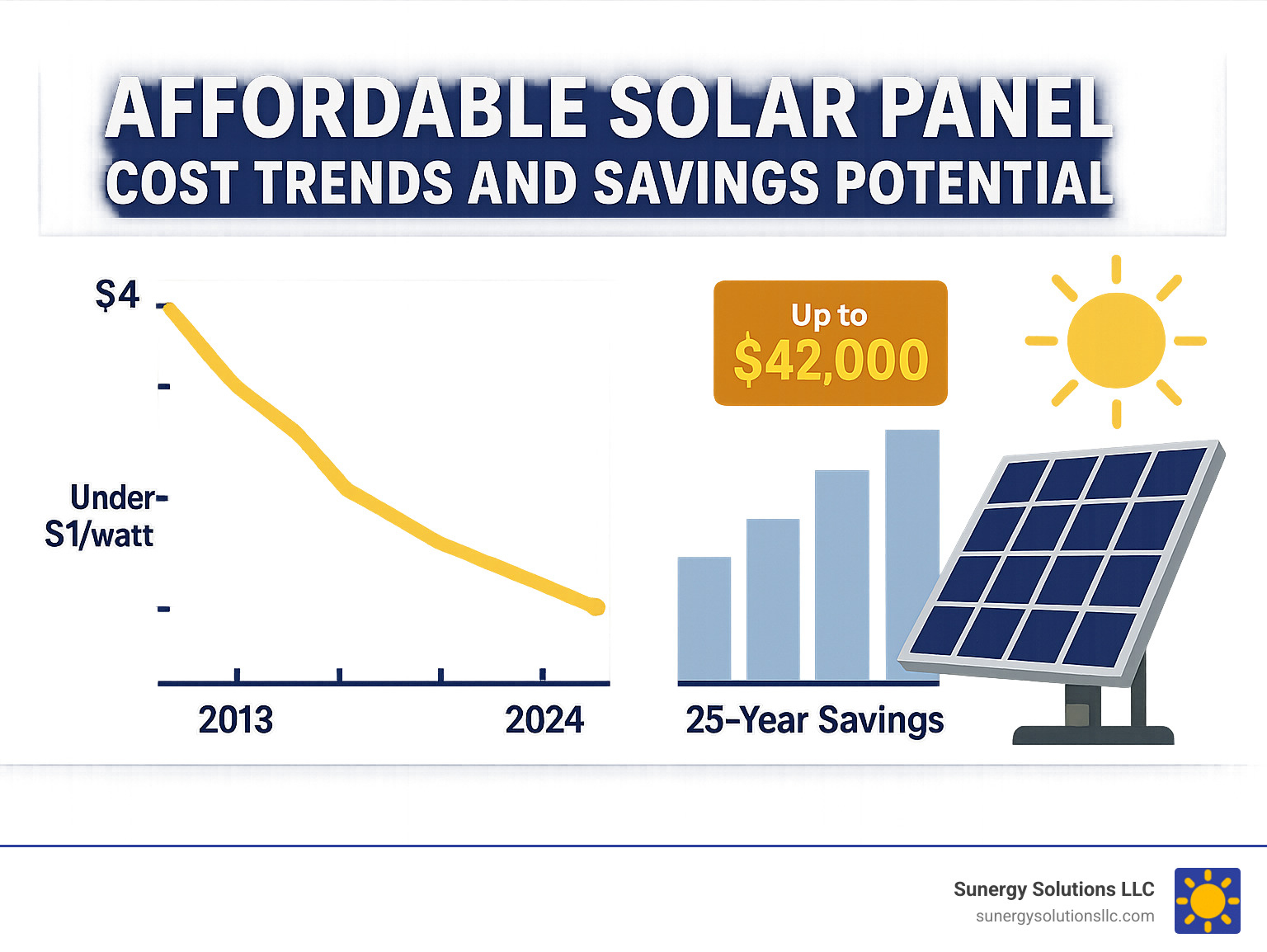
When we talk about affordable solar panels, we’re really looking at the total value you get for your investment. The price-per-watt is our standard measuring stick – with the national average hovering around $3.00 per watt in 2024, anything under $2.85 per watt falls into the “affordable” category.
But true affordability goes beyond just the initial price tag. It’s about what those panels deliver over their entire lifetime. Let’s look at what really determines whether solar panels are a good deal:
| Factor | Budget Panels | Premium Panels |
|---|---|---|
| Price per Watt | $2.36-$2.89 | $3.00+ |
| Efficiency | 16-20% | 20-23% |
| Product Warranty | 10-12 years | 25 years |
| Performance Warranty | 25 years (80-85% output) | 25-30 years (90%+ output) |
| Degradation Rate | 0.5-0.7% annually | 0.25-0.4% annually |
| Expected Lifespan | 20-25 years | 25-30+ years |
Here’s the good news – many affordable solar panels come from the same Tier-1 manufacturers that produce premium models. The difference often comes down to small variations in materials or specifications rather than fundamental quality issues.
What makes one solar panel cost more than another? Several key factors are at play:
Materials make a big difference in pricing. Monocrystalline panels cost more than polycrystalline but give you higher efficiency in return. The quality of everything from the silicon cells to the glass covering, aluminum frame, and junction boxes all affect what you’ll pay.
Manufacturing scale creates significant price differences. Larger manufacturers benefit from economies of scale, which is why panels made in massive Chinese factories often cost less than those produced in smaller American or European facilities.
Shipping costs matter more than you might think. Solar panels are heavy, fragile, and awkward to transport. Panels made closer to your home often have a price advantage simply because they travel a shorter distance.
Technology features like half-cut cells, PERC technology, and bifacial capabilities add cost but can improve performance. These advanced features are becoming more common even in budget-friendly options.
At Sunergy Solutions LLC, we carefully weigh all these factors to find the sweet spot between affordability and quality for our customers across Maine, Massachusetts, New Hampshire, Rhode Island, Vermont, Montana, and Virginia.
The main differences between budget-friendly and premium panels boil down to three key areas:
Efficiency is where you’ll notice the first difference. Budget panels typically convert 16-20% of sunlight into electricity, while premium panels reach 20-23%. Higher efficiency means more power from the same roof space – important if you have limited installation area.
Warranties tell you a lot about manufacturer confidence. Most affordable solar panels include a 10-12 year product warranty against defects, plus a 25-year performance warranty. Premium options often extend the product warranty to match the 25-year performance guarantee.
Lifespan and degradation reflect how panels age over time. All panels naturally produce less electricity as they age. Budget panels might lose 0.5-0.7% efficiency annually, while premium panels degrade more slowly at 0.25-0.4% per year.
According to the latest research on module prices from the Department of Energy, solar panel costs continue to fall while performance improves across all price categories, making now an excellent time to invest in solar energy.
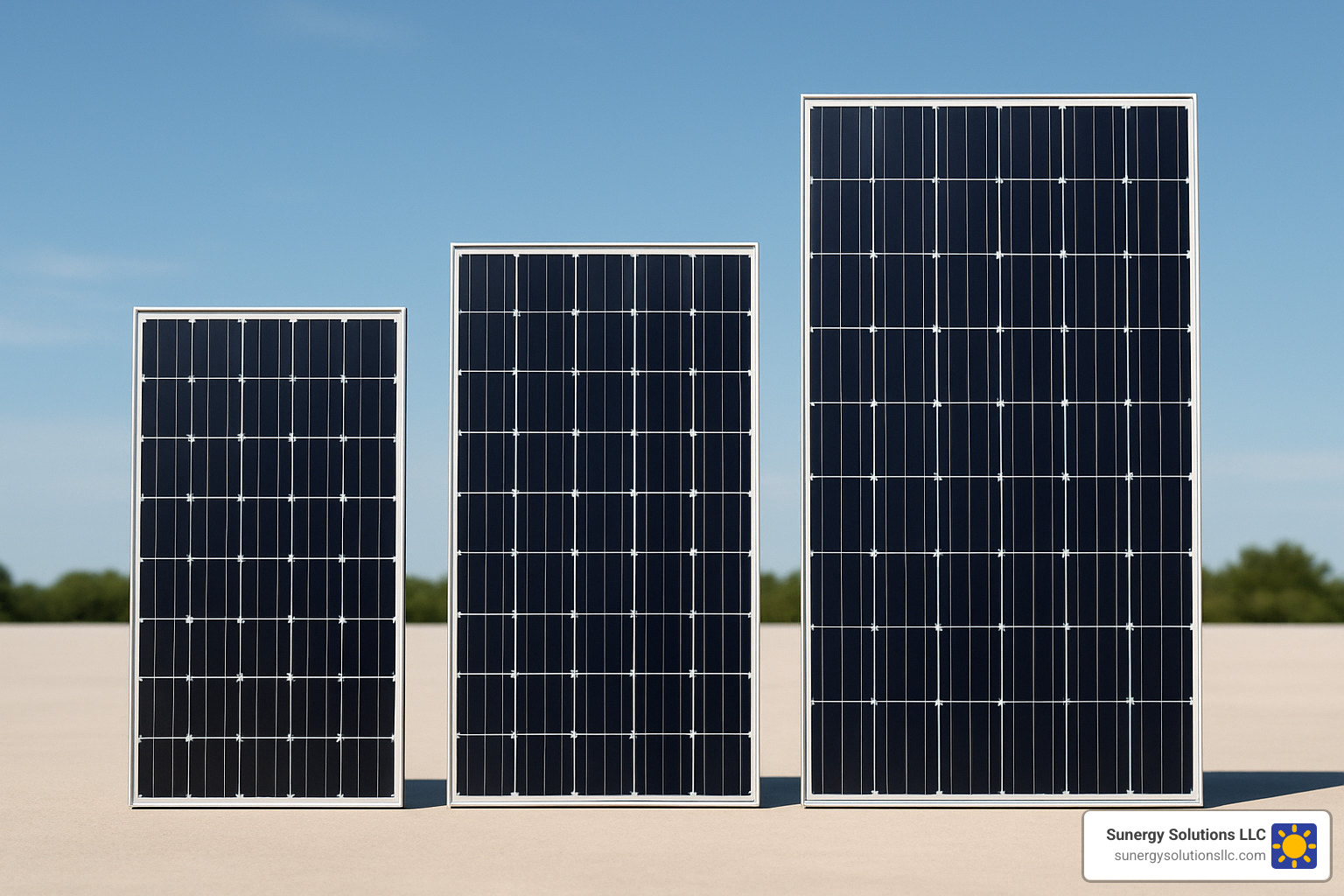
I’ve spent countless hours researching the solar market this year, and I’m excited to share what I’ve found. If you’re looking for the sweet spot where price meets performance, 2024 has delivered some impressive options. Today’s affordable solar panels are hitting that 400W average output mark, with advanced features like half-cut cells and bifacial technology that were premium extras just a few years ago.
The AXITEC AC-335MH/120S at just $2.36/watt is our hands-down winner for the budget-conscious homeowner. With nearly 20% efficiency and half-cut cell technology, these panels perform admirably even when partially shaded by trees or nearby structures.
I love recommending these to first-time solar adopters because they come with a solid 12-year product warranty backed by a 25-year performance guarantee. AXITEC achieves these low prices through high-volume production while maintaining quality standards that should give you peace of mind for decades.
If efficiency is your priority but your budget is still tight, the LONGi LR4-72HPH-455M at $2.40/watt delivers exceptional value. These panels achieve an impressive 21.3% efficiency thanks to their advanced PERC cell technology.
What really sets these panels apart is their stellar performance in less-than-ideal light conditions. That morning fog or late afternoon haze? The LONGi panels keep generating strong output when other budget panels might underperform.
Sometimes spending a little more upfront saves a lot in the long run. The REC Alpha Pure panels at $2.82/watt exemplify this principle perfectly. With a remarkable 92% power output guarantee after 25 years (compared to the industry standard of 80-85%), these panels are built to last.
The 20-year product warranty is nearly double what most affordable solar panels offer, and their advanced heterojunction cell technology delivers efficiency on par with much more expensive premium brands.
Not everyone needs a full rooftop system. For cabins, RVs, or emergency backup power, the Renogy 100W Portable Solar Panel Kit at $199 is tough to beat. These plug-and-play systems include everything you need to start generating power immediately, including the charge controller.
The foldable design with carrying case makes it perfect for those who need flexibility or are just dipping their toes into solar.
Let’s face it – the panels themselves are just one piece of the solar puzzle. There are plenty of ways to make your solar journey more affordable, and I’m excited to share them with you!
Here’s some fantastic news for your wallet: the federal government wants to reward you for going solar. The solar investment tax credit (ITC) lets you deduct a whopping 30% of your solar system cost from your federal taxes.
This isn’t just a deduction – it’s a dollar-for-dollar reduction in what you owe Uncle Sam. So if your system costs $20,000, you’ll get $6,000 back on your taxes, bringing your actual cost down to $14,000.
This generous 30% credit is guaranteed through 2032. After that, it steps down to 26% in 2033 and 22% in 2034 before disappearing for homeowners in 2035. So there’s definitely an advantage to going solar sooner rather than later!
Beyond the federal incentive, your state might be offering you free money too! Each state has its own solar perks:
In Massachusetts, the SMART program pays you for your solar production for a full decade. Rhode Island residents enjoy performance-based incentives through their REG program. Vermont offers additional savings through Green Mountain Power, while Maine has an excellent net energy billing program.
If you’re in New Hampshire, you could get $0.20 per watt (up to $1,000) through their rebate program. Montana residents can claim an alternative energy system tax credit, and many Virginia localities offer property tax exemptions.
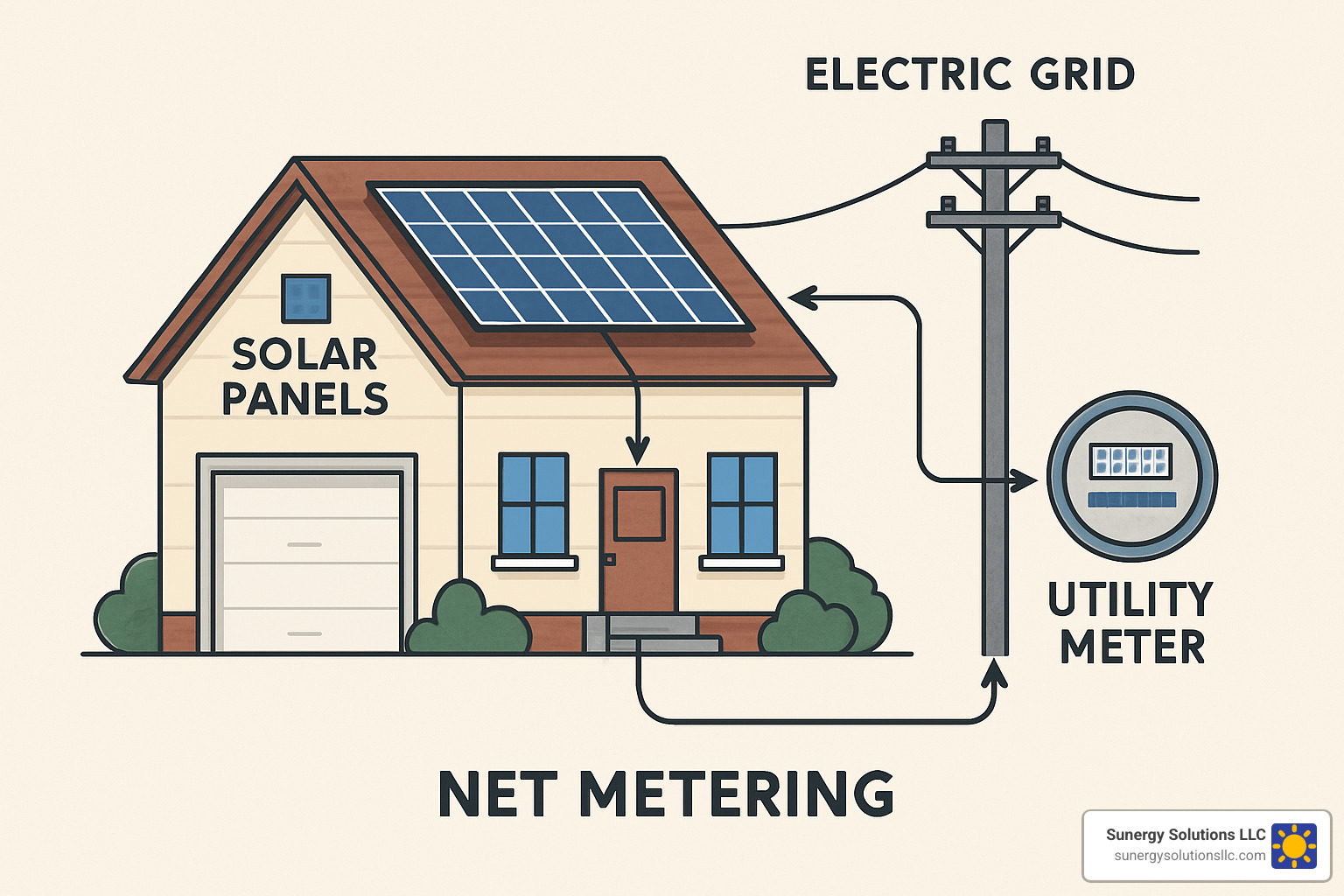
Think of net metering as your personal energy bank account. When your affordable solar panels produce more electricity than you’re using, that excess power flows back to the grid, and you get credits on your utility bill. Later, when you need more power than your panels are making (like at night), you withdraw from those credits.
Don’t have $20,000 sitting in your bank account? No problem! There are plenty of ways to finance your solar system:
Solar Loans make going solar incredibly accessible. Many come with $0 down payment, terms ranging from 10-25 years, competitive interest rates between 3-8%, and no penalties if you want to pay it off early.
Home Equity Lines of Credit (HELOCs) let you tap into your home’s value to fund your solar project, often at very favorable rates.
Credit Union Green Loans are a hidden gem – many credit unions offer special rates for renewable energy projects that beat traditional financing options.
Of course, a Cash Purchase will always give you the best long-term return, but it requires that significant upfront investment.
At Sunergy Solutions LLC, we’ve partnered with multiple financing providers to create flexible payment options custom to your specific financial situation.
While rolling up your sleeves and installing solar panels yourself might seem tempting to save some cash, I generally don’t recommend it for most homeowners. The risks include safety hazards, permitting complexities, potential warranty voids, and utility connection requirements.
Used or refurbished panels can sometimes be found at half the price of new ones, which sounds great on paper. But there are important trade-offs to consider including hidden defects, no warranty coverage, and lower efficiency than newer models.
For most home installations, especially grid-tied systems, I recommend new panels where reliability and warranty coverage are important.
Want to learn more about financing your solar system? Check out our Residential Solar System Financing page or see if you qualify for additional incentives with our Incentive Eligibility Application.
Let’s talk about what most homeowners really want to know: when will your affordable solar panels actually pay for themselves, and how much money will stay in your pocket over the long run?
Before we dive into dollars and cents, we need to figure out the right system size for your home. This isn’t a one-size-fits-all situation – it’s about matching the system to your specific needs.
First, take a peek at your electric bills from the past year. Those kilowatt-hour (kWh) numbers tell us your energy appetite. A typical American home uses about 10,000 kWh annually, but yours might be different depending on your habits, home size, and climate.
Next, we need to consider your available roof space. Each panel needs about 17 square feet and produces between 300-400 watts. That beautiful sunshine hitting your roof varies by location too. In Boston, you’ll get around 4.2 peak sun hours daily (averaged across the year), while Portland, Maine sees about 4.0, and Richmond, Virginia enjoys a sunnier 4.8 hours.
For a Northeast home using 10,000 kWh annually, you’re typically looking at:
At Sunergy Solutions LLC, we’ll analyze your specific situation and design a custom system that fits your energy needs like a glove – not too big, not too small, but just right.
Now for the bottom line: how quickly will your investment pay itself back? With today’s affordable solar panels, most homeowners see their systems reach the break-even point in about 7-12 years, depending on where you live, your electricity rates, and available incentives.
Over a 25-year period (the minimum lifespan of quality panels), you’re looking at total savings between $30,000 and $50,000. That’s real money that stays in your family’s budget instead of going to the utility company!
In terms of return on investment, solar typically delivers an internal rate of return between 10-20% – often outperforming many traditional investments.
What makes solar such a good investment? Several factors work in your favor:
Local electricity rates play a huge role – higher rates mean faster payback. If you’re in an area with expensive electricity (looking at you, Massachusetts and Rhode Island), your solar investment will pay off more quickly.
Annual rate increases from utilities typically run 2-4% each year, which means your savings actually grow over time as you avoid these rising costs.
Available incentives can dramatically reduce your payback time. The federal tax credit is just the start – many states offer additional perks that make solar even more attractive.
As a bonus, solar panels typically increase your home’s resale value by about 4%, according to Zillow research.
Even affordable solar panels are marathon runners, not sprinters. They’re built to produce clean energy for decades:
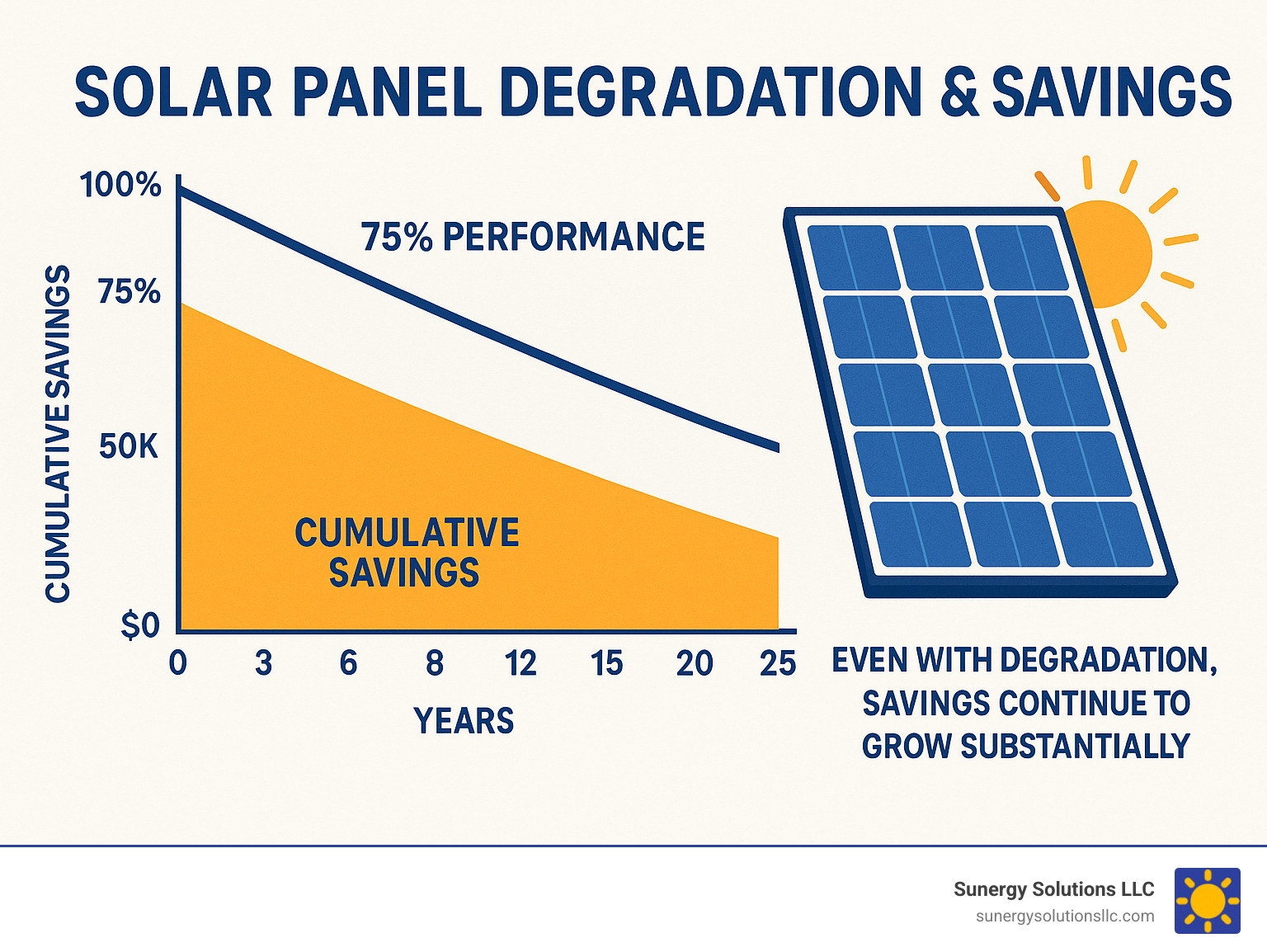
Most panels have an expected lifespan of 25-30+ years of solid energy production. Yes, they do gradually produce less energy over time – typically declining by about 0.5-0.7% annually for budget-friendly panels. That means after 25 years, your panels will still be churning out 80-85% of their original capacity.
Today’s solar panels are remarkably tough cookies. Before they ever reach your roof, they’ve endured brutal testing: extreme temperature swings, high humidity chambers, mechanical stress tests, simulated hailstorms, and even salt spray testing for coastal installations.
All this rigorous testing ensures that even budget-friendly panels can weather decades of environmental exposure with minimal maintenance. Most systems only need occasional cleaning and an inverter replacement after 10-15 years to keep performing optimally.
When homeowners ask me about longevity, I’m always happy to share some good news: Yes, today’s affordable solar panels are built to last! Modern budget-friendly panels from reputable manufacturers are engineered for 25+ years of reliable service.
While they do degrade slightly faster than premium options (typically 0.5-0.7% annually compared to 0.25-0.4% for high-end models), they’ll still retain a respectable 80-85% of their original power output after a quarter-century of converting sunshine to electricity.
The panels we recommend at Sunergy Solutions all include at least a 10-year product warranty and a 25-year performance warranty. This gives you valuable peace of mind that your investment is protected. The key is choosing panels from established manufacturers with solid track records and the financial stability to honor those warranties for decades to come.
The federal solar investment tax credit (ITC) is your biggest money-saver, hands down. This powerful incentive slices 30% right off your total system cost through a direct tax credit. But that’s just the beginning of potential savings!
Beyond this nationwide incentive, your location determines what additional programs you can tap into:
If you’re in Massachusetts, you’ve hit the solar jackpot – combining the federal tax credit with the SMART program creates some of the best solar economics in the entire country. Our Rhode Island customers benefit from excellent performance-based incentives through the REG program, while Maine residents can significantly improve their solar payback through the net energy billing program.
For our New Hampshire friends, we can help you access rebates of $0.20/watt (up to $1,000). In Vermont, additional incentives through utilities like Green Mountain Power sweeten the deal. Montana homeowners can claim an alternative energy system tax credit, and many of our Virginia customers qualify for valuable property tax exemptions.
I get this question a lot, and here’s my honest take: While solar panel prices have indeed fallen dramatically over the past decade, that rapid price decline has significantly slowed. Several important factors suggest that now is actually an optimal time to invest in affordable solar panels:
First, the 30% federal tax credit is guaranteed through 2032 but will start stepping down after that. That’s a substantial incentive you don’t want to miss.
Meanwhile, utility rates continue their steady climb (typically 2-4% annually) in most areas. Every month you delay is another month of higher electric bills you could have avoided.
The recent supply chain stabilization has brought panel prices to historic lows in 2024, creating an excellent buying opportunity. And I’ve noticed that local incentive programs tend to become less generous as solar adoption increases in a given market.
Perhaps most importantly, there’s a real opportunity cost to waiting. Each year you delay is a year of potential savings lost forever – money that could have stayed in your pocket instead of going to your utility company.

The solar revolution is here, and it’s more accessible than ever. Affordable solar panels have opened doors for countless homeowners who previously thought clean energy was beyond their reach. At just $2.36 per watt, today’s budget-friendly panels deliver impressive efficiency and reliability without breaking the bank.
What’s particularly exciting is how the financial picture has improved. Between historically low equipment costs, the generous 30% federal tax credit, and the patchwork of state and local incentives, solar has become a smart investment for almost any homeowner. Most of our customers see their systems pay for themselves within 7-12 years – after that, it’s essentially free electricity for decades to come.
I’ve personally seen the change solar brings to families. There’s something deeply satisfying about checking your electric bill and seeing it shrink month after month. Beyond the immediate savings, solar provides peace of mind against unpredictable utility rate hikes. It’s like locking in your energy costs for the next quarter-century.
Here at Sunergy Solutions LLC, we take pride in guiding homeowners across Maine, Massachusetts, New Hampshire, Rhode Island, Vermont, Montana, and Virginia through their solar journey. We don’t just sell panels – we create customized energy solutions that consider your unique home, budget, and electricity needs.
The environmental benefits shouldn’t be overlooked either. The typical residential solar system offsets about 100,000 pounds of carbon dioxide over its lifetime – equivalent to planting over 50 trees each year. It’s a powerful way to reduce your carbon footprint while also reducing your energy bills.
Ready to harness the power of affordable solar panels for your home? We’d love to show you exactly how much you could save with a free, no-pressure consultation. Our financing options, including zero-down plans, make it possible to start saving from day one without any upfront investment.
More info about Residential Solar System Financing
Start your zero-down, high-savings solar journey today!
Appointments Available, 7 Days a Week


