
5.0 Rating
Request A Free Estimate
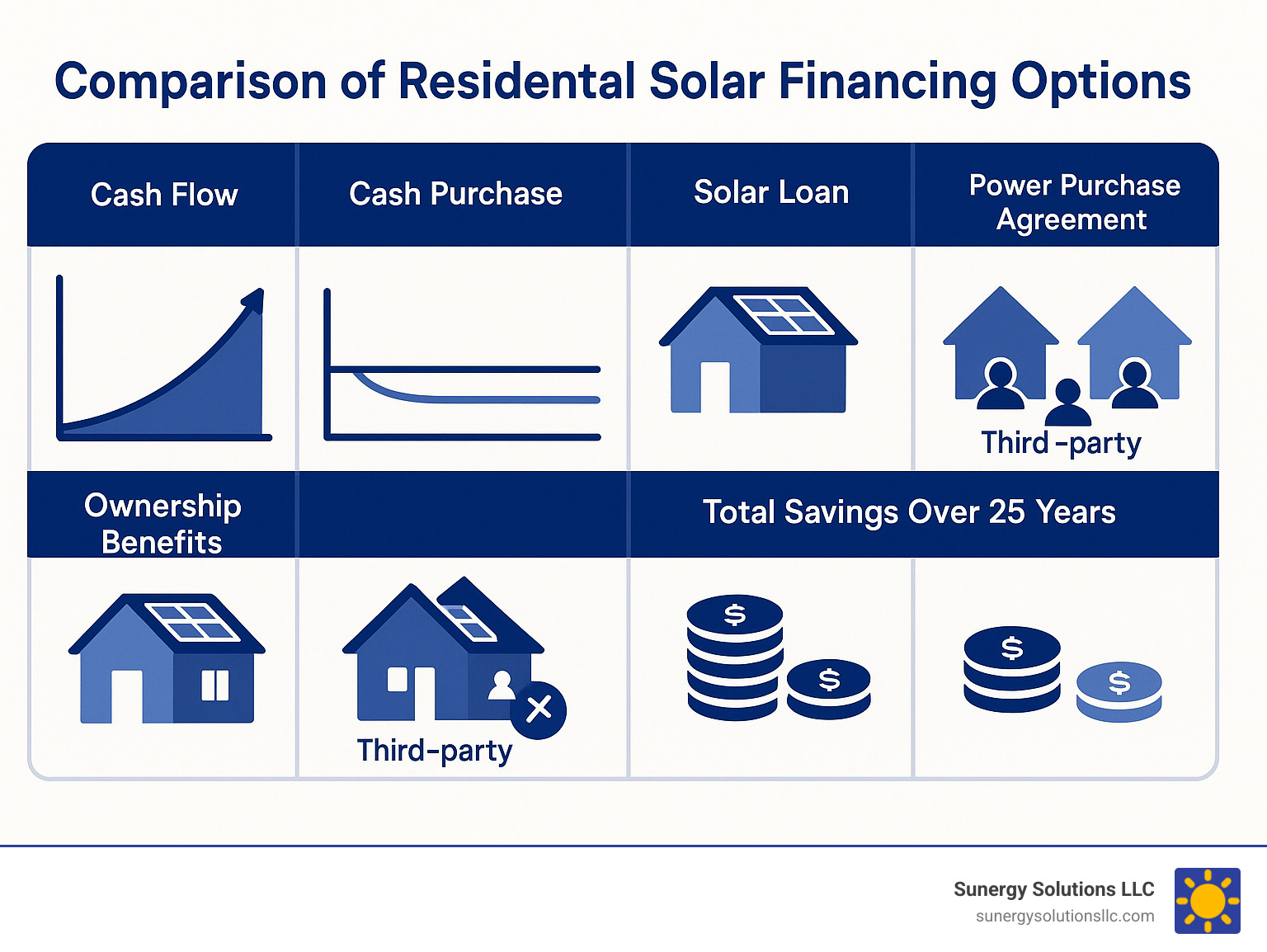
Residential solar system financing has evolved dramatically in the last decade, making clean energy accessible to millions of homeowners. If you’re wondering how to pay for solar panels, here are the main options at a glance:
| Financing Option | Upfront Cost | Who Owns Panels | Tax Credits | Maintenance Responsibility |
|---|---|---|---|---|
| Cash Purchase | $15,000-$35,000 | Homeowner | Homeowner | Homeowner |
| Solar Loan | $0-$3,000 down | Homeowner | Homeowner | Homeowner |
| Solar Lease | $0 down | Third party | Third party | Third party |
| Power Purchase Agreement (PPA) | $0 down | Third party | Third party | Third party |
| PACE Financing | $0 down | Homeowner | Homeowner | Homeowner |
The average cost of a home solar system is about $30,000 before incentives, which explains why over 90% of homeowners choose some form of financing. With electricity rates increasing by roughly 2.5% annually, investing in solar now rather than later can lock in significant long-term savings.
When you finance your solar panels, you’re essentially converting unpredictable, rising utility bills into fixed monthly payments. Many homeowners see immediate positive cash flow, with loan payments lower than their previous electric bills. Plus, solar-equipped homes typically sell faster and command premiums of about $15,000 on average.
My name is Rob Raffa, CEO and founder of Sunergy Solutions LLC, where I’ve spent nearly a decade helping homeowners steer residential solar system financing options to maximize their return on investment while minimizing upfront costs. My background in investment banking gives me unique insight into creating financing solutions that work for real families with real budgets.
Thinking about going solar but feeling a bit shocked by that $30,000 price tag? Don’t worry – you’re not alone. While that initial number might make your wallet want to hide, it helps to think of solar not as an expense but as one of the smartest long-term investments for your home. Most systems pay for themselves in about 10 years, and after that? You’re essentially enjoying free electricity for another 15+ years!
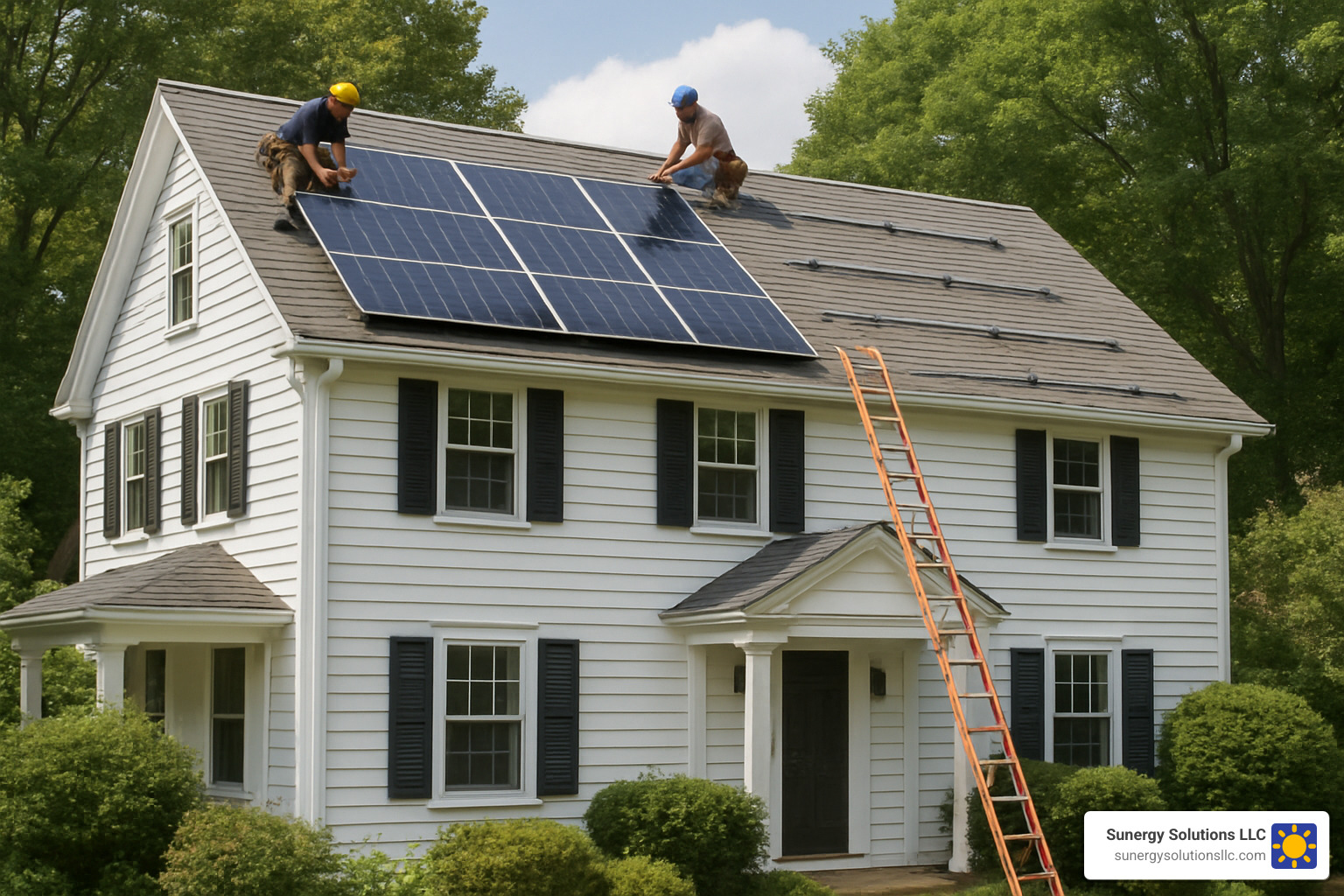
Here’s what makes residential solar system financing particularly attractive: while you’re paying a fixed amount each month, your neighbors without solar are watching their utility bills climb roughly 2.5% every year (and sometimes much more dramatically). Today’s solar panels come with robust 25-year warranties, and the technology has become so reliable that most panels will still produce 80-85% of their original output even after a quarter century.
In 2024, we’re seeing residential solar costs between $2.50 and $3.50 per watt before any incentives kick in. For the average home needing an 8-10 kilowatt system, that translates to somewhere between $20,000-$35,000 total.
Your solar investment breaks down into two main parts: about 60% goes toward the actual equipment (your panels, inverters, and mounting hardware), while the remaining 40% covers labor, permits, and other “soft costs” involved in installation.
The silver lining? According to research from EnergySage, solar costs have plummeted by more than 60% since 2010. What was once a luxury for the eco-wealthy has become increasingly accessible to everyday homeowners – especially with smart financing options.
I often meet homeowners who say, “I’ll go solar when I’ve saved up enough.” While that caution is understandable, financially speaking, it’s actually costing them money for two important reasons:
Opportunity cost is real – every month you delay is another month sending your hard-earned money to the utility company instead of investing in your own energy independence.
Inflation protection might be the most underappreciated benefit of solar financing. By securing residential solar system financing today, you’re essentially locking in your energy costs for decades. If you’re currently spending $150 monthly on electricity, you’re looking at more than $65,600 in utility payments over the next 25 years (assuming that typical 2.5% annual rate increase). Solar lets you escape that ever-rising cost spiral.
At Sunergy Solutions LLC, we’ve seen this play out hundreds of times – the clients who move forward with appropriate financing almost always end up financially ahead of those who waited to save up. As I like to tell homeowners: the best time to go solar was five years ago, but the second-best time is today. With the right residential solar system financing plan, most families can start saving immediately without emptying their savings accounts.
When you’re considering residential solar system financing, you’re really facing one big question: Do you want to own your solar panels, or just buy the electricity they produce? This choice shapes everything from which incentives you’ll get to who handles repairs when something goes wrong.
Paying cash upfront is like buying a car without a loan – you’ll save the most money in the long run if you can swing it. With this approach:
You avoid all interest costs and sneaky fees, capture all those juicy incentives directly, and your system starts generating essentially free electricity once you’ve recouped your initial investment. The catch? You’re on the hook for maintenance and monitoring.
For a typical $30,000 system, the federal tax credit alone puts $9,000 back in your pocket next tax season, bringing your net cost down to $21,000. Many of our Vermont and Massachusetts customers who go this route see complete payback in 7-9 years. After that? It’s like having your own little electricity factory on your roof for the next 15+ years.
That said, tying up $20,000+ in solar panels isn’t for everyone. Cash purchases make the most sense if you:
Solar loans have become the crowd favorite for residential solar system financing, and it’s easy to see why – you can go solar with little or no money down while still owning the system and getting all those tax perks. These loans come in two main flavors:
Secured Loans use your home or the solar equipment as collateral. They typically offer lower interest rates (around 5-12%), longer terms (10-25 years), and may have tax-deductible interest (though you should check with your tax advisor on that). They usually require a credit score of at least 650. Home equity loans, HELOCs, and specialized solar loans fall into this category.
Unsecured Loans don’t require collateral but depend on your creditworthiness. They come with higher interest rates (typically 6-20%), shorter terms (5-12 years), and usually need excellent credit (680+). The upside? There’s no risk to your home. Personal loans and solar-specific unsecured loans are common examples.
| Loan Type | Interest Rate | Term Length | Collateral | Credit Score | Pros | Cons |
|---|---|---|---|---|---|---|
| Secured | 5-12% | 10-25 years | Home/Equipment | 650+ | Lower rates, longer terms | Risk to assets |
| Unsecured | 6-20% | 5-12 years | None | 680+ | No collateral required | Higher rates |
At Sunergy Solutions LLC, we’ve developed a clever option called the “solar combo loan.” This two-part approach includes a short-term balloon loan (12-18 months) to cover the 30% federal tax credit portion, paired with a long-term fixed-rate loan for the remaining 70%. Once your tax credit arrives, you pay off the balloon portion, leaving just the long-term loan. It’s a great way to minimize interest while still going solar with zero down.
Pro tip: Always ask what the cash price would be when shopping for solar loans. Some installers slip “dealer fees” into loan pricing, essentially charging you more for the same system when financed. Don’t fall for it!
Not everyone wants to own their solar panels. If you’re looking for zero upfront cost and no maintenance headaches, third-party ownership might be your ticket:
Solar Leases work like renting your panels. You pay a fixed monthly fee regardless of how much electricity they produce. These typically include performance guarantees and no maintenance worries, but you don’t get the tax credits (they go to the system owner). Most leases run 20-25 years and include annual escalator clauses of 1-3%.
Power Purchase Agreements (PPAs) are slightly different – you only pay for the power the system actually generates, at a predetermined rate per kilowatt-hour. Like leases, they often start below utility rates, include no maintenance responsibility, and typically feature escalator clauses over their 20-25 year terms.
While these options require no money down and shift maintenance to the provider, they generally deliver less long-term savings than ownership. We find these work best for folks who can’t use the tax credits, have credit challenges, or simply prefer a predictable, hands-off arrangement.
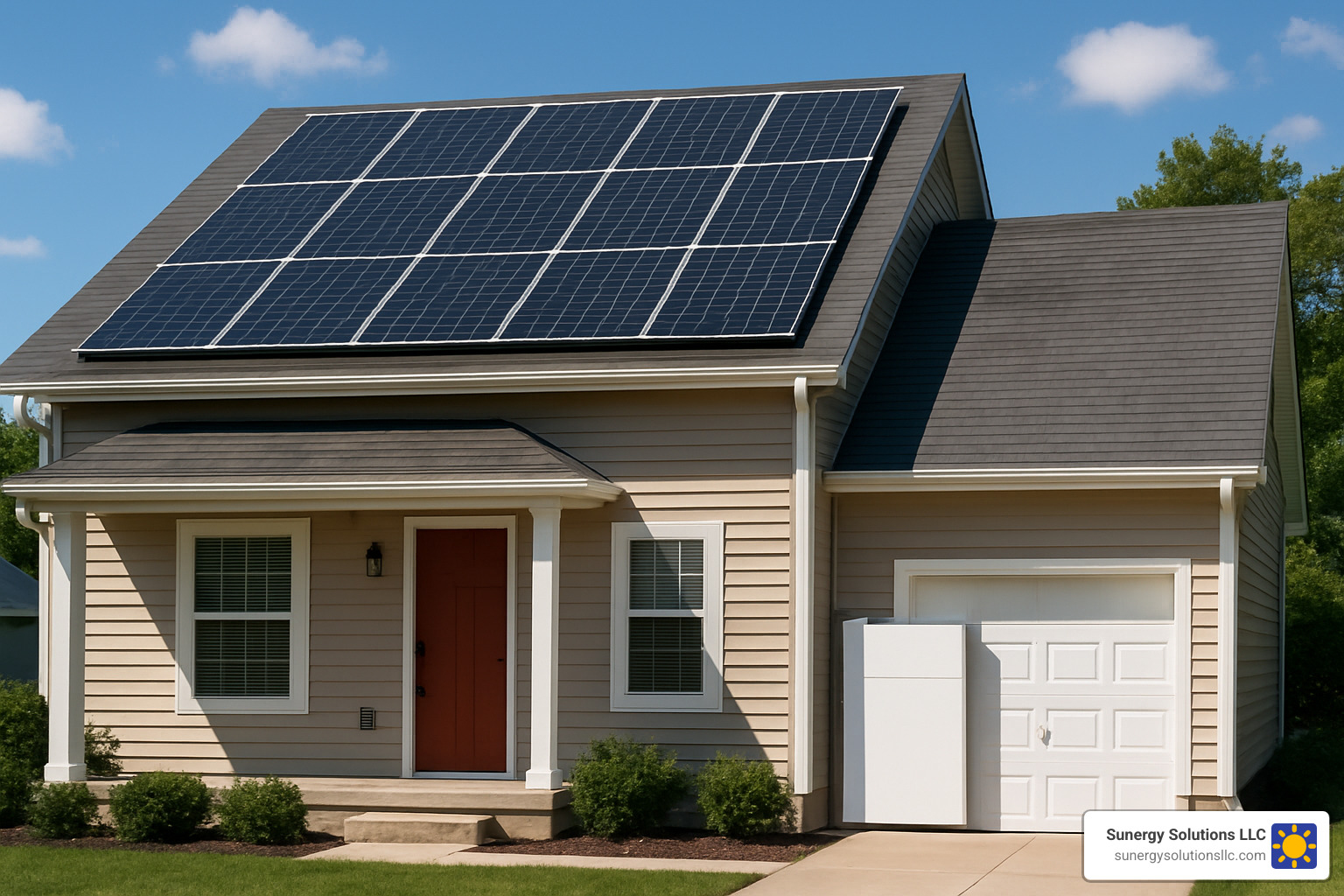
There are several government-supported financing options that can make solar more accessible, especially if you have unique circumstances:
Property Assessed Clean Energy (PACE) Financing attaches the solar loan to your property rather than to you personally. It’s repaid through your property tax assessments, based on home equity rather than credit score, and transfers to new owners if you sell. Terms stretch up to 20 years, though it’s only available in limited areas (mainly California, Florida, and Missouri). The Department of Energy provides detailed information about how PACE programs work.
FHA Solar Loans include options like PowerSaver loans for existing homeowners and energy-efficient mortgages for home buyers. These can cover up to 20% of property value and have accessible minimum credit score requirements of 580 (with 3.5% down) or 500 (with 10% down).
Fannie Mae HomeStyle Energy Mortgage lets you finance solar as part of your primary mortgage. You can finance up to 15% of the home’s appraised value for energy improvements, though you’ll need a home energy report and a minimum credit score of 620. The big advantage is avoiding subordinate liens by wrapping solar into your primary mortgage.
Low-Income Solar Programs exist in several states for income-qualified households. These include state-run green banks with preferential terms, community development financial institution (CDFI) loans, utility-sponsored on-bill financing, and even solar grant programs.
At Sunergy Solutions LLC, we specialize in helping homeowners in Maine, Massachusetts, New Hampshire, Rhode Island, Vermont, Montana, and Virginia steer these specialized programs. Each state has its own unique offerings, and our team stays up-to-date on all available options to help you get the most bang for your buck. You can learn more about these options on our Solar System Financing Options for Homeowners page.
Let’s talk about the fun part of going solar – saving money! The crown jewel of solar incentives is the federal Investment Tax Credit (ITC), which puts a whopping 30% of your total solar system cost right back in your pocket. Unlike deductions that only reduce taxable income, this credit directly slashes your federal tax bill dollar-for-dollar. It’s like getting a 30% off coupon for your entire solar purchase!

But wait, there’s more! Beyond this federal sweetener, a colorful patchwork of state, local, and utility incentives can make your solar investment even more delicious:
Think of solar incentives like a savings sundae – the more layers, the sweeter the deal! The 30% federal ITC forms your base (guaranteed through 2032), then steps down to 26% in 2033 and 22% in 2034 before residential systems lose the benefit.
Here’s what you need to know about maximizing this federal credit:
Your tax bill needs to be large enough to absorb the full credit, but don’t worry – unused portions can roll forward to future tax years. The credit applies to everything – panels, inverters, mounting hardware, and installation labor. Even battery storage qualifies when installed alongside your solar system!
For the latest on state-specific goodies, check the DSIRE database (Database of State Incentives for Renewables & Efficiency) or better yet, give our Sunergy Solutions LLC team a call. We track these ever-changing incentives like hawks to ensure you don’t leave a single dollar on the table.
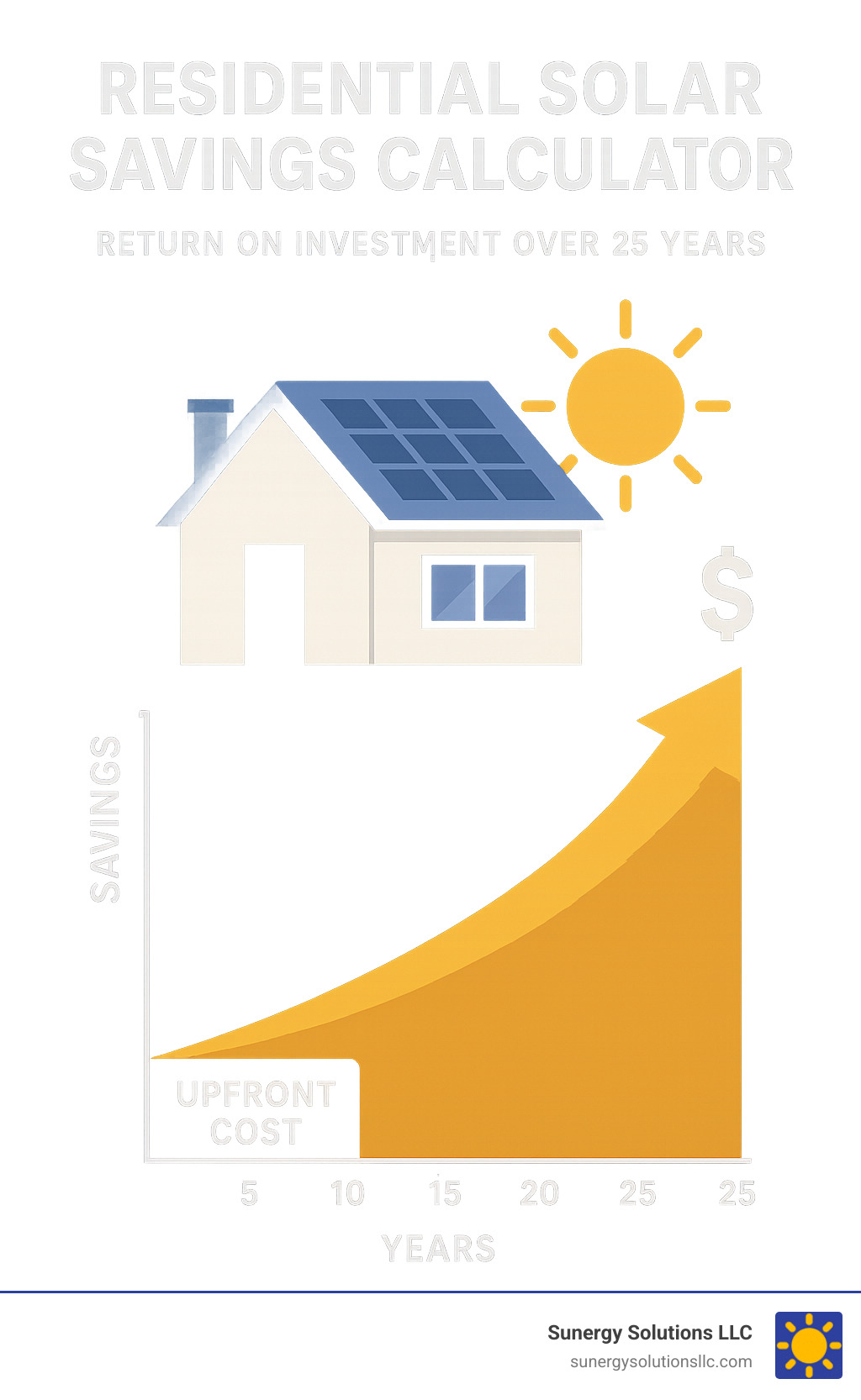
Your solar journey is as unique as your fingerprint. Your savings will depend on your current electricity usage, roof characteristics, local weather patterns, available incentives, and your chosen residential solar system financing option.
To get a crystal-clear picture of your solar potential, I recommend three simple steps:
First, gather 12 months of electricity bills to understand your consumption patterns. Second, play around with Google’s Project Sunroof for a quick ballpark estimate. Finally, invite a Sunergy Solutions LLC professional to your home for a detailed assessment custom to your specific situation.
A properly designed system should offset 80-100% of your electricity usage. With smart residential solar system financing, your monthly loan payment should be less than your old utility bill – creating positive cash flow from day one!
Solar panels typically come with 25-year warranties, but they often keep producing for 30+ years. When calculating your return on investment, consider these extended decades of free electricity, not just the time until your system is paid off. It’s like planting a money tree that keeps bearing fruit long after it’s matured!
Shopping for residential solar system financing can feel like navigating a maze. I’ve seen countless homeowners get confused when trying to compare different offers that seem to be written in entirely different languages. Let me help you cut through the confusion.
When reviewing financing options, don’t just focus on the monthly payment. That’s exactly what some less scrupulous companies want you to do! Instead, look at the complete picture. A lower monthly payment stretched over 25 years might cost you thousands more than a slightly higher payment over 15 years. Always compare the total cost of ownership, including the APR (Annual Percentage Rate).
One of the sneakiest things in the solar industry? Dealer fees. These hidden markups can add 15-30% to your system cost. I always recommend asking a simple question: “What’s the cash price versus the financed price?” If there’s a big difference, you’re looking at dealer fees that pad someone else’s pocket, not your solar panels.
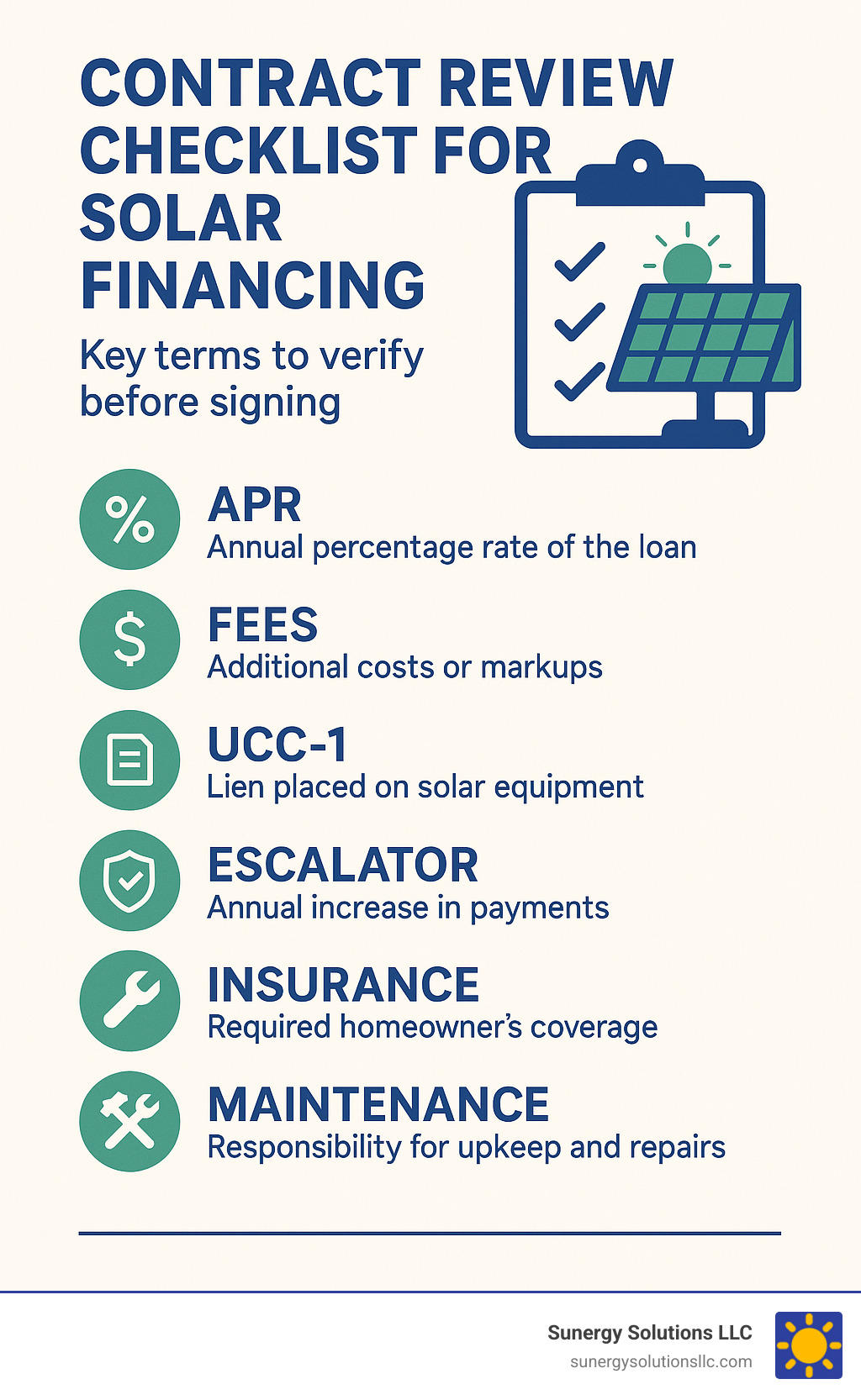
Have you heard about UCC-1 filings? Most homeowners haven’t until they try to sell their home. These filings place a lien on your solar equipment as collateral for the loan. They’re normal, but can complicate home sales if not properly handled. At Sunergy Solutions LLC, we walk you through the process of clearing these liens when it’s time to sell.
Watch out for those sneaky escalator clauses in leases and PPAs! These annual price increases (typically 1-3%) might seem small, but they compound over time. While your solar payment starts below utility rates, it could eventually exceed them if utility inflation slows down. Think of it like the old fable of the tortoise and the hare – slow and steady increases eventually add up.
Don’t forget about insurance and maintenance. Your homeowner’s insurance might need adjusting to cover your new solar system. And while panels are remarkably durable, understanding what’s covered under warranties (and what isn’t) prevents surprises down the road.
I can’t tell you how many times I’ve had customers call me confused about their solar contract with another company. Solar financing agreements can be as thick as novels and just as complex. Here’s what deserves your special attention:
Transfer provisions matter tremendously if you might sell your home. Some loans can be assumed by new buyers, while others must be paid off at sale. Some even have early payoff penalties that can sting if you’re not prepared. At Sunergy Solutions LLC, we prefer financing options with flexible transfer terms because life happens, and homeowners need flexibility.
Production guarantees sound great on paper, but the details matter. If your system underproduces, how exactly will you be compensated? Are there exclusions for weather events or grid outages? Who’s responsible for monitoring system performance? These guarantees are only as good as their enforcement mechanisms.
Prepayment terms can vary wildly between financing options. Some loans carry hefty penalties if you try to pay them off early, while others welcome extra payments. Some even have “minimum interest guarantees” that essentially charge you interest even if you pay early. Always ask: “Can I pay this off early without penalty?”
At Sunergy Solutions LLC, transparency is our policy. We walk every customer through their financing agreement line by line before signing. No surprises, no hidden clauses, just clear information so you can make confident decisions.
Ready to finalize your residential solar system financing? Let me share some insider tips to help you secure better terms:
Don’t limit yourself to installer-offered financing. Credit unions often have solar-specific loans with fantastic rates. In fact, we partner with several across New England and Montana precisely because they offer our customers such competitive options.
Getting multiple quotes isn’t just about finding the lowest price – it gives you leverage. When you tell us another company offered better financing terms, we’ll work to match or beat them. Different installers have access to different financing programs, so shopping around truly pays off.
Consider installer reputation alongside financing terms. The cheapest financing won’t feel like a bargain if the installer cuts corners or isn’t around to honor warranties. A five-star Google review average like ours at Sunergy Solutions LLC means we’ll be here to support you for the 25+ year lifespan of your system.
Timing matters in solar purchases. Some incentive programs have limited annual funding that runs out. For example, in Massachusetts, securing your place in the SMART program early in the year can mean thousands in additional savings. We help our customers time their purchases strategically to maximize these benefits.
Ask about special promotions directly. Solar manufacturers occasionally offer special financing or rebates that aren’t advertised widely. Our team at Sunergy Solutions LLC always passes these savings directly to customers – just ask us what’s currently available!
The best financing option isn’t necessarily the one with the lowest monthly payment or upfront cost. It’s the one that maximizes your total savings over the life of your system while giving you peace of mind. After all, solar is a relationship you’re entering for decades – choose a partner you can trust.
Let’s talk about credit scores – that three-digit number that can feel like it controls so much of your financial life. The good news is that solar financing has options for nearly every credit situation.
For secured solar loans (those using your home or equipment as collateral), you’ll typically need a score of 650 or higher. If you’re looking at unsecured solar loans, the bar rises a bit to around 680-700+, since there’s no collateral backing the loan.
Thinking about a lease or PPA? These third-party ownership options generally require scores in the 650+ range. One bright spot for homeowners with credit challenges is PACE financing, which focuses primarily on your home equity rather than your credit score.
For government-backed options like FHA loans, you can qualify with a score as low as 580 (with 3.5% down) or even 500 (with 10% down).
Don’t meet these thresholds? Don’t worry! Consider adding a co-signer with stronger credit, exploring PACE financing where it’s available, or investigating special low-income solar programs in your area. Sometimes, taking a few months to improve your credit before applying can make a significant difference.
Here at Sunergy Solutions LLC, we’ve helped customers with scores in the low 600s secure affordable residential solar system financing through our network of specialized lending partners. We believe solar should be accessible to everyone, not just those with perfect credit.
Absolutely yes! This is one of the most common questions we hear, and I’m happy to clear up any confusion.
As long as you own your solar system (whether through cash purchase or financing), you’re eligible to claim the federal Investment Tax Credit. The financing method doesn’t matter – what matters is ownership.
The 30% credit applies to your total system cost, including equipment and installation. However, you must have sufficient tax liability to benefit fully since the credit reduces what you owe but isn’t refundable. The good news is that unused credit amounts can be carried forward to future tax years if you can’t use the full amount immediately.
One important note: if you choose a lease or PPA where a third party owns the system, you won’t qualify for the tax credit – the system owner claims it instead (though they often pass some savings to you through lower rates).
Many of our Sunergy Solutions LLC customers use what we call a “solar combo loan” – a clever financing structure that includes a short-term loan specifically designed to bridge the gap until you receive your tax credit. This allows you to apply the credit directly to your loan balance when you file your taxes, reducing your long-term payments and interest costs.
Home sales happen – life changes, families grow, jobs relocate. We’ve helped hundreds of customers successfully steer this transition, and there are several straightforward options depending on your financing method.
If you have a residential solar system financing loan, you can:
For leases or PPAs, your options include:
PACE financing is particularly straightforward during a sale since the assessment automatically transfers to the new homeowner with the property – it’s attached to the home, not to you personally.
When you work with Sunergy Solutions LLC, we provide all necessary documentation and support during home sales to ensure a smooth transition. We’ve guided countless homeowners through this process, and we’re always just a phone call away if questions arise during your home sale.

Residential solar system financing has come a long way in recent years. What was once a specialized market has blossomed into a robust ecosystem with options for virtually every homeowner and budget. The secret to solar success isn’t just finding any financing—it’s finding the perfect structure that maximizes your incentives, keeps costs low, and aligns with your long-term vision for your home and finances.
Here at Sunergy Solutions LLC, we firmly believe solar power should be within reach for everyone. That’s why we take the time to offer truly personalized financing consultations for homeowners across Maine, Massachusetts, New Hampshire, Rhode Island, Vermont, Montana, and Virginia. Our approach isn’t one-size-fits-all—we carefully analyze your specific energy usage patterns, tax situation, and financial goals before recommending the perfect financing solution for your unique circumstances.
You might be drawn to the impressive long-term savings of a cash purchase, or perhaps you’re looking to balance affordability with ownership through a well-structured solar loan. Maybe you simply want to reduce your monthly expenses right away with a lease or PPA. Whatever your priorities, we have financing options designed to match your needs and help you start saving from day one.
Going solar represents more than just a smart financial move—it’s one of the most meaningful investments you can make for both your family’s future and our planet’s wellbeing. With the right residential solar system financing approach, your investment can begin paying dividends immediately, both environmentally and economically.
Ready to explore what solar financing could look like for your home? We’d love to help. Contact Sunergy Solutions LLC today for a friendly, no-pressure consultation that’s completely free. Our experienced team will walk you through every step of the journey—from designing your perfect system to finding ideal financing to handling the installation with care and precision. We’re committed to ensuring you receive maximum value from your solar investment for decades to come.
The path to energy independence starts with a single conversation. Let’s talk about how we can help you harness the power of the sun while respecting your budget and goals.
More info about Residential Solar System Financing
Appointments Available, 7 Days a Week


