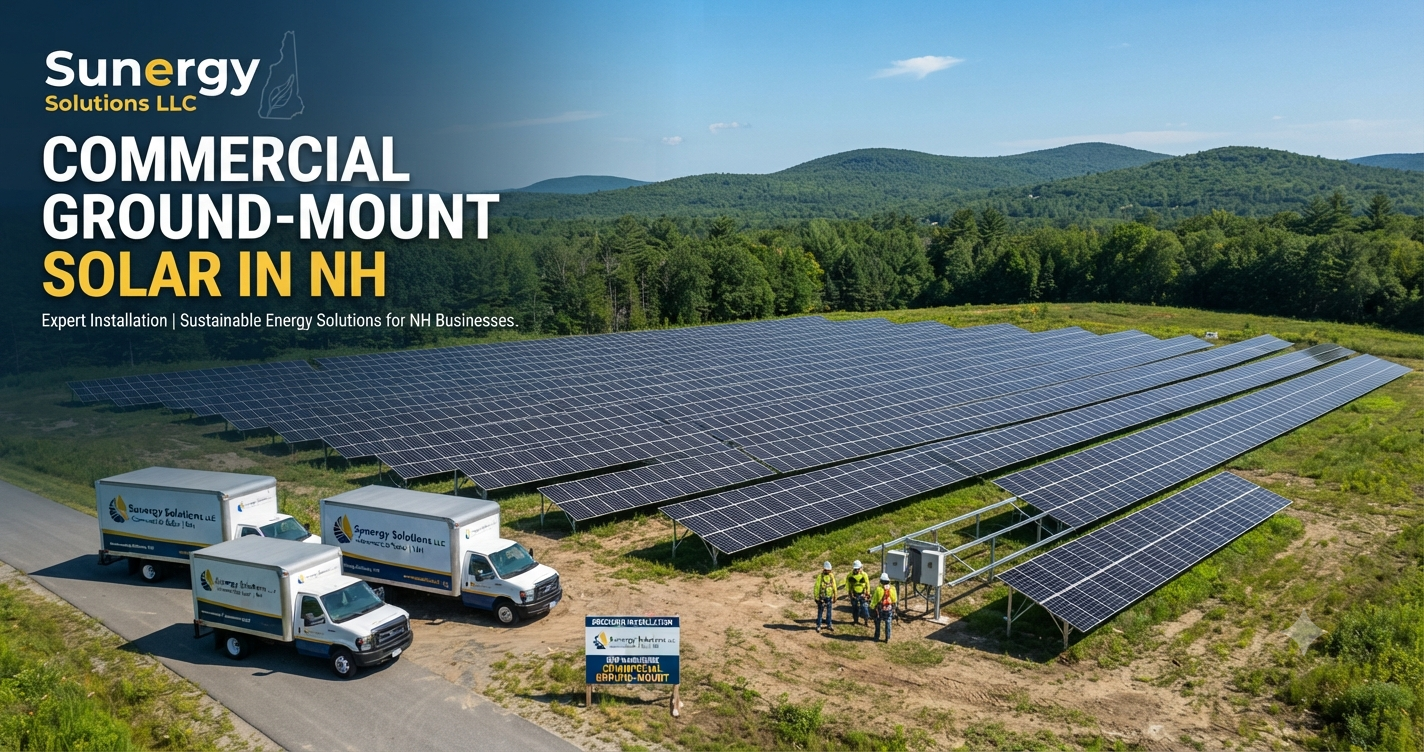
Commercial Ground-Mount Solar in NH & Industrial Solar Panel Contractors for New Hampshire
Serving Manchester, Nashua, Concord, Portsmouth, Keene & All of the Granite State
Why New Hampshire Businesses Are Choosing Ground Mount Solar 2026
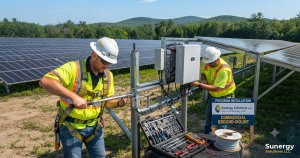
Not every commercial property has a roof suitable for solar. Aging structures, insufficient load capacity, complex geometries, or heavy shading can make rooftop installation impractical or impossible. For warehouses with deteriorating roofs, manufacturing facilities with limited roof space, agricultural operations with barns that can’t support panels, and industrial campuses with multiple buildings, commercial ground mount solar in NH offers a powerful alternative.
Ground-mounted solar systems can produce 10–25% more energy than equivalent rooftop systems by allowing optimal tilt angle, perfect south-facing orientation, and improved airflow that keeps panels cooler and more efficient.
In New Hampshire, where every kilowatt-hour counts against some of the highest electricity rates in the nation, that production advantage translates directly into faster payback and greater lifetime savings.
At Sunergy Solutions LLC, we are industrial solar panel contractors in New Hampshire who specialize in designing, engineering, and installing commercial ground mount solar systems built specifically for the Granite State’s climate, terrain, and regulatory environment. From the Merrimack Valley to the North Country, we help businesses turn underutilized land into revenue-generating energy assets.
What Is Commercial Ground Mount Solar?
Commercial ground mount solar installs photovoltaic panels on freestanding racking systems anchored to the earth rather than a building roof. This approach eliminates roof-related constraints while offering significant performance and operational advantages for New Hampshire businesses.
Key Advantages of Ground Mount Solar for NH Businesses
Optimal Orientation & Tilt Ground-mounted panels can be positioned at the perfect azimuth and tilt angle for New Hampshire’s latitude—typically 30–45 degrees facing true south. Rooftop systems are limited by existing roof pitch and orientation, which are rarely ideal.
Superior Energy Production The combination of optimal positioning and better airflow cooling can increase annual energy production by 15–25% compared to equivalent rooftop installations. In New Hampshire’s high-rate environment, that difference is worth thousands of dollars annually.
Easier Maintenance & Snow Removal Ground-level access eliminates the need for ladders, harnesses, and roof safety equipment. Panel cleaning, inverter servicing, and snow removal are faster, safer, and less expensive.
No Roof Penetrations or Structural Concerns Ground mount systems eliminate the risk of roof leaks, voided roofing warranties, and structural load issues. Your existing roof can be replaced or repaired without disturbing the solar installation.
Scalability to Larger System Sizes Commercial ground mount systems can scale from 100 kW to multi-megawatt installations, limited only by available land. This makes them ideal for industrial facilities, distribution centers, and agricultural operations with significant energy needs.
Dual Land Use Potential Elevated racking systems and tracking arrays allow continued use of land beneath panels for grazing, equipment storage, or limited agriculture—particularly valuable for New Hampshire farms and rural businesses.
Ground Mount Solar System Types for New Hampshire
As experienced industrial solar panel contractors in New Hampshire, we design and install several ground mount configurations:
Fixed-Tilt Ground Mount
The most common commercial ground mount configuration. Panels are mounted on steel racking at a fixed optimal tilt angle.
Best for: Most commercial and industrial applications seeking maximum ROI with minimal maintenance Advantages: Lowest cost, highest reliability, no moving parts Typical cost: $2.80–$3.40 per watt in New Hampshire
Fixed-Tilt Bifacial Arrays
Bifacial panels capture sunlight on both the front and rear surfaces, utilizing light reflected off the ground—particularly effective in New Hampshire where snow cover creates a highly reflective surface.
Best for: Properties with high-albedo ground surfaces (gravel, snow, light-colored soil) Advantages: Up to 14% additional winter production from snow reflection; highest long-term ROI
Typical cost: $2.80–$3.40 per watt
Dual-Axis Tracking Systems
Tracking systems use GPS sensors to follow the sun’s path throughout the day, maximizing energy capture.
Best for: Businesses with limited land area who need maximum production density Advantages: 35–45% more energy annually than fixed systems
Considerations: Higher upfront cost, mechanical components require periodic maintenance Typical cost: $4.50–$5.50 per watt
Driven Pier Racking
Steel piers are vibrated directly into the earth, eliminating the need for concrete footings. Ideal for New Hampshire’s rocky “Granite State” soil conditions.
Best for: Properties with rocky or uneven terrain, areas with high water tables Advantages: Rapid installation, minimal site disturbance, avoids frost heave issues
Typical cost: $2.90–$3.50 per watt
Ballasted Ground Mount
Heavy concrete blocks hold the array in place without penetrating the ground.
Best for: Properties with environmental restrictions, protected wetlands, or historical designations Advantages: Zero ground penetration, easiest to decommission or relocate
Considerations: Higher material costs, requires very level surface Typical cost: $3.80–$4.60 per watt
Pole-Mount Systems
A single heavy-duty steel pole elevates a smaller array, leaving ground beneath usable.
Best for: Small commercial applications, farms needing dual land use Advantages: Minimal footprint, excellent snow shedding, space beneath remains functional
Typical cost: $3.50–$4.20 per watt
Is Your New Hampshire Property Right for Ground Mount Solar?
Commercial ground mount solar in NH is ideal for businesses that:
✓ Have available land — Minimum 1/2 to 1 acre of clear, unshaded space for typical commercial systems (larger systems require proportionally more land)
✓ Have unsuitable roofs — Aging, structurally compromised, heavily shaded, or improperly oriented roofs
✓ Need larger systems — Energy needs that exceed viable rooftop capacity
✓ Want maximum production — Businesses seeking the highest possible energy yield per installed watt
✓ Value easy maintenance — Operations teams that prefer ground-level access for cleaning and service
✓ Plan future roof work — Businesses that anticipate roof replacement or major repairs in the next 10–15 years
✓ Are agricultural operations — Farms with barns that can’t support panels but have adjacent land available
Site Requirements for NH Ground Mount Solar
Land Area
-
100 kW system: approximately 0.5–0.75 acres
-
250 kW system: approximately 1–1.5 acres
-
500 kW system: approximately 2–3 acres
-
1 MW system: approximately 4–6 acres
Additional space is needed for setbacks, access roads, and electrical equipment.
Solar Access
-
Unshaded southern exposure throughout the day
-
Minimal shading from trees, buildings, or terrain
-
Clear horizon to the south, east, and west
Soil Conditions
-
Stable, well-drained soils suitable for pier or foundation installation
-
Rocky soils may require driven pier or specialized foundation systems
-
High water tables may necessitate ballasted or elevated designs
Electrical Infrastructure
-
Proximity to existing electrical service and utility interconnection point
-
Adequate utility transformer capacity
-
Three-phase service for larger commercial systems
Zoning & Permitting
New Hampshire Incentives for Commercial Ground Mount Solar
The same robust incentive stack that makes rooftop solar attractive in New Hampshire applies equally to ground mount systems:
Federal Investment Tax Credit (ITC) — 30%
Claim 30% of total system costs as a federal tax credit. For a 250 kW ground mount system costing $625,000, that’s a $187,500 credit.
Net Metering
New Hampshire’s net metering program allows commercial solar owners to receive credits for excess energy sent to the grid. Major utilities include Eversource, Liberty Utilities, Unitil, and New Hampshire Electric Cooperative.
Property Tax Exemptions
Hundreds of New Hampshire municipalities have adopted local property tax exemptions that prevent solar installations from increasing assessments.
USDA REAP Grants & Loans
For agricultural producers and rural small businesses, grants covering up to 50% of project costs and loans covering up to 75%.
PACE Financing
Property-Assessed Clean Energy financing allows commercial property owners to borrow money for solar with repayment through property tax assessments.
The Commercial Ground Mount Solar Process in New Hampshire
At Sunergy Solutions LLC, we’ve refined our process for NH’s unique conditions:
Phase 1: Free Site Assessment & Feasibility Study
We evaluate your land, electrical infrastructure, utility interconnection requirements, and energy needs. You’ll receive a preliminary system design, production estimate, and detailed financial projections.
Phase 2: Engineering & Permitting
Our engineering team produces stamped structural and electrical plans. We handle all permitting, including local zoning approvals, building permits, and utility interconnection applications.
Phase 3: Site Preparation & Foundation Installation
We prepare the site, install foundations (concrete piers, driven piers, or ballast blocks depending on soil conditions and system type), and trench electrical conduit.
Phase 4: Racking & Panel Installation
Our certified crews install racking systems and mount panels according to manufacturer specifications and engineering plans.
Phase 5: Electrical & Commissioning
We complete DC and AC electrical installation, install inverters and monitoring equipment, and commission the system for optimal performance.
Phase 6: Utility Interconnection & Activation
We coordinate with your utility for final inspection, meter installation, and Permission to Operate (PTO).
Phase 7: Monitoring & Maintenance
Real-time production monitoring, preventive maintenance programs, and ongoing support for the system’s 25+ year lifespan.
Why Choose Sunergy Solutions LLC as Your Industrial Solar Panel Contractors in New Hampshire?
Deep Granite State Expertise From Manchester’s utility structures to the North Country’s permitting processes, we know New Hampshire. We engineer systems for heavy snow loads, rocky soils, freeze-thaw cycles, and high winds.
Ground Mount Specialization We don’t just “also do ground mount.” We specialize in it. From fixed-tilt bifacial arrays to tracking systems, from driven piers in rocky soil to ballasted systems on sensitive terrain, we have the experience to design and install the right system for your property.
End-to-End Accountability From initial site assessment through 25-year performance monitoring, Sunergy Solutions LLC manages every detail. One contractor, one relationship, complete accountability.
Incentive Optimization We navigate the full incentive stack—federal ITC, net metering, property tax exemptions, USDA REAP, and PACE financing—to maximize your return on investment.
Quality Equipment & Workmanship Tier 1 bifacial solar panels, commercial-grade inverters, and racking systems rated for New Hampshire’s snow loads, wind conditions, and frost heave potential.
Transparent Financial Modeling Detailed analyses using real utility data, verified production estimates based on NH weather patterns, and conservative assumptions. No inflated projections—just honest numbers your CFO can trust.
Solar + Land Use Integration We understand that your land is a working asset. We design systems that preserve productive use of your property while generating clean energy and long-term savings.
Frequently Asked Questions
How much does commercial ground mount solar cost in New Hampshire? Commercial ground mount solar in NH typically ranges from $2.80–$3.50 per watt for fixed-tilt systems, and $4.50–$5.50 per watt for tracking systems. A 250 kW fixed-tilt system might cost $700,000–$875,000 before the 30% federal tax credit and other incentives.
How much land do I need for a commercial ground mount system? A 100 kW system requires approximately 0.5–0.75 acres. A 500 kW system needs 2–3 acres. A 1 MW system requires 4–6 acres. Additional space is needed for setbacks, access roads, and electrical equipment.
How much more energy does ground mount produce compared to rooftop? Ground mount systems typically produce 15–25% more energy than equivalent rooftop systems due to optimal orientation, tilt angle, and improved cooling airflow. Bifacial systems can capture an additional 11–15% from ground-reflected light.
Will ground mount solar work on rocky New Hampshire soil? Yes. Driven pier racking systems are specifically designed for rocky or uneven terrain. Steel piers are vibrated directly into the earth, bypassing the need for concrete footings and avoiding frost heave issues.
Can I still use my land with a ground mount solar system? In many cases, yes. Elevated fixed-tilt systems and pole mounts allow continued use of land beneath panels for grazing, equipment storage, or limited agriculture. Tracking systems require more clearance but still preserve significant usable area.
How long does installation take? Most commercial ground mount projects are completed within 8–16 weeks from groundbreaking to commissioning, depending on system size, foundation type, weather conditions, and utility interconnection timeline.
Do ground mount systems qualify for the same incentives as rooftop? Yes. The 30% federal ITC, net metering, property tax exemptions, USDA REAP, and PACE financing all apply equally to ground mount and rooftop commercial solar systems in New Hampshire.
What about snow? Ground-mounted panels are typically elevated 2–3 feet off the ground, allowing snow to shed and accumulate beneath the array rather than on it. The open design also allows wind to help clear snow. Bifacial panels actually benefit from snow’s high reflectivity, boosting winter production.
Can ground mount systems include battery storage? Yes. Battery storage can be integrated with any ground mount system, providing peak demand reduction, backup power, and additional grid services revenue.
Ready to Turn Your New Hampshire Land into a Solar Asset?
If your roof isn’t suitable for solar—or if you want maximum energy production from every installed watt—commercial ground mount solar in NH may be the ideal solution. With New Hampshire’s high electricity rates, strong net metering policies, and the 30% federal tax credit, the financial returns are compelling.
The industrial solar panel contractors in New Hampshire you choose matter. A well-designed, properly installed ground mount system will deliver decades of reliable savings with minimal maintenance. A poorly executed one will cost you money, time, and peace of mind.
Contact Sunergy Solutions LLC today. We’ll evaluate your property, analyze your energy needs, and deliver a custom ground mount solar proposal with projected production, payback timeline, and lifetime savings—designed specifically for your New Hampshire business.
📍 Serving all of New Hampshire including: Manchester, Nashua, Concord, Portsmouth, Dover, Rochester, Keene, Laconia, Lebanon, Somersworth, Claremont, Berlin, Franklin, and surrounding communities.
Service Areas
Sunergy Solutions LLC provides commercial ground mount solar and industrial solar panel contractor services throughout New Hampshire, including:
-
Manchester & Southern NH — Hillsborough County, Rockingham County
-
Concord & Central NH — Merrimack County, Belknap County
-
Portsmouth & the Seacoast — Strafford County, coastal communities
-
Lebanon & the Upper Valley — Grafton County, along the Connecticut River
-
Keene & Southwest NH — Cheshire County
-
North Country — Coös County, Carroll County, rural commercial and agricultural properties
Sunergy Solutions LLC is a licensed commercial and industrial solar contractor serving businesses across New Hampshire. This article is for informational purposes and does not constitute tax or financial advice. Consult with your CPA or tax professional regarding specific incentive eligibility.