
5.0 Rating
Request A Free Estimate
Commercial solar financing companies provide the funding solutions that make solar energy accessible to businesses without massive upfront costs. The onsite commercial solar market is over 145 gigawatts in the U.S., and streamlined financing could boost growth from 9% to 35% compound annual growth rate.
Main financing options:
1. Solar loans – You own the system, claim tax credits, 5-30 year terms
2. Solar leases – Low upfront costs, maintenance included, 6-10 year terms
3. Power Purchase Agreements (PPAs) – Pay only for electricity produced, 10-25 years
4. C-PACE financing – Property-based loans up to 30 years, no upfront costs
5. Energy Service Agreements – Performance-based contracts, 5-15 years
The federal Investment Tax Credit allows businesses to deduct 30% of solar system costs from federal taxes through 2032. Direct purchase offers the highest return, with average payback periods of 5-7 years, while financing options can deliver 120% return on equity through tax credits and accelerated depreciation.
As Robert Raffa, CEO of Sunergy Solutions LLC, I’ve spent nearly a decade helping businesses steer commercial solar financing companies and their various loan products, drawing on my investment banking background to ensure clients maximize their ROI. My experience has shown that choosing the right financing partner is just as critical as selecting quality equipment and installers.
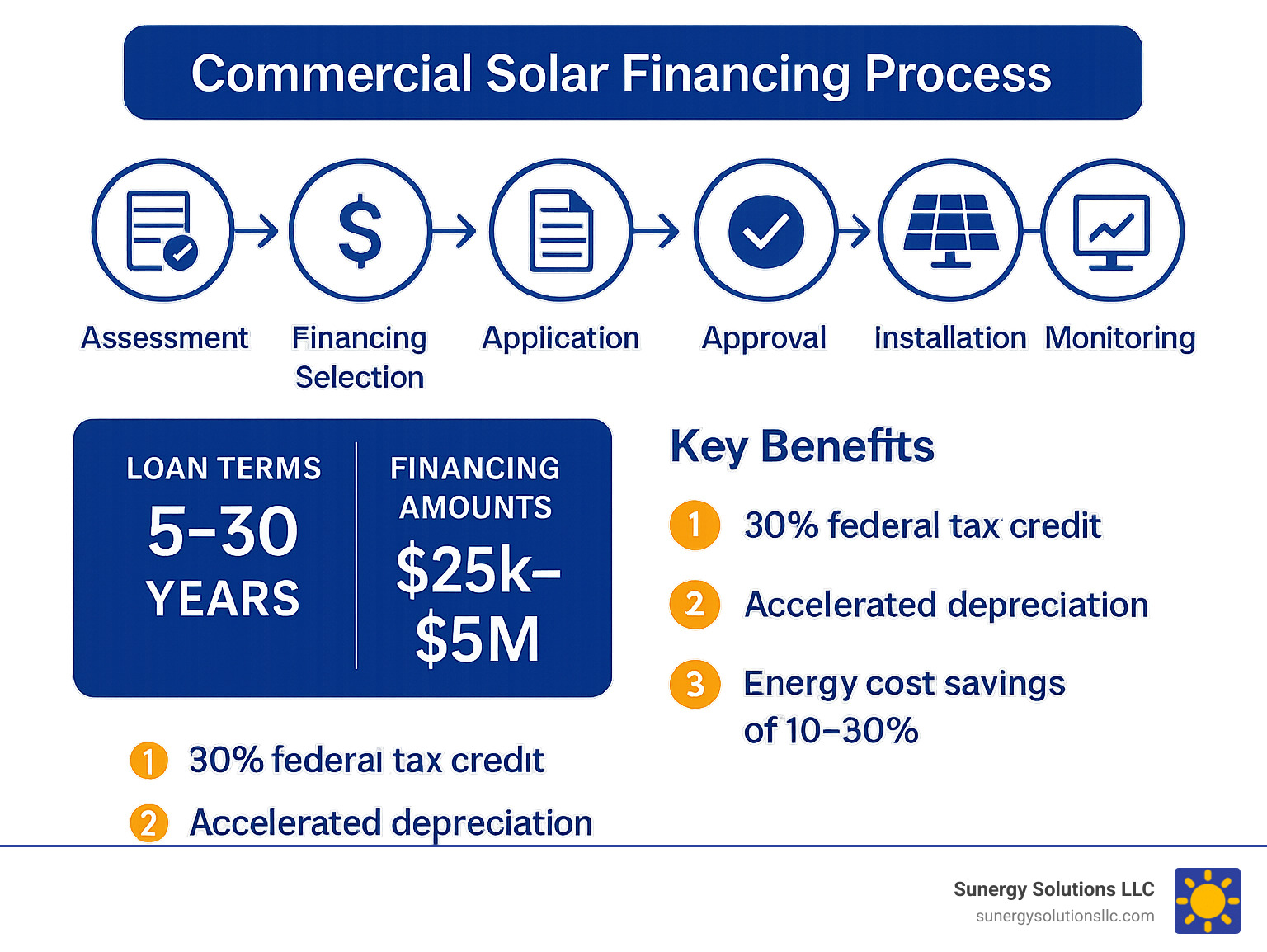
Before diving into commercial solar financing companies, let’s cover the basics that’ll help you make smart decisions. Understanding these concepts will save you time, money, and headaches down the road.
The solar financing world has its own language, and frankly, it can feel overwhelming at first. You’ll hear terms like PPAs, C-PACE, ESAs, and MACRS depreciation thrown around like everyone should know what they mean. Don’t worry—we’ll break it all down in plain English.
Most businesses don’t have $100,000 to $500,000 sitting around for a solar installation. That’s where commercial solar financing comes in—it transforms a massive capital expenditure into manageable monthly payments while making your business cash-flow positive from day one.
Instead of writing one huge check, you spread the cost over 5 to 30 years through loan terms that work with your budget. Meanwhile, you’re immediately saving 10% to 30% on energy costs, which often covers your monthly payment and then some.
Most commercial solar systems pay for themselves within 5-7 years, but with financing, you’re building equity while saving money from month one. Plus, you’re hedging against utility rate increases that average 2.5% annually—your solar payment stays predictable while your neighbors’ electric bills keep climbing.
Different financing options create value in unique ways, and understanding this helps you pick the right fit for your business goals.
Ownership models like loans put you in the driver’s seat. You own the system, claim the full 30% federal Investment Tax Credit, and benefit from MACRS accelerated depreciation. When you combine these tax benefits properly, some businesses see up to 120% return on equity.
Third-party ownership through leases and PPAs takes a different approach. You don’t own the system, so no tax credits for you—but the financing company passes those savings along through lower lease payments or discounted electricity rates. The big win here? They handle all maintenance and performance risk.
Property-based financing like C-PACE creates value by aligning with your real estate. The financing stays with the property, and if you sell the building, the new owner takes over the payments along with the energy savings.
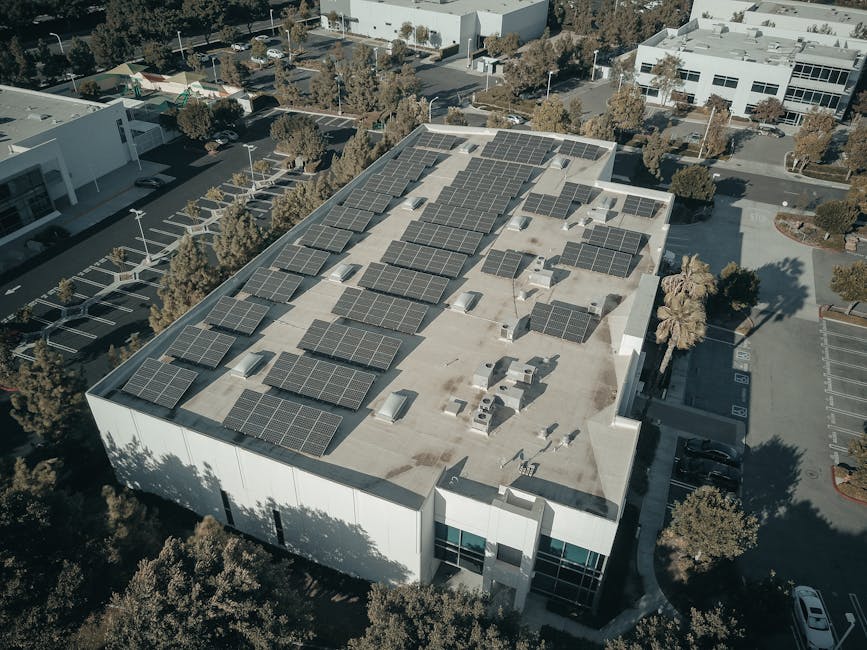
Choosing the right financing structure can make or break your solar investment. Commercial solar financing companies offer five main funding structures, each designed for different business situations. The key is matching your company’s financial profile, tax situation, and operational preferences to the right option.
| Financing Type | Ownership | Tax Benefits | Typical Terms | Best For |
|---|---|---|---|---|
| Solar Loans | Business | Full ITC + Depreciation | 5-30 years | Companies with tax liability |
| Solar Leases | Third-party | None | 6-10 years | Businesses wanting simplicity |
| PPAs | Third-party | None | 10-25 years | Predictable energy costs |
| C-PACE | Business | Full ITC + Depreciation | Up to 30 years | Property improvements |
| ESAs | Third-party | None | 5-15 years | Performance guarantees |
Solar loans give you full ownership of your system, which means you get to claim every penny of available tax credits and depreciation benefits. This is typically the most profitable option if your business has sufficient tax liability.
Current market rates range from 3.49% to 8.99% APR, depending on your creditworthiness and the lender you choose. Most loans cover $25,000 to $5 million with terms stretching from 5 to 30 years. The sweet spot for most businesses is 10-15 years, balancing monthly payment size with total interest paid.
Split loan structures can dramatically improve your cash flow. These allow you to make a large payment after receiving your federal tax credit refund, then re-amortize the remaining balance. This can reduce monthly payments by 30% or more while maximizing tax benefits.
Solar leases work like equipment leases for any other business asset. You make fixed monthly payments for 6-10 years, typically starting at just 10% of the system’s value.
Power Purchase Agreements flip the script entirely. Instead of paying for equipment, you only pay for the electricity the system actually produces. PPA rates typically run 10-30% below your current utility rates, and the contracts often stretch 10-25 years.
The beauty of both structures is risk transfer. If a panel breaks or an inverter fails, that’s the financing company’s problem, not yours. They guarantee system performance and handle all maintenance.
Commercial PACE financing is available in more than 30 states and offers something unique: the financing stays with the property, not your business. This makes C-PACE perfect for businesses planning to sell or refinance their facilities.
C-PACE provides fixed-rate financing for up to 30 years with no money down. The loan is secured by a property assessment that transfers to future owners.
Energy Service Agreements take risk transfer to the extreme. Under these 5-15 year contracts, you pay for guaranteed energy savings rather than equipment. If the system underperforms, the financing company absorbs the loss, not your business.

Choosing the right commercial solar financing companies can make or break your solar investment. With the commercial solar market experiencing explosive growth—jumping from 9% to potentially 35% annually—new lenders are entering the space almost monthly. While this creates more options, it also means you need to separate the wheat from the chaff.
Excessive dealer fees are one of the biggest red flags in commercial solar financing. Some lenders charge dealer fees ranging from 3% to 6% of your total loan amount, and guess who often ends up paying? You do, through higher system prices or additional charges.
Hidden escalators can turn an attractive lease into a financial nightmare. Some agreements start with reasonable monthly payments but include annual increases of 2% to 3%. Over a 20-year term, this can nearly double your payments.
Prepayment penalties are particularly problematic in solar financing because they prevent you from optimizing your tax benefits. When you receive your Investment Tax Credit refund, you might want to pay down your loan principal.
Start by focusing on sector experience. Commercial solar financing companies that specialize in this market understand the unique challenges you’ll face. They know how utility interconnection works, how to time funding with construction milestones, and how to structure loans to maximize your tax benefits.
Credit requirements vary dramatically between lenders. Traditional banks might require credit scores of 700 or higher, while specialized clean energy lenders often work with businesses scoring 650 or above.
Digital underwriting platforms can save you weeks of waiting. The best financing companies offer online applications with real-time status updates and digital document submission.
Understanding the broader picture of Commercial Solar Panel Cost factors will help you evaluate whether financing terms make sense for your specific project.
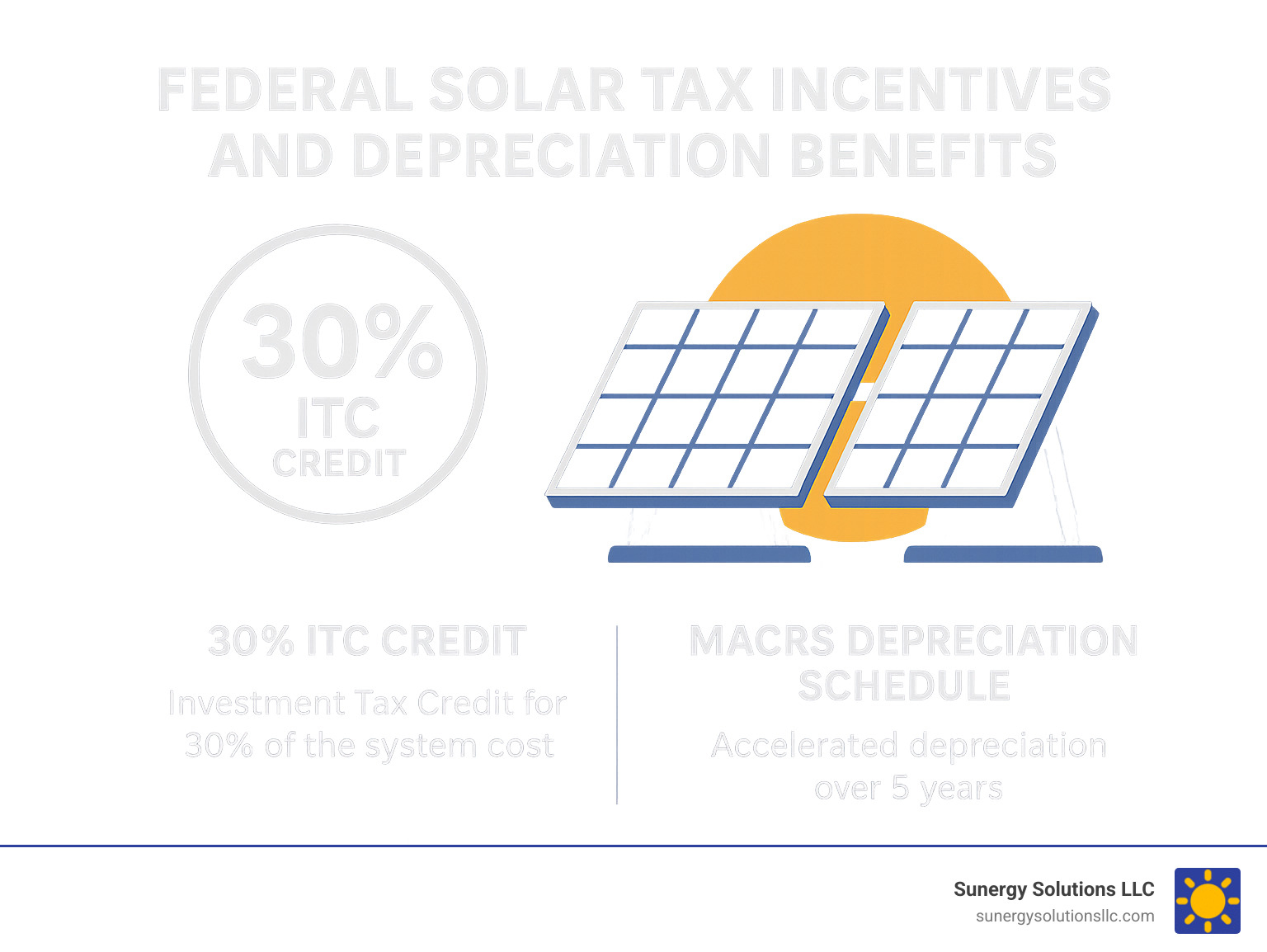
When evaluating commercial solar financing companies, the interest rate is just one piece of the puzzle. The real magic happens when you understand how federal tax credits, depreciation benefits, and various fees work together to determine your actual cost of capital.
The federal Investment Tax Credit alone can slash your system cost by 30%, but that’s just the beginning. State incentives, accelerated depreciation, and renewable energy credits can stack up to create impressive returns.
The federal Investment Tax Credit is like getting a 30% discount directly from Uncle Sam. If you install a $200,000 solar system, you can claim $60,000 as a credit against your federal taxes. This isn’t a deduction that reduces taxable income—it’s a dollar-for-dollar reduction in what you owe.
The credit stays at 30% through 2032, then drops to 26% in 2033 and 22% in 2034. For businesses that meet certain requirements like paying prevailing wages or serving low-income communities, the credit can jump to an impressive 70%.
MACRS accelerated depreciation is another powerful tool. Instead of depreciating your solar system over 27 to 39 years like other commercial property, you can write it off over just five years. With bonus depreciation rules, many businesses can depreciate 60% to 80% of the system cost in year one.
Split loan structures let you optimize these tax benefits by making a large payment after you receive your ITC refund, then spreading the remaining balance over your original loan term. This strategy can cut your monthly payments by 20% to 30%.
To claim your ITC, you’ll need to file IRS Form 3468 with your tax return.
Dealer fees are probably the sneakiest cost you’ll encounter. These are fees that lenders charge your installer, who then passes them along to you. We’re talking about 2% to 6% of your total project cost—that’s $4,000 to $12,000 on a $200,000 system.
Origination fees typically add 1% to 3% to your loan amount. While they’re sometimes negotiable, most lenders build them into the loan rather than requiring upfront payment.
Early termination clauses in leases and PPAs can create nasty surprises if your business needs change. These penalties can range from several thousand to tens of thousands of dollars.
The bottom line? A slightly higher interest rate from a lender with no hidden fees often beats a lower rate that comes with expensive add-ons.
The financing application process can feel overwhelming, but it doesn’t have to be. Whether you’re running a small local business or managing a large enterprise, understanding what commercial solar financing companies expect can make the difference between a smooth approval and months of back-and-forth documentation requests.
Small business owners often worry about their credit scores, but here’s some good news: many commercial solar financing companies start with soft credit pulls during pre-qualification. This means you can explore your options without any impact on your credit score.
100% financing has become the norm rather than the exception. You don’t need to drain your business savings account or skip payroll to go solar. While putting some money down might get you a slightly better rate, most businesses find that keeping their cash for operations makes more sense.
The documentation requirements are refreshingly simple compared to traditional business loans. Most lenders need just your last two years of tax returns, three months of bank statements, and basic business information like your legal entity structure and years in operation.
Digital application platforms have transformed the experience entirely. You can complete applications during your lunch break, upload documents from your phone, and get real-time updates on your approval status.
One particularly helpful feature is the six-month no-payment period that most lenders offer. This gives you time to complete installation and start seeing energy savings before your first payment is due.
Large enterprises face different challenges, mainly around internal approval processes and corporate reporting requirements. The best commercial solar financing companies for enterprises provide audit-ready reporting with detailed project documentation that satisfies even the most thorough CFO.
Nonprofit organizations get a raw deal with solar tax credits since they don’t pay federal taxes, but creative financing structures can still work. Some lenders offer reduced rates for nonprofits, recognizing that your mission aligns with clean energy goals.
Multi-site projects open up portfolio financing opportunities that can significantly improve your terms. If you’re a franchise owner with multiple locations or a company with several facilities, bundling projects often results in better rates and simplified administration.
For businesses ready to explore their options, understanding the full scope of Commercial Solar Systems available can help inform your financing decisions.
These are the questions I hear most often from business owners exploring their solar financing options. Each one touches on important considerations that can significantly impact your project’s success and financial returns.
The financing structure you choose directly determines who gets to claim the valuable tax benefits that make commercial solar so attractive. When you finance through a loan, you maintain ownership of the system, which means you can claim the full 30% federal Investment Tax Credit and take advantage of accelerated depreciation through MACRS.
This ownership advantage is huge. I’ve seen businesses effectively reduce their net system cost by 50% or more when they properly maximize these tax benefits. The key is having sufficient tax liability to absorb the credits, which is why loan financing works best for profitable companies.
Lease and PPA structures work differently because a third-party company owns your system. While you can’t directly claim the tax credits, these benefits don’t just disappear. The financing company factors their tax savings into your lease payments or electricity rates, passing much of the value back to you through lower costs.
Split loan structures offer the best of both worlds for many businesses. You can make a large payment after receiving your ITC refund, then re-amortize the remaining balance over your original loan term. This approach can cut your monthly payments by 20-30% while preserving all the tax advantages of ownership.
Commercial solar financing companies have varying credit requirements, and the good news is that many are more flexible than traditional bank loans. Most prefer credit scores of 650 or higher, but I’ve worked with clients who secured financing with lower scores based on strong cash flow and business fundamentals.
The key metrics lenders typically evaluate include your debt-to-income ratio (usually under 40%), time in business (most want at least 2 years), annual revenue relative to the loan amount, and cash flow stability. Many specialized solar lenders focus more on your ability to service the debt than just your credit score.
What makes solar financing unique is that lenders understand they’re financing an asset that immediately starts generating value through energy savings. This makes them more willing to work with businesses that might not qualify for other types of commercial loans.
Your business structure also matters. LLCs and corporations often have easier approval processes than sole proprietorships, and businesses with audited financial statements typically get better terms than those with just tax returns.
Absolutely, and this is becoming increasingly popular as businesses realize the value of comprehensive energy projects. Many lenders now offer bundled financing that can include battery storage systems, roof replacements, electrical upgrades, and other energy efficiency improvements alongside your solar installation.
Battery storage financing makes particular sense because these systems qualify for the same 30% federal tax credit as solar panels. When you finance them together, you can often get better terms than separate loans, and you’ll maximize your tax benefits across the entire project.
Roof replacement bundling is especially smart if your roof needs work anyway. Solar systems last 25+ years, so it makes sense to start with a solid foundation. C-PACE financing works particularly well for these bundled projects because it can finance any property improvement that reduces energy consumption.
I’ve helped clients bundle everything from HVAC upgrades to LED lighting retrofits with their solar projects. The key is working with financing companies that understand these comprehensive approaches and can structure deals that make financial sense for your specific situation.
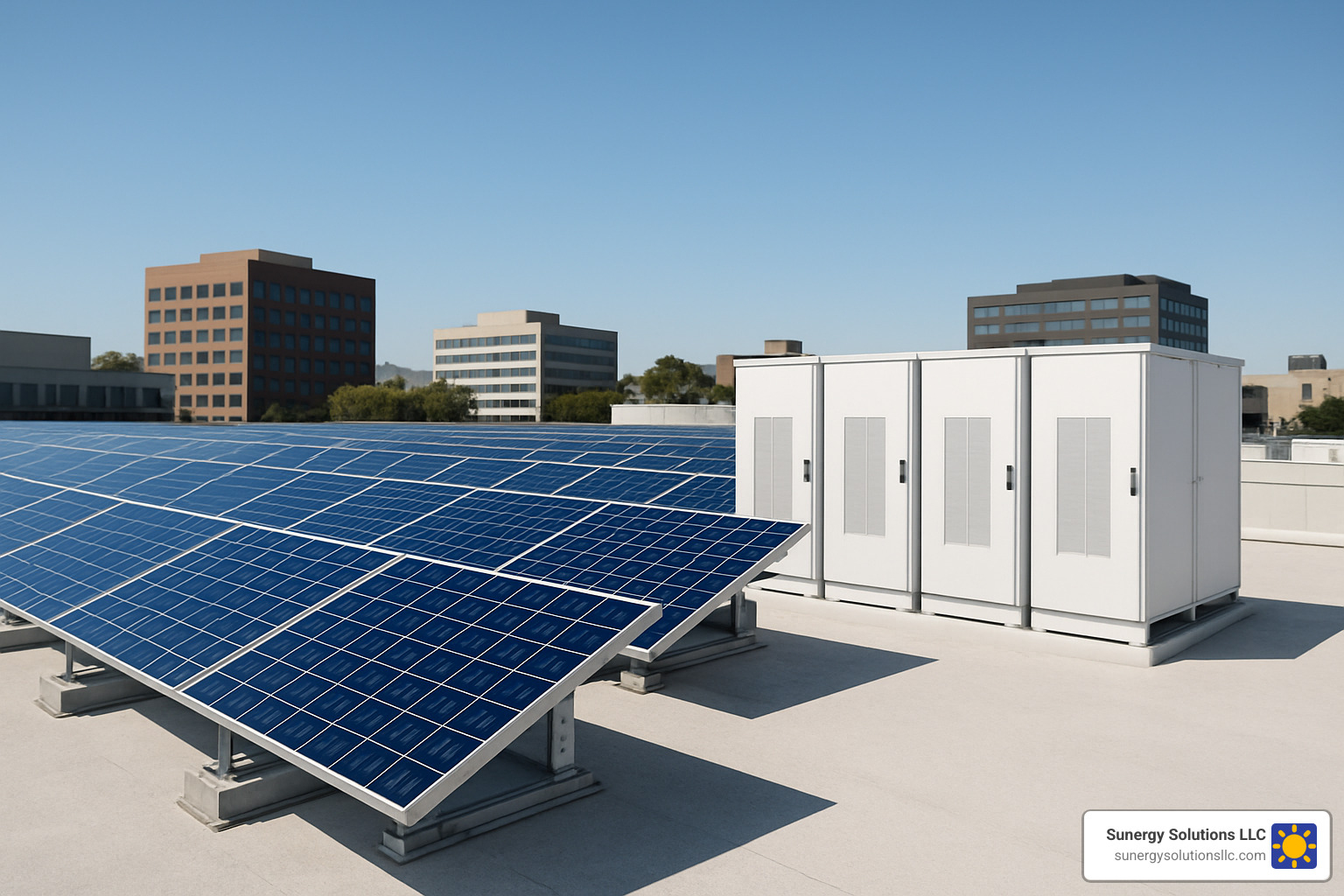
Navigating commercial solar financing companies can feel overwhelming at first, but understanding your options makes all the difference in securing the best deal for your business. Today’s solar financing landscape offers more flexibility and better terms than ever before.
The most important decision you’ll face is whether you want to own your system outright or work with a third-party owner. Ownership through loans gives you complete control over tax benefits—that 30% federal Investment Tax Credit can be a game-changer for your bottom line. On the other hand, leases and PPAs offer simplicity and predictable costs without the maintenance headaches.
Your business’s unique situation should guide your choice. Companies with strong tax liability often benefit most from loan financing, while businesses wanting hands-off operation may prefer third-party ownership structures.
Don’t overlook the details that can make or break your solar investment. Hidden dealer fees, prepayment penalties, and escalating lease payments can significantly impact your savings over time. The best commercial solar financing companies are transparent about all costs and flexible with their terms.
At Sunergy Solutions LLC, we’ve spent nearly a decade helping businesses across Maine, Massachusetts, New Hampshire, Rhode Island, Vermont, Montana, and Virginia find the perfect financing match for their solar projects. Every business is different, and what works for a small retail shop isn’t necessarily right for a large manufacturing facility.
The federal tax incentives available through 2032 create a limited-time opportunity that’s too good to pass up. Combined with accelerated depreciation and state incentives, many businesses see returns that far exceed traditional investments. Commercial solar isn’t just about going green anymore—it’s about smart financial planning.
Your due diligence pays off in the long run. Take time to compare multiple lenders, read the fine print, and ask plenty of questions. The right financing partner will welcome your questions and provide clear, detailed answers about every aspect of your agreement.
For businesses ready to explore the broader benefits of solar investment, our guide on Commercial Solar Power: A Smart Business Decision shows how solar fits into your overall business strategy and long-term planning.
The solar financing market continues evolving rapidly, with new products and better terms appearing regularly. What hasn’t changed is the fundamental value proposition: immediate energy savings, predictable costs, and substantial tax benefits that can transform your business’s energy expenses from a liability into an asset.
Working with experienced professionals who understand both the technical and financial sides of solar makes the entire process smoother and more successful. Your solar investment should deliver decades of savings and sustainability benefits—choosing the right financing partner ensures you maximize both from day one.

Appointments Available, 7 Days a Week


