
5.0 Rating
Request A Free Estimate
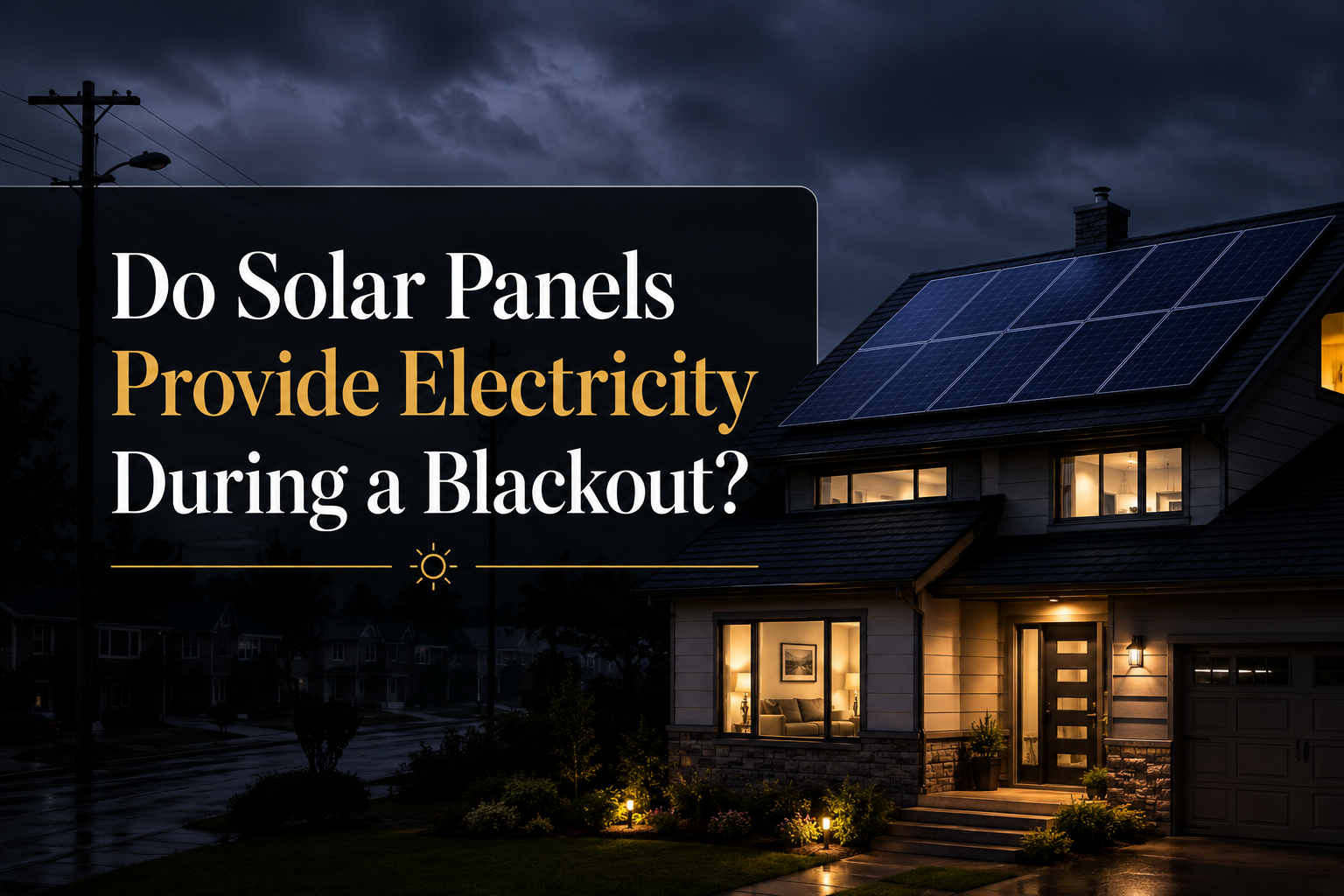
Standard grid-tied solar panels usually do not provide usable electricity during a blackout, even when the sun is shining.
When the utility grid goes down, the solar inverter automatically shuts off the system to prevent electricity from flowing back onto power lines.
Solar panels can continue powering a home when the system includes equipment designed for backup operation.
This may include a compatible solar battery, backup-enabled inverter, isolation device, and electrical panel configured to support selected circuits or the entire home.
Certain specialized systems can also provide limited daytime power without a battery, but this is not how most residential solar installations operate.
SEE IF SOLAR MAKES SENSE FOR YOU
Standard grid-tied solar systems normally shut down during a blackout.
Solar panels can provide outage power when the system includes compatible backup equipment and can safely disconnect the home from the utility grid.
Not every solar battery installation includes blackout protection.
Some specialized systems can provide limited daytime power without a battery, but they cannot provide electricity at night.
Battery runtime depends on stored energy, power output, household demand, weather, and whether the panels can recharge the battery during the outage.
Whether solar panels work during a power outage depends on the type of system installed.
A standard grid-tied solar system will normally shut down when utility power is lost.
A system designed for backup power may continue operating after safely separating the home from the utility grid.
| Solar system type | Provides electricity during an outage? | Works at night? | What is required? |
| Standard grid-tied solar without backup | No | No | Standard inverter and utility connection |
| Grid-tied solar with backup-enabled battery storage | Yes | Yes, while stored power is available | Battery, compatible inverter, and grid-isolation equipment |
| Specialized daytime backup without a battery | Sometimes | No | Compatible inverter and backup controls |
| Off-grid solar with battery storage | Yes | Yes, while stored power is available | Battery bank, inverter, and charge controls |
Having solar panels does not automatically mean a home will have electricity during a blackout. Backup capability must be included in the system design.
Solar systems shut down during a utility outage to protect utility workers, emergency crews, electrical equipment, and the home.
When electrical lines are damaged or being repaired, utility crews need to know that those lines are not carrying electricity.
If a home solar system continued sending excess electricity onto the grid, it could energize a line that workers believe is inactive.
This could create a serious safety hazard.
Grid-connected inverters prevent this through a safety feature known as anti-islanding.
The inverter constantly monitors the utility grid.
When it detects a power failure, it stops delivering solar electricity into the home and utility lines.
The shutdown normally happens automatically.
Homeowners generally do not need to turn the solar system off manually when a blackout begins.
It may seem logical that solar panels should continue powering a home whenever the sun is shining.
The challenge is that solar production and household electricity use constantly change.
Clouds can reduce solar output within seconds.
Appliances can also create sudden increases in demand when they turn on.
Refrigerators, air conditioners, well pumps, sump pumps, and other motor-driven equipment may require more electricity at startup than they use while running.
During normal operation, the utility grid balances these changes.
The home draws additional power from the grid when solar production is too low and sends excess power back when production is higher than household demand.
During a blackout, the utility grid is unavailable.
A backup-capable battery or specialized inverter must stabilize the home’s electrical system and keep energy production aligned with energy use.
Sunlight may still be reaching the panels, but a standard grid-tied system cannot deliver that electricity for normal household use.
Solar panels produce direct-current electricity.
The inverter converts that electricity into alternating-current power that can be used by household appliances.
When the inverter shuts down during a utility outage, electricity from the panels cannot flow through the home’s electrical system in the usual way.
The panels have not necessarily stopped receiving solar energy.
The system has stopped converting and delivering that energy because it cannot safely operate while connected to the inactive grid.
A properly configured solar battery system can keep selected appliances or an entire home powered during an outage.
A typical backup sequence works like this:
This creates a temporary independent electrical system, sometimes called an islanded system.
Depending on the equipment, the transfer to battery power may happen quickly enough that homeowners notice little more than a brief interruption.
No.
A home can have a solar battery without having blackout protection.
Some batteries are installed mainly to store solar electricity for later use.
Homeowners may use that stored energy in the evening or during times when utility rates are higher.
If the battery system is not designed to disconnect safely from the utility grid, it may also stop operating during an outage.
A backup-capable installation may require:
When comparing battery systems, homeowners should ask whether the installation includes outage backup, not just energy storage.
Most grid-tied solar systems cannot power a home during an outage without a battery.
However, certain specialized systems can provide limited electricity directly from the panels while sufficient sunlight is available.
This setup may be described as daytime backup or sunlight backup.
It may support a small number of selected circuits, but it comes with limitations:
Daytime backup may help keep basic devices running, but it does not provide the same consistency or flexibility as a properly sized battery system.
The appliances that can remain on depend on battery capacity, inverter output, available solar production, system configuration, and the circuits connected to backup power.
| Household load | Commonly included in backup? | Main consideration |
| Refrigerator and freezer | Often | Cycling and startup power |
| LED lights | Often | Relatively low electricity use |
| Internet modem and router | Often | Low electricity use |
| Phone and device chargers | Often | Low electricity use |
| Medical equipment | Often | Equipment requirements should be reviewed carefully |
| Garage door opener | Sometimes | Brief startup demand |
| Well pump | Sometimes | May require substantial surge power |
| Sump pump | Sometimes | Startup demand and frequency of operation |
| Microwave | Sometimes | High power draw for short periods |
| Electric water heater | Less commonly | High electricity use |
| Electric range or oven | Less commonly | High power demand |
| Central air conditioning | Depends on system size | High startup and running demand |
| Electric resistance heating | Less commonly | Can drain stored energy quickly |
| EV charger | Rarely during outages | Very high energy demand |
A smaller backup system may be designed to support refrigeration, lights, internet access, outlets, medical devices, and pumps.
Powering central air conditioning, electric heating, water heating, cooking equipment, or EV charging may require multiple batteries and higher-capacity equipment.
A whole-home backup system is designed to power most or all circuits in the house.
A selected-circuit system supplies electricity only to a designated backup panel.
Common backup circuits include:
Backing up fewer circuits can help stored energy last longer and reduce the chance that several large appliances will draw electricity at the same time.
Whole-home backup provides more flexibility, but the system must be sized for both total energy use and short periods of high demand.
GET THE MOST OUT OF YOUR SOLAR SYSTEM
A solar battery may power a home for several hours, overnight, or longer.
Runtime depends on how much usable energy is stored and how much electricity the home consumes.
A simple estimate is:
For example, a battery with 10 kWh of usable capacity supporting an average backup load of 1 kW may provide approximately 10 hours of electricity.
The actual runtime may be shorter or longer because of:
If the panels produce more electricity than the home is using during the day, the extra energy may recharge the battery and extend the amount of time the home can remain powered.
Households can often extend battery runtime by avoiding high-demand appliances until utility service returns.
Battery specifications commonly include kilowatts and kilowatt-hours.
These measurements describe different parts of system performance.
Kilowatt-hours, or kWh, measure stored energy.
This affects how long the battery may power the home.
Kilowatts, or kW, measure power output.
This affects how much equipment the battery can operate at one time.
A battery may contain enough stored energy to run a refrigerator and lights for many hours but still lack the power output needed to start a large air conditioner or well pump.
Both kW and kWh should be considered when designing a solar backup system.
Yes.
A properly designed solar-plus-storage system can usually recharge its battery while the utility grid is down.
During daylight, available solar energy may be used in the following order:
The exact process depends on the inverter, battery, control system, sunlight, and household demand.
The ability to recharge during an outage can help a solar battery support the home through a longer power interruption, especially when energy use is carefully managed.
During normal operation, excess solar electricity may be sent to the utility grid.
That cannot happen during a blackout because the home must remain safely isolated from utility lines.
If the battery has available storage capacity, extra solar energy may be used to recharge it.
If the battery is full and the home is not using all the electricity available from the panels, the system may reduce or temporarily stop solar production.
This process is sometimes called curtailment.
The system adjusts production to keep electricity supply and household demand balanced.
Solar panels can power an entire house during a blackout when the system has enough solar generation, battery storage, inverter output, and compatible backup equipment.
Whether whole-home backup is practical depends heavily on household energy demands.
A home with efficient appliances and gas heating may be easier to support than a fully electric home with central air conditioning, electric heat, an electric water heater, and EV charging.
Whole-home backup planning should account for:
Some systems use load-management controls to temporarily prevent several high-demand appliances from running at the same time.
Battery backup can often be added to an existing solar system, but the existing equipment must be evaluated first.
An installer may review:
Some solar installations can be upgraded using an AC-coupled battery with its own inverter.
Other systems may require the existing solar inverter to be replaced or modified.
The appropriate setup depends on the home, existing solar equipment, electrical configuration, and desired level of outage protection.
Solar panels, batteries, and generators can sometimes be combined into one backup system.
However, the equipment must be designed and configured to operate together safely.
A generator may provide additional support during:
Depending on the system, a generator may power household loads, recharge the battery, or do both.
Not every solar inverter or battery is compatible with every generator.
Transfer equipment, control settings, fuel type, generator size, and electrical requirements should be reviewed before combining these technologies.
A blackout plan should be created before an outage occurs.
Begin by identifying which appliances and circuits need to remain powered.
Refrigeration, lighting, internet access, medical equipment, pumps, and heating controls are common priorities.
Next, confirm how the solar and battery system is configured.
A battery used for everyday energy savings may not automatically provide outage backup.
Homeowners should also review:
During an outage, reducing unnecessary electricity use can extend battery runtime.
Electric ovens, clothes dryers, EV chargers, portable heaters, and other high-demand equipment can quickly use stored energy.
Power outages can result from thunderstorms, hurricanes, winter storms, ice, fallen trees, equipment failures, and utility maintenance.
The appropriate backup system depends on the home’s electricity use, outage concerns, existing electrical equipment, and preferred level of coverage.
Sunergy Solutions works with homeowners in Connecticut, Massachusetts, Maine, New Hampshire, Rhode Island, Vermont, and Virginia to install solar systems that make sense for you.
A home energy evaluation can help determine whether selected-circuit backup, whole-home battery storage, daytime backup, or another configuration is appropriate for the property.
Solar panels do not usually provide usable electricity during a blackout unless the system has been designed for backup operation.
A standard grid-tied system shuts down to prevent electricity from reaching utility lines.
A properly configured battery, compatible inverter, isolation equipment, and backup electrical panel can allow the home to continue using solar energy safely.
The right setup depends on which appliances need power, how much electricity the home uses, how long outages may last, and whether the goal is selected-circuit or whole-home backup.
Homeowners who are unsure whether an existing or proposed solar system will work during a blackout can have the inverter, electrical panel, battery options, and backup priorities evaluated.
Sunergy Solutions can help homeowners in CT, MA, ME, NH, RI, VT, and VA determine which type of solar backup configuration may fit their property and energy needs.
Most standard grid-tied solar systems do not work during an outage without a battery. Certain specialized systems can provide limited daytime power, but they require compatible inverters and grid-isolation equipment.
Your solar inverter likely shut down after detecting a utility outage. This prevents electricity from flowing from the solar system onto power lines while utility workers may be repairing them.
Standard grid-tied solar panels usually will not provide usable electricity during a blackout, even in full sunlight. A backup-capable battery system or specialized daytime-backup system is required.
No. Some batteries are configured only to store electricity for later use or reduce utility costs. Outage protection requires compatible controls, isolation equipment, and proper electrical wiring.
They may be able to, but air conditioners require significant power and may have high startup demands. The battery, inverter, and solar array must be sized for the specific air-conditioning system.
Excess solar energy may recharge the battery. If the battery is full and household demand is low, the system may reduce solar production because electricity cannot be exported to the inactive grid.
Often, yes. An installer will need to review the existing inverter, electrical panel, battery compatibility, utility requirements, and the circuits that need backup power.
Appointments Available, 7 Days a Week


