
5.0 Rating
Request A Free Estimate
No, solar panels do not store energy.
They generate electricity from sunlight.
If you want to save that energy for later, you need a battery.
Without one, any extra power is either used right away, sent to the grid, or lost.
That’s the short answer.
Now let’s walk through exactly what happens to your solar power in real-world situations.
GET THE MOST OUT OF YOUR SOLAR POWER SYSTEM
Solar panels use photovoltaic (PV) cells to convert sunlight into electricity.
When sunlight hits the panels, it creates an electrical current that flows into your home or business.
Here’s the key idea:
Solar panels produce energy when the sun is shining, but they don’t store it.
Think of them like a generator that runs during the day.
Once the sun goes down, they stop producing electricity unless you have stored power.
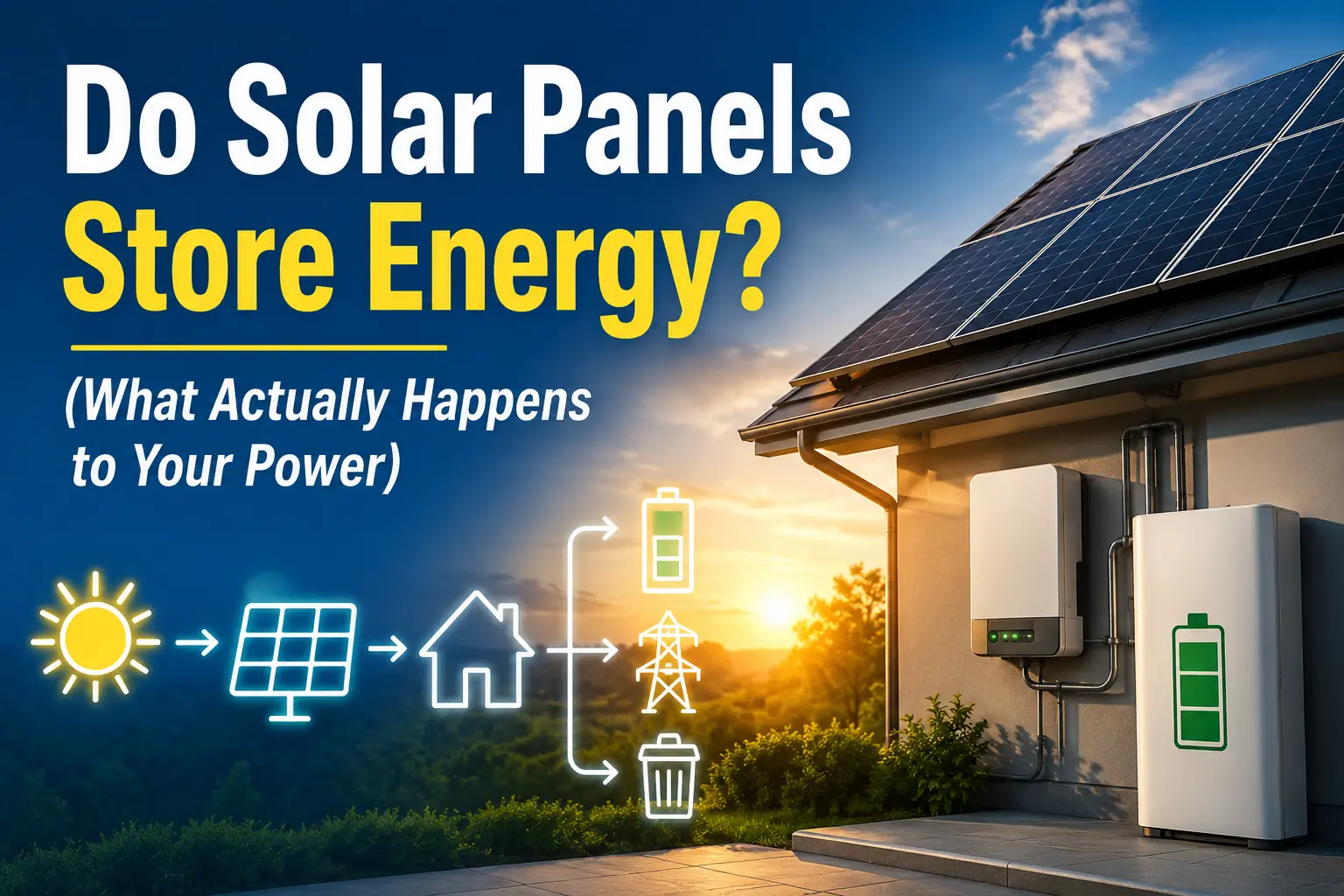
The moment your panels produce electricity, it has to go somewhere.
There are three main possibilities:
Which path it takes depends on how your solar setup is designed.
If you’re running an off-grid system, everything depends on your batteries.
Here’s what happens step by step:
At that point, your system will:
If neither of these options is in place, the extra energy is simply lost.
If your batteries are full and your system isn’t designed to use excess power, that energy goes to waste.
This is why proper system sizing and energy planning are so important for off-grid setups.
Grid-tied systems are the most common setup for homes and businesses.
When your panels produce more electricity than you need:
Later, like at night or during cloudy weather, you use those credits when you draw power from the grid.
In simple terms, the grid acts like a backup system.
You’re not storing energy at home, but you’re still getting value from what you produce.
If you want to actually store solar power, you need a battery system.
A solar battery holds excess electricity so you can use it later, at night, during outages, or when your panels aren’t producing enough.
Here’s how it works:
Modern systems like the Tesla Powerwall automatically manage this process, switching between solar, battery, and grid power as needed.
Not always.
It depends on how you want your system to function.
You may not need a battery if:
A battery may make sense if:
Batteries increase upfront cost, but they also increase independence and reliability.
Your system type determines exactly what happens to your energy.
Only in a limited way.
In grid-tied systems, excess energy is tracked by your utility and returned to you as credits.
This can feel like storage, but it’s not the same as having energy saved on-site.
If you want real, on-demand stored power you can use anytime, batteries are the only true solution.
Two solar systems can produce the same amount of energy but perform very differently depending on how they’re set up.
A well-designed system helps you:
That’s why it’s important to match your system to your energy habits, goals, and environment.
Solar panels don’t store energy, they generate it.
What happens next depends on your setup:
Understanding this helps you choose the right system so you can get the most out of your solar power, without confusion or wasted energy.
No, solar panels do not store energy. They generate electricity from sunlight. To store that energy for later use, you need a solar battery system.
Not on their own. Without a battery, solar panels stop producing electricity at night. If you want power after sunset, you’ll need stored energy in a battery or access to the grid.
If you don’t use the energy right away, it either gets stored in a battery, sent back to the grid (in grid-tied systems), or wasted (in off-grid systems with full batteries).
In off-grid systems, extra energy charges your batteries first. Once they’re full, the system either reduces production, redirects power to a dump load, or the energy is lost.
In a grid-tied system, the extra electricity is sent to the grid and may earn you energy credits. In an off-grid system, it can be wasted if your batteries are already full.
Not physically. In grid-tied systems, excess energy can be tracked as credits by your utility company, but this isn’t true storage like a battery.
Not always. If you’re connected to the grid, you may not need one. But if you want backup power, energy independence, or an off-grid setup, a battery is essential.
Most solar batteries can store energy for several hours to a couple of days, depending on their size and your energy usage.
Appointments Available, 7 Days a Week


