
5.0 Rating
Request A Free Estimate
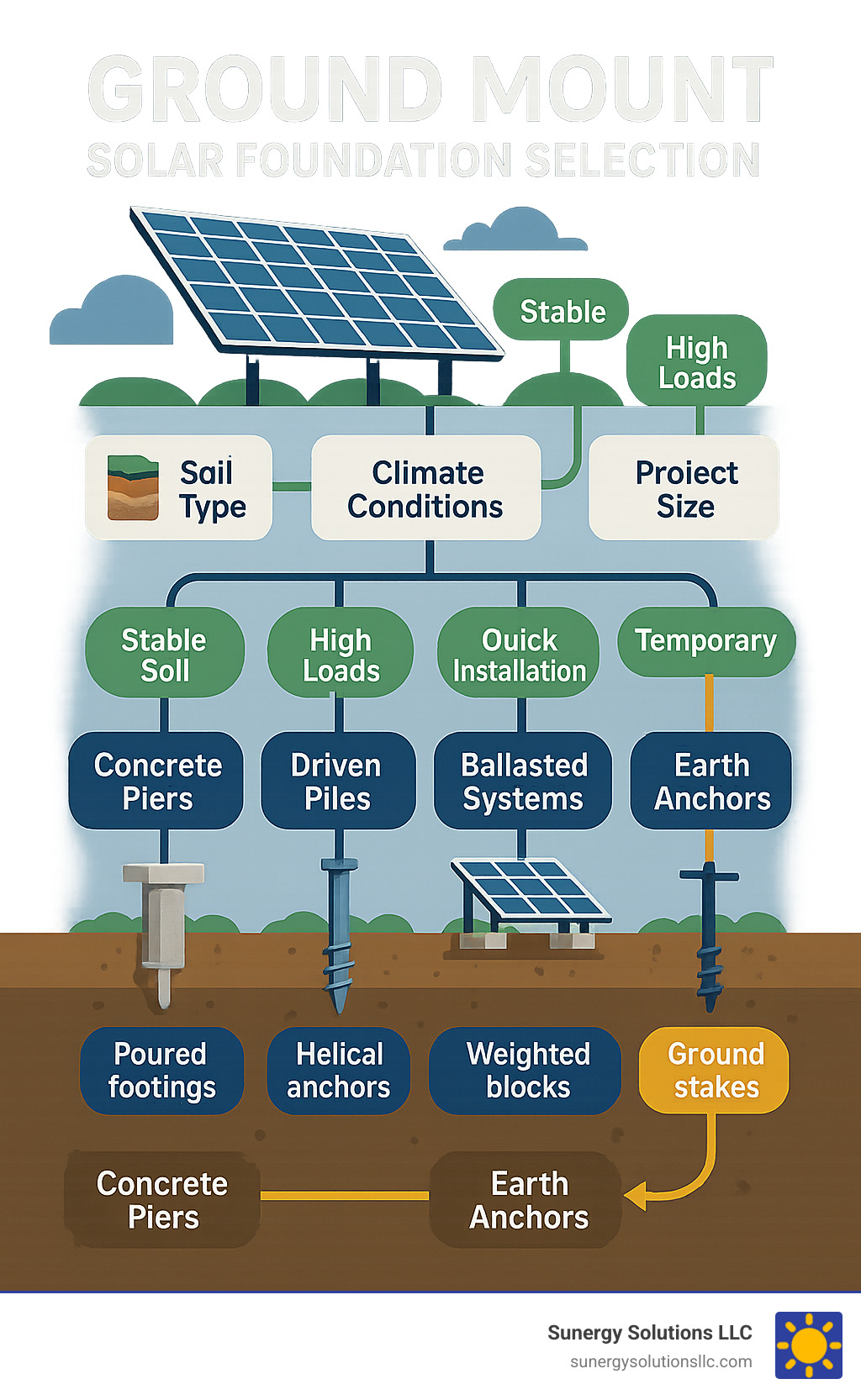
Ground mount solar foundations are the structural anchoring systems that secure solar panels to the ground, providing stability against wind, snow, and seismic forces while ensuring optimal energy production for decades. These foundations come in several types – from concrete piers and driven piles to ground screws and ballasted systems – each designed for specific soil conditions and installation requirements.
Key Foundation Types:
– Concrete Piers – Poured footings for permanent installations
– Driven Piles – Steel posts hammered 8-10 feet deep
– Ground Screws – Helical anchors twisted into soil
– Ballasted Systems – Weighted blocks requiring no ground penetration
– Earth Anchors – Rapid-deploy solution for temporary installations
Ground-mounted solar systems offer significant advantages over rooftop installations. They can be positioned for optimal sun exposure, avoid roof structural limitations, and provide easy access for maintenance. However, their success depends entirely on proper foundation design and installation.
A poorly designed foundation can lead to costly system failures, while an over-engineered solution wastes money. The key is matching the right foundation type to your specific soil conditions, local climate, and project requirements.
I’m Robert Raffa, CEO and Founder of Sunergy Solutions LLC, and I’ve spent nearly a decade helping homeowners and businesses across the Northeast steer complex solar installations, including extensive experience with ground mount solar foundations for challenging sites. This guide will walk you through everything you need to know to make the right foundation choice for your solar investment.
When we evaluate solar options for our clients, ground-mount systems often emerge as the superior choice for properties with adequate land. Unlike rooftop installations that must work around existing structures, ground mounts offer complete design freedom.
Roof versus Ground Advantages:
– Optimal Positioning: Ground mounts can be oriented due south with precise tilt angles
– Shade-Free Siting: Position arrays away from trees, buildings, and other obstructions
– Maintenance Access: Easy cleaning and repairs without climbing on roofs
– No Roof Penetrations: Eliminates leak risks and preserves roof warranties
– Scalability: Add more panels as energy needs grow
The freedom of tilt adjustment alone can increase energy production by 15-25% compared to roof-mounted systems constrained by existing roof angles.
Ground mount solar foundations must withstand substantial forces throughout their operational life. A typical residential 10kW ground-mount system represents a $20,000-30,000 investment, making proper foundation design critical for protecting that investment.
Structural loads include:
– Dead Loads: Weight of panels, racking, and foundation components
– Live Loads: Snow accumulation (up to 70 PSF in northern climates)
– Wind Forces: Systems must resist winds up to 170 MPH
– Seismic Activity: Earthquake resistance in applicable regions
– Thermal Expansion: Materials expand and contract with temperature changes
A properly engineered foundation system distributes these loads safely into the ground while maintaining precise panel alignment for optimal energy production.
The engineering behind ground mount solar foundations might seem complex, but understanding the basics helps you make smarter decisions about your solar investment. Your soil tells the story of what foundation will work best.
Sandy soils can typically support 2,000 to 3,000 pounds per square foot. Clay soils handle only 1,000 to 1,500 pounds per square foot. Solid rock can support over 10,000 pounds per square foot (though you’ll need special equipment to anchor into it).
Frost can be your foundation’s worst enemy. The frost line varies dramatically – from 36 inches in coastal areas to over 48 inches in northern regions. All foundation elements must go deeper than this frost line to prevent frost heave. Scientific research on soil frost heave shows how water expansion during freeze-thaw cycles can generate enough force to lift an entire solar array right out of the ground.
Wind creates tremendous uplift forces that try to pull the entire system out of the ground. Those beautiful solar panels basically become giant sails in a windstorm. This is where ground screws really shine – their twisted design creates a cone effect underground that grips the soil like a giant corkscrew.
Drainage is the unsung hero of foundation longevity. Water sitting around foundations causes soil erosion, frost heave, and rust on steel components. Smart drainage design with gravel backfill keeps water moving away from your investment.
Engineers design ground mount solar foundations to survive weather events that might happen only once every 25 to 50 years.
Wind loading keeps foundation engineers awake at night. The standard 170 MPH wind resistance accounts for hurricane-force winds that can generate over 50 pounds of uplift force per square foot of panel surface. Coastal installations face the biggest wind challenges because there aren’t any trees or hills to break up those ocean winds.
Snow loading varies dramatically depending on location and elevation. The 70 pounds per square foot standard applies to heavy snow areas, while coastal regions might only need 30 to 40 pounds per square foot capacity. Snow doesn’t fall evenly – we’ve seen 6-foot drifts pile up against arrays during big storms.
Corrosion resistance becomes critical for long-term performance. All steel components need hot-dip galvanization, while aluminum parts need the right alloy selection, especially near the coast where salt air accelerates corrosion.
A professional soil investigation eliminates the guesswork from foundation selection. A basic geotechnical report includes soil boring logs, bearing capacity analysis, groundwater level assessment, and corrosivity testing. Pull-out tests verify how much holding power your foundation will actually have in real soil conditions.
For most residential projects, we conduct visual soil assessment and test boreholes at key locations. This practical approach balances good engineering with reasonable project costs.
Every ground mount solar foundation has three essential parts: the above-grade post that holds up your solar panels, the below-grade anchor that transfers forces into the ground, and the connection hardware that joins everything together.
Above-grade posts are typically galvanized steel pipes that resist bending from wind and snow loads. Below-grade anchors transfer structural loads safely into the ground through bearing pressure, friction, or weight. Connection hardware includes all the bolts, brackets, and clamps – everything must be galvanized or stainless steel for corrosion resistance.
Selecting the optimal foundation type requires balancing soil conditions, installation timeline, budget constraints, and long-term performance requirements.
Concrete Piers provide maximum stability and longevity but require the longest installation time. Installation involves excavating holes 3-4 feet deep, placing reinforcing steel, and pouring concrete around the support post. Concrete must cure for several days before loading.
Concrete piers excel for:
– Permanent installations in stable soil
– High-wind coastal locations
– Large commercial arrays requiring maximum stability
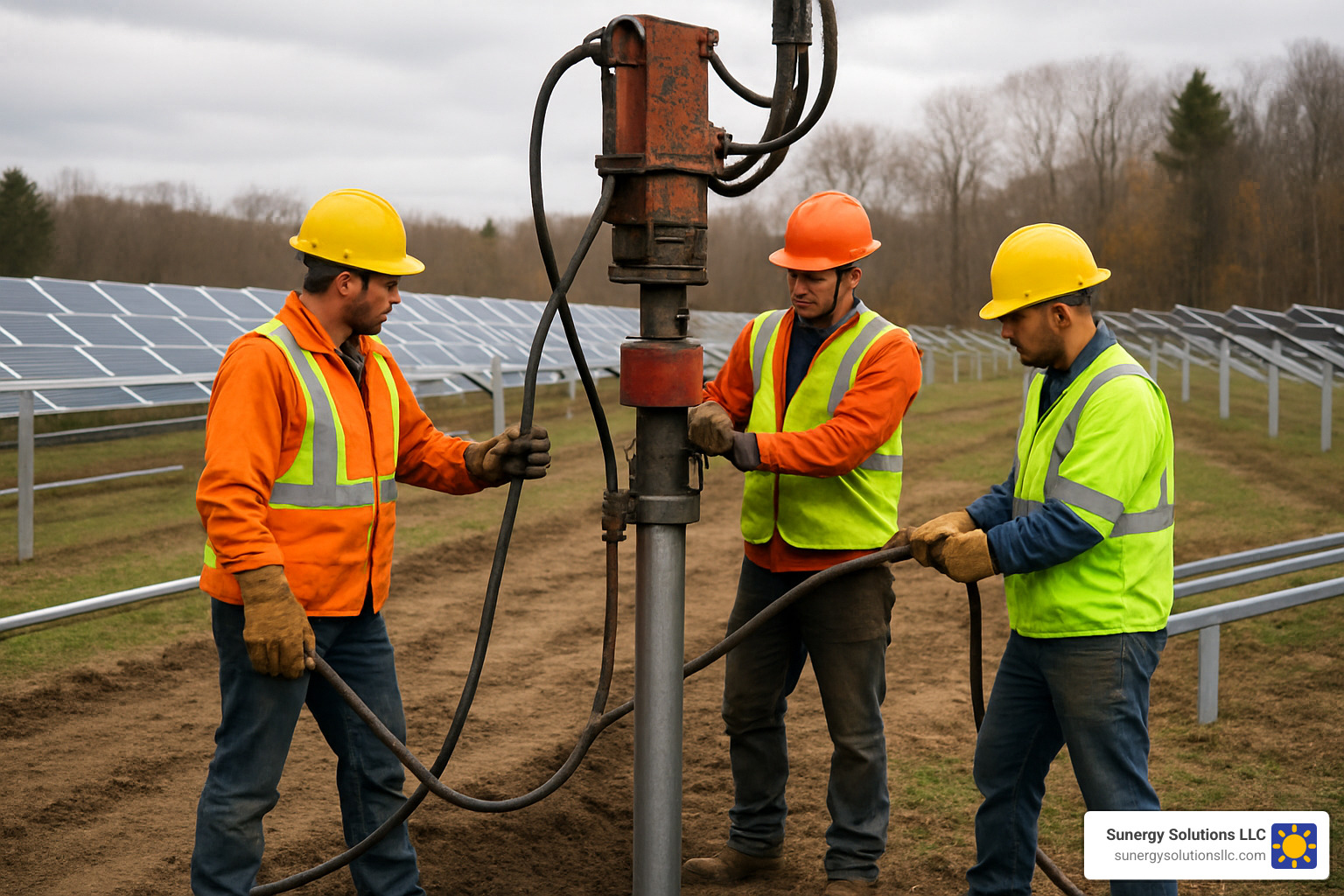
Driven Piles offer rapid installation with excellent load capacity. Steel piles are driven 8-10 feet deep using hydraulic hammers, reaching depths that provide superior resistance to frost heave and wind uplift.
Driven piles work best for:
– Projects requiring fast installation
– Soils with good bearing capacity
– Areas with deep frost lines
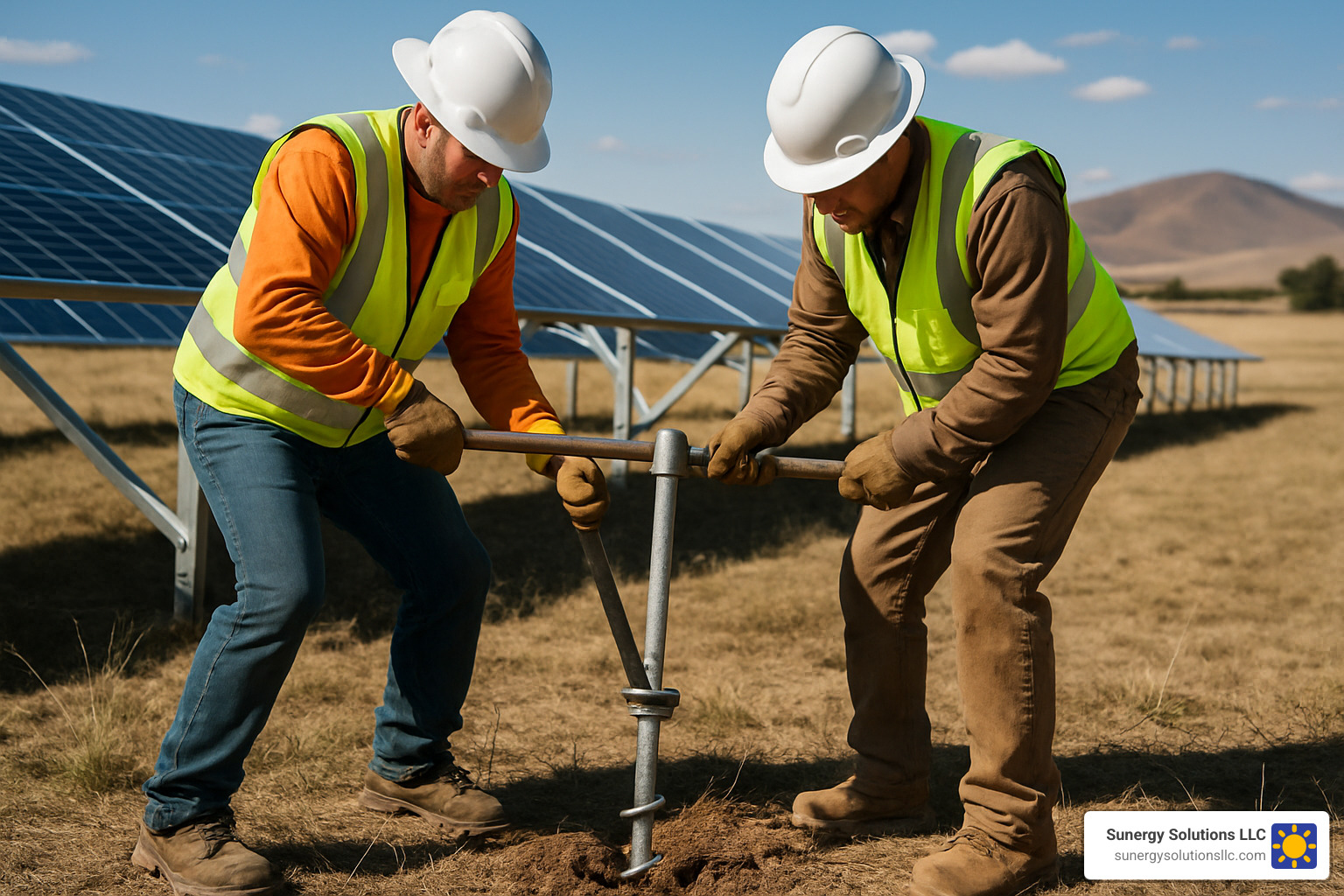
Ground Screws combine speed with versatility, installing in minutes using standard excavator attachments. The helical design provides excellent pullout resistance when properly installed in suitable soil.
Ground screws excel for:
– Quick installations with minimal site disturbance
– Sandy or loamy soils
– Residential projects
Ballasted Systems require no ground penetration, making them ideal for environmentally sensitive sites. Precast concrete blocks or steel baskets filled with aggregate provide stability through weight alone.
Ballasted foundations suit:
– Capped landfills and brownfields
– Sites with shallow bedrock
– Areas where ground penetration is prohibited
Earth Anchors represent the newest foundation technology, offering rapid deployment for temporary installations. These systems support wind loads up to 140 MPH and snow loads up to 60 PSF.
Earth anchors work for:
– Disaster relief power systems
– Military applications
– Construction site temporary power
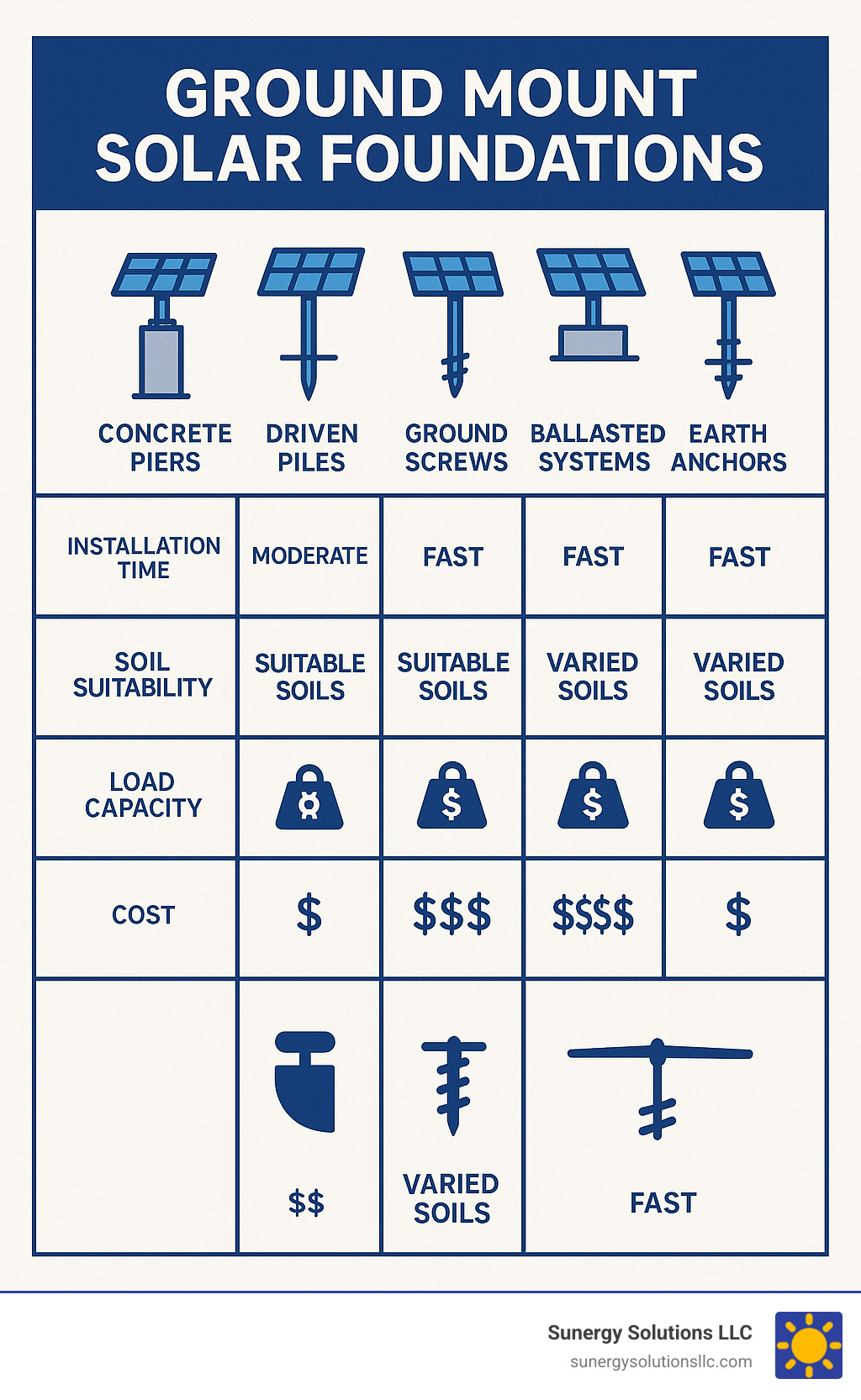
Longevity Leaders: Concrete piers and driven piles offer the longest service life, often exceeding 50 years with proper installation.
Speed Champions: Ground screws and earth anchors enable same-day installations, critical for projects with tight timelines.
Removability Options: Ballasted and earth anchor systems offer the best removability for temporary installations. Ground screws can also be removed with minimal site disturbance.
Environmental Impact: Ballasted systems create the least ground disturbance, followed by earth anchors and ground screws.
When ground penetration is restricted, ballasted foundation systems provide viable alternatives. These systems rely on weight and friction to resist forces without penetrating the ground surface.
Traditional Ballast Blocks use precast concrete units weighing 200-500 pounds each. Geo Ballast Systems use steel baskets filled with locally-sourced aggregate, reducing transportation costs.
Ballasted systems work well on:
– Capped landfills where penetration could damage liner systems
– Brownfield sites with contaminated soil
– Rocky terrain where excavation is impractical
For more information about professional installation approaches, visit our solar installations page.
Earth Anchor Technology eliminates heavy machinery requirements and concrete curing delays. Anchors install using standard hand tools, making them suitable for remote locations or emergency deployments.
Common temporary applications include:
– Disaster relief power for medical equipment
– Military forward operating base energy supply
– Construction site power
– Remote research station power
Planning a successful ground mount solar foundations project requires coordinating multiple phases from initial design through decades of reliable operation.
The permit timeline often catches homeowners off guard. While some jurisdictions approve projects in 2-4 weeks, others require 3-6 months. Most permits demand PE-stamped structural drawings showing foundation design and load calculations.
Equipment needs vary dramatically by foundation choice. Concrete piers require excavation equipment and several days of curing time. Driven piles need pile drivers or hydraulic hammers. Ground screws install with excavator-mounted auger attachments. Ballasted systems only require material handling equipment.
Labor requirements typically range from 4-8 hours per foundation point. A typical 10kW residential system with 8-12 foundation points requires 1-3 days for foundation installation, followed by 1-2 days for racking and panel installation.
For comprehensive guidance on avoiding common installation pitfalls, review our detailed analysis of common solar system installation mistakes.
Foundation costs typically represent 15-25% of your total ground-mount system cost.
Material costs vary significantly between foundation types. Concrete piers run $50-150 per foundation point. Driven piles cost $75-200 per point. Ground screws range from $100-250 per point. Ballasted systems cost $200-400 per point. Earth anchors fall in the $150-300 range.
Equipment and labor costs depend on installation complexity and site accessibility. Projects requiring specialized equipment face higher mobilization costs. Remote sites increase transportation expenses for both materials and equipment.
Engineering and permitting costs range from $2,000-10,000 depending on project complexity. The 30% federal tax credit applies to all foundation types, providing substantial savings on your total system cost.
Site preparation begins with surveying and marking foundation locations. Utility location services must clear all excavation areas before ground disturbance begins.
Foundation installation varies by system type. Driven piles get hammered to design depth using pile drivers. Ground screws install using excavator-mounted auger attachments in minutes per location. Concrete piers require excavating holes, placing forms and reinforcing steel, then pouring concrete around support posts.
Racking assembly connects foundation posts with horizontal rails using galvanized hardware. Panel installation and wiring completes the mechanical work. Commissioning and testing verifies system operation and safety.
Galvanization protection provides 25+ years of corrosion resistance for steel components. Annual torque checks prevent connection loosening from thermal cycling and wind vibration. Drainage maintenance prevents water accumulation around foundations by clearing vegetation and debris annually.
Annual inspections should document foundation alignment, hardware condition, drainage function, and any corrosion requiring repair. Vegetation management maintains proper clearance around arrays for fire safety and access.
High-wind resistance requires careful attention to foundation depth and racking design, especially for coastal installations. Snow load management varies dramatically across regions – northern areas must handle 60-70 PSF snow loads while coastal areas may only see 30-40 PSF.
Frost line considerations mandate minimum foundation depths. Foundation elements must extend below local frost depth to prevent heave damage. Coastal corrosion accelerates deterioration, requiring upgraded materials including stainless steel hardware and improved protective coatings.
Yes – virtually every ground mount solar foundation project requires permits, even small residential systems. You’re building a permanent structure and connecting to the electrical grid, so local authorities want to ensure safety.
Zoning setbacks are usually the first hurdle. Most communities require solar arrays to sit 5 to 30 feet back from property lines. Some neighborhoods also want screening vegetation around ground-mount installations.
The building permit process requires structural drawings showing how your foundation will handle wind and snow loads. For larger installations, you might need PE-stamped drawings from a licensed professional engineer.
Electrical permits cover everything from DC wiring to utility connections. All electrical work must meet NEC requirements, including UL 2703 grounding standards. Most areas require multiple inspections throughout the project.
Your soil type is probably the biggest factor in choosing the right ground mount solar foundations.
Sandy soils are generally ideal. They drain well, provide good bearing capacity, and make installation straightforward. Ground screws work particularly well in sandy conditions.
Clay soils present more challenges with lower bearing capacity and expansion/contraction with moisture changes. The solution is usually going deeper – extending foundations below the active clay zone.
Rocky conditions with shallow bedrock limit options but don’t eliminate them. Ballasted systems work well on solid rock surfaces. Ground screws can work if we pre-drill holes through shallow soil into rock.
Wetland areas bring environmental regulations into play. Ballasted systems minimize environmental impact since they don’t disturb the ground.
This depends on your skills, available time, and local code requirements. Some handy homeowners successfully install their own ground mount solar foundations, but it’s not a weekend project.
The tool requirements can be daunting. You’ll need excavation equipment, compaction equipment, and specialized tools for your chosen foundation type. Tool rental costs add up quickly.
Installation complexity varies dramatically by foundation type. Ballasted systems are relatively straightforward. Ground screws require more skill. Concrete piers involve timing and curing considerations.
Common DIY mistakes include inadequate foundation depth for frost conditions, poor drainage around foundations, incorrect torque on hardware, and improper electrical grounding.
Code compliance presents another challenge. Professional installers stay current with NEC electrical requirements and local codes.
For comprehensive guidance on avoiding installation pitfalls, check out our detailed analysis of common solar system installation mistakes.
Most homeowners find that professional installation provides better overall value when factoring in tool costs, time investment, and warranty coverage.
Ground mount solar foundations represent a critical investment in your solar energy system’s long-term performance and reliability. The right foundation choice depends on your specific soil conditions, local climate, project timeline, and budget constraints.
Key takeaways for foundation selection:
– Match foundation type to soil conditions and site constraints
– Consider long-term maintenance and durability requirements
– Factor installation timeline and equipment needs into project planning
– Ensure all installations meet local permitting and code requirements
– Plan for proper drainage and vegetation management
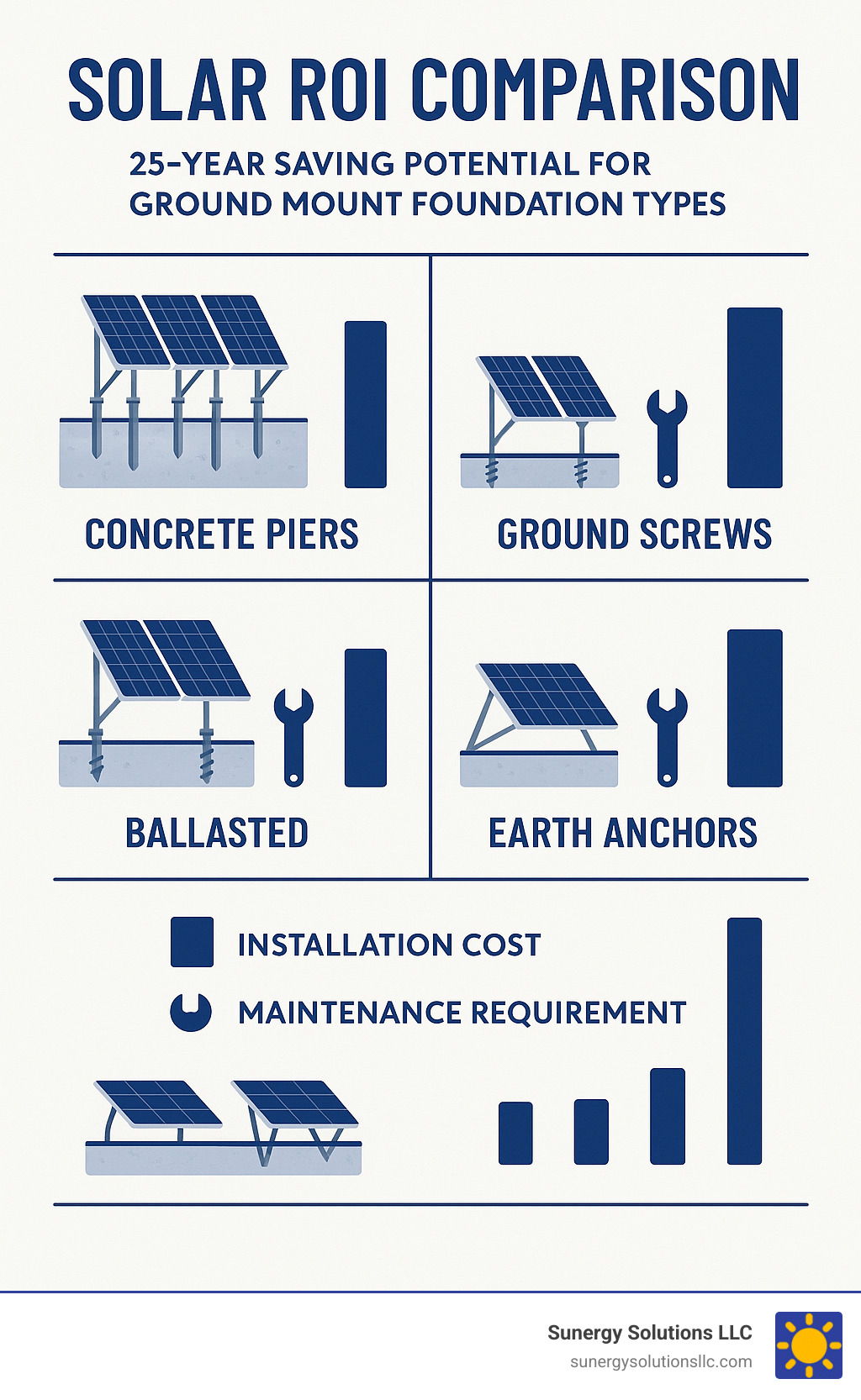
The solar ROI from ground-mount systems often exceeds rooftop installations due to optimal positioning and easier maintenance access. A typical 10kW ground-mount system in our New England service area generates $1,500-2,500 annual savings, providing attractive returns over the system’s 25+ year lifespan.
Foundation choice significantly impacts both initial project costs and long-term performance. Concrete piers offer maximum longevity for permanent installations, while ground screws provide rapid installation with good performance. Ballasted systems work well for sensitive sites, and earth anchors excel for temporary applications.
At Sunergy Solutions LLC, we bring nearly a decade of experience helping homeowners and businesses across Maine, Massachusetts, New Hampshire, Rhode Island, Vermont, Montana, and Virginia steer complex solar installations. Our approach combines top-tier equipment, extensive warranties, and exceptional customer service to ensure reliable, cost-effective solar solutions.
We understand that every site presents unique challenges requiring customized foundation solutions. Our comprehensive site assessment process evaluates soil conditions, local climate factors, and regulatory requirements to recommend the optimal foundation approach for your specific project.
Ready to explore ground-mount solar options for your property? Our experienced team can guide you through foundation selection, permitting, and installation to maximize your solar investment’s performance and longevity.
For more information about our comprehensive solar solutions and to schedule your personalized consultation, visit our solar energy solution page. Let us help you anchor your solar investment with the right foundation for decades of reliable, clean energy production.

Appointments Available, 7 Days a Week


