
5.0 Rating
Request A Free Estimate
Ground mounted solar panels are becoming an increasingly popular option for homeowners and businesses that want more flexibility, strong long-term energy production, and an alternative to rooftop solar.
While rooftop systems work well for many properties, they are not always the ideal solution.
If your roof has shade, limited space, structural concerns, or poor orientation for sunlight, a ground-mounted solar system may provide better performance and more installation flexibility.
Ground-mounted systems are also gaining attention among farms, warehouses, industrial facilities, and commercial properties with open land and higher energy demands.
Whether you are comparing solar panels on ground vs roof systems or researching ground mounted solar panels for business properties, understanding the pros, costs, and residential or commercial installation considerations can help you determine which option best fits your property and energy goals.
SEE HOW YOU CAN SAVE WITH SOLAR
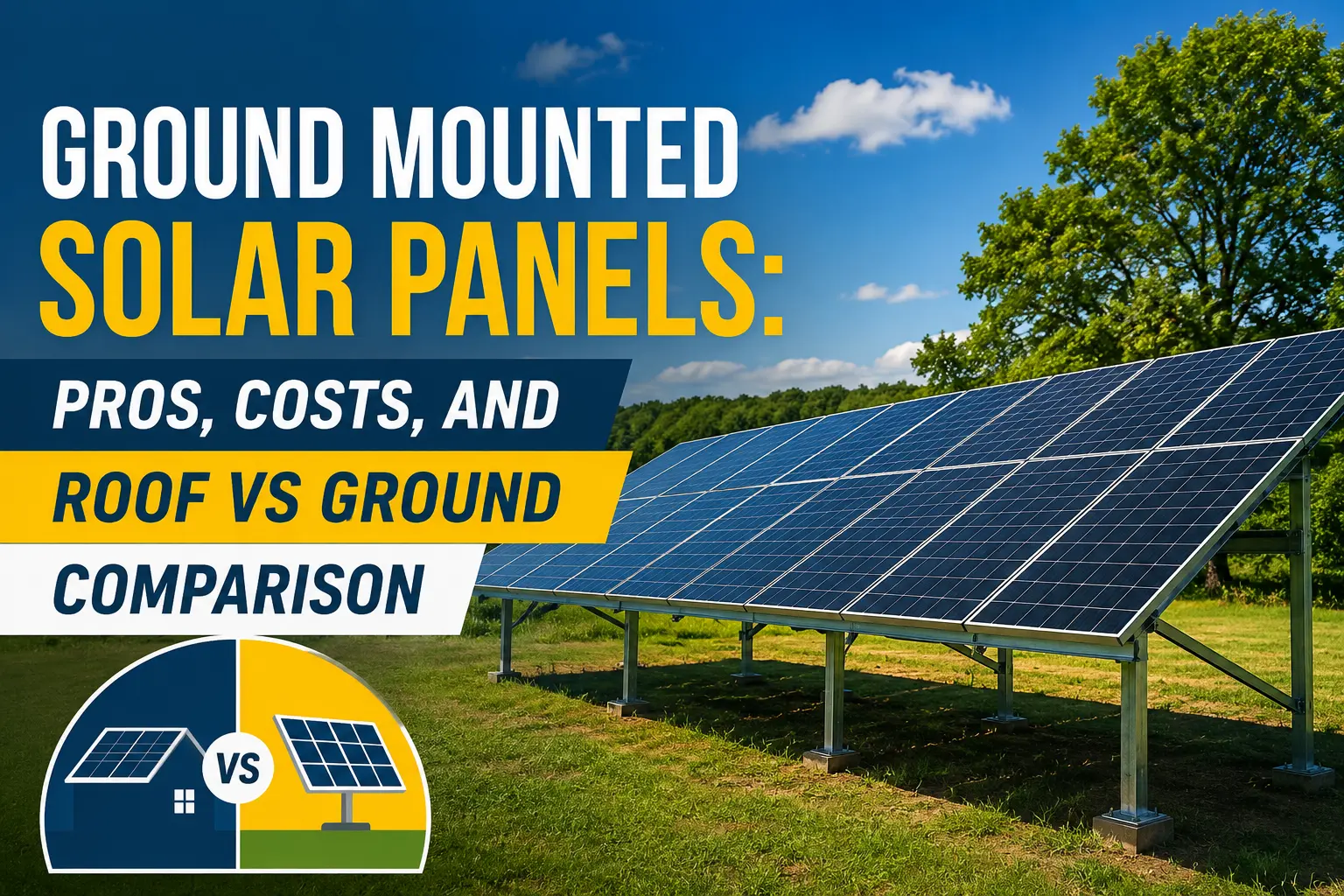
Ground mounted solar panels are solar energy systems installed directly into the ground instead of being attached to a roof.
These systems use steel or aluminum framing structures that securely support the photovoltaic panels while positioning them for sunlight exposure.
Unlike rooftop systems, ground-mounted solar arrays can often be installed in the most optimal location on the property rather than being limited by roof shape, slope, or direction.
Ground-mounted solar systems are commonly used for:
There are two primary types of ground-mounted systems.
Fixed-tilt systems remain stationary at a set angle throughout the year.
These are the most common systems because they are simpler and generally more cost-effective.
Solar tracking systems automatically adjust throughout the day to follow the sun.
This may improve energy production but usually increases installation and maintenance costs.
One of the most common questions people ask is whether solar panels should be installed on the ground or on the roof.
The answer depends on factors such as available land, roof condition, energy goals, sunlight exposure, and budget.
For some homes and businesses, rooftop solar is the practical choice.
For others, a ground-mounted system may provide better long-term performance and flexibility.
| Feature | Ground Mounted Solar | Rooftop Solar |
| Installation Flexibility | High | Limited by roof design |
| Sunlight Optimization | Can be positioned ideally | Depends on roof angle and direction |
| Maintenance Access | Easier access | Harder to access |
| Roof Penetration | None | Usually required |
| Expansion Potential | Easier to expand | Limited by roof size |
| Space Requirements | Requires open land | Uses existing roof space |
| Cooling and Airflow | Often improved airflow | Less airflow beneath panels |
| Visibility | More visible on property | Less noticeable from ground level |
Ground-mounted systems can be especially beneficial when:
SEE WHICH SOLAR OPTION IS RIGHT FOR YOU
Ground mounted solar panels offer several advantages for both residential and commercial properties.
Because the panels are not restricted by roof layout, they can often be placed at the ideal angle and direction for sun exposure.
This may improve overall energy production compared to some rooftop systems.
Ground-mounted systems are easier to access for:
This can simplify long-term system upkeep.
Some roofs are not ideal for solar due to:
Ground-mounted systems avoid many of these issues.
If your energy needs increase over time, expanding a ground-mounted system is often easier than adding panels to a crowded roof.
Ground-mounted solar panels may experience better airflow underneath the array, which can help reduce heat buildup and improve efficiency.
Ground-mounted systems also come with a few important considerations.
Ground-mounted solar systems often cost more upfront because they may require:
You need enough open land with good sun exposure to support the installation.
Trees, shading, terrain, and setbacks can affect placement.
Some municipalities have local zoning requirements or restrictions related to:
Unlike rooftop systems, ground-mounted arrays are visible on the property, which may affect aesthetics for some homeowners.
The total cost of a ground-mounted solar system depends on several factors, including:
In many cases, ground-mounted systems cost more upfront than rooftop systems because of the additional labor and structural materials involved.
However, some homeowners and businesses feel the added flexibility, easier maintenance access, and performance potential justify the investment over time.
Larger commercial solar systems can vary significantly in cost depending on:
The amount of land required depends on the size of the solar array and the overall system design.
Smaller residential systems may only require part of a backyard or open field, while larger commercial systems may require significantly more space.
Several factors influence land requirements:
Properties with large open areas and strong sunlight exposure typically provide the best conditions for ground-mounted solar.
Ground mounted solar panels for business properties are becoming increasingly common, especially for companies with:
Commercial ground-mounted solar systems are often used by:
| Business Type | Potential Benefits of Ground Mounted Solar |
| Farms | Can utilize open land while helping offset operating costs |
| Warehouses | Supports large electricity demands |
| Manufacturing Facilities | May reduce long-term energy expenses |
| Office Buildings | Can support sustainability and energy goals |
| Industrial Properties | Allows scalable energy production and expansion |
Businesses with limited roof space or roofs occupied by HVAC systems may find ground-mounted solar to be a more practical long-term solution.
Ground mounted solar panels can be worth it for many property owners, especially if:
The overall value depends on several factors, including:
For some properties, a ground-mounted system offers flexibility and scalability that rooftop systems cannot match.
Ground-mounted solar systems often work best on:
They can also be a strong alternative for properties where rooftop solar is less effective because of:
While DIY solar kits are available, ground-mounted solar installations are often more complex than many people realize.
The installation process may involve:
Improper installation can affect safety, performance, and long-term reliability.
Many homeowners and businesses choose to work with experienced solar professionals to help ensure the system is properly designed and installed.
Sunergy Solutions helps homeowners and businesses explore customized solar solutions based on their property layout, energy needs, and long-term goals.
Whether you are comparing solar panels on ground vs roof systems or considering ground mounted solar panels for business use, Sunergy Solutions can help determine the right setup for your property.
From residential systems to larger commercial installations, choosing the right solar design can help maximize long-term efficiency and energy production.
Ground-mounted solar panels can sometimes be more efficient because they can be positioned at the ideal angle and direction for sunlight exposure.
For many homeowners and businesses, ground-mounted solar panels can be worth it if they have enough land and want more flexibility, easier maintenance, or larger energy production potential.
The amount of land needed depends on the size of the system, panel spacing, and local regulations. Smaller residential systems may only require part of a yard, while larger commercial systems may require more space.
Ground-mounted systems can help businesses support large energy demands, utilize available land, and create scalable long-term energy solutions.
Yes. Solar panels can be installed directly on the ground using specially designed mounting systems that securely support the solar array.
Like rooftop systems, ground-mounted solar panels may require occasional cleaning, inspections, and maintenance to help maintain performance over time.
Appointments Available, 7 Days a Week


