
5.0 Rating
Request A Free Estimate
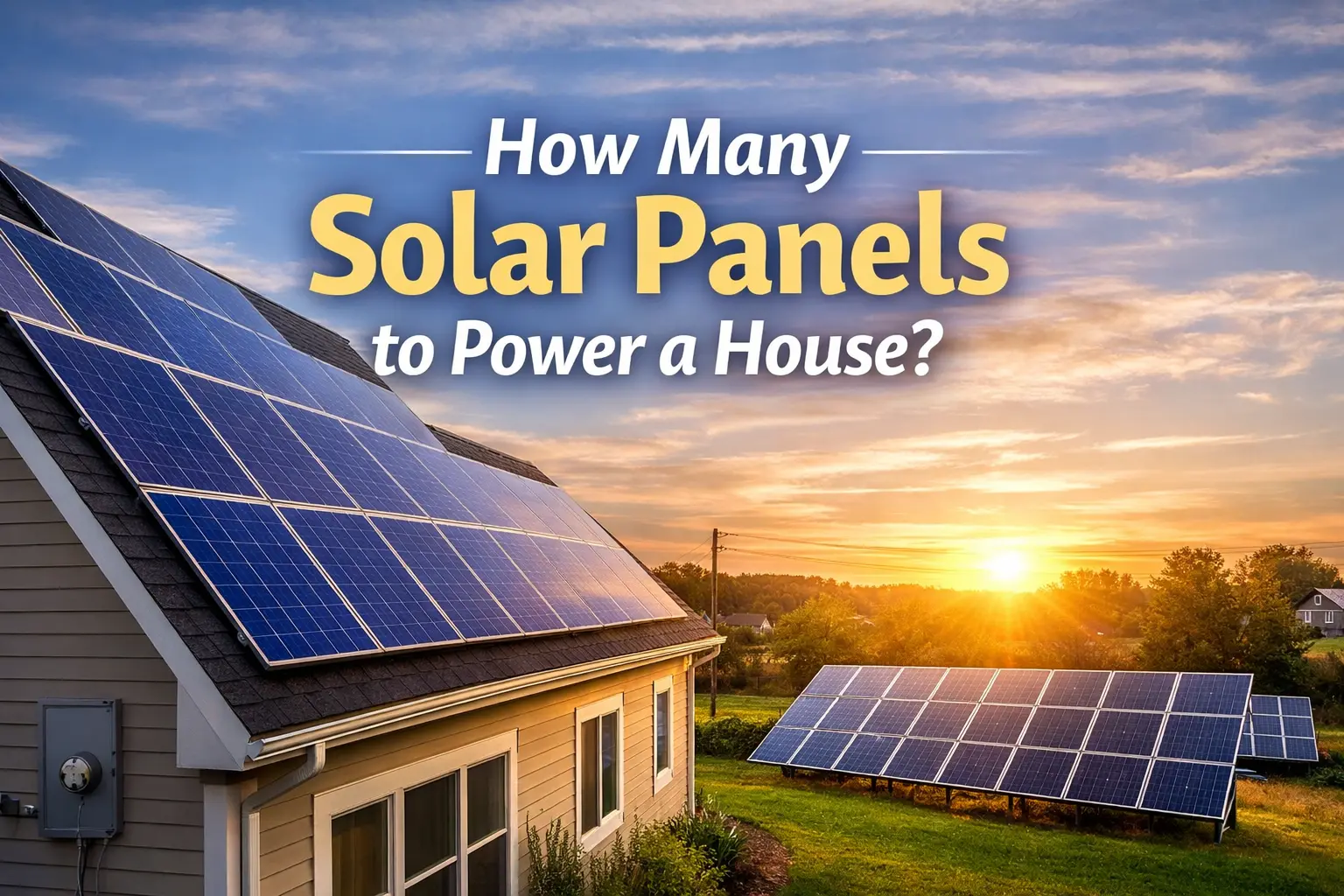
If you’re wondering how many solar panels to power a house, the short answer is that most homes need 15 to 30 solar panels to cover their electricity usage.
However, the exact number of photovoltaic panels you need depends on how much energy your household uses, how much sunlight your roof receives, and the wattage of the solar panels installed.
Most homes need 15 to 30 solar panels to fully power a house, which equals roughly a 6kW to 10kW solar system, depending on electricity usage, panel efficiency, and sunlight exposure.
Rising electricity costs are one of the main reasons homeowners consider switching to solar energy.
Understanding how many panels you need can help you estimate system size, energy savings, and whether solar can meet your household’s needs.
This guide explains how to calculate solar panel requirements, what factors affect the number of panels needed, and real-world examples for different home sizes.
SEE HOW SOLAR POWER CAN MEET YOUR ENERGY NEEDS
Most homes in the United States use about 900 to 1,200 kWh of electricity per month.
With modern solar panels producing around 350–450 watts each, the average household typically needs:
15 to 30 solar panels
or
a 6kW to 10kW solar system
Homes with higher energy usage, electric vehicles, or all-electric heating systems may require more panels.
Most households use between 25 and 35 kWh per day, although energy usage varies based on home size, climate, and appliances.
Daily energy use is important because solar panels generate electricity gradually throughout the day.
A properly sized system ensures enough energy is produced to match your household’s needs over time.
Example:
30 kWh per day × 30 days = 900 kWh per month
This is why many homes fall within the 15–30 panel range.
The number of solar panels needed depends primarily on how much electricity your household uses each year.
Homes using:
Homes with electric heating or EV charging may require additional panels.
A basic formula can help estimate how many solar panels your home may need:
Example:
A home using 10,800 kWh per year with panels producing about 400 watts may need approximately:
Actual numbers vary based on sunlight exposure, roof direction, and shading.
Solar panels typically range between 350 watts and 450 watts.
Higher wattage panels produce more electricity per panel, which can reduce the total number of panels needed.
| Panel Wattage | Efficiency Level | Typical Use |
| 350W | standard efficiency | common residential solar installations |
| 400W | high efficiency | most popular option |
| 425W | premium efficiency | maximizes roof space |
| 450W | very high efficiency | ideal for limited roof area |
Higher wattage panels are often recommended when roof space is limited.
While electricity usage is the most accurate way to estimate panel needs, home size provides a helpful guideline.
| Home Size | Estimated Monthly Usage | Estimated Panels Needed |
| 1,000 sq ft | 600–750 kWh | 10–14 panels |
| 1,500 sq ft | 750–900 kWh | 12–18 panels |
| 2,000 sq ft | 900–1,100 kWh | 15–22 panels |
| 2,500 sq ft | 1,100–1,300 kWh | 18–26 panels |
| 3,000 sq ft | 1,300–1,600 kWh | 22–30 panels |
Energy-efficient homes may need fewer panels even if the square footage is larger.
Your electric bill provides the most accurate estimate of how many solar panels you may need.
| Monthly Electricity Usage | Estimated Solar System Size | Approximate Panels Needed |
| 500 kWh | 4kW system | 10–12 panels |
| 750 kWh | 6kW system | 14–16 panels |
| 1,000 kWh | 8kW system | 18–22 panels |
| 1,250 kWh | 10kW system | 24–28 panels |
| 1,500 kWh | 12kW system | 28–34 panels |
Higher efficiency panels may reduce the number needed.
Let’s take a look at how many solar panels you typically need across some different house sizes:
A 1500 sq ft home typically requires 12 to 18 solar panels, depending on energy consumption.
A 2000 sq ft home often needs 15 to 22 solar panels.
Most 2500 sq ft homes require 18 to 26 solar panels.
Larger homes may need 22 to 30 solar panels or more.
Several factors influence how many solar panels are required to power a home.
Homes with higher electricity consumption need more solar panels.
Large families, electric heating systems, pools, or EV chargers increase energy demand.
Areas with more sunlight require fewer panels to generate the same amount of electricity.
Homes located in CT, MA, ME, NH, RI, VT, and VA typically receive moderate sunlight levels throughout the year, which can slightly affect total system size compared to sunnier regions.
Higher wattage panels produce more electricity per panel, which can reduce the total number needed.
Roof space determines how many panels can be installed.
Roof angle, direction, and shading impact performance.
LED lighting, efficient HVAC systems, and proper insulation can reduce electricity usage.
Many homeowners install solar systems sized to offset 100% of their electricity usage.
This usually requires:
6kW to 12kW solar system
or
15 to 34 solar panels
Actual requirements depend on household energy consumption and local sunlight levels.
Off-grid homes typically require more solar panels because they rely entirely on solar energy instead of the utility grid.
Most off-grid systems require:
Plus battery storage to provide electricity at night or during cloudy weather.
Energy storage plays an important role in determining system size.
Understanding how much electricity appliances use can help estimate solar needs.
| Appliance | Estimated Energy Use | Solar Panels Needed |
| Refrigerator | 150–300 kWh/year | 1 panel |
| Washing machine | 400–500 kWh/year | 1–2 panels |
| Central AC | 3,000+ kWh/year | 6–8 panels |
| Electric water heater | 3,000–4,500 kWh/year | 7–10 panels |
| Lighting | 500 kWh/year | 1–2 panels |
| EV charger | 3,000–4,000 kWh/year | 7–10 panels |
Energy usage varies by appliance model and frequency of use.
Yes, solar panels can power an entire home when the system is properly sized to match electricity usage.
Some homeowners choose systems that offset 100% of electricity consumption, while others install smaller systems to reduce monthly energy costs.
Battery storage can provide backup power during outages and increase energy independence.
The best way to determine how many solar panels your home needs is to evaluate your electricity usage and roof characteristics.
Every home is different, and factors like energy consumption, sun exposure, and panel efficiency all affect system size.
A professional evaluation can provide a precise estimate tailored to your home’s energy needs.
Most homes require between 15 and 30 solar panels to fully power a house. The exact number depends on electricity usage, sunlight exposure, and panel wattage.
Running a home entirely on solar typically requires a system sized to offset 100% of electricity usage, usually between 6kW and 12kW or about 15 to 34 panels.
Ten solar panels may cover part of a home’s electricity usage but usually will not power an entire house unless energy consumption is very low.
Larger homes often use more electricity, which can require more solar panels. However, energy-efficient homes may require fewer panels regardless of size.
You can estimate by dividing annual electricity usage by the yearly output of one solar panel. A professional evaluation provides the most accurate calculation.
Yes, a 10kW solar system is enough to run most homes, especially those using around 900 to 1,200 kWh per month. Larger homes or households with electric heating, pools, or EV charging may require a larger system.
Yes, solar panels can power an air conditioning system. Central air conditioners typically require multiple panels due to higher electricity usage, but a properly sized solar system can run AC during the day and even longer when paired with battery storage.
Solar batteries can be beneficial for storing excess energy, providing backup power during outages, and increasing energy independence. Whether batteries are worth it depends on energy goals and how much backup power is desired.
Appointments Available, 7 Days a Week


