
5.0 Rating
Request A Free Estimate
A residential solar system with battery backup combines solar panels with energy storage to keep your home powered during grid outages while reducing electricity bills year-round.
Key Components:
Main Benefits:
Typical Costs:
The average American home experiences five power outages per year, making backup power more valuable than ever. Modern systems like the Tesla Powerwall 3 can power an entire home and operate in temperatures as low as -20°C, while lithium batteries offer over 6,000 cycles at 95% depth of discharge.
I’m Robert Raffa, CEO and Founder of Sunergy Solutions LLC, and I’ve spent nearly a decade helping Northeast homeowners transition to clean energy through strategic residential solar system with battery backup installations.
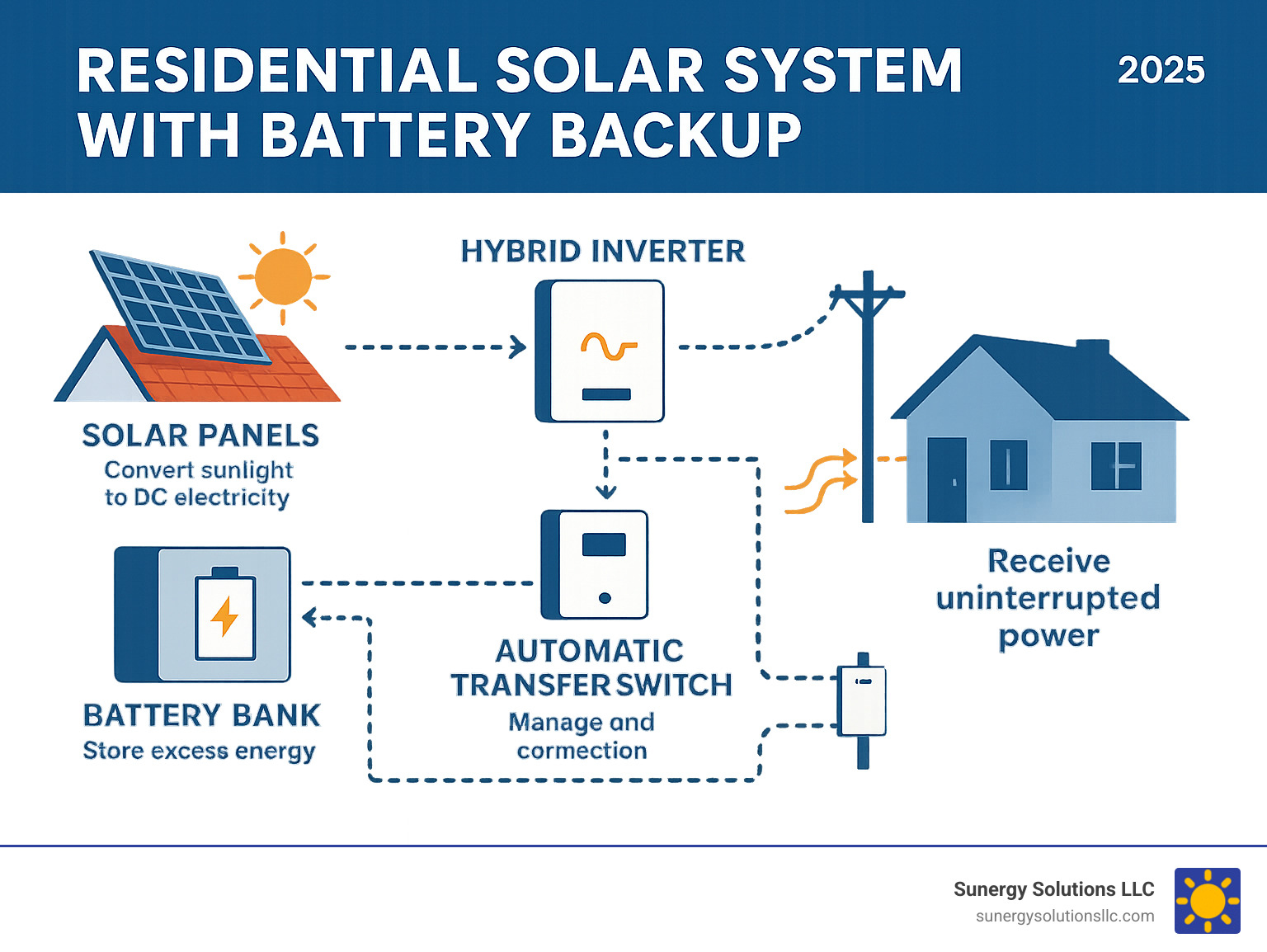
Your residential solar system with battery backup works as your home’s personal power plant. Solar panels convert sunlight into DC electricity through the photovoltaic effect. This DC power flows to a hybrid inverter that converts it to AC power and manages battery charging.
The automatic transfer switch monitors grid power continuously. During normal operation, your house draws power in priority order: solar first, then batteries, then grid backup. When the grid fails, your system detects the outage in milliseconds and seamlessly switches to battery power – often faster than your Wi-Fi router resets.
This bidirectional energy flow enables self-consumption optimization. During sunny days, panels charge batteries while powering your home. At night, batteries take over. Excess production gets sold back through net metering programs.
For more details on solar panel operation, check out our guide on Solar Panels: How They Work and Their Efficiency.
Your solar array contains silicon cells that create an electric field when sunlight hits them. Maximum Power Point Tracking (MPPT) technology constantly adjusts to maximize power output under changing conditions, boosting energy harvest by 15-30%.
During peak sun hours (10 AM to 4 PM), panels often produce more electricity than needed. This excess flows to your battery bank for evening use. A properly sized system can generate enough daytime power to handle most evening energy needs.
DC-coupled systems connect batteries directly to the solar array’s DC side, offering higher efficiency (95-98%) and working well for new installations.
AC-coupled systems connect batteries after the solar inverter, providing better reliability and easier expansion. While slightly less efficient (92-95%), they offer tremendous flexibility for retrofits and future modifications.
For most homeowners, we recommend AC-coupled systems due to their adaptability and easier maintenance. Learn more about battery storage benefits in our article on The Benefits of Solar Battery Storage.
Your residential solar system with battery backup components work together to deliver reliable power and energy savings.
Solar modules convert sunlight to DC electricity with 25-year performance warranties. The hybrid inverter manages power between panels, batteries, home, and grid. A Battery Management System (BMS) monitors cell health and prevents dangerous conditions. Smart meters track energy flow while rapid shutdown devices ensure safety compliance.
For detailed inverter information, see our guide on Solar Inverters: What They Are and Why You Need Them.
Lithium-ion batteries (specifically LiFePO4) deliver over 6,000 cycles at 95% depth of discharge, charge faster, weigh 60% less, and require zero maintenance. A 10 kWh lithium battery provides 9.5 kWh of usable energy and performs well in cold weather.
Lead-acid batteries cost less upfront but typically last only 800 cycles, need regular maintenance, require ventilation, and deliver only about 50% usable capacity due to depth of discharge limitations.
Over 15-20 years, lithium batteries cost 30-50% less per kWh of actual energy delivered despite higher upfront investment.
Modern systems include weather forecasting integration to optimize battery charging before storms, load prioritization to extend backup runtime, and heat mode functionality for cold-weather performance.
Mobile apps provide real-time monitoring and remote control capabilities. Tesla’s heat mode technology is detailed in their Heat Mode White Paper.
For more battery storage insights, explore The Benefits of Solar Battery Storage.
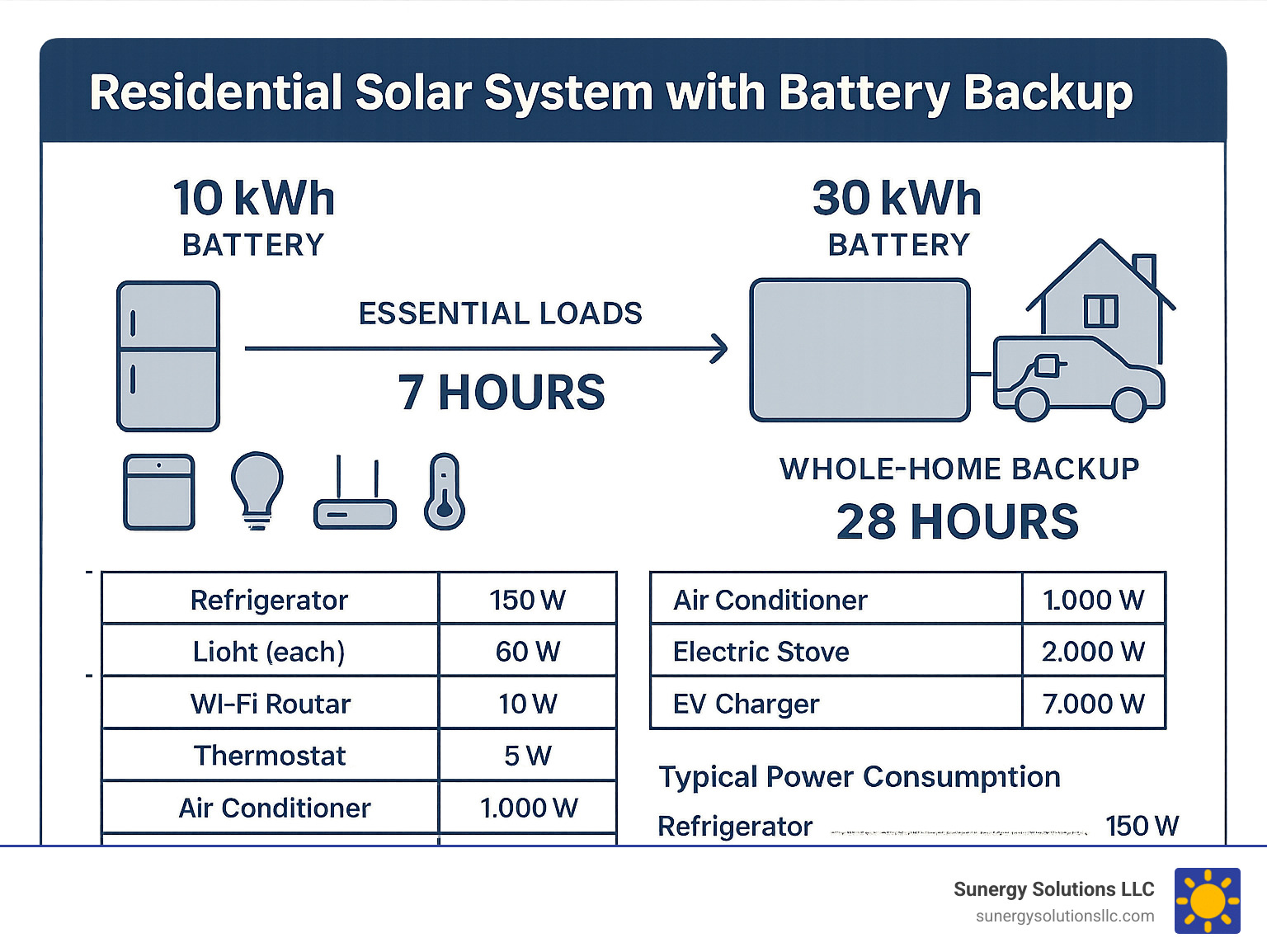
Proper sizing ensures your residential solar system with battery backup meets your needs without overspending.
Essential backup (10-15 kWh) covers refrigerator, lights, Wi-Fi, and heating controls for 7-12 hours. Partial home backup (15-25 kWh) adds conveniences like coffee makers and office equipment for 12-20 hours. Whole home backup (25-40 kWh) powers everything including AC for 20-35 hours.
Budget ranges: $15,000-$25,000 for essential backup, $25,000-$35,000 for partial home, and $35,000-$50,000 for whole home backup (before tax credits).
We start with daily consumption analysis from your utility bills to understand usage patterns. Future load planning considers electric vehicles or heat pumps you might add later.
Inverter sizing handles peak power demands plus 20-30% safety margin. Solar arrays in our service areas produce 1,200-1,400 kWh per kW installed annually. We design arrays for 80-120% of annual consumption.
System costs include equipment ($20,000-$50,000), permits and installation ($3,000-$8,000). Solar loans spread costs over 10-25 years with competitive rates. Payback periods range from 6-12 years with 25-year warranties.
The 30% federal tax credit significantly improves ROI. For financing details, see our guide on Residential Solar System Financing.
A residential solar system with battery backup delivers excellent financial returns alongside environmental benefits.
The federal Investment Tax Credit (ITC) offers 30% tax credit through 2034 – a $9,000 savings on a $30,000 system. State and utility programs add $1,000-$5,000 in additional rebates.
Net metering programs let you sell excess production back to the grid. Property value increases average $4 per watt installed – potentially $24,000 for a 6 kW system. Solar homes sell 20% faster than comparable properties.
Environmentally, the average system eliminates 3-4 tons of CO2 annually, equivalent to planting 75-100 trees yearly. Over 25 years, you’ll prevent 75-100 tons of greenhouse gases.
For complete incentive details, see our guide on Solar Tax Credits and Rebates: What You Need to Know.
Combining net metering with battery storage creates “energy arbitrage” – storing cheap daytime solar energy for expensive evening peak hours. This strategy increases savings by 20-40%.
Grid services programs let your battery participate in virtual power plants, earning $100-$500 annually while improving grid stability. Net metering credits from summer production offset winter bills when solar output decreases.
Learn more in our article: Net Metering: How It Works and Why It’s Important.

Professional installation ensures your residential solar system with battery backup performs flawlessly for decades.
We start with thorough site assessment using drone technology and 3D modeling. We evaluate roof orientation, shading, and electrical panel capacity. Many homes need panel upgrades for safe solar integration.
Installation takes 1-3 days depending on system complexity. We handle all permit drawings, inspection scheduling, and utility interconnection paperwork. System commissioning includes testing every component and training you on system operation.
For installer selection guidance, see our guide: How to Find a Reliable Solar System Installer.
DIY kits might seem cost-effective but leave you responsible for permit drawings, troubleshooting, and warranty issues. Professional installation provides comprehensive warranties and ongoing support.
The cost difference between DIY and professional installation is often smaller than expected when factoring in permits, electrical work, and warranty value.
Lithium batteries last 10-15 years with premium options exceeding 20 years. Quality batteries maintain 80% capacity after 6,000-8,000 cycles.
Temperature control between 60-80°F maximizes battery life. Software updates happen automatically, adding features and improving performance. Annual check-ups and remote diagnostics catch issues early.
When replacement time arrives, you’ll likely access better technology at lower prices, often using replacement as an upgrade opportunity.
A 10 kWh battery powering essential loads (refrigerator, lights, Wi-Fi, heating controls) at 500 watts continuous can run for 16-18 hours after efficiency losses. Runtime varies dramatically based on usage – a 1,500-watt microwave running 10 minutes uses the same energy as your refrigerator running 2 hours.
Lithium batteries provide 80-90% of rated capacity as usable energy, so your 10 kWh battery delivers 8-9 kWh of actual power.
Grid-tied systems connect directly to utilities without batteries, maximizing solar savings but providing no backup power during outages.
Hybrid systems combine grid connection with battery storage – the typical residential solar system with battery backup. You get solar savings plus backup power during outages.
Off-grid systems operate independently from utilities, requiring large battery banks and often backup generators. They’re ideal for remote properties but cost significantly more.
Hybrid systems offer the best balance for most homeowners – maximum savings with energy security.
Modular battery systems like Tesla Powerwall allow expansion in 5-15 kWh increments. You can typically add 2-3 additional batteries to reach 40+ kWh total capacity.
Your inverter capacity may limit expansion – oversized inverters during initial installation accommodate future growth. Electrical panel space and installation area also affect expansion options.
Planning for expansion during initial installation is most cost-effective, though modular systems make later additions much easier than full system replacement.
A residential solar system with battery backup delivers peace of mind during outages while slashing monthly electricity bills. With the 30% federal tax credit through 2034, most homeowners start saving immediately.
At Sunergy Solutions LLC, we’ve perfected residential solar system with battery backup installations across Maine, Massachusetts, New Hampshire, Rhode Island, Vermont, Montana, and Virginia. Our systems handle regional challenges from cold winters to summer storms.
The numbers are compelling: 6-12 year payback periods, 25-year warranties, and 30+ year system lifespans mean 15-20 years of essentially free electricity. Add increased property values and environmental benefits, and solar battery backup becomes an obvious investment.
Ready for energy independence? Visit our Solar Energy Storage Systems for Your Home: A Bright Future page to schedule your free consultation today.
Don’t wait for the next outage. Contact Sunergy Solutions LLC today and find how a residential solar system with battery backup can transform your home into an energy fortress.

Appointments Available, 7 Days a Week


