
5.0 Rating
Request A Free Estimate
Rhode Island solar panel incentives offer some of the most generous savings in the country, helping homeowners save an average of $4,842 on installation costs while earning money from their solar production for decades.
Quick Answer: Top Rhode Island Solar Panel Incentives for 2025:
With Rhode Island’s electricity rates running more than 21% higher than the national average, these incentives help offset rising energy costs while providing long-term savings. The average 5 kW solar system costs $16,140 before incentives but can save homeowners about $130,355 over 25 years.
The key is understanding how to combine multiple incentive programs effectively. Some programs like the REG feed-in tariff actually pay you more than your utility charges – up to 33.85 cents per kWh compared to the average retail rate of 19 cents per kWh.
I’m Robert Raffa, CEO and Founder of Sunergy Solutions LLC, and I’ve helped hundreds of Rhode Island homeowners steer Rhode Island solar panel incentives over the past decade as a solar energy entrepreneur. My background in investment banking helps me ensure every client maximizes their solar ROI through strategic incentive planning.
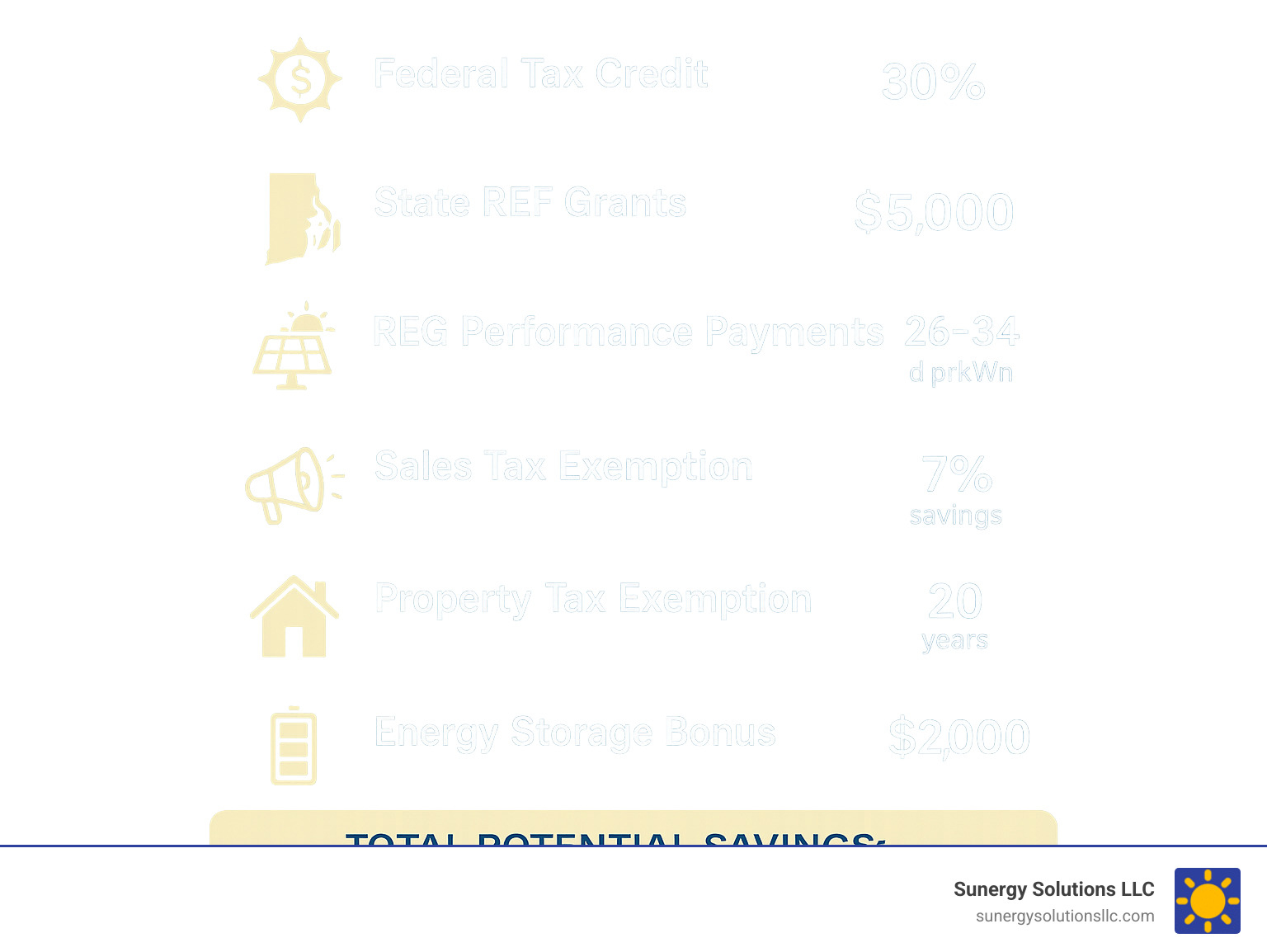
Rhode Island homeowners are sitting pretty when it comes to solar savings. The Ocean State has created one of the most generous Rhode Island solar panel incentives packages in the country, and honestly, it’s like getting paid to go green.
Think of it as a layered cake of savings. You’ve got your federal tax credit as the foundation, state grants for the filling, performance payments as the frosting, and tax exemptions as the cherry on top. Each layer works together to make solar not just affordable, but genuinely profitable.
The beauty of Rhode Island’s approach is that most of these incentives can be combined. While some states make you choose between programs, Rhode Island lets you stack them up like building blocks. The Federal Solar Investment Tax Credit pairs perfectly with REF grants, REG program payments, and tax exemptions to create substantial savings.
Let me walk you through each program so you can see how they work together. For the complete details on state funding, check out the Rhode Island Renewable Energy Fund (REF).
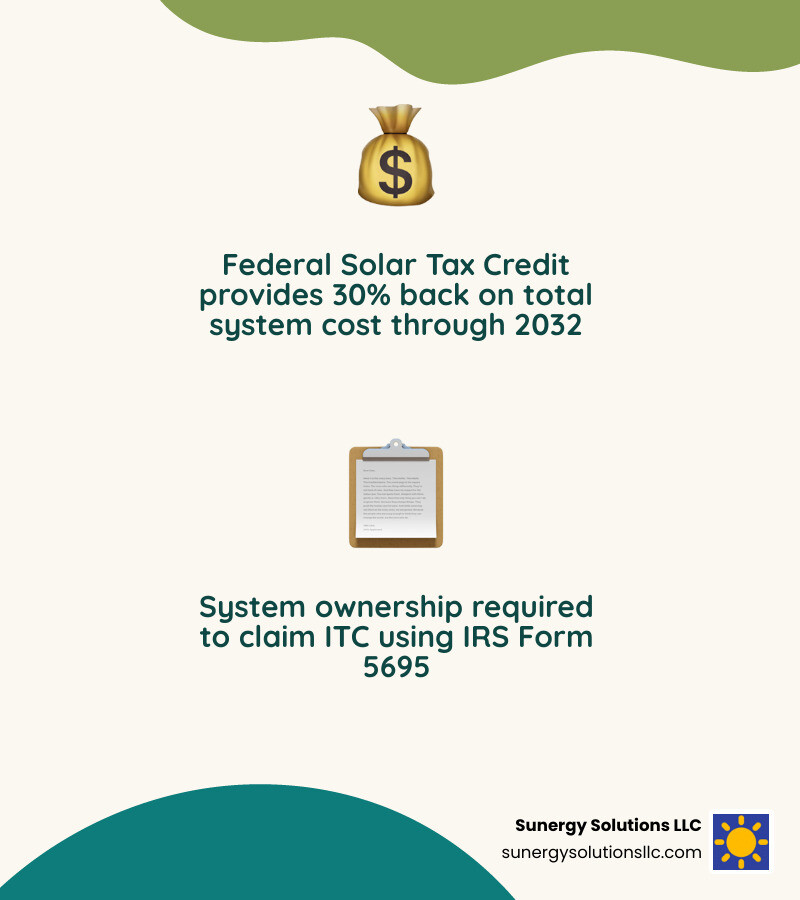
The Federal Solar Investment Tax Credit is your biggest single source of savings, and it’s available to every Rhode Island homeowner who owns their solar system. Now officially called the Residential Clean Energy Credit, this program gives you 30% of your total solar investment back as a dollar-for-dollar credit on your federal taxes.
Here’s what makes this credit so valuable: it covers everything. Equipment costs like panels and inverters, installation costs including labor and permits, even battery storage systems. If it’s part of your solar project, the ITC covers 30% of it.
System ownership is the key requirement here. You can’t claim the credit if you lease your panels or sign a power purchase agreement. But when you own your system, you file IRS Form 5695 with your tax return for the year your system goes live, and the credit is yours.
The math is straightforward. On Rhode Island’s average system cost of $16,140, you’ll get $4,842 back from Uncle Sam. And if your tax bill isn’t big enough to use the whole credit in one year? No problem – you can roll the unused portion forward to future tax years.
Rhode Island doesn’t stop at federal incentives. The state runs its own programs through the REF program and REG program, each designed to make solar even more attractive for homeowners.
The REF Small Scale Solar program puts cash directly in your pocket upfront. You get $0.65 per watt of solar capacity installed, with a $5,000 maximum per project. For most residential systems, this means you’ll hit that maximum and get the full $5,000 back.
Enrollment periods happen quarterly, and funding is limited, so timing matters. Your installer handles the application process, but spaces fill up fast during each enrollment window. Direct ownership is required – just like with the federal credit, you need to own your system to qualify.
The program also includes energy storage incentives. Add a battery system to your solar installation, and you can grab an additional $2,000 on top of your solar grant.

What really sets Rhode Island apart is how these programs work together. You can claim the federal tax credit, receive the REF grant, and still qualify for the performance-based programs we’ll cover next. It’s this stacking ability that makes Rhode Island solar panel incentives so powerful for homeowners looking to maximize their solar investment.
Here’s where Rhode Island solar panel incentives get really exciting. The Renewable Energy Growth (REG) Program is honestly one of the best-kept secrets in American solar. While most states just let you offset your electric bill, Rhode Island actually pays you to produce clean energy—often at rates higher than what you’d pay the utility company.
Think of the REG program as becoming a mini power plant owner. Instead of just reducing your monthly electric bill, you’re getting paid like a solar entrepreneur. The state locks you into a feed-in tariff contract for 15-20 years, guaranteeing you’ll receive 26.15 to 33.85 cents per kilowatt-hour for every bit of electricity your panels produce.
Here’s the math that makes this so attractive: Rhode Island Energy charges you about 19 cents per kWh when you use electricity. But through REG, they’ll pay you up to 33.85 cents for the same kWh your solar panels generate. That’s nearly double!
The performance payments arrive monthly, creating a steady income stream that many of our clients describe as their “solar paycheck.” Over a 20-year contract period, this can add up to substantial savings—often tens of thousands of dollars more than traditional net metering.
For complete program details and current enrollment status, check out the Renewable Energy Growth (REG) Program page.
The catch? Enrollment capacity is limited. Rhode Island Energy only accepts a certain amount of new REG participants each year, so timing matters. We help our clients steer these enrollment periods to secure their spot.
Choosing between net metering and the REG program is probably the biggest decision you’ll make about your Rhode Island solar panel incentives strategy. Both are excellent options, but they work completely differently.
Net metering is the traditional approach most people think of with solar. Your panels power your home first, and any excess generation gets sent to the grid. Rhode Island Energy gives you credit at the retail rate (about 19 cents per kWh) for up to 125% of your annual usage. These credits roll over month to month, so your summer production can cover winter utility bills.
The REG program flips this completely. You’re essentially selling all your solar production to Rhode Island Energy under a long-term contract, while still buying your household electricity at regular rates. It’s like owning a small solar farm that happens to be on your roof.
Net metering works best if you want immediate bill relief and maximum flexibility. You can move, sell your home, or change your mind without contract obligations. Plus, you can still grab that REF grant for upfront savings.
REG makes more sense if you’re planning to stay put for the long haul and want to maximize your total financial return. The program comparison is pretty straightforward: REG typically generates more money over time, while net metering provides more immediate bill offset.
The enrollment capacity for REG fills up quickly each year, so if you’re leaning that direction, don’t wait too long to make your decision. We track the enrollment windows and can help you secure your spot when applications open.
Here’s where Rhode Island solar panel incentives get really exciting—the state basically says “we won’t tax your smart decision to go solar.” And honestly, that’s a refreshing change from the usual tax story.
Rhode Island waives its 7% sales tax on all solar equipment and installation costs. That means on a typical $16,000 system, you’re saving about $1,120 right off the bat—no forms to fill out, no hoops to jump through.
Your installer handles everything at the point of sale. It’s one of those rare government programs that actually makes your life easier instead of more complicated.
You can find the official details in the Rhode Island Sales Tax Exemption statute, but the bottom line is simple: solar equipment = no sales tax.
This one’s a real gem. For 20 full years, you won’t pay a penny of extra property tax on the increased home value from your solar system—even though solar typically adds about 4% to your home’s value.
Think about it: a typical 6 kW system can boost your home value by around $15,000, but your property tax bill stays exactly the same. That’s real money staying in your pocket year after year.
The process is refreshingly straightforward too. Just provide proof of installation to your town assessor, and you’re all set. The Rhode Island Property Tax Exemption law handles the rest automatically.
Rhode Island is betting big on battery storage—and they’re willing to pay you to join the party.
The REF Storage Adder gives you an extra $2,000 grant when you add a battery system to your solar installation through the REF program. It’s like getting paid to have backup power during outages.
But here’s where it gets really interesting: the Connected Solutions Program turns your battery into a mini power plant. You earn $225 per kW of battery capacity each summer—that’s roughly $1,000 per year for a typical home battery system.
How does it work? During peak demand times (think hot summer afternoons when everyone’s cranking their AC), the utility can tap into your stored solar energy. Don’t worry—your lights stay on and your beer stays cold. The system is smart enough to keep what you need while helping stabilize the grid.
The best part? You can stack this program with the REF grant, federal tax credit, and both tax exemptions. It’s like hitting the incentive jackpot.
Getting your Rhode Island solar panel incentives doesn’t have to be complicated. Think of it like getting a driver’s license—there are steps, but once you know what they are, it’s pretty straightforward.
The good news? You don’t have to steer this alone. When you work with a qualified installer like us at Sunergy Solutions LLC, we handle most of the heavy lifting for you.
Here’s how the process typically unfolds:
First, we’ll meet with you to design your perfect solar system and determine which incentive programs make the most sense for your situation. Every home is different, and so is every incentive strategy.
Next comes the REF Grant application. This is where timing matters—CommerceRI opens enrollment quarterly, and funds are limited. We submit your application during these windows and wait for approval before starting any work. No approval means no grant, so we make sure everything is buttoned up tight.
Once we get the green light, we handle all the permits and inspections. Rhode Island has streamlined this process quite a bit over the years, but there’s still paperwork involved. We coordinate with your local building department and utility company to get everything approved.
If you’re choosing the REG Program, we’ll enroll you during the annual enrollment window (usually in April). This program has its own capacity limits, so early application is key to securing your spot.
The federal tax credit is the easiest part—just keep all your receipts and work with your tax preparer to file IRS Form 5695 when tax season rolls around. The credit applies to the year your system goes live, not when you sign the contract.
For battery storage systems, we’ll help you enroll in the Connected Solutions Program. This adds a nice annual income stream and helps the grid stay stable during peak demand periods.
You can learn more about our complete residential solar services at More info about residential solar services.
The documentation you’ll need includes your system specifications, purchase agreements, installer certifications, proof of payment, and the various program application forms. Don’t worry—we’ll walk you through exactly what’s needed and when.
The key eligibility requirement across most programs is direct ownership of your solar system. Leased systems typically don’t qualify for state incentives, though they may still be eligible for some federal programs.
Solar savings shouldn’t be limited to families with deep pockets. Rhode Island recognizes this and has created pathways for everyone to benefit from clean energy.
The Affordable Solar Access Pathways (ASAP) initiative is designed specifically for households that might not qualify for traditional solar financing. Through partnerships with companies like PosiGen, the program offers $0-down solar options with simplified approval processes.
Income qualifications vary, but generally, if you’re at or below certain income thresholds or live in designated environmental justice communities, you may qualify. These programs often include energy efficiency upgrades alongside solar installation, giving you even more ways to cut your energy costs.
The beauty of these programs is that they often combine affordable financing options with many of the same incentives available to other homeowners. You’re not getting a lesser deal—you’re getting the same great technology with payment terms that work for your budget.
To apply, you can work through program partners or contact the Rhode Island Office of Energy Resources directly. We’re also happy to help you explore these options and connect you with the right resources.
Let’s get down to the numbers that really matter—your wallet. When you combine all the Rhode Island solar panel incentives, the math becomes pretty compelling.
Here’s what a typical 5 kW solar system looks like in Rhode Island:
Starting at $16,140 for the average system, you’ll immediately see significant savings through multiple incentive programs. The Federal ITC knocks off $4,842 right away (that’s 30% back), while the REF grant adds another $3,250 to your savings ($0.65 per watt). Don’t forget the sales tax exemption saving you $1,130—money you never have to pay in the first place.
Your net cost after incentives drops to around $6,918. That’s less than half of what you started with, and we haven’t even talked about the long-term benefits yet.
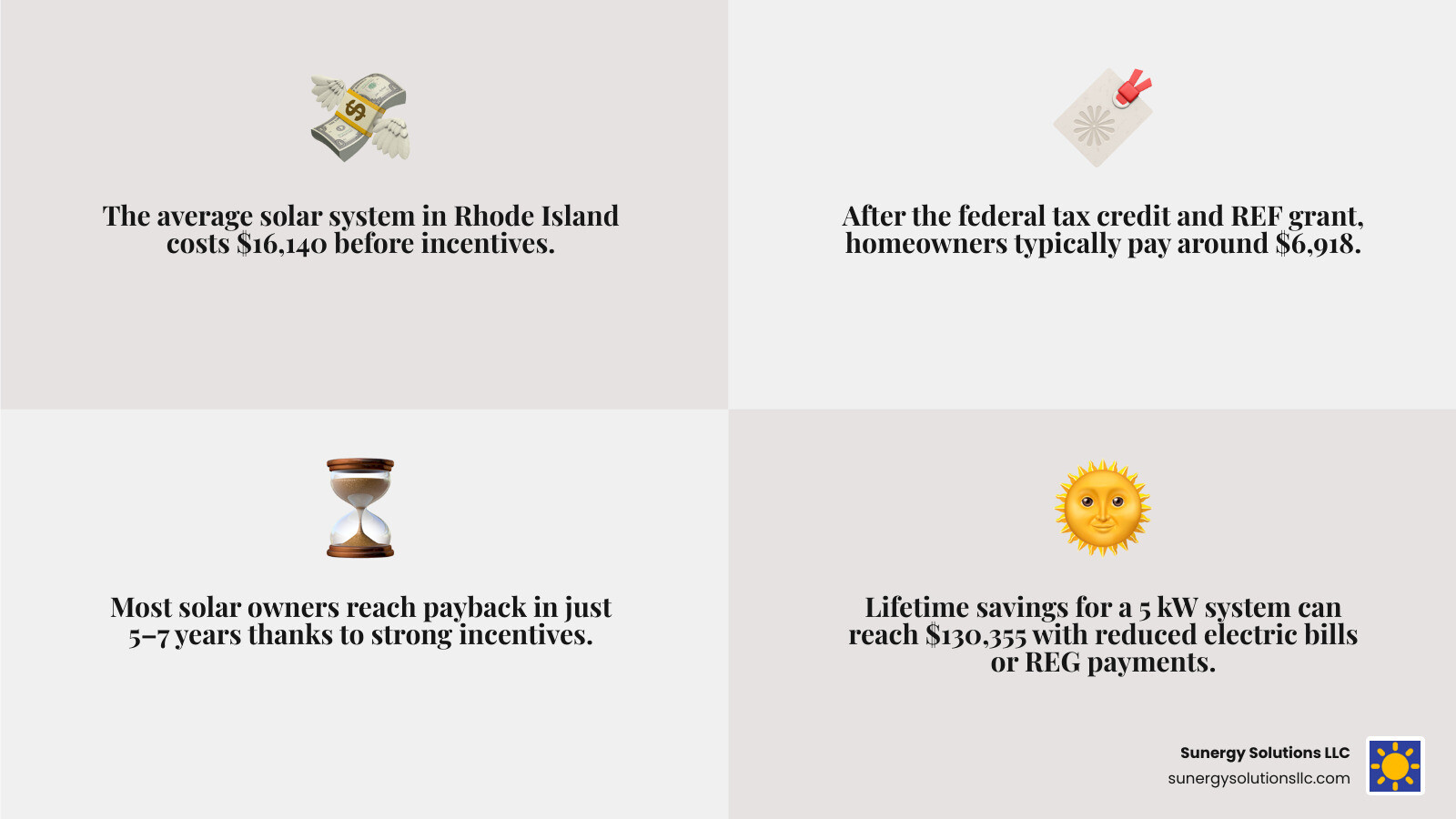
The real magic happens over the next 25 years. Most Rhode Island homeowners save about $130,355 over the lifetime of their solar system. That’s a combination of eliminated electric bills, REG performance payments, and protection against rising electricity rates.
Your payback period typically runs 5-7 years, depending on which incentive programs you choose and your energy usage. After that? It’s pure profit in your pocket.
If you go with the REG program instead of traditional net metering, you could earn $1,500-$2,000 per year in performance payments alone. Many of our clients tell me their REG checks are actually higher than their old electric bills used to be. Now that’s what I call a good investment.
The property tax exemption adds another layer of value. Your home’s value increases by about 4% (roughly $15,000 for a typical installation), but you won’t pay a penny more in property taxes for 20 years. It’s like getting a free home improvement that actually pays you back.
Let’s tackle the questions I hear most from Rhode Island homeowners considering solar. These answers will help you steer the incentive landscape with confidence.
Absolutely! This is where the magic happens—and where Rhode Island really shines compared to other states. Most homeowners successfully stack the federal ITC, state REF grant, sales tax exemption, property tax exemption, and battery storage bonuses all together.
Here’s a real example: On a typical $16,140 system, you’d get the 30% federal credit ($4,842), plus the REF grant (up to $5,000), plus sales tax savings ($1,130), plus no property tax increases for 20 years. That’s over $11,000 in combined savings right there.
The one big exception: You can’t combine the REF grant with the REG feed-in tariff program. Think of it as choosing between upfront cash (REF) or long-term monthly payments (REG). Both are great options—just different strategies for maximizing your Rhode Island solar panel incentives.
If you add battery storage, you can still stack the $2,000 REF storage adder with the Connected Solutions program that pays you $225 per kW annually. It’s like getting paid twice for the same battery!
Don’t worry—you won’t be drowning in paperwork. Most of the heavy lifting gets handled by your installer (that’s us!), but here’s what you should expect:
For the federal tax credit, you’ll need IRS Form 5695 (we’ll help you understand it), your final invoice showing total system cost, and basic system specifications. Keep everything in a folder—you might need it for years to come if you carry over unused credits.
For state programs like REF or REG, your installer submits most applications directly. You’ll sign project agreements, provide proof you own your home, and share basic utility account information. The state wants to make sure you’re eligible and that the system meets their technical requirements.
For battery programs, there are utility enrollment forms and equipment specifications, but again—your installer handles the technical details. You just sign on the dotted line.
Pro tip: Take photos of your completed installation and keep digital copies of all paperwork. It makes everything easier down the road.
This is a big one, and frankly, it’s why I usually recommend ownership over leasing in Rhode Island—our incentives are just too good to pass up.
The federal tax credit only works if you own your system. No ownership means no 30% credit, which is typically the biggest single incentive available. Leasing companies claim the credit themselves, which is part of how they make their business model work.
State grants through REF also require direct ownership. You can’t get that $5,000 grant if you’re leasing panels from a third party. Same goes for the REG program in most cases—though some larger developers can participate with special arrangements.
The exception is Rhode Island’s ASAP program for qualifying low-income households. This program specifically offers affordable leases and power purchase agreements as a way to make solar accessible when upfront ownership isn’t realistic.
Tax exemptions still apply regardless of ownership structure, since they’re tied to the property and equipment, not who owns the panels.
Bottom line: If you can swing ownership (and most homeowners can with today’s financing options), you’ll capture far more value from Rhode Island solar panel incentives. The numbers usually work out much better in the long run.
The Ocean State truly lives up to its reputation as a leader in renewable energy, offering some of the most comprehensive Rhode Island solar panel incentives in the nation. When you combine the federal tax credit, state grants, performance payments, and generous tax exemptions, you’re looking at savings that can transform your energy future.
Think about it: you could cut your upfront costs by thousands through the REF grant and federal tax credit, then earn money every month for the next 15-20 years through the REG program. Or choose the traditional net metering route and watch your electric bills shrink to nearly nothing. Either way, you’re protecting yourself from rising electricity costs while doing something great for the environment.
What makes Rhode Island special isn’t just the generous incentives—it’s how well they work together. The 7% sales tax exemption saves you money at purchase, the property tax exemption protects your investment for 20 years, and programs like Connected Solutions can put extra cash in your pocket if you add battery storage.
I’ve seen how these programs change lives. Homeowners who were skeptical about solar are now energy independent, earning checks from their utility company instead of paying them. The average savings of $130,355 over 25 years isn’t just a number—it’s college tuition, retirement security, or simply peace of mind.
At Sunergy Solutions LLC, we’ve helped hundreds of Rhode Island families steer these incentive programs and maximize their solar investment. We handle all the paperwork, coordinate with the state programs, and make sure you capture every available dollar.
The best part? Most of these incentives have limited funding or enrollment periods, so the sooner you act, the more you can save. Rhode Island’s commitment to renewable energy means these programs are designed to work for you—but only if you take advantage of them.
Ready to start your solar journey in the Ocean State? Our team is here to design a system that maximizes your incentives and delivers the savings you deserve.
Learn more about Rhode Island solar installation services
Questions about any of these incentive programs? We’re always here to help Rhode Island homeowners make the most of their solar investment. Let’s harness the power of the sun—and these incredible incentives—together!

Appointments Available, 7 Days a Week


