
5.0 Rating
Request A Free Estimate
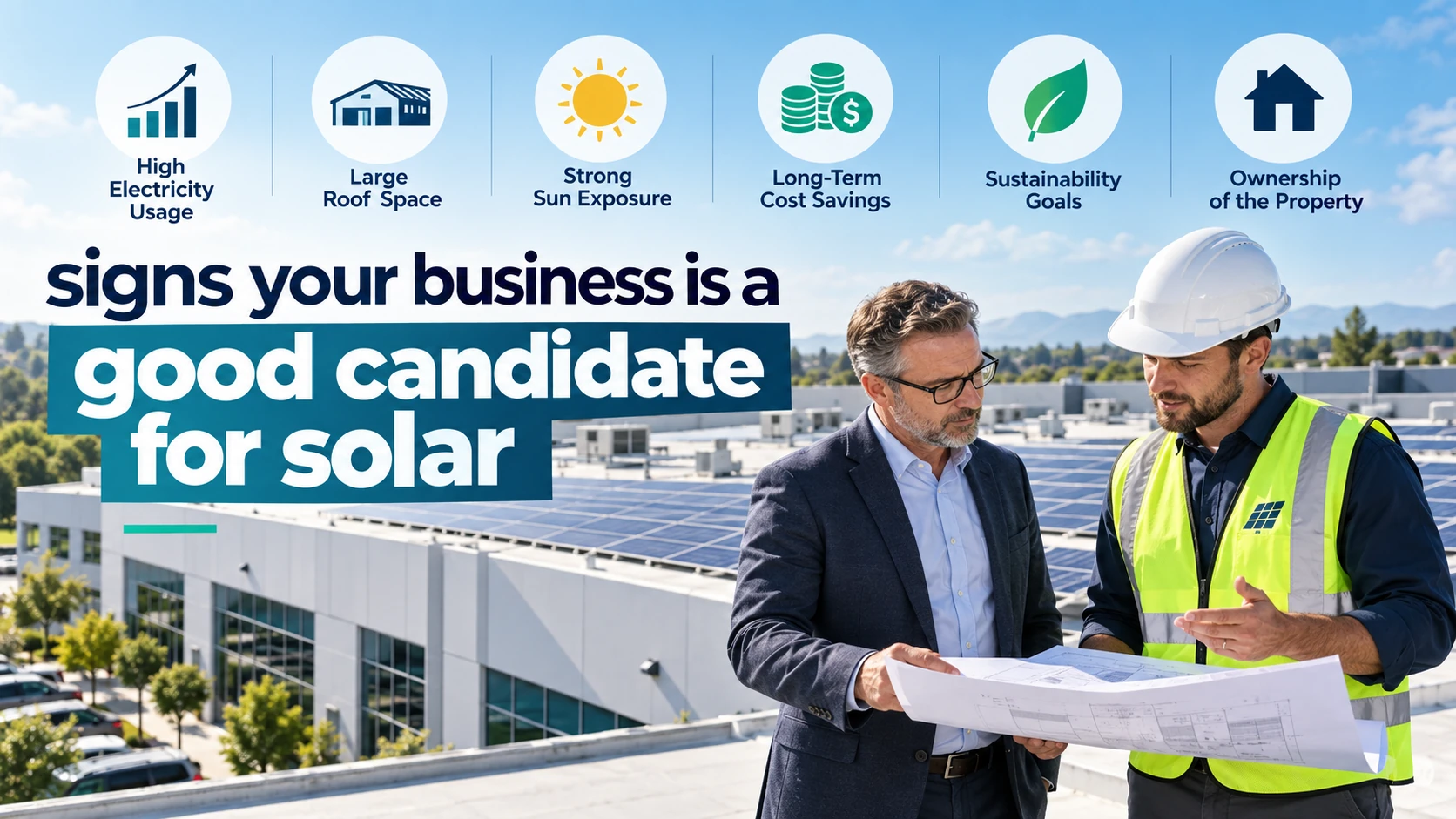
Your business may be a good candidate for solar if your roof has open, unshaded space and years of life left, your electricity use peaks during the day, your bills keep climbing, and you can actually use the federal tax credit.
States across the Northeast add their own incentives on top of that.
Sunergy Solutions helps businesses across the region check these signs before committing to a system.
A business is a good candidate for solar when it has enough sun-exposed roof or land space, a roof built to last as long as the panels, daytime electricity use, rising utility costs, and the ability to claim available tax incentives.
The more of these signs that apply, the stronger the case for going solar.
If you own or manage a commercial building, you’ve probably wondered whether solar panels actually make sense for your operation.
The honest answer depends on a handful of specific factors, not a gut feeling.
Below are nine signs that tend to show up together in businesses that get real value from solar.
You don’t need every single one to make the switch, but the more boxes you check, the better your payback period and return on investment will likely look.
This guide focuses on commercial buildings across Connecticut, Massachusetts, Maine, New Hampshire, Rhode Island, Vermont, and Virginia, where electricity costs and state-level incentives can swing the math significantly.
Solar panels need open, unobstructed space, and your roof needs to be strong enough to hold them.
As a general rule of thumb among installers, most commercial systems need roughly 100 square feet of usable roof space for every kilowatt of capacity.
A building with a large, flat, unobstructed roof is usually a better fit than one broken up by HVAC units, skylights, and vents.
Structural capacity matters just as much as square footage.
Older buildings, pre-engineered metal structures, and roofs without as-built drawings often need a licensed engineer to confirm the roof can carry the added weight of a solar array safely.
This is one of the first things our team checks during a commercial solar installation assessment, along with which panel and equipment options fit your roof type.
Your roof is a good match for solar if it has at least 20 to 25 years of useful life left, since most commercial systems carry 25-year manufacturer warranties and are expensive to remove and reinstall.
A roof nearing the end of its life should usually be replaced before panels go on, not after.
The National Roofing Contractors Association found that the average low-slope commercial roof lasts about 17.4 years, which is shorter than the 25 to 30 year lifespan most solar systems are built for.
That gap matters because removing and reinstalling panels to repair or replace a roof underneath them is costly and disruptive.
If your roof is newer or was recently replaced, this sign likely applies to you.
If it’s getting close to the end of its service life, a roof inspection before you move forward with solar can save you from paying for the same work twice.
Solar panels produce the most power when they face south, southeast, or southwest and avoid shade from trees, taller buildings, or rooftop equipment.
A roof that’s shaded for part of the day isn’t automatically disqualified, but it will produce less energy than the same system on a clear, well-oriented roof.
Flat roofs have an advantage here, since panels can usually be angled toward the sun regardless of the building’s orientation.
If your building sits in open space with a clear view of the sky for most of the day, this is a strong sign in your favor.
You can review more about how orientation and output interact on our commercial solar facts page.
A business is well suited for solar when most of its electricity use happens during daylight hours, since that’s when panels actually generate power.
Warehouses, manufacturing plants, retail stores, offices, and cold storage facilities that run equipment during the day tend to get the most value from going solar.
If your operation runs overnight shifts and sits mostly idle during the day, solar alone will offset less of your usage.
Pairing a system with battery storage can shift some of that stored daytime power into the evening, though it adds to the upfront cost.
Most businesses with standard daytime hours, whether that’s a retail storefront, a distribution center, or a professional office, line up well with when solar actually produces.
Rising electricity costs are one of the clearest financial signs that solar is worth considering, since a fixed, predictable solar investment becomes more valuable every time utility rates go up.
Businesses with consistently high or increasing electric bills tend to see the fastest payback.
Commercial electricity rates have not been kind to business budgets.
The national average commercial rate has climbed 33 percent since 2018, and that trend has only picked up speed recently.
That matters more than it might seem.
Faster retail rate growth alone can shrink the average commercial solar payback period from 6.3 years to 4.2 years, without the system producing a single extra watt.
In other words, every rate increase that happens after you go solar works in your favor instead of against you.
If you’ve opened an electric bill in the last year and felt your stomach drop a little, that’s a sign worth paying attention to.
Your business is positioned to benefit from solar incentives if you have enough tax liability to use the federal credit, since the incentive only has value if there’s tax owed to offset it against.
Businesses that start construction by July 4, 2026, or place a system in service by the end of 2027, can lock in the current credit before the rules change.
The federal solar Investment Tax Credit currently covers 30 percent of a commercial system’s installed cost, with a construction start deadline of July 4, 2026, and a December 31, 2027, placed-in-service cutoff to qualify at that level.
Projects that use US-made steel and components, or sit in certain designated energy communities, can add up to 20 percentage points on top of that base rate.
None of this helps if your business doesn’t owe enough in federal taxes to use the credit, which is why it’s worth checking your tax position with your accountant before assuming the math works.
You can carry unused credit back three years or forward up to 22, so a single lean year doesn’t necessarily rule you out.
Our commercial solar incentives page breaks down how these federal credits stack with the state programs covered in Sign 8 below.
Who owns the roof over your head changes the solar math completely.
If you own your building outright, you capture the full benefit of lower electric bills, tax incentives, and any increase in property value a solar system can add.
If you lease, you’ll need your landlord’s approval, and the lease term should realistically outlast the 10 to 15 year point where most systems have paid for themselves.
A short-term lease with an uncertain renewal isn’t a dealbreaker, but it does change how a solar company structures the investment and who ultimately benefits from it.
For some businesses, the deciding factor isn’t the electric bill at all.
If your company has committed to emissions reduction targets, sustainability reporting, or ESG goals that matter to investors, employees, or customers, solar gives you a concrete, visible way to back that up.
It’s one of the few sustainability investments that also lowers a fixed operating cost.
Retailers, manufacturers with supply chain sustainability requirements, and companies trying to attract environmentally conscious talent often find this sign carries just as much weight as the financial ones.
If your business is missing one or two signs, like an aging roof or heavy shading, that usually means a delay rather than a dead end.
Addressing the underlying issue, such as replacing a roof first or trimming back shade-causing trees, can turn a building into a strong solar candidate within a year or two.
A roof close to the end of its life is the most common reason a building isn’t ready yet, and it’s also the most fixable.
Handling a roof replacement before installing solar means you won’t have to remove panels later to deal with leaks or deterioration underneath them.
Heavy shading, low daytime usage, and an uncertain lease are tougher to solve quickly, but they’re worth revisiting as your business, building, or lease terms change.
Figuring out which of these signs apply to your specific building isn’t something you should have to guess at.
Our team evaluates your roof’s condition, structural capacity, and sun exposure, reviews your electricity usage patterns, and walks through which federal and state incentives your business can actually use.
We’ve built that process around commercial solar projects across Connecticut, Massachusetts, Maine, New Hampshire, Rhode Island, Vermont, and Virginia, with 25-year manufacturer warranties and 20-year workmanship warranties backing the installations we complete.
If your roof needs attention first, that’s not a separate headache to outsource elsewhere.
Handling roofing and solar under one roof means one team is accountable for how the two systems work together, rather than two contractors pointing fingers at each other later.
You can read more about Sunergy Solutions and the team behind these installations, or go ahead and reach out to get your building evaluated.
Solar isn’t the right move for every business, but if several of these nine signs sound familiar, it’s worth getting a straight answer instead of guessing.
Sunergy Solutions can tell you plainly whether your building is ready and what it would take to get it there.
Your business generally qualifies if you own the solar system and have enough federal tax liability to use the credit. Projects need to begin construction by July 4, 2026, or be placed in service by December 31, 2027, to lock in the current 30 percent rate, and unused credit can be carried back three years or forward up to 22.
Most commercial systems need roughly 100 square feet of open, unobstructed roof space for every kilowatt of capacity, though the exact number depends on panel efficiency and how much of your roof is clear of vents, HVAC units, and skylights.
Yes, but it’s usually smarter to replace or repair an aging roof before installing panels. Since commercial roofs average around 17.4 years of life while solar systems are built to last 25 to 30 years, fixing the roof first avoids paying to remove and reinstall panels later.
It can still work, but the savings will be smaller since solar only offsets electricity used while the sun is shining. Businesses with mostly overnight or evening usage sometimes add battery storage to shift that power to when it’s needed, though that raises the upfront cost.
You’ll need your landlord’s approval before installing solar, and it helps if your remaining lease term extends well past the point where the system typically pays for itself, usually 10 to 15 years. Shorter or uncertain leases change how the investment should be structured.
Payback periods vary by state, electricity rate, and incentive stacking, but rising commercial electricity rates have been shrinking typical payback windows across the country. Businesses in states with strong net metering or performance incentives, like Massachusetts, Connecticut, and Rhode Island, tend to see faster payback than the national average.
Appointments Available, 7 Days a Week


