
5.0 Rating
Request A Free Estimate
Solar Installation in VT has become one of the smartest financial decisions homeowners can make, with Vermont offering some of the most compelling solar economics in the nation. Here’s what you need to know:
Key Vermont Solar Facts:
– Average system cost: $22,351 after federal tax credit
– Payback period: ~10 years
– 25-year savings: $40,527
– Home value increase: 4.1% (over $15,824 for average Vermont home)
– Federal tax credit: 30% through 2032
Vermont homeowners face electricity rates that are 43% higher than the national average, making solar power 26% more cost-effective compared to other states. Despite receiving only 167 sunny days per year (below the national average of 205), Vermont’s high energy costs and excellent incentive programs create strong solar economics.
The state waives its 6% sales tax on solar equipment and exempts solar installations from property tax increases. Combined with net metering programs offered by all Vermont utilities, homeowners can earn bill credits for excess solar electricity sent to the grid.
I’m Robert Raffa, CEO and Founder of Sunergy Solutions LLC, where I’ve spent nearly a decade helping Northeast homeowners steer Solar Installation in VT projects from initial assessment through long-term performance monitoring. My background in investment banking helps me ensure every solar project delivers both environmental benefits and strong financial returns for Vermont families.
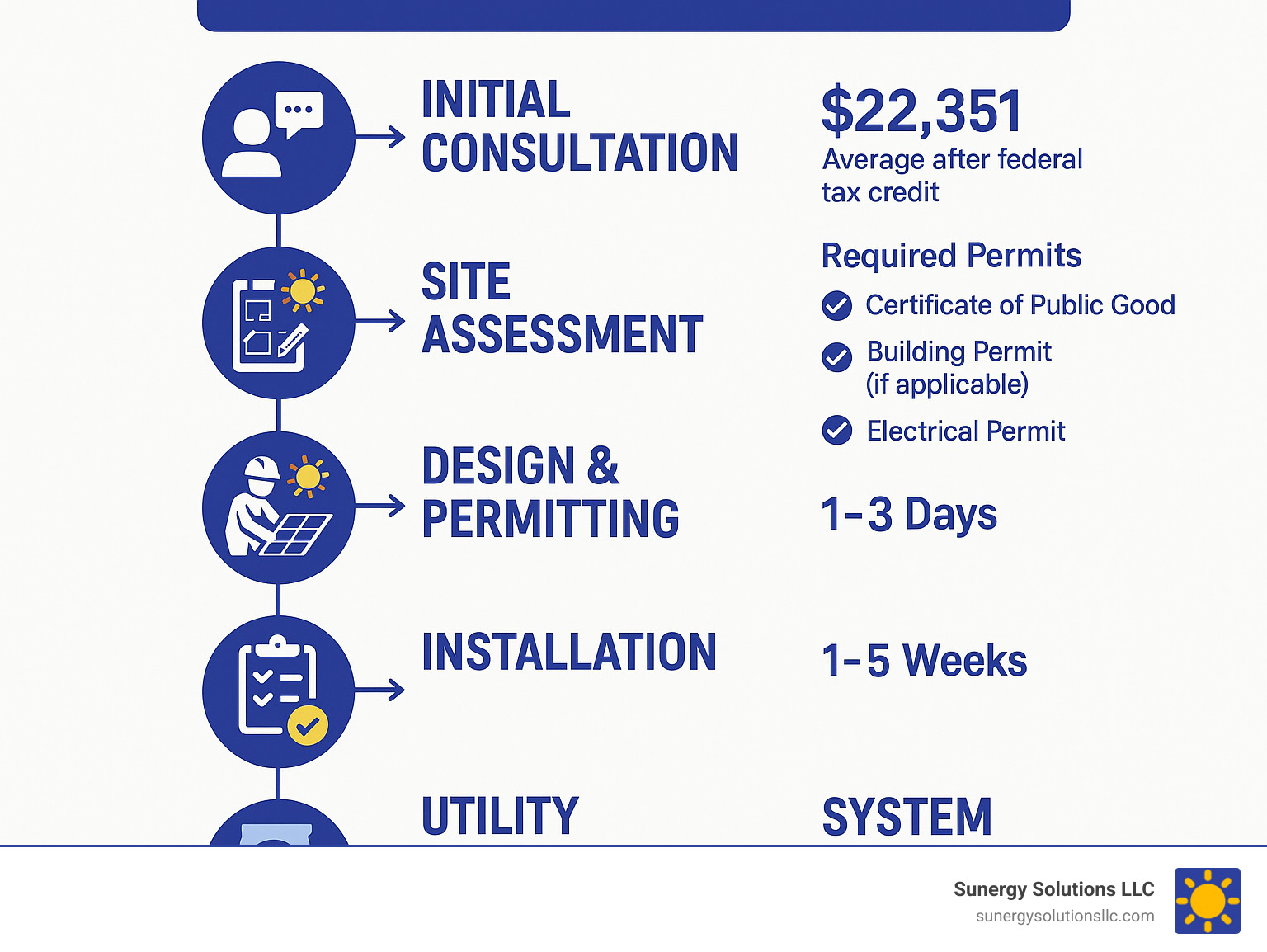
If you’ve been eyeing Solar Installation in VT, 2025 is an excellent time to move forward. The average homeowner saves about $40,000 over 25 years, and current incentives are locked in through 2032.
While Vermont sees just 167 sunny days each year, our 43%-above-average electricity rates turn every kilowatt of sunshine into serious savings. Most systems pay for themselves in roughly 10 years, after which you enjoy 15 – 20 years of power produced at minimal cost.
Vermont sweetens the deal with a 6% sales-tax waiver, a property-tax exemption, and the 30% federal tax credit. All told, an installation can raise your home’s value by 4.1%—about $15,800 for the median property.
Absolutely. Utility rates climb almost every year, but your solar payment—whether cash or loan—remains fixed. Waiting only shortens the time you can collect free power.
Your array supports the state’s goal of 90% renewable electricity by 2050 and fuels local job creation in installation, electrical work, and system maintenance. Cleaner air, stronger grid—everyone wins.

A typical Vermont home needs about a 10.89 kW array, priced near $3.59 per watt—roughly $31,930 before incentives. Apply the 30% federal ITC and your net cost falls to $22,351.
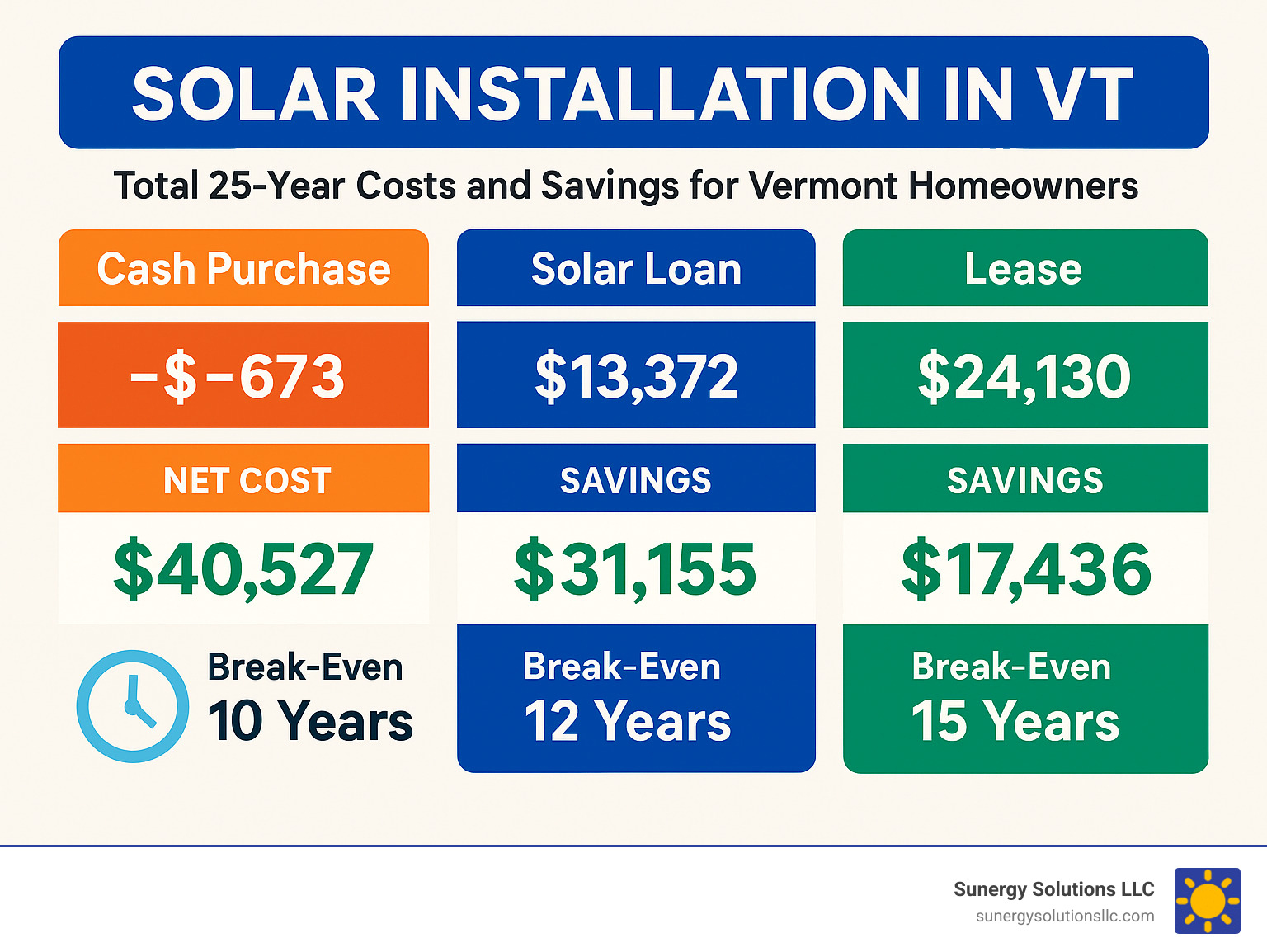
Add Vermont’s 6% sales-tax exemption (≈$1,300) and lifetime property-tax relief, and most systems break even in about 10 years, returning roughly $40,500 over 25 years.
About 60–70% of your outlay is hardware—panels, inverters, mounting. The rest covers labor, permits, and interconnection. Vermont runs a bit higher than the national average due to winter-ready materials, but incentives and high utility rates offset the premium.
Beyond the ITC, Vermont’s tax exemptions plus Green Mountain Power’s Bring Your Own Device battery incentive can shave thousands off project costs. Explore the latest programs in SEIA’s Vermont solar policy guide and our primer on Residential Solar Tax Incentives.
All Vermont utilities credit excess production at the full retail rate. Summer surpluses roll forward to cut winter bills, with a March true-up. Group net metering even lets renters or shaded-roof homeowners join a shared array.

Getting solar panels installed in Vermont typically takes 2-4 months from contract signing to generating your own clean electricity. The actual installation only takes 1-2 days – the rest of that time is spent on paperwork, permits, and waiting for utility approval.
Vermont’s winter weather can add a few weeks to your timeline, which is why many families choose to start their Solar Installation in VT project in spring or summer.
Your solar journey starts with figuring out whether your home is a good fit for solar panels. A quality installer will conduct a comprehensive site assessment that looks at your roof condition, which direction it faces, and what might be casting shadows on it throughout the day.
The best installers use satellite modeling technology combined with an actual visit to your property. This gives them accurate data about your roof’s angle, orientation, and any potential shading issues from trees or neighboring buildings.
Roof orientation matters a lot in Vermont. South-facing roofs typically perform best, but don’t worry if your roof faces east or west – modern high-efficiency panels and power optimizers can still deliver excellent results.
A thorough energy audit examines your past 12 months of electric bills to understand your usage patterns. This analysis helps ensure your system is sized correctly – not too small to meet your needs, and not so large that it exceeds Vermont’s net metering limits.
Looking for the right installer? Our guide on How to Find a Reputable Solar Company covers everything you need to know about choosing a partner you can trust.
Vermont homeowners have several smart ways to pay for their solar installation. Cash purchases offer the highest long-term returns and the simplest ownership experience.
Solar loans have become incredibly popular because they make solar accessible without requiring a large upfront payment. Many Vermont banks and credit unions offer specialized solar financing with competitive rates. Vermont State Employees Credit Union (VSECU) partners with solar installers to provide attractive loan terms, including zero-down options that can deliver immediate monthly savings.
Home Equity Lines of Credit (HELOC) can provide low-cost financing if you have sufficient equity in your home. The interest might even be tax-deductible, making this an attractive option for many homeowners.
Lease and Power Purchase Agreements (PPAs) let you go solar with little or no money down, but they typically provide lower long-term savings compared to ownership options.
A quality solar installation should come with comprehensive warranty coverage that protects your investment for decades.
Equipment warranties should cover your solar panels for at least 25 years, with many premium manufacturers offering 25-40 year coverage. Your panels should still be producing at least 80-85% of their original output after 25 years.
Inverter warranties vary depending on the technology. String inverters typically come with 10-15 year coverage, while microinverters and power optimizers often include 25-year warranties.
Workmanship warranties should protect you against installation-related issues for at least 10-12 years. This covers roof leaks, electrical problems, and other issues that could arise from poor installation practices.
At Sunergy Solutions LLC, we provide industry-leading warranty coverage because we believe in the quality of our installations. We want our Vermont clients to enjoy worry-free solar ownership for decades.
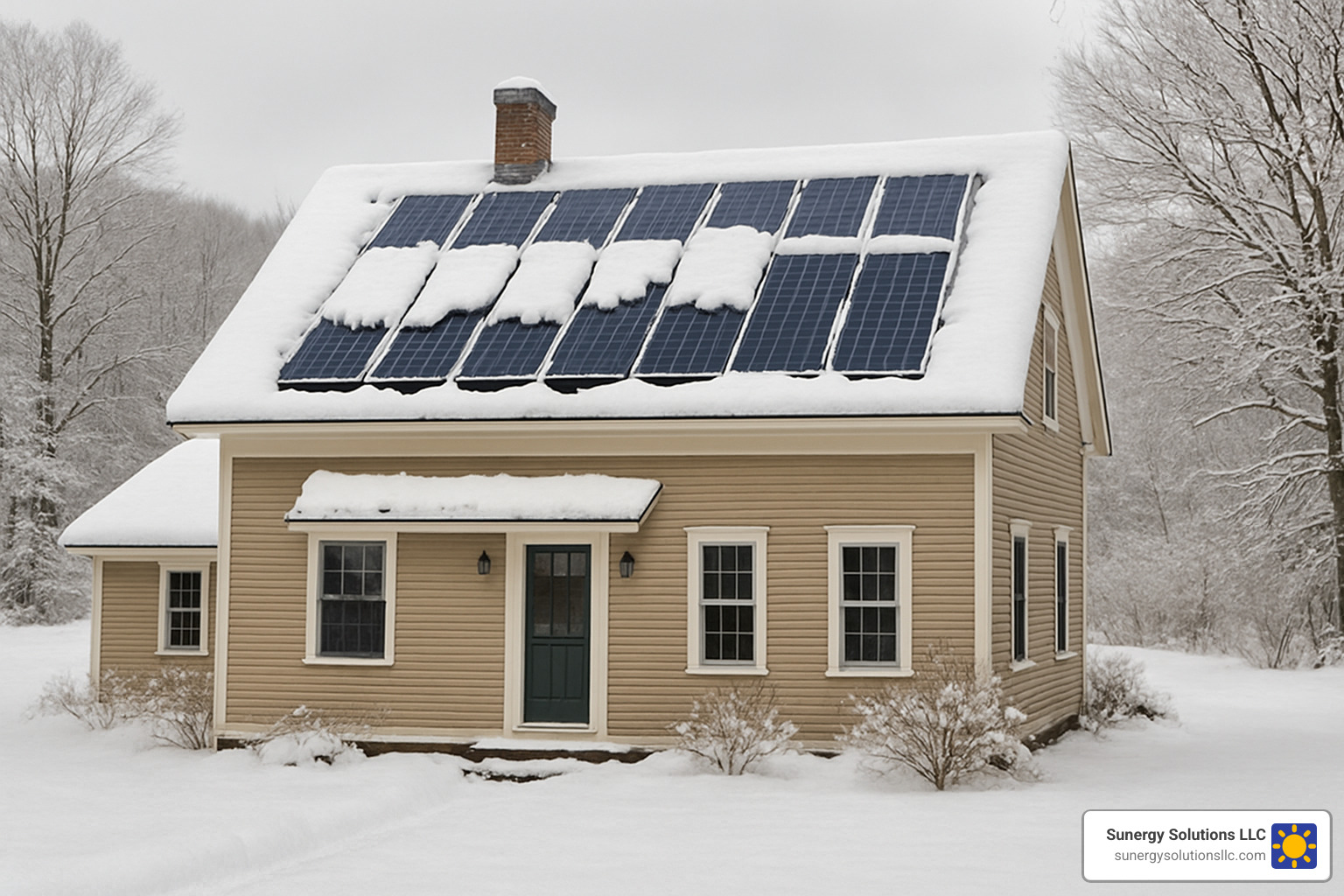
Cold air actually boosts solar efficiency, so Vermont winters aren’t the obstacle many expect. The key is maximizing short daylight hours with high-efficiency 450 W modules and panel-level electronics that keep production strong even if a few panels are snow-covered.
Select modules above 20% efficiency with a solid temperature coefficient and racking certified for heavy snow loads. Microinverters or power optimizers add panel-level monitoring and mitigate partial shading.
If outages are common or you’d like to join Green Mountain Power’s BYOD program, storage is smart. A 10–15 kWh battery such as Tesla Powerwall or LG Chem can power essentials for 8–12 hours, and incentives lower upfront cost.
Let snow slide off naturally—panels are slick and tilted 30–45°. Track production online and schedule a professional check-up once a year. No ladder required.
Selecting the right installer is crucial for a successful Solar Installation in VT project. The best installers combine technical expertise, local experience, and strong customer service to deliver systems that perform reliably for decades.
Look for installers with North American Board of Certified Energy Practitioners (NABCEP) certification, which demonstrates technical competency and commitment to industry best practices. Local licensing and insurance are also essential, protecting both you and the installation crew.
Experience matters significantly in Vermont’s challenging installation environment. Installers familiar with local permitting requirements, utility interconnection processes, and winter installation challenges can steer your project more efficiently and avoid common pitfalls.
Customer reviews and references provide valuable insights into an installer’s reliability and service quality. The best installers maintain strong reputations through consistent quality work and responsive customer service.
Before committing to any installer, ask detailed questions about their experience, equipment choices, and service approach. How long have they been installing solar in Vermont? What brands of equipment do they recommend and why? What does their typical project timeline look like?
Inquire about their service response procedures for any issues that arise after installation. The best installers provide clear communication channels and prompt response to customer concerns.
Financing options and payment schedules should be clearly explained, with no hidden fees or surprise costs. Reputable installers provide detailed contracts that specify equipment, timeline, and total costs including all permits and interconnection fees.
At Sunergy Solutions LLC, we believe in complete transparency throughout the sales and installation process. Our clients receive detailed proposals, clear contracts, and ongoing support that ensures their solar investment delivers expected returns.
While DIY solar kits are available, professional installation is strongly recommended for Vermont homeowners. The complexity of local permitting requirements, electrical codes, and utility interconnection processes makes professional installation nearly essential for compliance and safety.
DIY installations often void equipment warranties and may not qualify for rebates or incentives. Insurance companies may also refuse claims related to DIY electrical work, creating significant financial risk for homeowners.
Roof leak risks are particularly concerning with DIY installations. Professional installers use proven mounting techniques and weatherproofing methods that protect your roof for decades.
The permitting and inspection process in Vermont requires professional expertise to steer successfully. Professional installers handle all paperwork, coordinate inspections, and ensure compliance with local codes and utility requirements.
Most Vermont homeowners see their Solar Installation in VT pay for itself in about 10 years, though your specific timeline depends on several personal factors. If you’re paying cash upfront, you’ll typically hit that break-even point a bit sooner than if you’re financing your system.
Your home’s unique situation plays a big role here. Families with high electricity bills and south-facing roofs often celebrate their payback in just 8-9 years. On the flip side, if your roof faces north or you have significant shading issues, you might be looking at 11-12 years instead.
The math gets interesting when you consider that most solar systems keep producing power for 25-30 years. That means after your initial investment pays for itself, you’re essentially getting free electricity for the next 15-20 years. Not a bad deal for Vermont’s notoriously high energy costs!
Absolutely! Solar panels boost Vermont home values by an average of 4.1%, which translates to over $15,800 for the typical Vermont home. That’s nearly enough to cover your entire net system cost right there.
Here’s the really sweet part: thanks to Vermont’s property tax exemption, this increased value won’t bump up your annual tax bill. You get all the benefit of a more valuable home without paying extra taxes on it. It’s like having your cake and eating it too.
Real estate agents tell us that homes with solar panels sell faster than comparable homes without them. Today’s buyers are smart about energy costs, and they love the idea of predictable utility bills. When they see solar panels, they see decades of energy savings already installed and ready to go.
This might surprise you, but solar panels actually love cold weather! While those short winter days mean less sunlight overall, your panels work more efficiently in cold temperatures than they do during sweltering summer heat.
Yes, snow will occasionally cover your panels, but it’s rarely a problem. Most snow slides right off thanks to the panels’ smooth surface and tilted angle. When snow does stick around, the bright white ground actually reflects extra sunlight up to your panels, giving them a little production boost once they’re clear.
We size Vermont solar systems knowing exactly what winter looks like here. Your annual production estimates already account for those snowy February days and shorter December afternoons. The result? A system that meets your energy needs year-round, even when Mother Nature throws her worst at us.
The bottom line: Vermont winters are tough on a lot of things, but properly installed solar panels aren’t one of them. They’re built to handle our weather and keep producing clean energy for decades to come.
Vermont’s solar future has never looked brighter. As we move through 2025, the combination of high electricity costs, generous incentives, and proven technology creates a perfect storm of opportunity for Green Mountain State homeowners. Solar Installation in VT isn’t just about cutting your electric bill anymore—it’s about taking control of your energy future while contributing to Vermont’s clean energy leadership.
The numbers speak for themselves: $40,527 in savings over 25 years, a 10-year payback period, and an immediate 4.1% boost to your home’s value. But beyond the financial benefits, you’re joining a movement that’s helping Vermont reach its ambitious goal of 90% renewable electricity by 2050. Every rooftop solar system brings us closer to true energy independence.
Your journey from curious homeowner to solar owner follows a well-established path. Start with getting quotes from qualified installers, compare your financing options, and choose equipment that’s built to handle Vermont’s unique climate challenges. The process typically takes 2-4 months from contract to activation, with most of that time spent on paperwork rather than actual installation.
Winter performance concerns? Modern panels actually work more efficiently in cold temperatures, and that famous Vermont snow slides right off tilted panels. Worried about finding the right installer? Look for NABCEP certification, local experience, and comprehensive warranties that protect your investment for decades.
At Sunergy Solutions LLC, we’ve guided hundreds of Northeast homeowners through their solar journey. We understand Vermont’s permitting requirements, weather challenges, and utility interconnection processes. More importantly, we stand behind every installation with industry-leading warranties and the responsive customer service you deserve.
The path forward is clear. Vermont’s high electricity rates aren’t going down, but solar costs continue dropping while incentives remain strong. The 30% federal tax credit runs through 2032, and Vermont’s sales tax exemption and property tax benefits make the economics even more compelling.
Ready to join Vermont’s solar revolution? Request a Residential Solar Estimate today and find how much you could save with a custom solar system designed for your home and energy needs.
Your future self will thank you for making the switch to clean, affordable solar power. And Vermont’s beautiful landscape will benefit from every kilowatt-hour of clean energy your panels produce. The Green Mountain State is leading the way toward a renewable energy future—and your rooftop can be part of that success story.

Appointments Available, 7 Days a Week


