
5.0 Rating
Request A Free Estimate
Industrial buildings often have two characteristics that can make them strong candidates for solar energy: substantial electricity use and large areas of unused roof space.
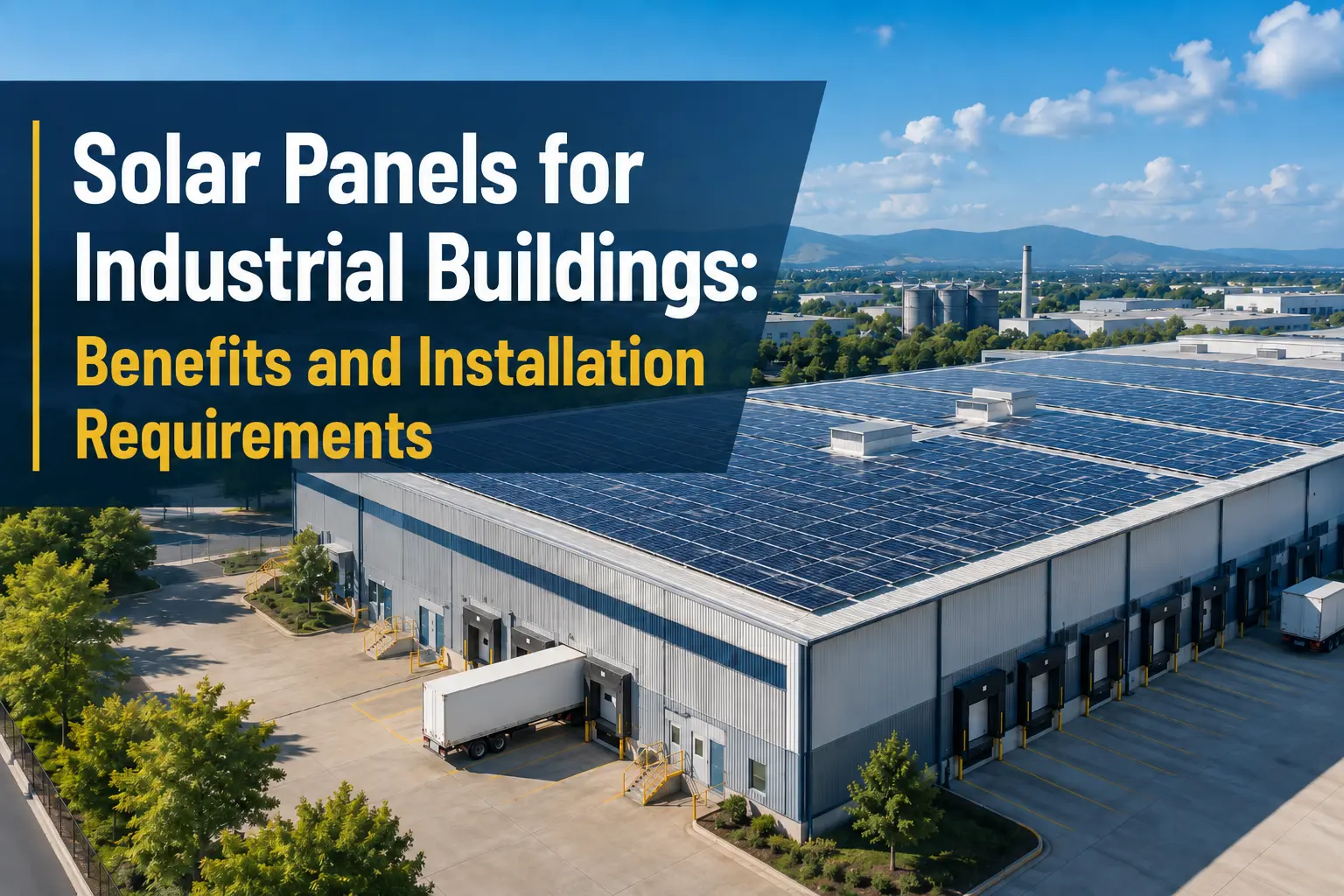
Warehouses, manufacturing plants, distribution centers, processing facilities, and industrial campuses may be able to use that space to generate electricity on-site.
However, installing solar panels for industrial buildings involves more than placing a large number of photovoltaic modules on a roof.
The system must be designed around the facility’s electricity demand, operating schedule, roof condition, structural capacity, utility requirements, and long-term business plans.
This guide explains how industrial solar panels work, how systems are sized, and what property owners should evaluate before starting a project.
SEE HOW A SOLAR SYSTEM CAN HELP YOU SAVE
Solar panels may be a worthwhile investment for industrial buildings with high daytime electricity use, sufficient roof or land area, suitable structural conditions, and favorable utility economics.
The right system size depends on the facility’s energy profile, electrical infrastructure, available installation space, utility rules, and financial goals.
Solar may not be suitable for every property.
Roof age, shading, structural limitations, low daytime consumption, interconnection restrictions, and short ownership or lease terms can all affect project feasibility.
A professional assessment should answer three main questions:
The term industrial solar panels generally refers to photovoltaic panels installed as part of a large solar energy system serving an industrial property.
The panels use the same basic technology found in smaller solar installations.
The difference is usually found in the scale of the project, the electrical design, the mounting system, and the amount of engineering required.
An industrial solar panel system may include:
The correct equipment depends on the facility’s voltage, electrical service, energy use, roof configuration, and project objectives.
A warehouse focused on reducing daytime utility purchases may need a different system than a factory seeking to manage demand charges or maintain selected operations during an outage.
Commercial and industrial solar are often grouped together, but industrial projects tend to involve larger loads, more complicated electrical systems, and more extensive structural and electrical engineering.
| Factor | Standard Commercial Solar | Industrial Solar |
| Typical property | Office, store, restaurant, or small business | Factory, warehouse, distribution center, or processing facility |
| Electricity use | Moderate | High and potentially variable |
| System size | Smaller rooftop array | Large rooftop, carport, or ground-mounted array |
| Electrical service | Often relatively straightforward | May include three-phase service, transformers, and large switchgear |
| Energy profile | Lighting, HVAC, computers, and office equipment | Machinery, automation, refrigeration, motors, and production equipment |
| Structural review | Standard commercial assessment | May require detailed roof and load analysis |
| Project stakeholders | Owner and solar contractor | Ownership, operations, facilities, finance, engineers, contractors, and the utility |
| Expansion planning | Usually limited | May account for new machinery, shifts, vehicles, or building additions |
Industrial properties may also be billed under more complicated utility rate structures.
The value of the solar system may depend not only on how much electricity it produces, but also on when it produces that electricity and whether production aligns with the facility’s highest demand.
Many types of industrial properties may be considered for solar, including:
The type of business does not determine suitability on its own.
A smaller manufacturing facility with steady daytime demand may be a stronger candidate than a much larger warehouse with low electricity use.
Likewise, a building with a large roof may not be suitable if the roof is nearing replacement or cannot support the additional load.
Important factors include:
A properly designed industrial solar system may support several financial, operational, and sustainability objectives.
Solar panels produce electricity at the facility, reducing the amount of energy that must be purchased from the utility while the system is operating.
The potential benefit depends on how closely solar production matches the facility’s electricity use.
A factory running machinery throughout the day may consume a large percentage of the energy produced.
A warehouse with low daytime demand may export more electricity, making utility compensation rules more important.
Utility rates can change over time, making future operating expenses difficult to predict.
On-site solar gives a business an additional source of electricity with more predictable production costs.
Solar does not necessarily remove the building from the electrical grid.
Most industrial facilities remain connected and continue paying for electricity, demand, service, and other charges the system does not offset.
Large industrial roofs often have substantial unused areas.
Rooftop solar can put that space to productive use without occupying land needed for parking, truck movement, drainage, storage, or future construction.
When rooftop space is limited, ground-mounted arrays or solar carports may provide additional capacity.
Some industrial electricity bills include demand charges based on the facility’s highest level of power use during a billing period.
Solar may reduce these charges when production overlaps with the building’s peak demand.
The actual savings depend on when the peak occurs, how long it lasts, and whether sufficient solar power is available at that time.
Battery storage may provide more targeted demand management by discharging when electricity use approaches a selected threshold.
On-site solar may help a business reduce its dependence on grid electricity and support sustainability reporting, emissions-reduction goals, supplier requirements, or customer expectations.
An industrial solar system may be designed with future changes in mind, including:
Future growth should be discussed during the original design because roof space, electrical capacity, interconnection limits, and equipment compatibility may restrict later expansion.
SEE HOW SOLAR PANELS CAN HELP YOUR BUSINESS
Industrial projects often use high-output solar modules because larger panels can reduce the number of individual modules, electrical connections, and mounting points required to reach the desired system capacity.
However, the panel with the highest wattage is not automatically the best option.
Solar panel selection should consider:
Higher-efficiency modules produce more power within a limited area.
This may be valuable when the usable roof space is restricted by HVAC equipment, vents, skylights, fire pathways, or structural limitations.
Large-format panels may produce more power per module, but they also take up more space and may be heavier or harder to handle.
The dimensions must work with the roof layout, racking, wind design, and installation process.
Solar panel output generally decreases as module temperature rises.
Temperature performance may matter on large roofs with limited airflow or dark roofing materials.
Equipment must be selected for the environmental conditions at the property.
Industrial systems in areas with heavy snowfall, high winds, coastal exposure, or severe storms may require specific panel and racking characteristics.
Solar modules gradually produce less electricity as they age.
Performance-warranty terms and projected degradation should be included in the long-term production model.
A product warranty covers certain equipment defects, while a performance warranty addresses expected output over time.
These warranties should be reviewed separately.
A long warranty is more valuable when the manufacturer has a stable business, established support process, and a practical method for handling claims.
The panels must work with the selected racking, inverter design, voltage range, electrical configuration, and monitoring platform.
The best industrial solar panel is the one that supports the building’s complete technical and financial design rather than simply having the largest wattage rating.
A useful industrial solar proposal should explain how projected system production translates into financial value.
An ROI analysis may consider:
A simplified calculation may begin with:
Simple payback may then be estimated as:
This calculation is only a starting point.
A complete financial model should account for financing, changing utility rates, equipment degradation, maintenance, tax treatment, and annual production variations.
Businesses should review the assumptions behind any savings estimate.
Small changes in electricity prices, consumption, export compensation, or project timing may materially change the result.
There is no universal payback period for industrial solar.
The timeline depends on:
A facility with high daytime electricity use may capture more value from each unit of solar energy than a building that exports most of its production.
Payback estimates should be based on the facility’s actual utility data and should clearly identify every assumption used in the calculation.
Federal, state, utility, and local incentives may be available for qualifying commercial and industrial solar projects.
Potential incentives can include:
Eligibility may depend on when construction begins, when the system is placed in service, who owns the project, labour requirements, equipment sourcing, project location, and other conditions.
Incentive rules can change.
Businesses should confirm current requirements with qualified tax, legal, and financial professionals before including an incentive in a final ROI calculation.
The amount of required roof space depends on the desired system capacity, panel dimensions, equipment layout, and usable area.
Not every part of the roof can be covered.
The design must account for:
A basic panel-count calculation is:
For example, dividing a 1,000,000-watt system by 500-watt panels produces an initial estimate of 2,000 panels.
That does not confirm that 2,000 panels will fit.
The actual layout must account for panel dimensions, row spacing, obstacles, access requirements, and structural limitations.
A large roof does not automatically mean that a large solar system can be installed on it.
The roof should be evaluated for:
Industrial roofs may already carry HVAC units, vents, exhaust equipment, piping, skylights, and drainage systems.
These obstacles reduce the usable area and influence the panel layout.
A structural engineer may need to review the roof deck, framing, connections, and expected loads before the final design is approved.
Solar panels can be installed on many metal industrial buildings, but the mounting system must match the roof profile and condition.
Standing-seam roofs may allow racking to be clamped to the seams.
This can reduce roof penetrations when the roof design and structural engineering permit it.
Corrugated roofs commonly require attached mounting points.
Each penetration must be properly designed, installed, flashed, and sealed.
The fasteners, washers, panels, and supporting structure should be inspected before installation.
Older exposed-fastener roofs may need repairs or replacement.
The assessment should also look for:
Roof material alone does not determine whether a building is ready for solar.
Its age, condition, geometry, construction, and warranty requirements are equally important.
Solar panels can supply electricity that offsets a factory’s overall electrical demand.
They do not normally connect directly to one individual machine.
The panels generate direct-current electricity.
Inverters convert it into alternating-current electricity that can be used through the facility’s electrical distribution system.
When the building needs more power than the solar system is producing, the remaining electricity comes from the utility.
When production exceeds immediate demand, the excess may be exported, stored, curtailed, or managed according to the system design and utility rules.
Whether solar can generate an amount equal to all of a factory’s annual consumption depends on:
For many facilities, the practical goal is not complete energy independence.
It is reducing utility purchases with a system designed around actual consumption and financial objectives.
The right installation type depends on the property, available space, structural conditions, and operating needs.
| Installation Type | Advantages | Considerations |
| Rooftop solar | Uses existing roof space and preserves land | Requires a suitable roof and enough unobstructed area |
| Ground-mounted solar | Allows flexible orientation and may be easier to expand | Uses land and may require zoning, civil, drainage, and vegetation work |
| Solar carport | Generates electricity while creating covered parking | Requires new structures and careful planning for drainage, traffic, snow, and lighting |
| Mixed installation | Uses several areas to increase system capacity | Requires a more complex electrical and construction plan |
Rooftop solar is often attractive for warehouses and factories because the building already provides a large installation surface.
Ground-mounted systems may be preferable when:
Solar carports may be considered when covered parking supports the facility’s goals, but vehicle movement, drainage, snow, lighting, and pedestrian safety must be included in the design.
Battery storage is not required for every industrial solar system.
It may be useful when a facility wants to:
Storage may offer less value when:
A battery should be evaluated using interval data and a defined operating objective.
Its value depends on how often it cycles, when it charges and discharges, and which loads it is intended to support.
Standard grid-connected solar panels generally do not continue supplying a building normally when the grid goes down.
The system shuts down to protect utility workers and prevent electricity from being sent onto damaged power lines.
A facility that needs power during an outage must have a system designed for that purpose.
It may include:
The required system depends on what the facility needs to keep operating.
Supporting emergency lighting, communications, and computers is very different from powering an entire factory with motors, refrigeration, processing equipment, and HVAC.
A tenant may be able to install solar on a leased industrial building, but the project requires cooperation with the property owner and careful contract planning.
Important issues include:
A short remaining lease term may not support a long-term solar agreement unless the lease is extended or the property owner participates in the project.
The solar contract, building lease, roof warranty, and financing documents should be reviewed together so each party’s responsibilities are clearly defined.
An industrial solar project generally moves through several planning, design, approval, and construction stages.
The business identifies what it wants the system to accomplish.
Goals may include:
The solar provider reviews utility bills and, when available, interval data.
This helps identify:
The inspection reviews:
Engineers determine whether the roof or land can support the system and whether the existing electrical infrastructure can accept the proposed capacity.
The preliminary layout estimates:
The project team estimates:
Final plans are prepared for structural, electrical, utility, fire, zoning, and building-code review.
Required work may include:
The racking, panels, inverters, wiring, monitoring equipment, and electrical components are installed according to the approved plans.
The system is tested and inspected.
Utility permission to operate is generally required before the system can be activated under the interconnection agreement.
After activation, monitoring equipment tracks production and helps identify equipment faults or unexpected performance changes.
The physical installation is only one part of the project timeline.
Before construction begins, the project may require:
A straightforward rooftop project may move faster than a ground-mounted system requiring civil engineering, utility upgrades, or extensive site work.
The most dependable timeline can be created after the property, system size, utility territory, and approval requirements have been reviewed.
Industrial solar systems have relatively few moving parts, but they should not be treated as maintenance-free.
An operations and maintenance plan may include:
Monitoring can help identify:
Roof maintenance must continue after the panels are installed.
The layout should preserve access for drainage, inspections, repairs, fire response, and maintenance of HVAC equipment.
Industrial building owners should look beyond the panel brand or the lowest quoted price.
Ask prospective solar companies:
The proposal should clearly define the scope of work, equipment, responsibilities, production assumptions, warranties, exclusions, and expected timeline.
Installing solar panels for an industrial building begins with understanding the property, its electricity use, and the company’s long-term goals.
Sunergy Solutions designs customized commercial and industrial solar systems for manufacturing facilities, warehouses, distribution centers, and other large properties.
Each project is evaluated based on energy demand, roof or land availability, structural conditions, electrical infrastructure, and financial objectives.
Sunergy Solutions also provides commercial roofing services, allowing roof condition and solar requirements to be evaluated as connected parts of the same project.
Buildings in these regions may face different snow, wind, coastal exposure, permitting, and utility requirements.
These local conditions should be included in the structural design, equipment selection, installation plan, and financial analysis.
A detailed property and energy assessment can help determine how much solar the site can support, what improvements may be required, and whether the project aligns with the organization’s operational and financial goals.
Contact us today to get started.
Solar panels may be suitable for industrial buildings with sufficient roof or land area, a structurally sound installation surface, compatible electrical infrastructure, and substantial daytime electricity use. A feasibility assessment is needed to determine the appropriate system size and expected financial value.
The required panel count depends on the warehouse’s electricity use, available roof space, panel wattage, shading, utility restrictions, and desired system size. Utility bills and interval data should be reviewed before estimating the appropriate number.
Industrial solar panels can be installed on many standing-seam, corrugated, and exposed-fastener metal roofs. The mounting method depends on the roof profile, age, condition, structural capacity, and warranty requirements.
Many solar panels include long-term performance warranties, but the life of the complete system also depends on inverters, racking, electrical equipment, installation quality, environmental conditions, monitoring, and maintenance. Each warranty should be reviewed separately.
Solar panels can help businesses reduce the amount of electricity they purchase from the utility, make better use of available roof or land space, and improve long-term energy cost predictability. Depending on the facility, solar may also support sustainability goals, help manage some demand charges, and provide room for future additions such as battery storage or electric vehicle charging.
Appointments Available, 7 Days a Week


