
5.0 Rating
Request A Free Estimate
Commercial solar energy systems are photovoltaic installations designed for businesses, schools, government facilities, and other non-residential properties to generate clean electricity and reduce operating costs. These systems typically range from 25 kilowatts to multiple megawatts and can deliver significant financial returns through reduced utility bills and federal tax incentives.
Key Benefits of Commercial Solar Energy Systems:
The commercial solar market has exploded in recent years, with over 8,300 MW of projects installed across 43 states. Rising energy costs and corporate sustainability mandates are driving unprecedented demand for these systems. Whether you’re managing a warehouse, office building, or manufacturing facility, solar offers a proven path to energy independence and predictable operating costs.
If you’re new to the technology, you can explore a concise technical primer on photovoltaics to understand how sunlight is converted into usable electricity.
I’m Robert Raffa, CEO and Founder of Sunergy Solutions LLC, where I’ve spent nearly a decade helping businesses across the Northeast transition to clean energy through strategic commercial solar energy systems installations. My background in investment banking allows me to apply rigorous financial analysis to every project, ensuring our solar solutions deliver both environmental impact and strong economic returns.
Think of commercial solar energy systems as your business’s personal power plant on the roof. The magic starts with photovoltaic (PV) cells made of silicon that turn sunlight into electricity. When those rays hit the panels, they create direct current (DC) electricity—the same type you’d find in a car battery.
Here’s where it gets interesting: most business equipment runs on alternating current (AC), so inverters work behind the scenes to convert that DC power into the AC electricity your computers, lights, and machinery need.
Once converted, the solar-generated power flows into your building’s electrical panel. Your facility uses this clean electricity first, and any excess power flows back to the utility grid through net metering. This means you’re essentially spinning your electric meter backwards, earning credits on your utility bill.
When the sun isn’t shining—like during those late-night inventory sessions or cloudy days—you automatically draw electricity from the grid just like before. Many modern systems now include battery storage to capture that excess solar generation for use during peak demand periods or power outages.
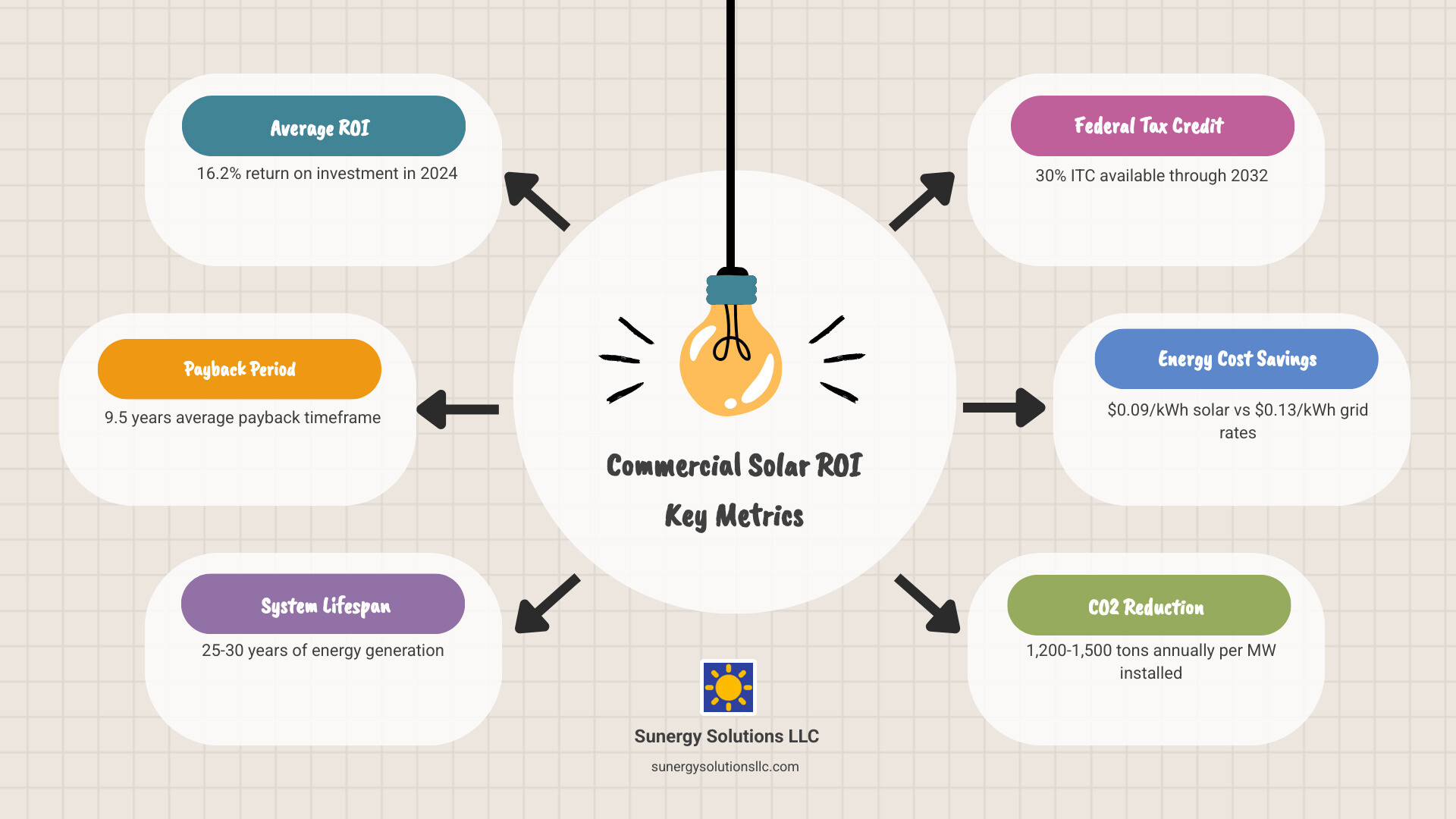
Commercial solar panels come with robust warranties: typically 25-year performance warranties and 10-25 year inverter warranties. These systems are built to last, operating effectively for 25-30 years while gradually declining in efficiency by only about 0.5% per year.
For businesses ready to explore their options, our Commercial Solar Systems page provides detailed information about system configurations that might work for your facility.
Commercial solar energy systems are large-scale photovoltaic installations designed specifically for the commercial and industrial (C&I) sector. While residential systems typically range from 3-10 kW—enough to power a family home—commercial systems start around 25 kW and can scale to multiple megawatts for large facilities.
These systems serve a wide range of properties: businesses, schools, hospitals, government buildings, warehouses, and manufacturing facilities. The larger scale creates significant economies of scale in both equipment costs and installation expenses, making the per-watt cost lower than residential installations.
The differences between commercial and residential solar go way beyond just size—though size definitely matters. Commercial panels are physically larger, typically measuring around 2,300mm x 1,100mm compared to residential panels at approximately 1,700mm x 1,100mm. This bigger footprint allows for higher wattage ratings, with commercial panels commonly rated at 400-600+ watts versus 300-400 watts for residential panels.
Commercial systems use higher cell counts—typically 72, 96, 120, or even 144 cells per panel compared to 60-72 cells in residential panels. The electrical requirements get more complex too. Commercial systems often operate at higher voltages (480V three-phase is common) and must comply with more stringent electrical codes and safety requirements.
When it comes to commercial solar energy systems, there’s no one-size-fits-all approach. The beauty of solar technology lies in its flexibility—your system can be custom to work with your specific property, business needs, and budget constraints.
Most businesses start by looking at their rooftop space, which often provides the most straightforward installation. But don’t overlook other creative options that might work even better for your situation. Ground-mounted systems can be ideal if you have available land, while solar carports turn your parking lot into a dual-purpose energy generator.
The latest innovations in commercial solar include bifacial panels that capture sunlight from both sides, increasing energy production by up to 30%. Many businesses are also integrating EV charging stations directly into their solar installations, creating a complete clean energy ecosystem.
For companies looking to make a sustainability statement, solar canopies and carports offer excellent branding opportunities while providing practical benefits. These visible installations showcase your environmental commitment to customers and employees every day.
Our Commercial Solar Installation team works with you to evaluate all options and design the perfect system for your property and energy goals.
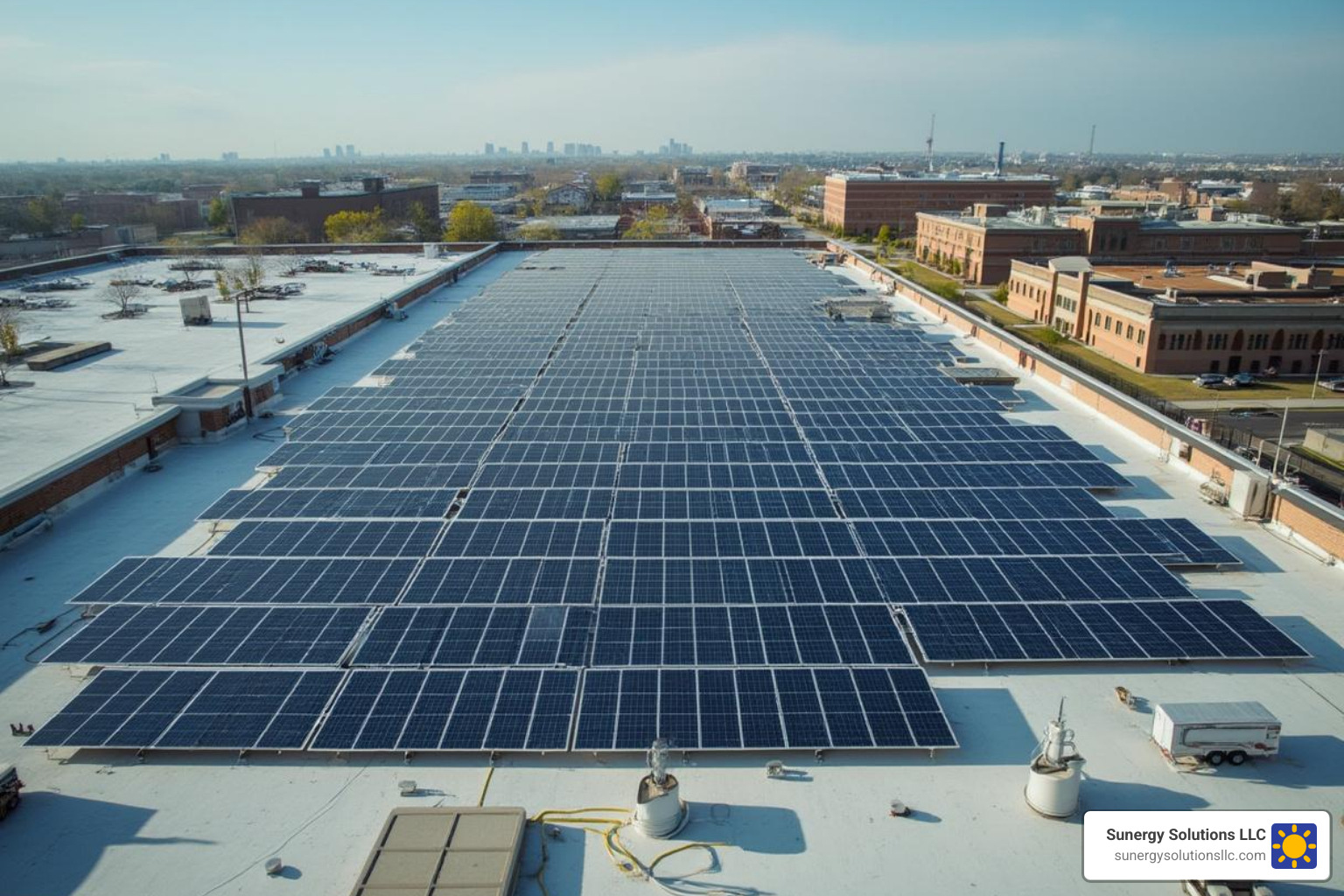
Your building’s roof is prime real estate for solar panels. Most commercial buildings have flat or low-slope roofs that work perfectly for solar installations, giving us flexibility to position panels for maximum sun exposure throughout the day.
The key to a successful rooftop installation is getting the tilt angles right. We typically set panels at 15-35 degrees depending on your location, which captures the most sunlight year-round. On flat roofs, we often use ballasted mounting systems that rely on concrete weights rather than roof penetrations, protecting your roof’s integrity.
Before we recommend a rooftop system, we always check your structural load capacity. Solar panels, mounting equipment, and ballast typically add 3-5 pounds per square foot. Most modern commercial buildings handle this easily, but older structures might need reinforcement.
Here’s something many business owners don’t consider: if your roof needs replacement within the next 5-10 years, it’s usually smart to coordinate that work with your solar installation. This timing saves money and ensures your roof warranty covers the solar mounting points.
If you have available land, ground-mounted systems often deliver the best bang for your buck. Without roof constraints, we can design your system for optimal sun exposure and easier maintenance access.
Land requirements are reasonable—you’ll need about 100 square feet per installed kilowatt. A 500 kW system that powers a medium-sized facility typically requires about 1.5 acres, including space for access roads and equipment.
Ground-mount installations open up exciting possibilities like tracking systems that follow the sun throughout the day. These systems boost energy production by 15-25% compared to fixed panels, though they do add complexity and cost.
Fencing is essential for ground-mount systems, both for security and safety compliance. We design attractive perimeter fencing that protects your investment while maintaining your property’s professional appearance.
Solar carports represent the perfect marriage of form and function. You get clean energy generation while creating valuable covered parking that employees and customers love.
The shade benefits are significant, especially in hot climates. Cars stay cooler, which means less air conditioning when people get in their vehicles. This translates to additional energy savings beyond your solar production.
From a branding perspective, solar carports are marketing gold. They’re visible proof of your company’s commitment to sustainability and innovation. We can integrate LED lighting that runs entirely on solar power, creating safe, well-lit parking areas.
Dual-use parking structures make financial sense too. You’re generating revenue from the same footprint twice—once through energy savings and once through improved parking amenities. Many businesses find that solar carports help with employee recruitment and customer attraction.
The engineering flexibility of carports means we can optimize them for perfect solar orientation, regardless of how your building faces. Plus, maintenance is much easier when panels are accessible from ground level rather than requiring roof access.
Let’s talk money—because that’s probably what you’re really wondering about when it comes to commercial solar energy systems. The good news? The financial picture has never looked better for businesses ready to make the switch to solar.
Most commercial solar installations cost between $1.50 and $3.00 per watt. So if you’re looking at a 100-kilowatt system for your warehouse, you’re probably looking at $150,000 to $300,000 before incentives.
Now here’s where the math gets really exciting. The federal Investment Tax Credit (ITC) gives you back 30% of your total project cost through 2032. That $200,000 system? You just saved $60,000 in federal taxes. Many states sweeten the deal even further with their own rebates and Solar Renewable Energy Credits (SRECs) that you can sell for ongoing revenue.
Net metering is like having the utility grid as your personal battery bank. When your panels produce more electricity than you’re using, that excess power flows back to the grid and you get credited at retail rates.
With typical payback periods of 5-10 years and systems lasting 25-30 years, you’re looking at 15-25 years of essentially free electricity. Our clients are seeing average returns of 16.2% with payback periods averaging 9.5 years in 2024.
For the complete breakdown of available incentives, check out our detailed guide on Solar Tax Credits and Rebates: What You Need to Know. You can also find the latest federal program updates at CleanEnergy.gov and get comprehensive ITC information from the Solar Investment Tax Credit overview.
| Financing Option | Upfront Cost | Ownership | Tax Benefits | Monthly Payment | Best For |
|---|---|---|---|---|---|
| Cash Purchase | 100% of system cost | Customer owns | Full ITC + depreciation | None | Businesses with available capital and tax appetite |
| Solar Loan | $0-20% down | Customer owns | Full ITC + depreciation | Fixed monthly payment | Businesses wanting ownership without large upfront cost |
| Power Purchase Agreement (PPA) | $0 | Third-party owns | None to customer | Per kWh rate (typically 10-20% below utility) | Businesses with limited tax appetite or capital |
| Operating Lease | $0-10% down | Lessor owns | None to customer | Fixed monthly lease payment | Businesses wanting predictable costs without ownership |
Think of solar incentives like a layer cake—each layer adds more sweetness to the deal. The federal ITC forms the foundation, giving you that solid 30% tax credit against your federal tax liability. Can’t use it all in one year? No problem—you can carry it forward for up to five years.
Then there’s bonus depreciation, which lets you write off 100% of your system’s cost in the first year, creating immediate tax benefits. If you prefer to spread things out, the MACRS five-year schedule lets you depreciate 20% in year one, 32% in year two, and so on.
State-level SRECs add another revenue stream in many markets. These credits represent the environmental benefits of your solar generation, and utilities will actually pay you for them.
Cash purchases deliver the biggest long-term returns because you own everything and capture all the tax benefits. If you’ve got the capital and enough tax liability to use the credits, this is usually your best bet.
Solar loans give you the best of both worlds—ownership benefits without the big upfront hit to your cash flow. Many lenders now offer specialized solar financing with rates and terms that align perfectly with your system’s energy production.
Power Purchase Agreements (PPAs) are perfect for businesses that want immediate savings without any upfront investment. A third-party developer owns and maintains the system on your property, and you simply buy the electricity at a rate that’s typically 10-20% below your current utility costs.
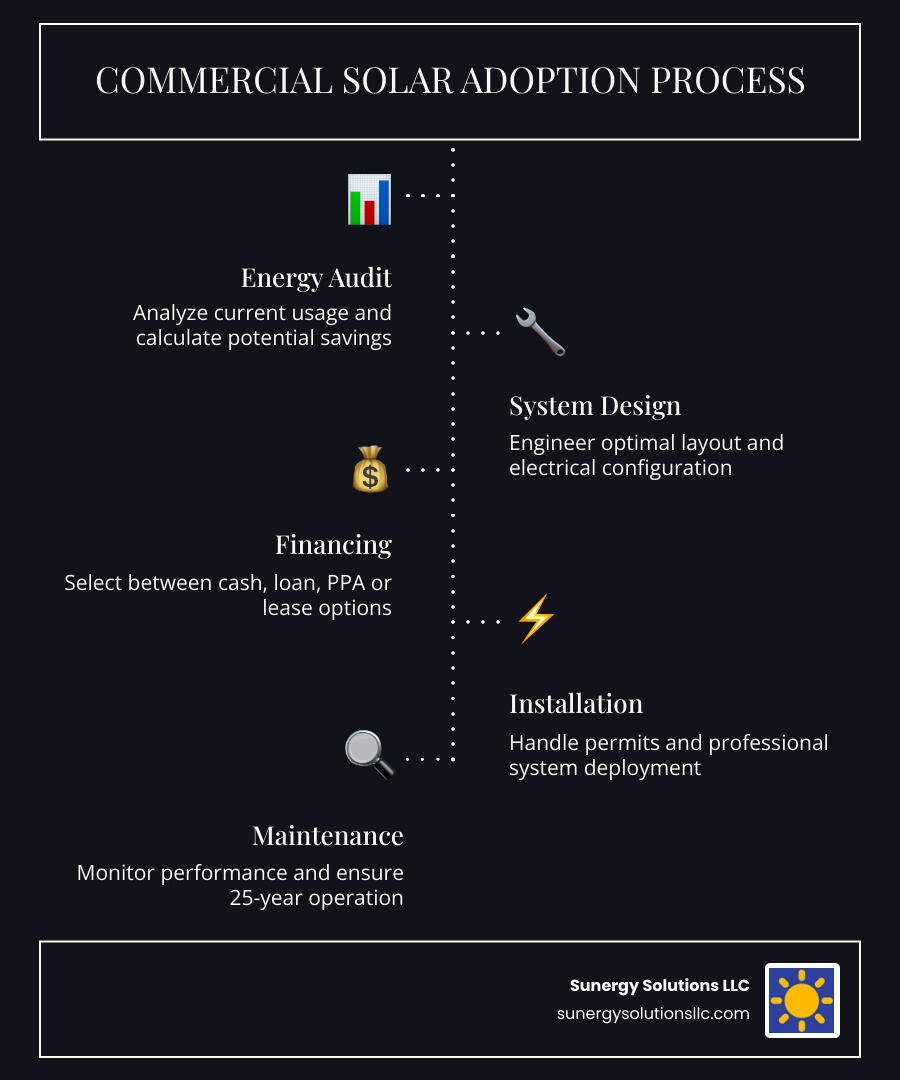
The journey from initial interest to operational commercial solar energy system involves a systematic process designed to ensure optimal system performance and maximum return on investment. This comprehensive approach typically spans 3-9 months from initial consultation to system commissioning, depending on project size and complexity.
The process begins with a thorough energy audit and feasibility analysis. Our team reviews 12-24 months of utility bills to understand your energy consumption patterns, demand charges, and rate structures. This analysis identifies the optimal system size and configuration to maximize financial benefits while meeting your sustainability goals.
Site assessment includes structural engineering analysis for rooftop installations, soil conditions for ground-mount systems, and electrical infrastructure evaluation. We use advanced tools including drone surveys, LIDAR data, and shading analysis software to model system performance under various conditions.
Permitting and interconnection can be complex for commercial installations, often requiring multiple approvals from local building departments, fire departments, and utility companies. Systems over certain sizes may require additional engineering reviews and utility studies.
Construction typically follows a structured timeline with minimal disruption to business operations. Most installations can be completed during normal business hours, with electrical connections often scheduled during off-hours or weekends to avoid operational interruptions.
Our Solar Energy Services encompass the entire project lifecycle from initial assessment through long-term maintenance and support.
Phase 1: Site Survey and Energy Analysis
Our certified energy auditors conduct detailed site assessments including roof condition evaluation, structural load analysis, electrical infrastructure review, and shading studies. We analyze your energy consumption patterns, peak demand periods, and utility rate structures to optimize system sizing and configuration.
Phase 2: System Design and Engineering
Using advanced modeling software, we create detailed system designs that maximize energy production while meeting all code requirements. This includes electrical single-line diagrams, structural calculations, and 3D renderings that help visualize the completed installation.
Phase 3: Permitting and Interconnection
We handle all permitting requirements including building permits, electrical permits, and utility interconnection applications. For larger systems, this may include utility impact studies and additional engineering reviews.
Phase 4: Installation and Commissioning
Professional installation crews complete the mechanical and electrical work according to engineered specifications. Final inspections by local authorities and utility representatives ensure code compliance before the system is energized and begins generating power.
Commercial solar energy systems require minimal maintenance compared to other energy generation technologies, but proactive care ensures optimal performance throughout the system’s 25-30 year lifespan.
Annual professional maintenance should include comprehensive system performance verification, electrical connection inspection, mounting hardware assessment, inverter diagnostics, and monitoring system calibration.
Performance monitoring is crucial for identifying issues before they impact energy production. Modern systems include web-based monitoring platforms that track real-time and historical performance, automatically alerting facility managers to potential problems.
Component replacement is infrequent but inevitable over the system’s lifespan. Inverters typically require replacement after 10-15 years, while panels may need individual replacement due to damage or underperformance.
The adoption of commercial solar energy systems delivers benefits that extend far beyond simple cost savings, creating value across financial, operational, and strategic dimensions.
Financial Benefits:
Operational Benefits:
Strategic Benefits:
Potential Challenges:
Despite these challenges, the overwhelming majority of commercial solar installations deliver strong returns and high customer satisfaction.
Environmental, Social, and Governance (ESG) considerations have become increasingly important for businesses of all sizes, with commercial solar energy systems playing a crucial role in achieving sustainability objectives and meeting stakeholder expectations.
Environmental Impact:
Solar installations provide immediate and measurable reductions in Scope 2 emissions (indirect emissions from purchased electricity). A typical 1 MW commercial solar system prevents approximately 1,200-1,500 tons of CO2 emissions annually—equivalent to removing 250-300 cars from the road.
Social Responsibility:
Solar installations demonstrate corporate commitment to environmental stewardship, often improving employee engagement and customer loyalty. Many businesses report that their solar installations serve as conversation starters with customers and help attract environmentally conscious employees.
Governance Benefits:
Solar projects provide measurable, reportable sustainability metrics that support ESG reporting requirements. The long-term nature of solar installations demonstrates strategic thinking and commitment to sustainable business practices that many investors and stakeholders value.
When businesses start exploring solar energy, they naturally have questions about costs, timelines, and long-term commitments. After nearly a decade of helping companies across the Northeast transition to clean energy, I’ve found that most concerns center around three key areas: financial returns, available incentives, and ongoing maintenance requirements.
Most commercial solar energy systems pay for themselves within 5-10 years, with our clients averaging about 9.5 years based on 2024 project data. Your specific payback period depends on several factors that can dramatically speed up or slow down your return on investment.
System size makes a huge difference. Larger installations benefit from economies of scale, often achieving payback periods on the shorter end of that range. When you use energy matters more than you might think. Manufacturing facilities and retail stores that consume most of their electricity during daylight hours see the fastest paybacks because they’re using solar power as it’s generated.
Your current utility rates play a major role too. If you’re paying $0.15 per kWh, solar becomes attractive much faster than if you’re paying $0.08 per kWh. The 30% federal Investment Tax Credit significantly accelerates payback for most businesses. Combined with bonus depreciation benefits, many companies recover 40-50% of their investment through tax benefits alone in the first year.
The incentive landscape for commercial solar is actually quite generous right now, though it varies depending on where your business is located. Federal incentives provide the biggest impact for most businesses. The Investment Tax Credit gives you 30% of your total project cost back as a dollar-for-dollar tax credit through 2032.
Bonus depreciation lets you write off 100% of the system cost in the first year. Alternatively, you can use the MACRS 5-year accelerated depreciation schedule. If you’re a rural business, the USDA REAP grant program can cover up to 50% of your project cost, with a maximum grant of $1 million.
State and local incentives vary significantly across our service areas. In Massachusetts, the SMART program provides performance-based incentives. New Hampshire offers net metering and renewable energy fund grants. Vermont, Maine, Rhode Island, Virginia, and Montana each have their own combination of net metering, renewable energy certificates, and rebate programs.
Commercial solar energy systems are remarkably low-maintenance compared to other energy generation technologies. Annual maintenance is pretty straightforward. We recommend professional service visits that include performance monitoring analysis, visual inspection of panels and mounting hardware, inverter diagnostics, electrical connection checks, and monitoring system calibration.
The biggest maintenance item you’ll face is inverter replacement, typically needed after 10-15 years of operation. Budget $1,000-$3,500 for this depending on your system size and inverter technology. Panel replacement is rare but occasionally necessary due to damage or significant underperformance.
Warranty coverage provides substantial protection. Panel performance is typically warranted for 25 years, guaranteeing 80-85% of original output after two and a half decades. The bottom line? Plan on spending about 1-2% of your original system cost annually on maintenance and repairs.
The path forward for your business is clear: commercial solar energy systems offer an best combination of financial returns, environmental impact, and strategic advantages that position companies for long-term success. With average returns of 10-20% and payback periods of just 5-10 years, solar installations deliver decades of predictable energy savings that compound year after year.
Right now, the stars are perfectly aligned for commercial solar investment. The 30% federal Investment Tax Credit runs through 2032, accelerated depreciation benefits remain robust, and equipment costs continue to decline while performance improves. This combination creates what many financial analysts consider the most attractive clean energy investment environment in decades.
As CEO and Founder of Sunergy Solutions LLC, I’ve watched countless businesses transform their operations through strategic solar investments. What excites me most isn’t just the immediate cost savings—though those are substantial—but the long-term competitive advantages that solar provides. Companies that invest in commercial solar energy systems today are essentially locking in low electricity costs for the next 25-30 years while their competitors remain vulnerable to rising utility rates.
Our approach at Sunergy Solutions LLC centers on three fundamental commitments: top-tier equipment that performs reliably for decades, extensive warranties that protect your investment, and exceptional customer service that makes the entire process smooth and transparent. We don’t just install solar systems—we build long-term partnerships that ensure your investment delivers maximum returns throughout its lifespan.
Whether you’re operating a small retail space in Vermont or managing a large distribution center in Virginia, the financial fundamentals of commercial solar remain compelling. Our team serves businesses across Maine, Massachusetts, New Hampshire, Rhode Island, Vermont, Montana, and Virginia, bringing national expertise with local market knowledge to every project.
The businesses that thrive in tomorrow’s economy will be those that make smart infrastructure decisions today. Solar installations do more than reduce operating costs—they demonstrate environmental leadership, strengthen your brand, support sustainability reporting requirements, and provide the energy independence that protects against future uncertainty.
Your next step is simple. Visit our Commercial Solar Power Solutions page to explore how commercial solar energy systems can specifically benefit your operation. Better yet, contact our team today for a complimentary energy audit and feasibility analysis. We’ll analyze your current energy costs, evaluate your property’s solar potential, and show you exactly how much you can save.
The sun rises every day—shouldn’t your business be capturing that free energy? Let’s start your solar journey today.

Appointments Available, 7 Days a Week


