
5.0 Rating
Request A Free Estimate
Commercial solar installation companies are changing how businesses across North America power their operations, with over 2,000 grid-connected systems installed by leading providers and some companies completing more than 1,000 installations across Canada alone.
Top commercial solar installation companies offer:
The shift toward commercial solar is happening fast. With electricity costs rising faster than inflation and businesses facing pressure to meet sustainability goals, the right installation partner can help you reduce energy consumption by up to 80% while enhancing your company’s green reputation.
The challenge? Not all installers are created equal. From system design and permitting to long-term maintenance, choosing the wrong company can cost you thousands in lost savings and headaches down the road.
I’m Robert Raffa, CEO and Founder of Sunergy Solutions LLC, where I’ve spent nearly a decade helping businesses transition to clean energy through strategic commercial solar installation companies partnerships. My background in investment banking and renewable energy development has shown me how the right installer makes all the difference in maximizing your solar ROI.
Commercial solar installation companies terms to know:
If you’re a business owner considering solar, you might wonder how different commercial installations are from the residential panels you see on neighborhood rooftops. Commercial solar installation companies work in a completely different league – and understanding these differences could save you thousands of dollars.
Think of it this way: if residential solar is like buying a family car, commercial solar is like purchasing a fleet of delivery trucks. The scale, complexity, and requirements are vastly different.
System scale is the most obvious difference. While your home might need a 5-10 kW system, businesses typically require 50 kW to several megawatts of capacity. That’s not just bigger panels – it’s entirely different equipment, from inverter size to mounting systems designed for commercial roof loads.
The energy demand patterns are also worlds apart. Your business likely runs on three-phase power with consistent high-load profiles throughout the day. A manufacturing facility or large office building can consume as much electricity in a day as an entire residential neighborhood uses in a week.
Payback periods work differently too. While residential customers might see 8-12 year payback periods, businesses often achieve faster returns due to higher electricity rates and better net-metering arrangements. However, commercial utility interconnect requirements are more complex, sometimes requiring grid studies and upgraded transformers.
The warranties and service agreements are also more comprehensive. Commercial Solar Panels come with longer warranty periods and more robust maintenance packages because businesses can’t afford unexpected downtime.
Your business operates in a different energy universe than residential customers. Most commercial buildings run on three-phase power systems that can handle the massive electrical loads from manufacturing equipment, large HVAC systems, and extensive lighting networks.
These high-load profiles mean that even a substantial residential-sized system would barely make a dent in your monthly energy bills. A typical commercial facility might need 20-50 times more solar capacity than a home to achieve meaningful savings.
Commercial solar installation companies understand this scale difference. They know that your peak energy usage might coincide perfectly with peak solar production, creating immediate cost savings that residential customers rarely experience.
Here’s where commercial solar gets serious about the technical details. Commercial solar installation companies must steer structural analysis requirements that would make residential installers’ heads spin.
Your commercial roof needs to support not just the weight of panels, but also mounting hardware, potential snow loads, and wind forces that can be dramatically different from residential applications. We’ve seen businesses find their roof needed reinforcement – adding weeks to the timeline and thousands to the budget.
Code compliance is another major difference. Commercial installations must meet stricter fire safety requirements, including specific spacing around HVAC equipment and emergency access routes. The electrical work involves integrating with existing three-phase systems and often requires coordination with utility companies for upgraded interconnection equipment.
The permitting process alone can take months longer than residential projects. Commercial solar installation companies need expertise in navigating Authority Having Jurisdiction (AHJ) requirements that vary significantly from residential permits.

When you’re investing in commercial solar, you’re not just buying panels—you’re choosing a partner who’ll guide your business through a complex process that can make or break your energy savings goals. After nearly a decade of working with commercial solar installation companies across seven states, I’ve learned that the difference between a good installer and a great one can mean thousands of dollars in your pocket.
The best commercial solar installation companies don’t just show up and bolt panels to your roof. They offer true turnkey EPC services, handling every detail from that first site visit through the day your system starts generating power and beyond. This means you’re not juggling multiple contractors or dealing with finger-pointing when something goes wrong.
Safety should be non-negotiable. When we evaluate potential installation partners, we look for companies with COR safety certifications and spotless OSHA compliance records. One installer we work with has maintained over 14 years without a lost-time injury. That’s not luck—that’s commitment to doing things right.
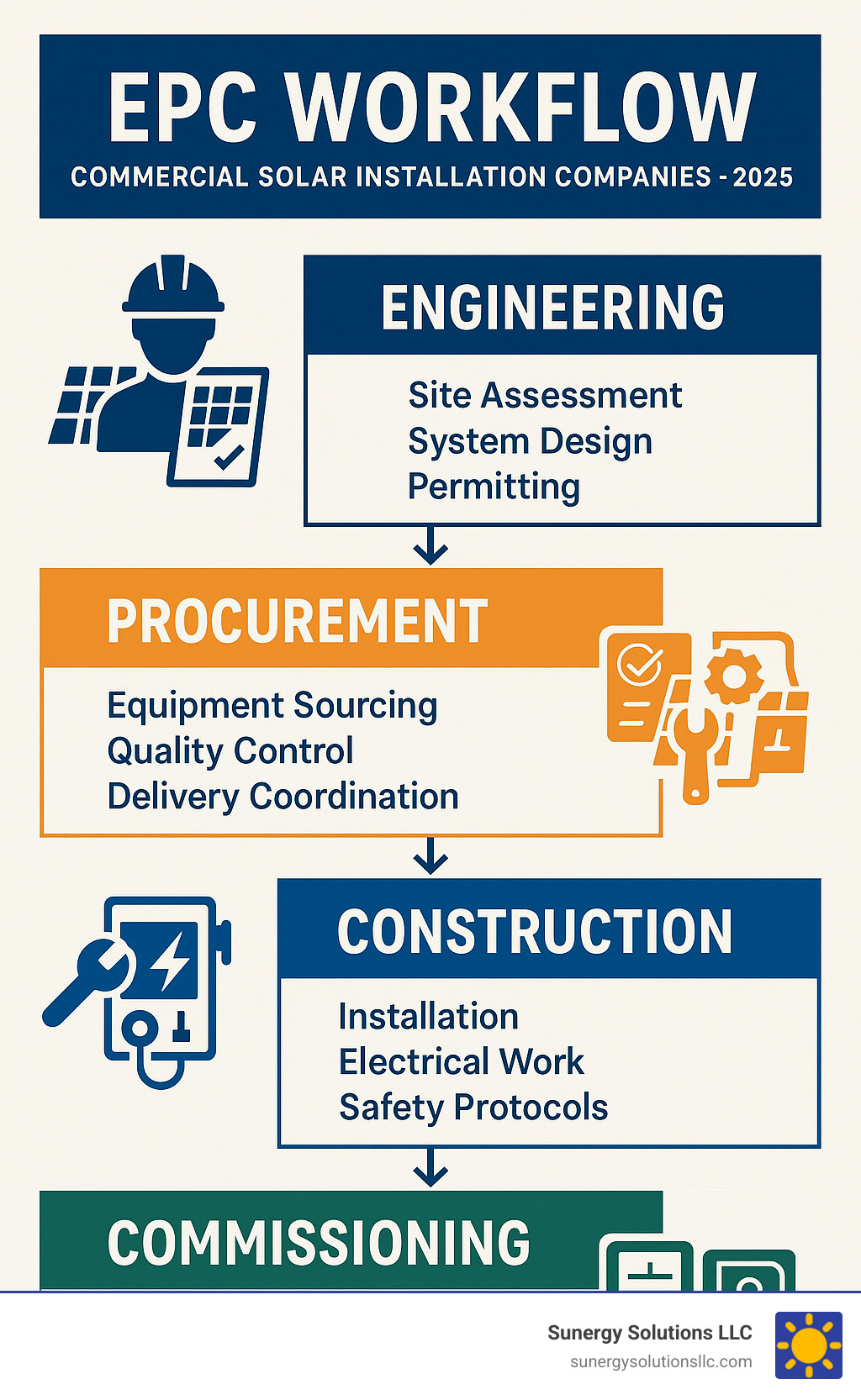
Local permitting expertise can make or break your project timeline. The best installers know your local building codes inside and out. They understand what your utility company expects and how your Authority Having Jurisdiction likes to see applications formatted. This insider knowledge can shave weeks off your project and prevent those frustrating delays that keep your energy savings on hold.
A proper site assessment goes way beyond someone climbing on your roof with a tape measure. The right installer will analyze your energy usage patterns over multiple seasons, evaluate how shadows move across your roof throughout the year, and assess whether your building structure can handle the additional load.
System design should feel custom-built for your business, because it is. Cookie-cutter approaches don’t work when you’re dealing with the unique energy demands of commercial operations. Your installer should use sophisticated modeling software to predict exactly how much energy your system will produce and optimize every panel placement for maximum efficiency.
Don’t underestimate the value of financing guidance. Commercial solar economics can get complicated fast, with Power Purchase Agreements, operating leases, and cash purchase options all offering different advantages. The best installers help you steer these choices while ensuring you capture every available incentive, including the substantial 30% Clean Technology Investment Tax Credit.
NABCEP certification is your assurance that the people designing and installing your system actually know what they’re doing. This isn’t just a nice-to-have credential—it’s the gold standard that separates trained professionals from well-meaning amateurs.
The top commercial solar installation companies also carry comprehensive insurance coverage that protects your business throughout the installation process. We’re talking general liability, workers’ compensation, and professional liability insurance.
Quality equipment sourcing makes a huge difference in your long-term satisfaction. Look for installers who use Tier 1 solar panels with defect rates below 0.05%—that’s dramatically better than the industry average of 1-2%. When they back that equipment with 25-year warranties covering panels, inverters, and workmanship, you know they’re confident in what they’re installing.
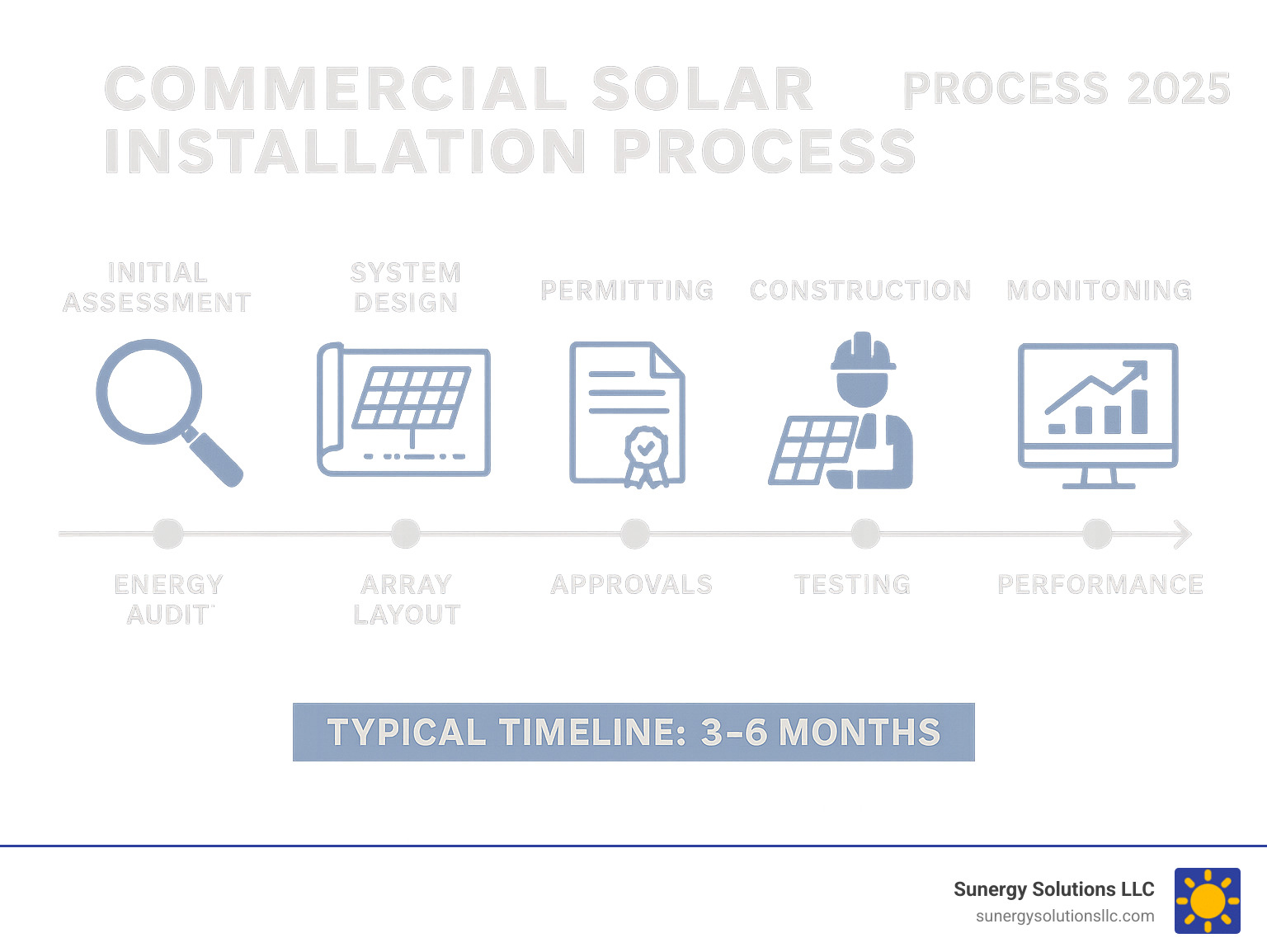
Getting solar installed for your business doesn’t have to feel overwhelming. After helping hundreds of companies through this process, I’ve found that understanding what happens at each stage makes everything smoother. Here’s how commercial solar installation companies guide you from that first “should we go solar?” conversation to flipping the switch on clean energy.
The entire journey typically takes 3-6 months from start to finish, though this can vary based on your project size and local permitting requirements. Most of this time involves background work by your installation team while you focus on running your business.
Step 1 begins with a comprehensive energy audit and feasibility analysis. Your installer will want to see 12-24 months of your utility bills to understand your energy patterns. This detective work helps design a system that matches your real-world needs.
The team also evaluates your physical space – whether that’s rooftop area, parking lots, or open land. They’re looking at structural capacity, shading from nearby buildings or trees, and how your electrical infrastructure can integrate with solar. This phase wraps up in 1-2 weeks with a preliminary report that tells you if solar makes sense for your situation.
Step 2 is where the magic happens – system design and proposal development. Using sophisticated modeling software, experienced commercial solar installation companies create a custom design optimized for your specific energy usage patterns.
Your proposal should include detailed production estimates showing exactly how much electricity your system will generate month by month. You’ll also see financial projections that factor in your local utility rates, available incentives, and different financing options. Quality installers take 2-3 weeks for this phase because they’re running multiple scenarios to find the optimal solution for your Solar Installation for Businesses.
Step 4 brings the excitement of actual construction and installation. For most commercial projects, the physical installation takes 1-3 weeks depending on your system size and any complexity factors like multiple roof levels or electrical upgrades.
The best commercial solar installation companies maintain detailed project schedules and keep you updated on progress. You’ll see the change happen quickly once construction begins – panels going up, electrical connections being made, and your future energy savings taking shape.
Step 3 – the permitting and approvals phase – often tests business owners’ patience because it feels like nothing visible is happening. But behind the scenes, your installer is navigating a complex web of approvals that can make or break your project timeline.
This is where working with experienced commercial solar installation companies really pays off. They know which Authority Having Jurisdiction (AHJ) offices move quickly and which ones require extra documentation. Some municipalities have streamlined solar permitting that takes just days, while others might require multiple review cycles stretching over weeks.
Utility interconnection paperwork adds another layer of complexity for commercial installations. Unlike residential systems, larger commercial arrays may require grid impact studies to ensure your solar production won’t negatively affect local electrical infrastructure. Your installer handles all this coordination, but the utility’s timeline is largely outside everyone’s control.
The permitting phase typically takes 4-8 weeks, though we’ve seen it stretch longer in areas with backlogged permitting offices.
Step 5 – commissioning and activation – marks the official start of your solar savings, but it’s really just the beginning of your relationship with quality commercial solar installation companies.
Final inspections ensure everything meets code requirements and safety standards. Once your local authority and utility sign off, your system gets the green light to start producing power. Most installers provide training on how to monitor your system’s performance and understand your production reports.
Remote diagnostics capabilities are game-changers for commercial solar. Your installer can monitor system performance in real-time and often identify and resolve issues without stepping foot on your property.
Performance monitoring becomes part of your routine, though it’s usually as simple as checking a smartphone app or web portal. You’ll see daily, monthly, and annual production data that shows exactly how much money you’re saving and how much carbon emissions you’re avoiding.
Preventive maintenance keeps your investment performing optimally throughout its 25+ year lifespan. Most commercial systems benefit from annual professional cleaning and inspection, with more frequent service recommended in dusty environments or areas with heavy bird activity.
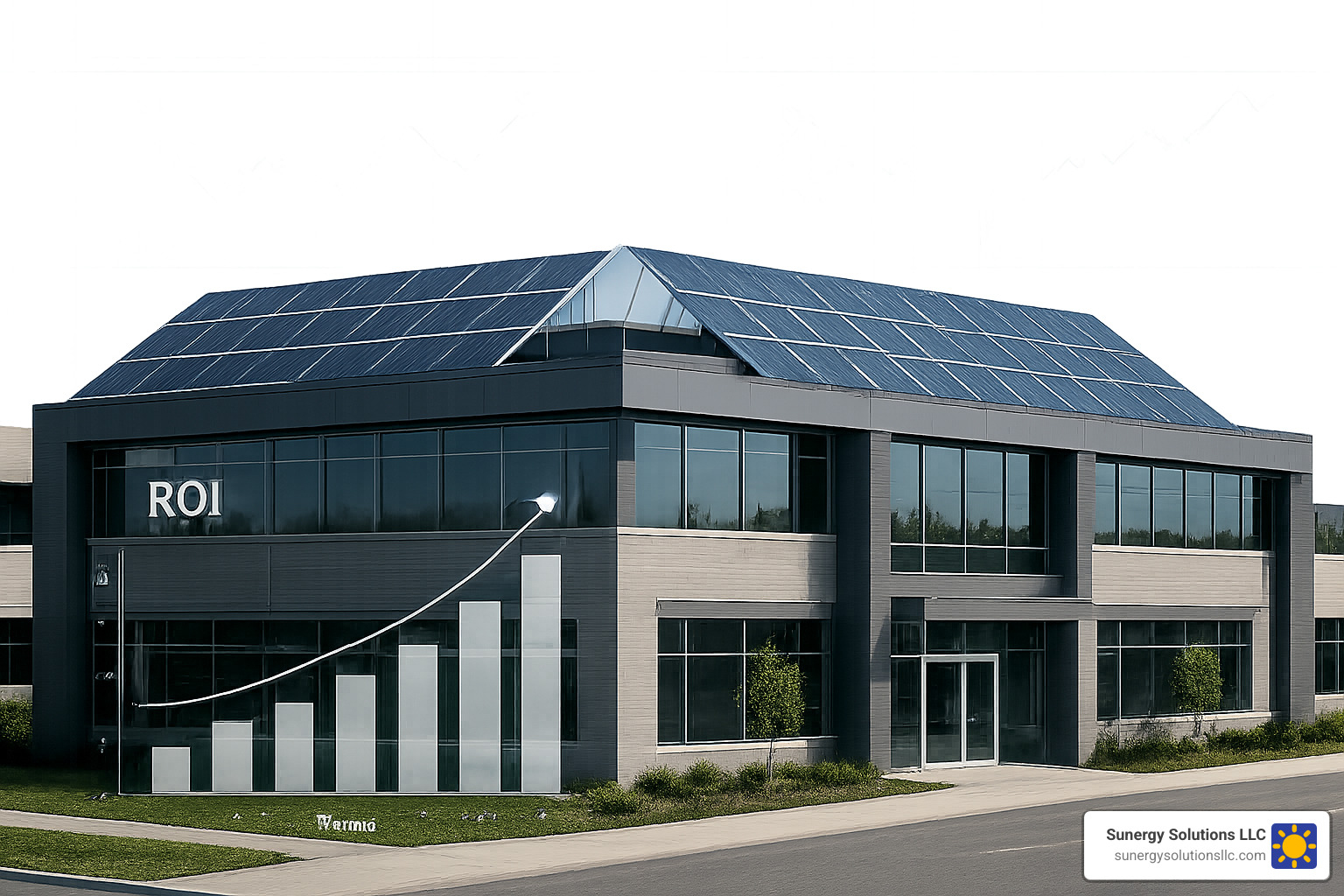
Here’s something that might surprise you: the biggest barrier to commercial solar isn’t the technology anymore—it’s understanding all the financial options available. The numbers have never looked better for businesses ready to make the switch.
The Clean Technology Investment Tax Credit (CTITC) alone puts 30% of your installation costs back in your pocket through federal tax credits. But that’s just the beginning. The Accelerated Capital Cost Allowance (ACCA) lets you deduct 50% of your solar equipment costs each year, or if you’re quick about it, 100% in the first year for systems installed before 2028.
Smart commercial solar installation companies know how to time your project to maximize these benefits. I’ve seen businesses save tens of thousands just by understanding when to install and how to structure their purchase.
The financing landscape has evolved dramatically too. Through partnerships with Commercial Solar Financing Companies, virtually any business can go solar regardless of cash on hand. Cash purchases give you full ownership and all tax benefits. Solar loans let you own the system with little to no money down while keeping those valuable tax credits. Power Purchase Agreements (PPAs) require zero upfront investment—you simply buy the power at a lower rate than your utility. Operating leases split the difference, giving you some tax benefits with no upfront costs.
| Financing Option | Upfront Cost | Ownership | Tax Benefits | Typical Term |
|---|---|---|---|---|
| Cash Purchase | Full system cost | You own | All benefits | N/A |
| Solar Loan | $0-20% down | You own | All benefits | 10-20 years |
| Power Purchase Agreement (PPA) | $0 | Third party | None | 15-25 years |
| Operating Lease | $0 | Leasing company | Depreciation only | 7-10 years |
The real magic happens when experienced commercial solar installation companies look beyond simple electricity generation. They understand your business operates differently than a home—and your savings strategy should too.
Demand charge reduction is huge for most commercial customers. You’re not just paying for the electricity you use; you’re paying for your peak demand too. A well-designed solar system can slash these demand charges by offsetting your consumption during those expensive peak periods.
Peak shaving is another game-changer. Your solar system generates the most power during the day when electricity rates are typically highest. It’s like getting paid premium prices for every kilowatt-hour your panels produce.
Net-metering credits work differently for commercial customers, but they still add up. When your building uses less power on weekends but your panels keep generating, those credits offset your weekday consumption.
At Sunergy Solutions LLC, we’ve helped businesses reduce their energy costs by 50-80% through properly designed systems. The secret isn’t just installing panels—it’s understanding how your business uses power and designing around that reality.
Most of our commercial clients see their systems pay for themselves within 7-10 years. After that? It’s essentially free electricity for the next 15+ years. When you think about it that way, solar isn’t really an expense—it’s buying 25+ years of electricity at today’s prices.
Solar panels come with 25-year performance warranties but are built to last much longer. We regularly see systems from the 1980s still producing power. The panels themselves can easily run for 40+ years with basic maintenance.
The one major expense to plan for is inverter replacement after 15-20 years. Quality commercial solar installation companies factor this into their financial projections upfront, so there are no surprises down the road.
Here’s why installer selection matters so much: you’re making a 25+ year investment. You want a company that will still be around to honor warranties and provide service throughout your system’s lifespan. That’s exactly why we focus on building long-term relationships with our commercial clients—your success is our success.
The short answer? Almost any business can benefit from solar, but some are absolute slam dunks for commercial solar installation companies.
Manufacturing facilities top our list because they’re energy-hungry operations with those beautiful, wide-open roof spaces perfect for solar arrays. We’ve worked with manufacturers who’ve cut their electricity bills by 70% or more – that’s real money flowing straight to their bottom line.
Warehouses and distribution centers are another sweet spot. These buildings often have minimal rooftop equipment cluttering up the space, giving us plenty of room to design efficient solar installations. Plus, their consistent daytime energy usage aligns perfectly with peak solar production hours.
Retail stores are finding that solar does double duty – reducing operating costs while boosting their green credentials with environmentally conscious customers. It’s a win-win that shows up in both their utility bills and their brand reputation.
Don’t overlook agricultural operations either. Barns, processing facilities, and available land create fantastic opportunities for solar installations. Farmers are some of the most practical business owners we work with, and they love the long-term predictability solar brings to their energy costs.
Healthcare facilities represent a growing market for commercial solar installation companies. These operations need reliable power and appreciate both the cost savings and backup power options that solar-plus-storage systems can provide.
The ideal solar candidate has consistent energy usage, a roof in decent condition, minimal shading, and plans to stay put for the long haul. But here’s the thing – we’ve successfully partnered with installation companies to find creative solutions for challenging sites too, including buildings with complex rooflines or shading issues.
Most business owners want to know: “When will I start saving money?” The typical answer is 3-6 months from handshake to flipping the switch, but let me break down what happens during that time.
The first 2-4 weeks involve getting to know your business – analyzing your energy bills, evaluating your property, and designing a system that fits your specific needs. This is where the magic happens in terms of optimizing your future savings.
Permitting and approvals take 4-8 weeks, and honestly, this phase can make or break your timeline. Commercial solar installation companies with strong local relationships and permitting experience can steer this maze much faster than newcomers to your area.
Equipment procurement usually takes 2-4 weeks, but smart installers often handle this simultaneously with permitting to avoid delays.
The actual installation is surprisingly quick – typically just 1-3 weeks depending on your system size. It’s amazing how fast a professional crew can transform your roof once they get started.
Final commissioning and activation wrap up in 1-2 weeks, involving inspections, utility approval, and system testing.
Here’s a pro tip: larger systems over 1 MW may need additional utility studies that can extend timelines. And if you’re in a northern climate, winter weather can slow things down. The best commercial solar installation companies plan for these variables and communicate realistic timelines upfront.
One of the beautiful things about solar is how little babysitting it needs once it’s running. But “low maintenance” doesn’t mean “no maintenance.”
Annual professional maintenance is your system’s yearly checkup. A qualified technician will inspect electrical connections, run diagnostics on inverters, check mounting hardware, and verify performance. For most commercial systems, this runs $150-600 depending on size and complexity – a small price for protecting a six-figure investment.
Continuous monitoring happens behind the scenes through remote monitoring systems. Quality commercial solar installation companies provide 24/7 monitoring that automatically alerts you (and them) if anything’s not performing as expected. It’s like having a security system for your solar investment.
Panel cleaning might be needed depending on your location. If you’re in a dusty area or have lots of birds treating your panels like a rest stop, occasional cleaning can boost performance. Many systems stay clean naturally through rain, but it’s worth discussing with your installer.
The one major expense to plan for is inverter replacement after 15-20 years. Think of inverters as the hardest-working component in your system – they convert DC power from panels to AC power your business can use. Replacement typically costs $1,000-3,500 depending on system size, but that’s spread over nearly two decades of service.
The smartest approach? Work with commercial solar installation companies that offer comprehensive maintenance packages. You get peace of mind, optimal performance, and someone to call when you have questions – all rolled into one predictable annual cost.
The path to commercial solar success starts with one crucial decision: choosing the right commercial solar installation companies to power your business change. After nearly a decade in the renewable energy industry, I’ve seen how this choice can make or break your solar investment.
The difference between working with a quality installer and settling for less can cost you thousands in lost savings, unexpected downtime, and the kind of headaches that keep business owners up at night. But when you partner with the right team, commercial solar becomes one of the smartest investments you’ll ever make for your company.
At Sunergy Solutions LLC, we’ve spent years building relationships with the most qualified commercial solar installation companies across Maine, Massachusetts, New Hampshire, Rhode Island, Vermont, Montana, and Virginia. Our approach is simple: we handle the complexity so you don’t have to. From initial feasibility through decades of performance monitoring, you get one trusted partner managing your entire solar journey.
The financial opportunity in front of businesses today is remarkable. The 30% Clean Technology Investment Tax Credit combined with 100% first-year depreciation for systems installed before 2028 creates an unprecedented chance to slash energy costs while building your sustainability credentials. These incentives won’t last forever, and energy prices aren’t getting any cheaper.
Whether your goal is reducing operating expenses, protecting against rising utility costs, or demonstrating environmental leadership to customers and employees, commercial solar delivers results that impact your bottom line for decades. The businesses making this transition now are positioning themselves for long-term competitive advantage.
Your company deserves an installation partner that understands commercial energy challenges and has the expertise to deliver lasting solutions. The right commercial solar installation companies don’t just install equipment – they become partners in your business success, providing the support and service you need throughout your system’s 25+ year lifespan.
Ready to find what commercial solar can do for your business? Explore how Commercial Solar Power: A Smart Business Decision and join the growing number of companies using solar to power their future success.
The opportunity is here. The technology is proven. The incentives are strong. Now it’s about choosing the right partner to help you capture maximum value from your solar investment. Make that choice wisely, and you’ll be generating savings and supporting your business goals for decades to come.
Appointments Available, 7 Days a Week


