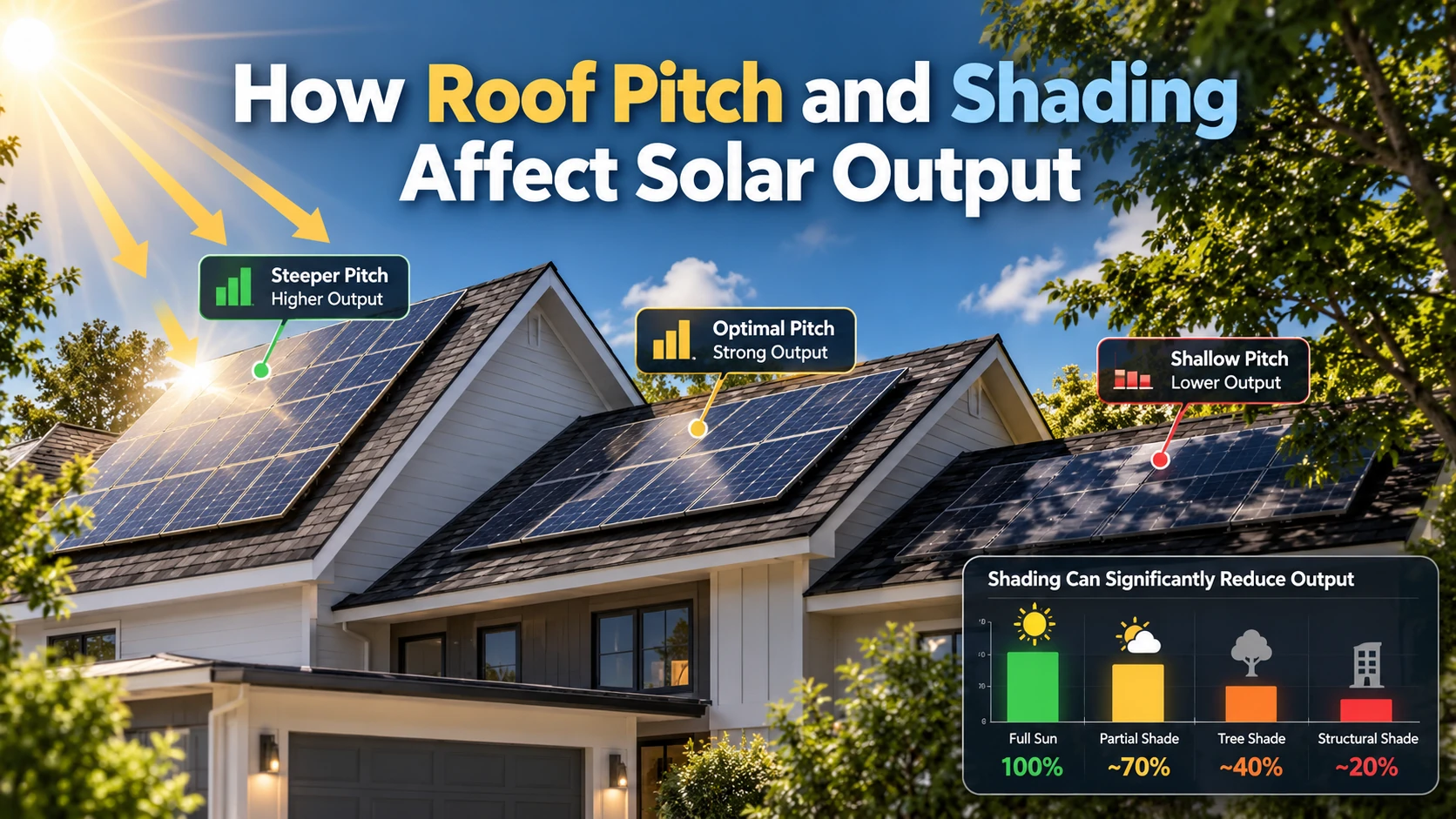
Roof pitch and shading both affect how much electricity your solar panels produce, but not by the same amount.
A roof pitched outside the 15 to 40 degree range usually costs only a few percent of annual output.
Even light shading on just one panel can cut production far more than that.
Here’s what the numbers actually show, and how to tell if your roof is a good fit for solar.
Ask three solar companies whether your roof will work for solar, and you might get three different answers.
One says your roof is too flat.
Another says the oak tree in your yard is a dealbreaker.
A third says it’s fine, no explanation given.
The truth is that roof pitch and shading affect solar output in very different ways and by very different amounts.
Pitch is usually forgiving.
Shading almost never is.
Once you understand how each one actually works, you can look at your own roof and know roughly what to expect, instead of guessing.
GET THE MOST OUT OF YOUR SOLAR
What Roof Pitch and Shading Actually Do to Your Solar Output
Roof pitch is the angle of your roof measured from flat ground, and it determines how directly sunlight hits your panels through the seasons.
Shading is anything that blocks sunlight from reaching a panel, even briefly or partially.
Pitch changes output gradually, often by just a few percent outside the ideal range.
Shading can cut output sharply, sometimes by 50 percent or more from a single blocked panel, because of how solar panels are wired together.
Think of pitch as a dial you can be a little off on without much penalty.
Shading is closer to a switch.
Once a panel is blocked, the loss shows up fast, and it is rarely proportional to how much shade is actually there.
Solar panels generate power by converting sunlight directly into electricity, so anything that changes how much direct sunlight reaches the cells changes how much electricity comes out the other end.
Why Roof Pitch Matters More Than You’d Think
Most homes in the Northeast have roofs pitched somewhere between 20 and 45 degrees, which happens to land right in the range solar panels like best.
The Ideal Pitch Range
The Department of Energy generally recommends south-facing roof pitches between 15 and 40 degrees for solar panels, with the sweet spot close to your local latitude.
That’s a wide window, not a narrow target.
Being a few degrees outside that range rarely ends a solar project.
A roof pitched at 18 degrees instead of the mathematically ideal angle for its location typically gives up only about 2 percent of its annual output compared to a perfectly optimized tilt.
That’s a rounding error next to what shading can do.
What Happens If Your Roof Is Flatter or Steeper Than That
Very flat roofs and very steep roofs both have workarounds.
On a low-slope or flat roof, installers mount panels on angled racking that tilts them up to the right angle regardless of what the roof itself is doing.
Different mounting approaches exist for exactly this reason.
Steep roofs and roofs with unusual materials, like standing seam metal roofs, use specialized clamps and racking instead of traditional penetrating mounts.
The panels still end up at a workable angle.
The hardware just looks different.
Does Roof Direction Matter as Much as Pitch?
Roof direction, also called orientation, generally matters more than pitch.
A south-facing roof produces the most energy.
Southeast or southwest-facing roofs produce about 8 percent less, and east or west-facing roofs produce about 15 percent less.
North-facing roofs lose the most, producing roughly 30 percent less than true south.
Being slightly off from true south barely matters.
Panels angled10 degrees off the ideal direction lose less than 1 percentof their production.
It’s only once a roof turns toward east, west, or north that the difference becomes noticeable.
Direction tends to get more attention than shading, but it shouldn’t.
A shaded roof that faces due south can still underperform a nearby section of roof that faces slightly off south but stays in full sun all day.
Shade usually needs to be ruled out before direction becomes the deciding factor.
How Much Does Shading Really Cut Into Solar Output?
Shading has a bigger effect than most people expect because of how solar panels are wired.
Research from Stanford found thatshading just one cell out of 36 in a panel can reduce that panel’s output by up to 75 percent.
A small shadow from a chimney or branch doesn’t cause a small loss.
It causes a disproportionately large one.
Why One Shaded Panel Can Drag Down an Entire Array
Solar panels are typically wired together in a series string, similar to old-style string lights where one dead bulb can dim the whole strand.
When one cell or panel is shaded, it limits how much current can flow through the entire string, not just the shaded section.
That’s why partial shading on a single panel in an array of twenty can still measurably lower your home’s total solar production, even though nineteen panels are sitting in full sun.
The math doesn’t work like simple percentages.
A little shade can mean a lot less power.
This is also why shading is worth taking seriously before signing a contract, since it changes how quickly a solar system pays for itself far more than pitch or minor direction differences ever will.
GET THE MOST OUT OF YOUR SOLAR SYSTEM
Common Culprits Behind Roof Shading
Shade doesn’t always come from the obvious source.
- Mature trees: Even trees that look far from the roof can cast long shadows at certain times of day or year.
- Chimneys and roof vents: Tall roof features throw short shadows at midday but longer ones in the morning and evening.
- Dormers, valleys, and roof peaks: Multi-level roofs can shade their own lower sections.
- Neighboring buildings: A two-story house or garage next door can block low-angle sun, especially in fall and winter.
Why Shade Patterns Change With the Seasons
Shade isn’t fixed.
The sun sits much lower in the sky during winter than summer, and this stretches every shadow across your roof.
A tree that clears your panels easily in July can shade part of the array in January, right when you can least afford to lose production.
This happens because of simple geometry: the lower the sun sits in the sky, the longer every shadow stretches.
In New England and the Mid-Atlantic, tall deciduous trees lose their leaves in winter but still cast long shadows from bare branches, and the low winter sun angle brings shade into play earlier in the afternoon than most homeowners expect.
A proper shading assessment should account for the worst-case season, not just how the roof looks on a sunny day in June.
Can Technology Make Up for a Less-Than-Perfect Roof?
Microinverters and power optimizers can recover much of the loss caused by shading, though not all of it.
In one test of a shaded home in Palo Alto, switching from a standard string inverter to microinverters or optimizers increased annual output by about 17 percent, because each panel could operate independently instead of being limited by its most shaded neighbor.
Microinverters and Power Optimizers
A standard string inverter treats an entire row of panels as one unit, so the weakest, most shaded panel sets the pace for all of them.
Microinverters and power optimizers work at the panel level instead, letting unshaded panels keep producing at full capacity even when one or two panels nearby are blocked.
This technology helps with shading.
It doesn’t fix a roof that faces the wrong direction or sits at a poor angle, since those limits apply evenly across every panel rather than to just a few.
When a roof has too much shade or too little usable space to make sense, a ground-mounted system placed elsewhere on the property is sometimes the better answer than fighting the roof’s limitations.
How Sunergy Solutions Evaluates Your Roof for Solar
At Sunergy Solutions, we look at pitch, direction, and shading together during every site assessment, because none of them tell the full story on their own.
Our team maps shadow patterns across the seasons, not just the day we happen to be on your roof, so the numbers we give you reflect a full year, not a single sunny afternoon.
Because we handle roofing and residential solar installation as one company, we also look at something most solar-only installers can’t speak to with much confidence: how much life is left in your roof.
A roof with less than about five years of useful life left is usually worth replacing before solar goes on, so you’re not paying to remove and reinstall panels a few years down the road.
If you’re not sure where your roof stands, a professional roof inspection is the easiest way to find out before you commit to anything.
CONTACT US
How Do You Know If Your Roof Is a Good Fit for Solar?
Your roof is likely a good fit for solar if it gets strong direct sun for most of the day, faces anywhere from southeast to southwest, and has a pitch somewhere in the 15 to 40 degree range.
None of those have to be perfect.
The one thing worth taking seriously is heavy, consistent shading, since that’s the factor with the biggest real impact on output.
If you want a quick gut check before bringing in a professional, our guide on figuring out if your roof is a good fit for solar walks through the same factors in more detail, along with a look at the pros and cons of putting solar on a roof versus other options.
The roofs that work best for solar are rarely the ones with a flawless pitch and a textbook-perfect compass heading.
They’re the ones that get consistent, unobstructed sun.
Sunergy Solutions can map out exactly what your roof’s pitch, direction, and shade patterns mean for your energy output, and tell you honestly whether your roof is ready now or needs a little work first.
GET A FREE ESTIMATE
FAQs
What is the ideal roof pitch for solar panels?
Most solar panels perform best on roofs pitched between 15 and 40 degrees, with the ideal angle usually landing close to your home’s latitude. Roofs outside this range still work. They just lose a small percentage of annual output rather than becoming unusable.
Does my roof need to face south for solar panels to work?
No. South-facing roofs produce the most energy, but southeast and southwest-facing roofs typically produce only about 8 percent less, and east or west-facing roofs produce roughly 15 percent less. All of these are workable, especially compared to the impact of heavy shading.
How much shade is too much for solar panels?
Even shade that covers a small part of a single panel can cause a disproportionately large drop in output, since panels are wired together in strings. Consistent shade during peak sun hours, especially in winter when the sun sits lower, is the kind worth addressing before installation.
Can I still go solar if my roof is flat or very steep?
Yes. Flat and low-slope roofs typically use angled racking to tilt panels to a better angle, and steep roofs use specialized mounting hardware. Neither roof shape rules out solar on its own.
Will microinverters fix a shading problem on my roof?
Microinverters and power optimizers can recover much of the lost output from partial shading by letting each panel operate independently, but they can’t fully replace the production lost from a panel that stays shaded. They won’t correct a poor roof direction or pitch either, since those affect every panel equally.
Should I replace my roof before installing solar panels?
If your roof has less than about five years of useful life left, it’s usually worth replacing before adding solar, since removing and reinstalling panels later adds cost. A professional roof inspection can tell you where your roof actually stands.