
5.0 Rating
Request A Free Estimate
Residential ground mount solar systems offer a powerful alternative when your roof isn’t ideal for solar panels. Whether you’re dealing with shading issues, structural concerns, or simply want maximum energy production, ground-mounted arrays can deliver 20-25% more power than rooftop installations.
Quick Answer: What You Need to Know About Residential Ground Mount Solar
Ground-mounted solar makes sense when you have available land with good sun exposure. The systems use the same solar panels as rooftop installations but mount them on ground-level racking systems. This allows you to position panels at the perfect angle and orientation – something that’s often impossible with existing roof slopes.
The higher upfront cost comes from additional materials like concrete foundations, trenching, and specialized racking hardware. However, the increased energy production from optimal positioning can offset these costs over time.
I’m Robert Raffa, CEO and Founder of Sunergy Solutions LLC, where I’ve spent nearly a decade helping Northeast homeowners transition to clean energy through high-performance solar installations. My experience in residential ground mount solar projects has shown me that these systems often provide the best long-term value when roof conditions aren’t optimal.
When we evaluate properties for solar installations, we often find that rooftop limitations force homeowners to compromise on system performance. Ground mount systems eliminate these constraints entirely.
Space limitations are the most common issue we encounter. Many homes have complex roof lines with dormers, chimneys, or HVAC equipment that create shading and reduce available installation area. Ground mount systems let you use any suitable open land on your property.
Roof issues frequently make rooftop installations problematic. Aging shingles, structural concerns, or steep slopes can rule out roof mounting. Ground mount systems bypass these issues entirely.
Higher production is perhaps the most compelling advantage. While rooftop systems are limited by your roof’s orientation and tilt, ground mount arrays can face true south at the optimal angle for your latitude. This positioning advantage typically results in 15-25% more energy production than comparable rooftop systems.
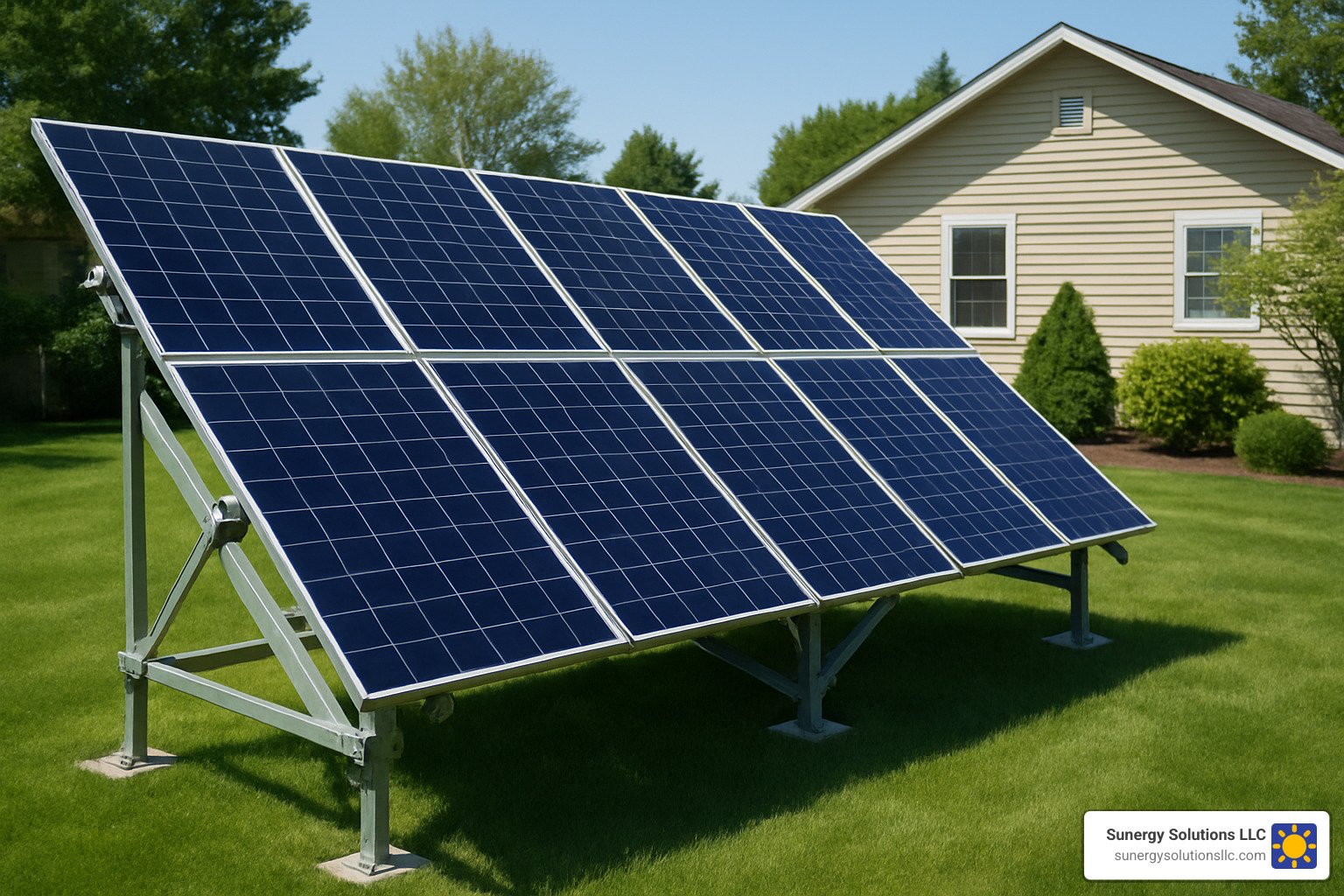
Residential ground mount solar systems give your solar panels the freedom to find their perfect spot. Instead of being stuck with whatever angle your roof happens to have, these systems let you position panels exactly where they’ll perform best – right in your yard at ground level.
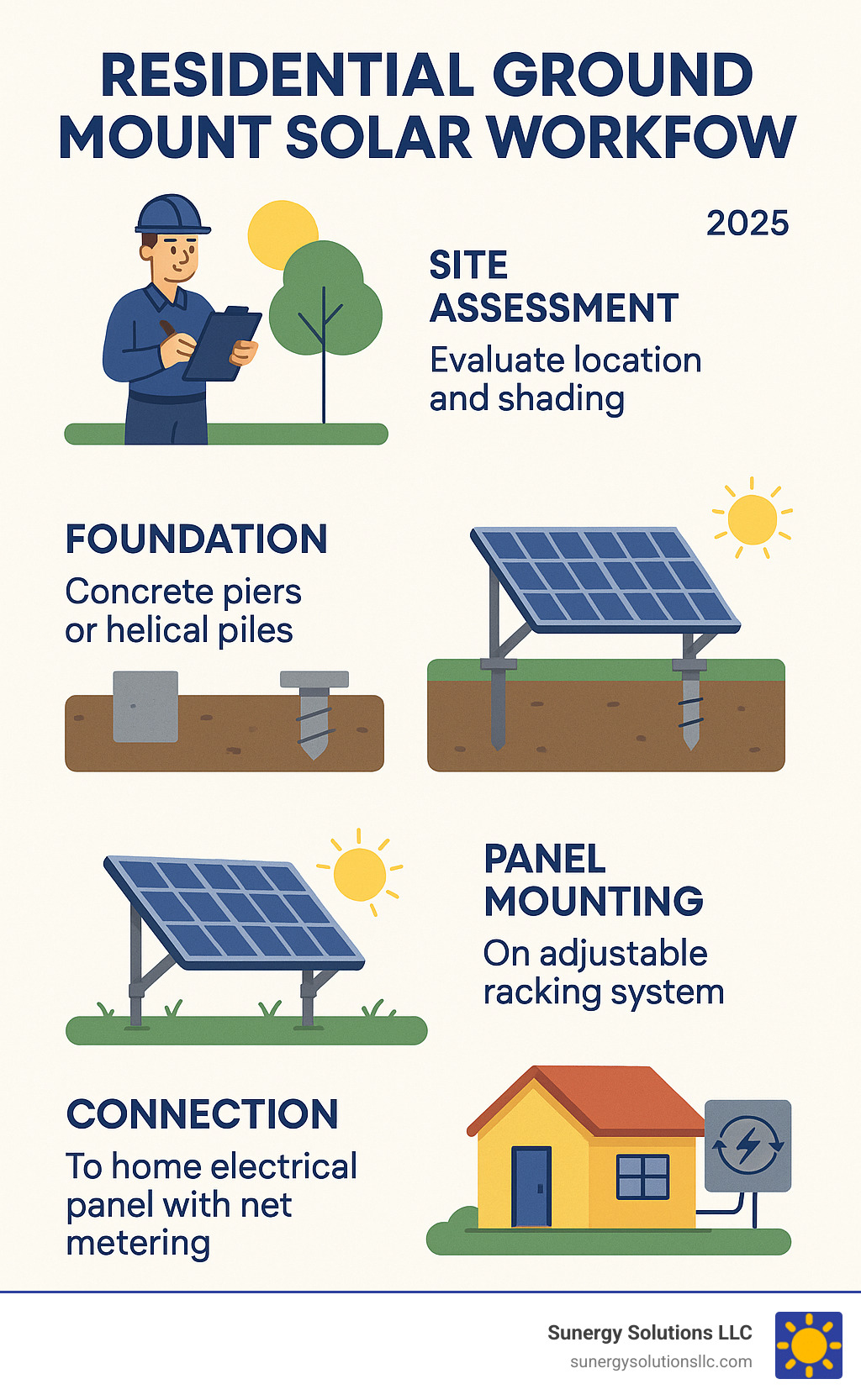
The systems work through specialized racking that holds panels securely above the ground using concrete piers, helical piles, or other foundation systems. This setup gives panels breathing room and optimal sun exposure.
Here’s what makes ground mount systems effective: precise control over positioning. While your roof might face northeast with a steep slope, ground mount arrays can face true south at the perfect tilt angle. This positioning advantage alone can boost energy production by 15-25%.
The electrical side works just like rooftop systems. Solar panels convert sunlight into DC electricity, which flows through wiring to inverters that transform it into AC power for your home. The main difference is flexibility – we can position everything for maximum efficiency.
Scientific research on residential solar performance confirms that proper system design significantly impacts long-term energy production.
For more details on how solar panels generate electricity, see our guide on solar panels and their efficiency.
The solar panels we use are often the same high-efficiency modules that would go on your roof, but ground mounting opens up more options. We can use larger commercial-grade 72-cell panels that might be too heavy for residential roofs.
Racking systems form the backbone that holds everything together. Quality racking uses aluminum rails and galvanized steel hardware designed to last decades outdoors. Premium systems incorporate ZAM® steel with zinc-aluminum-magnesium coating for superior corrosion resistance.
Foundation choice depends on soil conditions. Concrete piers work reliably in most soil types. Helical piles excel in rocky or unstable soils. Screw-pile anchors offer quick installation in suitable conditions.
Tracking systems represent the premium upgrade option. These motorized systems automatically follow the sun’s path, boosting energy production by 25-35%, though the added complexity requires careful cost consideration.
Standard fixed-tilt systems offer the sweet spot of performance and simplicity. These mount panels at a fixed angle and stay put year-round. Some allow manual seasonal adjustments to optimize for summer and winter sun angles.
Pole-mount systems work well for smaller installations up to 10-12 panels. A single central pole supports the entire array, perfect for tight spaces or challenging terrain.
Single-axis tracker systems automatically follow the sun’s east-to-west journey throughout the day, typically increasing energy production by 20-25% compared to fixed systems.
Dual-axis tracker systems provide maximum energy capture by adjusting both horizontal rotation and vertical tilt, boosting production by 30-35%. However, the added complexity often makes it more cost-effective to install additional fixed panels.
Residential ground mount solar systems cost more upfront than rooftop installations, but that extra cost often pays for itself through better performance and easier maintenance.
Ground mount systems typically run about $3.44 per watt compared to $2.75 per watt for rooftop systems. For an average home, that translates to roughly $60,200 for a 17.5 kW ground mount system versus $29,160 for a 10.8 kW rooftop system before incentives.
After applying the 30% federal tax credit, you’re looking at $42,140 for the ground mount system and $20,412 for the rooftop installation. The higher cost comes from concrete foundations, trenching for electrical connections, and specialized racking hardware.
But ground mount systems often produce 15-25% more energy than comparable rooftop installations because we can position panels at the perfect angle and orientation.
Better air circulation around ground-mounted panels keeps them cooler, which means they operate more efficiently. Plus, there’s no shading from chimneys or other roof features.
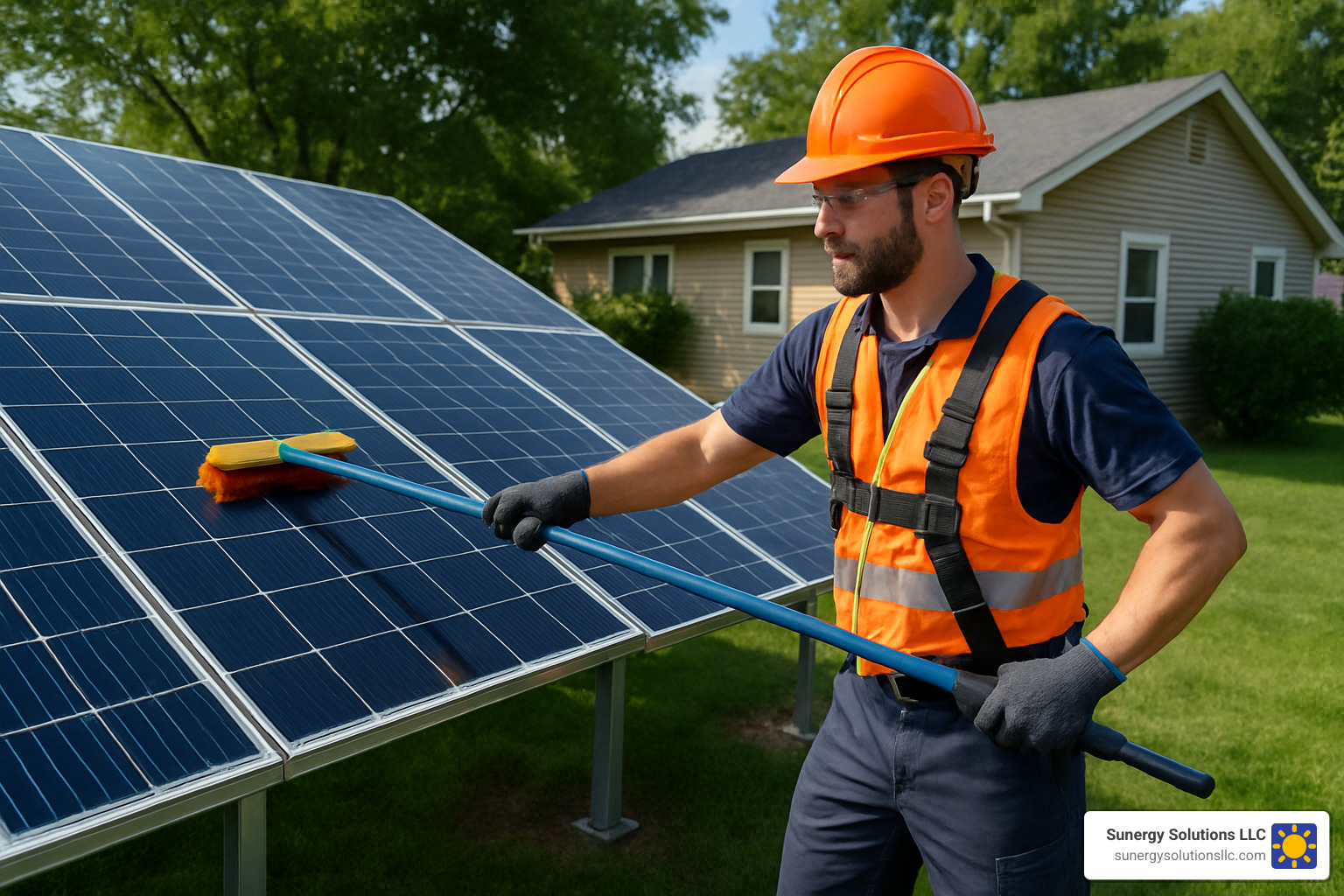
The maintenance advantages are significant. When it’s time to clean panels or inspect connections, you’re working at ground level instead of climbing on your roof. This means lower maintenance costs and safer service calls.
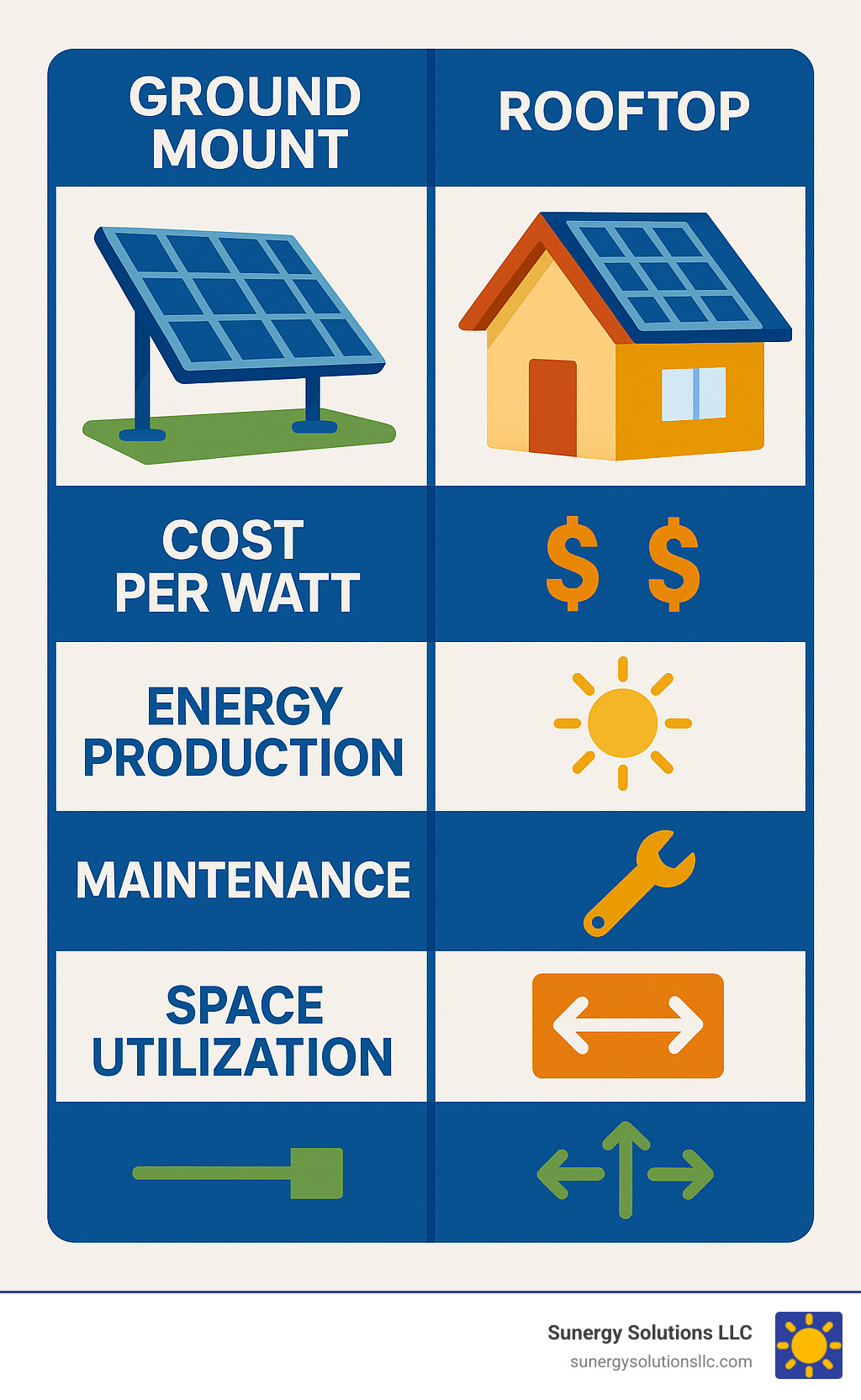
| Factor | Ground Mount | Rooftop |
|---|---|---|
| Cost per watt | $3.44 | $2.75 |
| Energy production | 15-25% higher | Standard |
| Maintenance ease | Excellent | Challenging |
| Aesthetic impact | More visible | Discrete |
| Land use | Requires yard space | Uses existing roof |
| Permitting complexity | Moderate | Simple |
You’ll need a minimum of 350-600 square feet of open land for a typical residential ground mount system. A 10 kW system typically requires about 600 square feet, while a 15 kW system might need 800-900 square feet.
The calculation isn’t just about panel area – you need additional space for row spacing to prevent panels from shading each other, especially during winter months.
Shading analysis becomes crucial when selecting the perfect spot. We use specialized software to map sun patterns throughout the year, identifying the location on your property that gets maximum solar exposure.
Setback requirements vary by location but typically require systems to sit at least 10-20 feet from property lines. Some municipalities have height restrictions or require visual screening.
Soil conditions play a bigger role than most homeowners expect. Rocky soil might require special equipment, while poor drainage can impact stability. For larger systems, we often recommend soil tests.
The 30% federal Investment Tax Credit (ITC) applies equally to ground mount and rooftop systems. For a typical $60,200 ground mount system, you’re looking at $18,060 in federal tax savings.
State and local incentives vary dramatically across regions. Some states offer additional rebates, performance-based incentives, or property tax exemptions.
Net metering policies become particularly valuable with ground mount systems since their higher production often generates more surplus energy than rooftop installations.
For comprehensive information about available incentives, check out the Database of State Incentives for Renewables & Efficiency or our guide on residential solar tax incentives.
When you combine federal tax credits, state incentives, and net metering benefits, the effective cost of ground mount systems often drops by 40-50% or more.
After installing hundreds of residential ground mount solar systems, I’ve learned that component selection makes or breaks long-term system performance. The outdoor environment is unforgiving – your racking system will face decades of weather that would challenge any structure.
The difference between a system that thrives for 25+ years and one requiring constant repairs comes down to quality materials and proven designs. We’ve seen homeowners struggle with systems using subpar components to save upfront costs, only to face expensive repairs within years.
Premium racking systems should combine corrosion-resistant materials with thoughtful engineering. The best systems use stainless steel fasteners, aluminum rails, and galvanized steel structures.
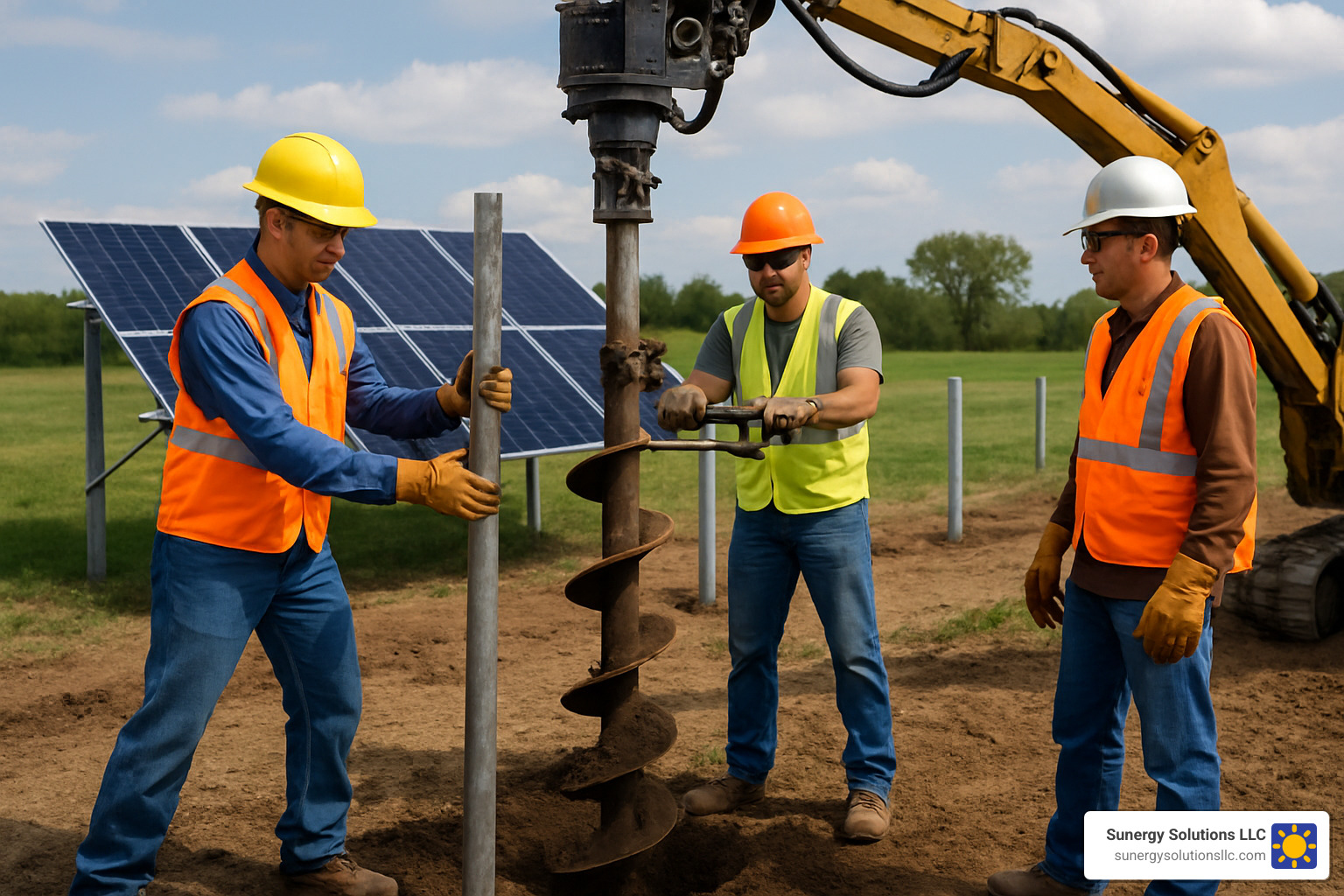
Foundation selection depends on site conditions. Concrete piers work in most soil types. Helical piles excel in rocky terrain. Screw-pile anchors offer quick installation with minimal ground disturbance.
For ground mount systems, larger commercial-grade panels that might be too heavy for residential roofs work perfectly. We typically recommend Tier 1 monocrystalline panels with 400+ watt ratings.
For comprehensive foundation information, check our guide on ground mount solar foundations.
ZAM® steel racking systems represent the premium option for harsh weather climates. The zinc-aluminum-magnesium coating provides superior corrosion resistance. These systems typically come with 5-10 year warranties.
Aluminum rail systems offer excellent choice for coastal areas or high humidity regions. While more expensive than steel alternatives, aluminum systems resist corrosion naturally.
Seasonal tilt adjustment systems provide middle ground between fixed systems and expensive tracking systems. These allow manual adjustment twice yearly, providing 5-10% increase in annual energy production.
Monocrystalline panels with 400+ watts have become our go-to choice. These panels typically deliver 19-22% efficiency ratings with strong performance warranties.
String inverters excel in ground mount systems where you can achieve uniform installation conditions. Modern string inverters include monitoring capabilities and required rapid shutdown features.
Microinverters make sense when you want panel-level monitoring or need varying panel orientations. While more expensive, they optimize each panel’s performance individually.
DIY installation kits can provide substantial cost savings for homeowners comfortable with construction projects. Quality DIY kits include detailed instructions, all necessary hardware, and technical support.
Professional installation offers significant advantages in permitting, electrical connections, and warranty coverage. Professional installers handle all permits, inspections, and utility interconnections.
Essential tools for DIY installation include concrete mixer, post-hole digger, trenching equipment, electrical conduit bender, torque wrench, digital multimeter, and basic hand tools.
The installation process for residential ground mount solar systems follows a systematic approach that ensures optimal performance and long-term reliability.
Site preparation begins with detailed survey to identify optimal location and orientation. We stake out the array location, mark utility lines, and prepare access routes.
Permitting requirements vary by location but typically include building permits, electrical permits, and utility interconnection agreements. We handle all permit applications and ensure code compliance.
Foundation installation typically represents the most labor-intensive phase. Concrete piers require excavation, form setting, and concrete placement. Proper foundation installation is critical for system stability.
For comprehensive maintenance information, see our guide on maintenance and cleaning of residential solar systems.
Site survey and design begins with evaluating available space, sun exposure, and site conditions. We use solar pathfinder tools to assess shading throughout the year.
Foundation installation varies by type but typically involves excavation, concrete placement, and anchor bolt installation. Concrete piers need 24-48 hours to cure.
Racking system assembly begins with installing main support beams and adjusting them to proper tilt angle. All fasteners are torqued to manufacturer specifications.
Panel installation and wiring involves mounting panels to the racking system and connecting DC wiring. Proper grounding is essential for safety and code compliance.
System commissioning includes testing all electrical connections, verifying proper operation, and configuring monitoring systems.
Panel cleaning is easier with ground mount systems. We recommend rinsing panels with water during cooler parts of the day. Avoid cleaning hot panels as thermal shock can cause damage.
Vegetation control around arrays prevents shading and maintains access. We recommend maintaining a 10-foot clear zone and using low-growing ground cover.
Annual inspections should include checking electrical connections, examining racking hardware, and verifying proper system operation. We recommend professional inspections annually or after severe weather.
Most homeowners need about 19 ground-mounted solar panels to cover typical electricity usage of 900 kWh per month. This assumes modern 400-watt panels in areas with about 4 peak sun hours daily.
Your actual needs depend on several factors. Your electricity usage patterns play the biggest role. Some families use 600 kWh monthly while others consume 1,500 kWh or more. We always review your actual electricity bills to understand real usage patterns.
Local solar conditions vary dramatically. Arizona homes might need fewer panels than Maine homes due to more intense sunlight. System positioning advantages of ground mount installations often allow for larger systems than rooftop constraints permit.
DIY installation is possible, but more involved than expected. Unlike rooftop systems where the “foundation” exists, residential ground mount solar requires concrete work, trenching, and electrical connections meeting strict codes.
Foundation work represents the biggest challenge. You’ll need to dig holes, mix concrete, set anchor bolts perfectly level, and ensure proper curing.
Electrical requirements must meet National Electrical Code standards. Most jurisdictions require permits and inspections regardless of who does the work.
Many homeowners choose a hybrid approach – handling site preparation and foundation work, then bringing in professionals for electrical connections.
Solar installations typically increase property values by 3-4%, and ground mount systems are no exception. The key is thoughtful placement and smart landscape integration.
Strategic positioning makes all the difference. We work with homeowners to place arrays where they’ll be least visible from main living areas and neighboring properties.
Landscaping integration can transform a utilitarian solar array into an attractive property feature. Low-growing shrubs or ornamental grasses can screen the array while avoiding shading issues.
Residential ground mount solar systems represent a smart investment for homeowners who want to maximize their energy independence without the limitations of rooftop installations. While the upfront cost runs about 20% higher than rooftop systems, the long-term benefits often make this premium worthwhile.
The math works in your favor over time. That extra cost gets offset by 15-25% higher energy production from optimal positioning, plus you’ll save money on maintenance since everything stays accessible at ground level. Add in the 30% federal tax credit and state incentives, and suddenly that price difference doesn’t look so intimidating.
What really makes ground mount systems shine is their freedom from roof constraints. No worrying about structural issues, no roof penetrations that might leak, and no compromising on system size because of dormers or chimneys. You get to position your panels exactly where they’ll perform best, which is something rooftop systems simply can’t match.
The ability to accommodate larger system sizes means you can potentially offset more of your electricity usage – or even all of it. Some of our customers have gone from high electric bills to actually receiving credits from their utility company. That’s the power of optimal solar positioning combined with adequate system sizing.
At Sunergy Solutions LLC, we’ve guided hundreds of homeowners across Maine, Massachusetts, New Hampshire, Rhode Island, Vermont, Montana, and Virginia through the transition to clean energy. Our ground mount installations combine premium equipment with comprehensive warranties and the kind of customer service that makes the whole process straightforward and stress-free.
Whether your roof isn’t suitable for solar, you want maximum energy production, or you simply prefer the flexibility that ground mount systems provide, we’re here to help you steer the options. Every property is different, and we take the time to design systems that match your specific needs and goals.
For information about financing options that can make ground mount systems more affordable, check out our guide on residential solar system financing.
Ready to explore how residential ground mount solar can work for your property? Contact us today for a free consultation and site assessment. We’ll evaluate your land, explain your options, and show you exactly how much you can save with a professionally installed system that’s built to deliver decades of reliable performance.

Appointments Available, 7 Days a Week


