
5.0 Rating
Request A Free Estimate
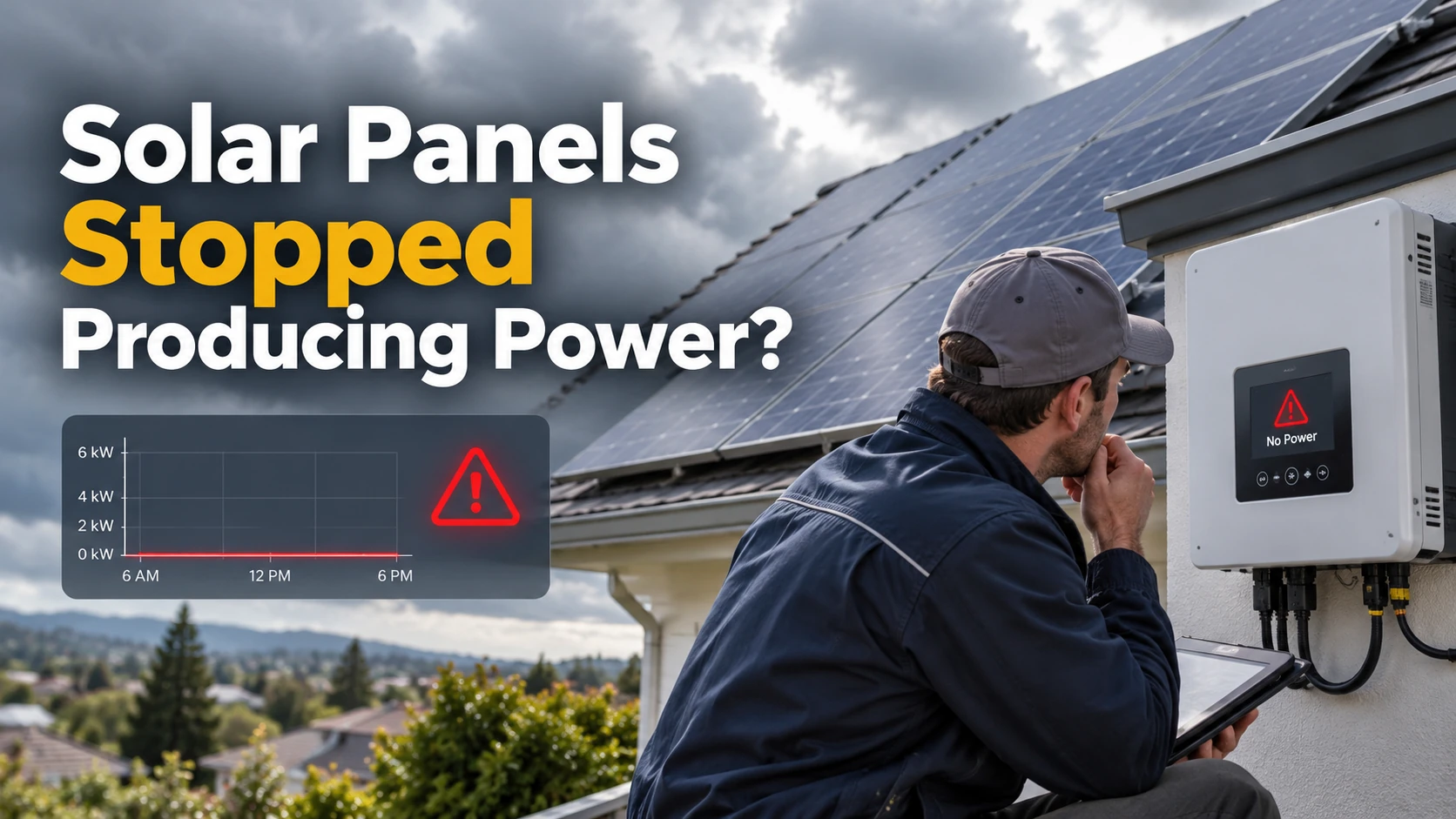
If your solar panels suddenly stopped producing power, start with your breakers and your inverter display.
Most total outages trace back to a tripped switch or a grid-related shutdown, not a broken panel.
A gradual decline usually points to dirt, shade, or an aging inverter instead.
This guide walks through what to check yourself, what’s safe to wait out, and when it’s time to call a professional.
GET HELP WITH YOUR SOLAR PANEL SYSTEM
The first thing to check is your inverter display and your home’s breaker panel, since a tripped breaker or a shutdown inverter causes the vast majority of sudden production drops.
Look at the inverter’s screen or status light before you assume anything is actually broken.
Most inverters show a simple status light: solid green usually means everything is fine, while a red light, blinking light, or error code points to a fault worth writing down.
If the display is completely blank, check whether the unit still has power at all.
Next, walk to your home’s electrical panel and look for a tripped breaker labeled “solar” or “PV.”
A power surge, a storm, or even someone bumping a disconnect switch can trip it without anyone noticing for days.
Flipping it back on resolves a surprising share of “dead” systems in a few seconds.
If your system includes a monitoring app, open it before you panic.
Sometimes the panels are working fine and the problem is just a lost Wi-Fi connection between your inverter and the app, which reports “no production” even though the system is generating normally.
A sudden drop to zero is almost always electrical: a tripped breaker, an inverter fault, or a grid outage.
A gradual decline over days or weeks usually points to something physical, like dirt buildup, growing shade, or a component wearing out.
Knowing which pattern you’re seeing narrows the list of likely causes before you even open an app or call anyone.
If your system was producing normally yesterday and is showing nothing today, think about what changed.
Was there a storm, a power flicker, or utility work nearby?
Grid-tied systems are required to shut off automatically during a grid outage as a safety feature, so a neighborhood power blip can take your solar offline with it even though your roof is still getting plenty of sun.
This also explains why net metering customers sometimes see a confusing gap on their utility bill after a storm.
The system wasn’t broken, it was just following a safety rule.
If output has been slipping for a while rather than dropping overnight, the cause is more likely environmental or mechanical.
Pollen, dust, leaves, and bird droppings settle on panels gradually, and a review of soiling studies found efficiency losses of roughly 6 to 7 percent within just a few months of panels going uncleaned, climbing higher the longer they sit.
Tree growth, new construction next door, or even a satellite dish can slowly cast more shade across a section of your array than it did when the system was installed.
Inverters also age, and their output typically softens in the final year or two before they need replacing, well before they fail outright.
GET HELP DIAGNOSING YOUR SOLAR ISSUE
Here’s a closer look at each of the usual suspects, roughly in order of how often they turn out to be the culprit.
This is the single most overlooked cause of a system that looks completely dead.
A power surge, a utility event, or someone accidentally knocking a switch can trip your system offline, and resetting it is often the entire fix.
Inverters do more work and take more wear than the panels themselves, which is exactly why they fail more often.
An analysis of claims data from 100,000 solar systems found string inverters fail at close to 9 per 1,000 units within the first two years, a far higher rate than the panels they’re attached to.
Industry-wide, inverter problems account for roughly 80 percent of non-weather production loss across monitored solar portfolios, which is why checking the inverter first is almost always the right move.
Grid-tied solar systems are built to shut down the moment they detect a grid outage, a safety feature called anti-islanding that protects utility workers repairing power lines.
The National Electrical Code requires this shutoff on every grid-connected inverter, so your panels going dark during a blackout is the system working exactly as designed, not a malfunction.
Panels need a clear, direct line to the sun, and anything that blocks that light cuts into output proportionally.
A layer of snow sitting on the array after a Northeast storm will drop production to near zero until it slides off or melts, and overhanging branches have the same effect once leaves fill in for the season.
Heat cycles expand and contract wiring year after year, and connections can loosen or corrode over time, especially after a hailstorm or wind event that stresses the mounting hardware.
A damaged connector creates resistance that shows up as reduced output long before it causes a total failure.
Sometimes nothing is wrong with the system at all.
Monitoring apps rely on an internet connection to report data, so a router reset, a changed Wi-Fi password, or a dead gateway battery can make a perfectly healthy system look offline on your phone.
Work through this order: check the inverter display, reset the breaker once, compare the app reading to the physical inverter, rule out shading or snow cover, and call a professional if the issue persists past a day.
This sequence rules out the quick fixes before you spend money on a service call.
If production still hasn’t returned after these checks, it’s time for a professional troubleshooting visit rather than continued guesswork.
Climbing onto a roof or opening an inverter cabinet involves high voltage DC wiring, and that part of the job belongs to a licensed technician.
If production still hasn’t returned after these checks, it’s time for a professional troubleshooting visit rather than continued guesswork.
Climbing onto a roof or opening an inverter cabinet involves high voltage DC wiring, and that part of the job belongs to a licensed technician.
GET HELP REPAIRING YOUR SOLAR PANELS
A standard grid-tied solar system will not power your home during a utility outage, even in full sunshine, because it’s required to shut off for safety.
Only a system paired with a battery or a special outage-ready inverter can keep your lights on when the grid goes down.
This catches a lot of homeowners off guard, especially after a nor’easter knocks out power across a whole region.
The panels aren’t failing: the inverter is doing exactly what code requires.
If backup power during storms matters to you, a residential battery backup system is the way to actually keep critical circuits running when the grid drops, since it lets your home run on stored solar energy instead of depending on the utility line.
For homeowners across New England and the Northeast, this is worth planning around in advance.
Winter storms that knock out grid power are also exactly when a battery-backed system earns its keep, running your heat, fridge, and a few lights while neighbors wait out the outage.
Call a professional if a breaker reset doesn’t hold, if the inverter shows a persistent error code, if output has been declining for more than a few weeks, or if you see any physical damage to panels or wiring.
These situations go beyond what’s safe or practical to fix yourself.
Specifically, reach out if:
Waiting too long to address a real fault can mean losing weeks of production value, and in some cases, missing a window to document damage for a warranty or insurance claim.
Most manufacturers want photographic evidence and monitoring logs from close to when the problem started, so getting a technician out sooner rather than later protects your claim as much as your power bill.
When the basic checks don’t bring your system back online, that’s exactly the point where it helps to have a team that installed systems like yours across Connecticut, Massachusetts, Maine, New Hampshire, Rhode Island, Vermont, and Virginia and knows how Northeast weather actually treats a solar array over the years.
Our technicians handle full solar panel troubleshooting, from reading inverter fault codes to tracing wiring issues that a visual check from the ground won’t catch.
If the diagnosis points to routine wear rather than damage, our servicing team can get your system back to its original output without a full equipment swap.
Because we also handle roofing and gutter work, we’re able to catch problems other solar-only companies miss, like a failing roof deck or a clogged gutter sending water where it shouldn’t be near your mounting hardware.
And if a storm or an aging inverter means it really is time for a replacement, we’ll walk you through your residential solar options and what your warranty actually covers before any money changes hands.
A short seasonal routine catches most problems before they cost you real production.
Walk out to check your panels and inverter display after any major storm, glance at your monitoring app every few weeks rather than only when the bill looks wrong, and schedule a professional checkup once a year.
Simple panel cleaning on a normal schedule prevents the slow soiling losses that build up quietly over a season.
Trimming back tree growth near your array before it starts casting new shade is far cheaper than losing output for months while you figure out why your numbers look low.
And keeping an eye on your electric bill for unexplained jumps gives you an early warning sign long before a full outage does.
Compare your current output to the same month last year rather than to last week, since solar production naturally swings with the seasons. If today’s number is close to zero and it was producing fine yesterday, that’s a real stop. If it’s just lower than a sunny day in July, it may simply be winter, cloud cover, or a shorter day length.
No, not on their own. A standard grid-tied system is required to shut off during a utility outage for safety, even in full sun. Only a system with a battery or a special outage-ready inverter will keep power flowing to your home when the grid goes down.
Yes. A layer of snow covering the panels blocks sunlight almost completely, dropping production to near zero until it melts or slides off. This is common and expected after Northeast winter storms, and it isn’t a sign of damage.
The lack of production itself doesn’t damage the system, but whatever caused it might get worse if ignored. A loose connection or an unresolved inverter fault can degrade further the longer it’s left unaddressed, so it’s worth having a professional look within a week or two if a reset doesn’t fix things.
Often, yes, if the cause is a defective panel or inverter within the coverage window. Manufacturers typically want monitoring logs and photos from around when the problem started, so getting a technician out promptly helps support a claim rather than hurt it.
Appointments Available, 7 Days a Week


