
5.0 Rating
Request A Free Estimate

RI solar incentives can save the average homeowner $4,842 on their solar installation, making it one of the smartest investments in the Ocean State. With Rhode Island’s electricity rates ranking 11th highest in the U.S. and a state goal of 100% renewable energy by 2033, these incentives help you escape rising utility bills while supporting clean energy.
Top Rhode Island Solar Incentives (2025):
The numbers speak for themselves. Rhode Island homeowners who go solar can save an average of $129,000 over 25 years when paying cash for their system.
I’m Robert Raffa, CEO and Founder of Sunergy Solutions LLC. I’ve spent a decade helping Northeast homeowners steer RI solar incentives. My background in investment banking taught me to spot good financial opportunities, and Rhode Island’s solar incentive stack is one of the best I’ve seen.
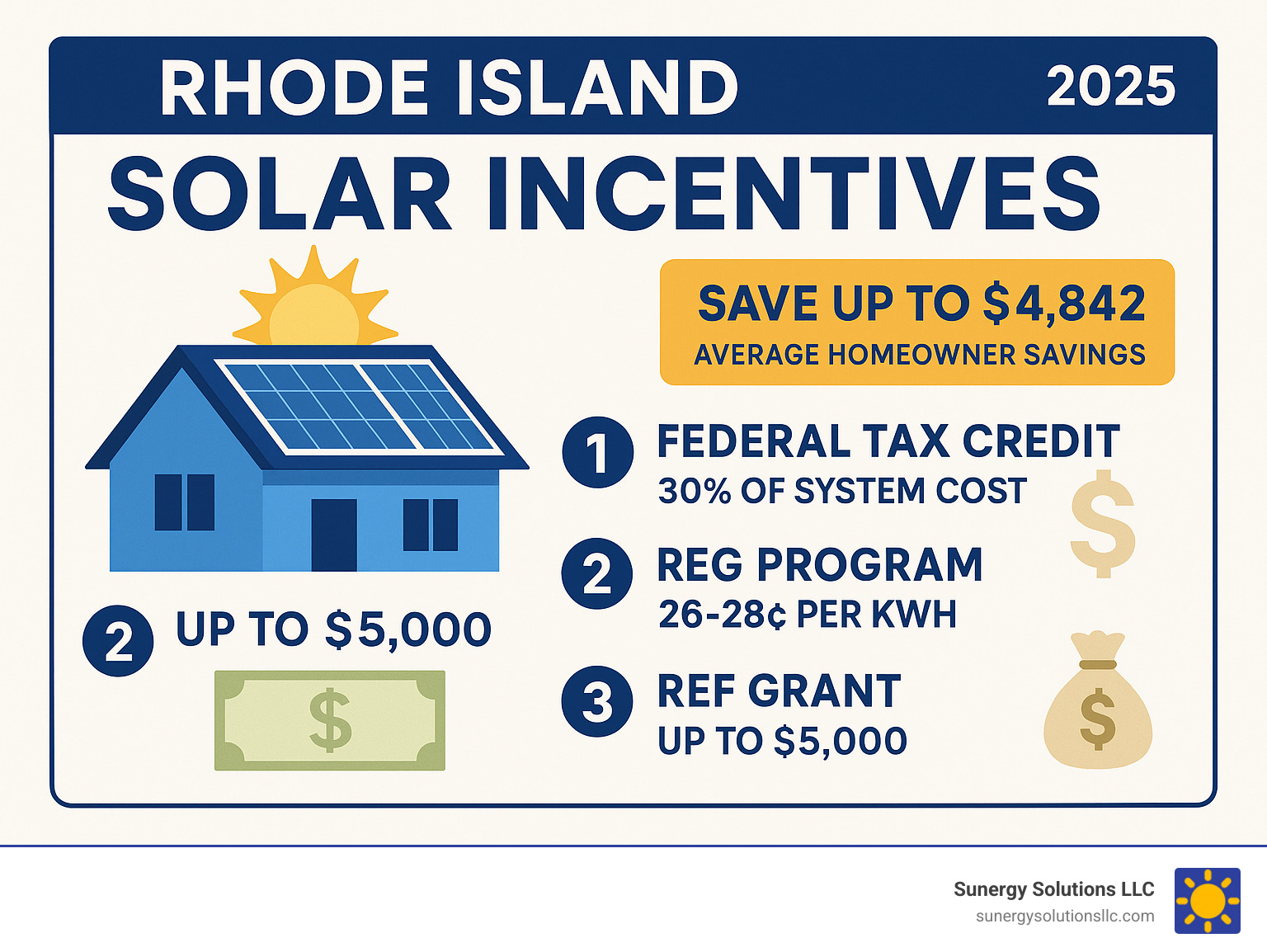
Ri solar incentives word list:
The most significant of all RI solar incentives is the federal Residential Clean Energy Credit, often called the Investment Tax Credit (ITC). This incentive provides a 30% credit on your total system cost, reducing your federal tax bill dollar-for-dollar. It’s a direct credit, not a deduction.

The federal credit generously covers your total system cost, including solar panels, installation labor, inverters, mounting equipment, permitting fees, and even solar batteries installed with your system. The sales tax on this equipment is also included in the credit calculation.
Crucially, you must own your solar system to claim this credit. Third-party-owned arrangements make you ineligible. This is why we always recommend ownershipto ensure you don’t miss out on thousands in savings.
If your tax bill isn’t large enough to use the entire credit in one year, the ITC’s credit rollover feature lets you carry the unused portion to future tax years, so you won’t lose a penny.
The 30% rate is locked in through 2032, stepping down to 26% in 2033 and 22% in 2034 before expiring in 2035, unless extended by Congress.
For a typical 5 kW system in Rhode Island costing around $16,140, this federal credit alone puts $4,842 back in your pocket. That’s nearly a third of your system cost covered before even considering state programs.
Learn more about the Federal Tax Credit.
Beyond the federal credit, state-level RI solar incentives make the Ocean State one of the most attractive places for solar. These programs show Rhode Island’s serious commitment to clean energy.
The REG Program provides steady payments for every kilowatt-hour (kWh) your system produces. The program pays you 26.15 to 27.75 cents for every kWh your panels generate. Often, you’re paid more for the electricity you produce than what you pay the utility.
These attractive rates are locked in for 15 to 20 years, offering incredible financial predictability. A typical 6 kW system could generate around $2,500 annually in payments and bill credits.
Administered by Rhode Island Energy, the REG program operates on a first-come, first-served basis with applications typically opening around April 1st. Since spots fill up fast, timing is critical. If you join the REG program, you are not eligible for traditional net metering.
More on the Renewable Energy Growth program.
The REF grant is an upfront cash grant from CommerceRI designed to slash your initial solar installation costs. You receive $0.65 for every watt of solar capacity installed, capped at $5,000 per project. For a 5 kW system, that’s an immediate $3,250 back in your pocket.
The REF grant has limited funding and is first-come, first-served. Application windows can close within days, so preparation is key.
The big decision: you can’t combine REF with REG. You must choose one path, depending on your financial strategy.
Check REF program status at CommerceRI.
Choosing between these two powerful RI solar incentives depends on your financial goals. Here’s how they stack up:
| Feature | Renewable Energy Growth (REG) Program | Renewable Energy Fund (REF) Small Scale Solar Grant |
|---|---|---|
| Incentive Type | Performance-based incentive (PBI) | Upfront cash grant |
| Payment Structure | Fixed rate per kWh generated (e.g., 26-28 cents/kWh) paid over time, often via bill credits and cash payments. | One-time lump sum payment based on system size ($0.65/W). |
| Term | Long-term (15-20 years) | One-time payment upon project completion. |
| Maximum Value | Can yield significant total payments over the long term (e.g., $2,500/year for a 6kW system). | Capped at $5,000 per project (with a potential $2,000 adder for storage). |
| Best For | Homeowners seeking consistent, long-term revenue or bill credits and a maximized lifetime ROI. | Homeowners looking for immediate reduction in upfront costs and a quicker payback period. |
| Can they be combined? | No, you must choose one or the other. However, both can be combined with the Federal ITC. | No, you must choose one or the other. However, both can be combined with the Federal ITC. |
| Eligibility | First-come, first-served; annual application window. | Limited funding; first-come, first-served; specific application windows. |
The choice boils down to this: REG maximizes your long-term returns while REF minimizes your upfront costs. Both can be combined with the federal tax credit.
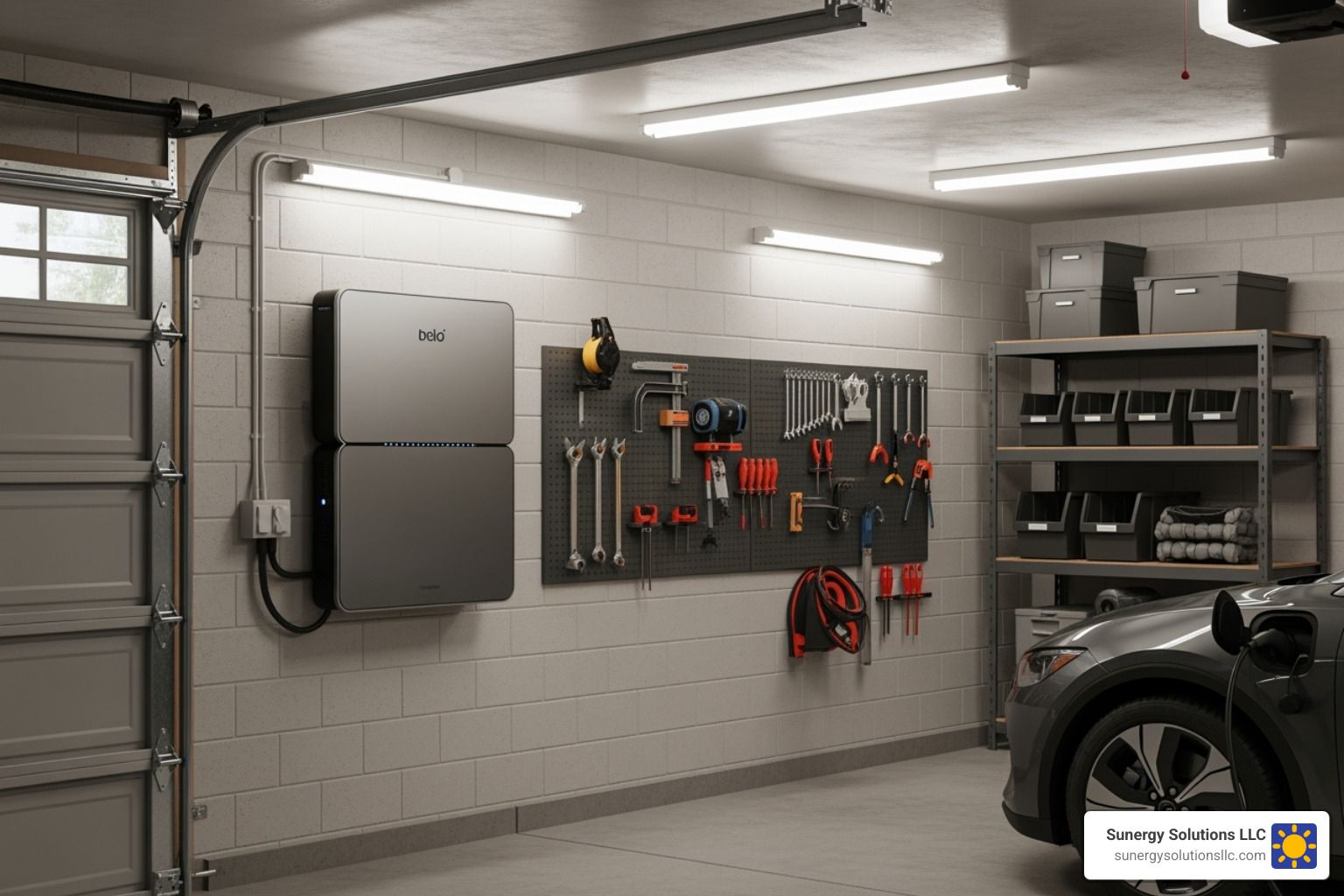
Rhode Island also offers RI solar incentives for adding a battery to your system, making it an even more attractive investment.
The Connected Solutions Program pays you for letting Rhode Island Energy tap into your stored power during peak demand (2-7 PM, June-September). In return, you receive $400 per kW of performance each summer. A battery providing 5 kW could earn you $2,000 annually.
The REF grant also offers an additional $2,000 energy storage adder if you install a battery with your solar panels, potentially raising your total grant to $7,000.
Beyond incentives, a battery provides increased energy independence by storing excess solar power for use at night or during outages.
Beyond the major programs, additional RI solar incentives chip away at costs. These often-overlooked benefits can add thousands to your total savings.
Rhode Island offers two powerful tax exemptions that provide immediate savings.
The 100% sales tax exemption means you pay no 7% sales tax on solar equipment and installation. For an average $17,000 system, this saves you about $1,190 upfront. The exemption covers panels, inverters, mounting equipment, wiring, and labor.
The property tax exemption is a valuable long-term benefit. A solar system can increase your home’s value by an average of 4.1% (often $15,000+), but Rhode Island exempts this added value from your property taxes for 20 years. You get the increased home value without the tax hike.
Rhode Island’s generous net metering program turns your electric meter into a two-way street. When your panels produce more electricity than you use, the excess power flows to the grid.
You are credited at the full retail rate for every kilowatt-hour sent to the grid. These credits roll over month-to-month, so you can bank credits in sunny months to use during winter. You can receive credits for up to 125% of your annual consumption.
Net metering differs from the REG program. REG pays for all generation, while net metering credits you for excess power. You will typically choose one or the other, as they are both excellent RI solar incentives that serve different financial goals.
Rhode Island offers programs to broaden access to clean energy, including options for households that qualify for income-based assistance or need alternative pathways when a roof isn’t ideal. For details on these resources, explore official Rhode Island energy program pages.
Note: Sunergy Solutions LLC specializes in residential and commercial solar ownership and installation. For other solar access options, we recommend exploring state resources for more information.
Let’s review the real-world financial impact of these powerful RI solar incentives. Stacking these programs makes solar in Rhode Island surprisingly affordable.
Consider an average 5 kW solar system in Rhode Island with an initial cost of around $16,140. Here’s how RI solar incentives reduce that price:
First, the 30% Federal ITC saves you $4,842, bringing the cost to $11,298.
Next, if you choose the REF Grant, you’ll receive $0.65 per watt for your 5,000-watt system. That’s another $3,250, bringing your net cost down to just $8,048.
A system initially costing $16,140 ends up at just $8,048 after two major incentives—cutting the cost by more than half. This doesn’t even include the upfront savings from the 100% sales tax exemption (over $1,100).
The long-term picture is even better. With Rhode Island’s high electricity rates, the average homeowner saves $129,000 over 25 years when paying cash for their system, building real wealth through energy independence.

The payback period is when your system stops costing you money and starts making you money. Thanks to robust incentives, Rhode Island has some of the shortest payback periods in the country.
Your specific payback timeline depends on your final system cost, current electricity rates, energy consumption, and system performance. Since Rhode Island has high utility rates, every kWh your panels produce saves you more money.
Most Rhode Island homeowners reach their payback point in just a few years. After that, the electricity your system generates is essentially free power for the next 20+ years of its life. It’s a smart investment that runs on sunshine, helps the planet, and builds wealth.
Here are answers to the most common questions we hear about RI solar incentives and going solar in the Ocean State.
Absolutely. Rhode Island is one of the best states for solar. The combination of high electricity rates (11th highest in the U.S.) and generous incentives creates a perfect storm for savings. Every kilowatt-hour your panels produce saves you serious money.
When you layer on the RI solar incentivesthe 30% federal tax credit, state grants or performance payments, and tax exemptionsthe financial case is compelling. The average savings for a cash-purchased system is $129,000 over 25 years.
Beyond money, solar increases your home’s value by an average of 4.1% without raising property taxes. You gain energy independence and help the state meet its 100% renewable energy goal by 2033. Your wallet, home value, and the environment all benefit.
Let’s set the record straight: you cannot get truly free solar panels in Rhode Island.
Some advertisements use the phrase “free solar” to describe arrangements where a third party owns the equipment on your roof. If you don’t own the system, you generally can’t claim the valuable RI solar incentives yourself.
You would miss out on the 30% federal tax credit (an average of $4,842), the REF grant (up to $5,000), and other benefits. You’d be trading tens of thousands in long-term benefits for no upfront cost.
At Sunergy Solutions LLC, we believe ownership is the clear winner for maximizing savings. We offer financing options that make ownership affordable while ensuring you qualify for all incentives. It’s the difference between renting and buying a house: ownership builds wealth.
The process is straightforward, but we always recommend working with a qualified tax professional. Here’s an overview:
Complete IRS Form 5695 when you file your taxes for the year your system was installed and became operational. You’ll enter your total system cost on this form. Then, attach Form 5695 to your federal tax return (Form 1040).
If the 30% credit is larger than your tax liability for the year, you can roll the unused portion forward to future tax years. You won’t lose any of your credit.
Keep excellent records of all installation-related documents, like invoices and contracts. The IRS may ask for documentation, so being organized is key.
IRS Form 5695 is available on the IRS website, but a tax professional can ensure you get every dollar you’re entitled to.
Rhode Island is a top state for solar because its combination of federal, state, and local RI solar incentives dramatically reduces upfront costs and provides decades of financial benefits. With high electricity rates and a state goal of 100% renewable energy by 2033, there has never been a better time to go solar.
The math is compelling. Cutting a $16,140 system to around $8,000, achieving energy independence, increasing home value without raising property taxes, and saving over $129,000 long-term makes solar a smart financial strategy, not just an environmental one.
At Sunergy Solutions LLC, we’ve spent over a decade helping Northeast homeowners steer these opportunities. We partner with you to design a custom system that maximizes every available incentive and delivers reliable, long-term performance.
Our commitment goes beyond installation. With top-tier equipment, extensive warranties, and exceptional customer service, we ensure your solar investment delivers the savings and peace of mind you deserve. We’ll guide you through the application processes for state programs and help you claim your federal tax credit, ensuring you take full advantage of every dollar available.
The window for these incredible RI solar incentives won’t stay open forever. State programs have limited funding, and the federal tax credit is scheduled to phase down. The best time to act is now.
Ready to turn your roof into a money-saving powerhouse? Let’s explore how these amazing Rhode Island solar incentives can work for your specific situation.

Appointments Available, 7 Days a Week


