
5.0 Rating
Request A Free Estimate
Commercial solar project financing offers businesses multiple pathways to harness clean energy without massive upfront capital requirements. The main financing options include:
Direct Purchase Options:
Third-Party Ownership:
Government Incentives:
With electricity inflation hitting 24.73% from 2020-2023, companies are turning to solar as a hedge against unpredictable energy expenses. The financing decision impacts everything – from cash flow and tax benefits to long-term ownership and operational control.
As Robert Raffa, former investment banker and CEO of Sunergy Solutions LLC, I’ve helped countless businesses steer commercial solar project financing decisions using rigorous financial analysis to maximize ROI.
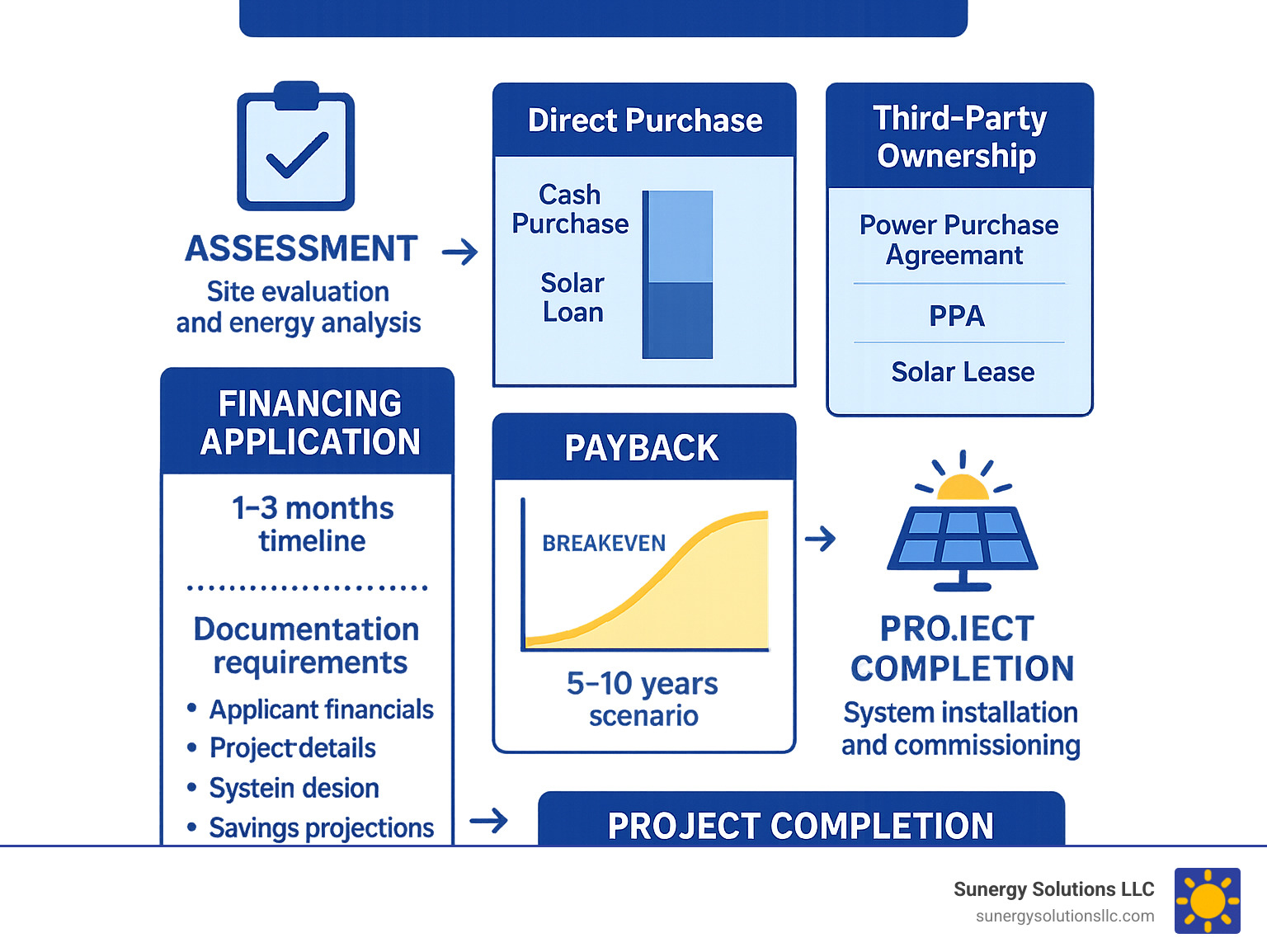
The commercial solar project financing world has transformed into a $2+ billion industry, with specialized lenders now funding thousands of projects nationwide. This isn’t just about environmental responsibility – it’s smart business.
Think of solar financing like assembling a financial puzzle. Developers find and structure your project, while lenders provide debt financing. Tax equity investors monetize federal tax credits, and cash equity sponsors fill remaining capital gaps. Your business becomes the off-taker, purchasing the clean energy your system produces.
Three critical milestones trigger funding disbursements. Notice to Proceed (NTP) gives the green light for construction. Commercial Operation Date (COD) marks when your system starts generating power and savings. Placed in Service is the IRS milestone that opens tax credit eligibility.
Risk allocation is where the art of commercial solar project financing comes into play. Each stakeholder takes on specific risks they’re best equipped to handle.
| Ownership Model | Upfront Cost | Tax Benefits | O&M Responsibility | Contract Term |
|---|---|---|---|---|
| Direct Purchase | High | Full | Owner | N/A |
| Solar Loan | Low/None | Full | Owner | 5-30 years |
| Solar Lease | None | Third-party | Third-party | 10-25 years |
| PPA | None | Third-party | Third-party | 15-25 years |
| C-PACE | None | Owner | Owner | Up to 30 years |
Direct purchase delivers the highest ROI with typical payback periods of 5-7 years, but requires substantial upfront capital. Third-party financing eliminates upfront costs but typically delivers lower overall savings since you share benefits with your financing partner.
With electricity inflation hitting nearly 25% in recent years, every dollar saved on operating costs translates to approximately $12 in increased building value at an 8% capitalization rate. Solar isn’t just environmental – it’s a hedge against utility rate volatility and a direct boost to property value.
The world of commercial solar project financing now offers a menu of creative financing solutions for businesses of every size. Think of it like choosing the right tool for the job – each option aligns differently with your business goals and financial capacity.
Direct purchase remains the champion for maximizing solar investment returns. Most businesses see payback periods of 5-7 years, followed by decades of essentially free electricity. You’ll capture the full 30% federal Investment Tax Credit, plus potential bonus credits that can push total incentives up to 70% of system cost.
When you own your solar system outright, you’re increasing property value, claiming depreciation benefits, and hedging against future utility rate increases. For detailed analysis, check out our Commercial Solar Panel Cost breakdown.
The trade-off? You need significant upfront capital and enough tax liability to fully use the credits.
Solar loans offer the best of both worlds – ownership benefits without depleting cash reserves. Split loans let you use your 30% tax credit to immediately pay down principal, dramatically reducing monthly payments.
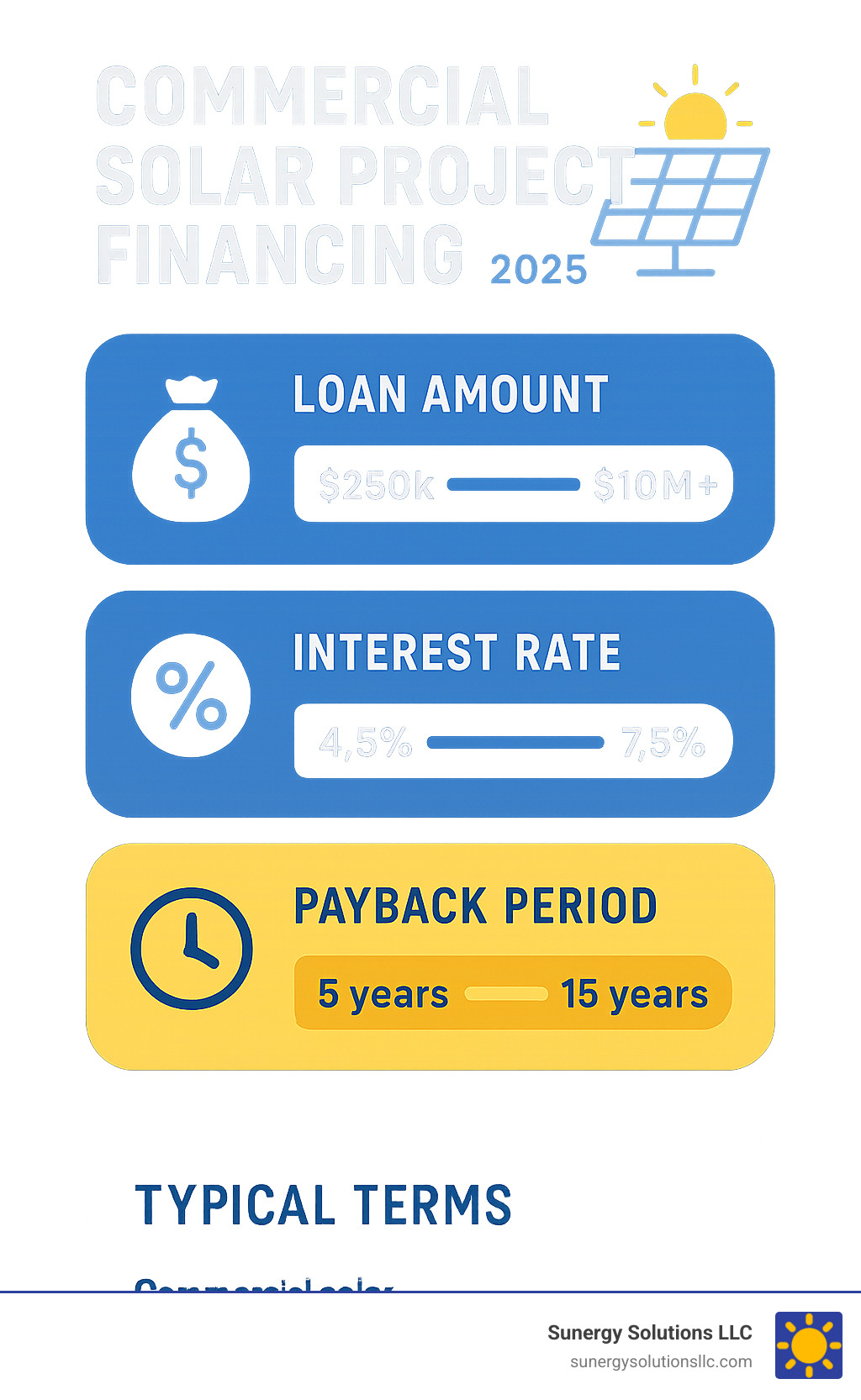
Leading solar lenders typically offer loan amounts from $500,000 to $10 million with interest rates ranging from 4.5% to 7.5%. Terms usually run 5-10 years, with many providing fixed rates for the first five years.
Most lenders require a Debt Service Coverage Ratio (DSCR) of at least 1.25, ensuring you can comfortably handle loan payments while maintaining healthy operations.
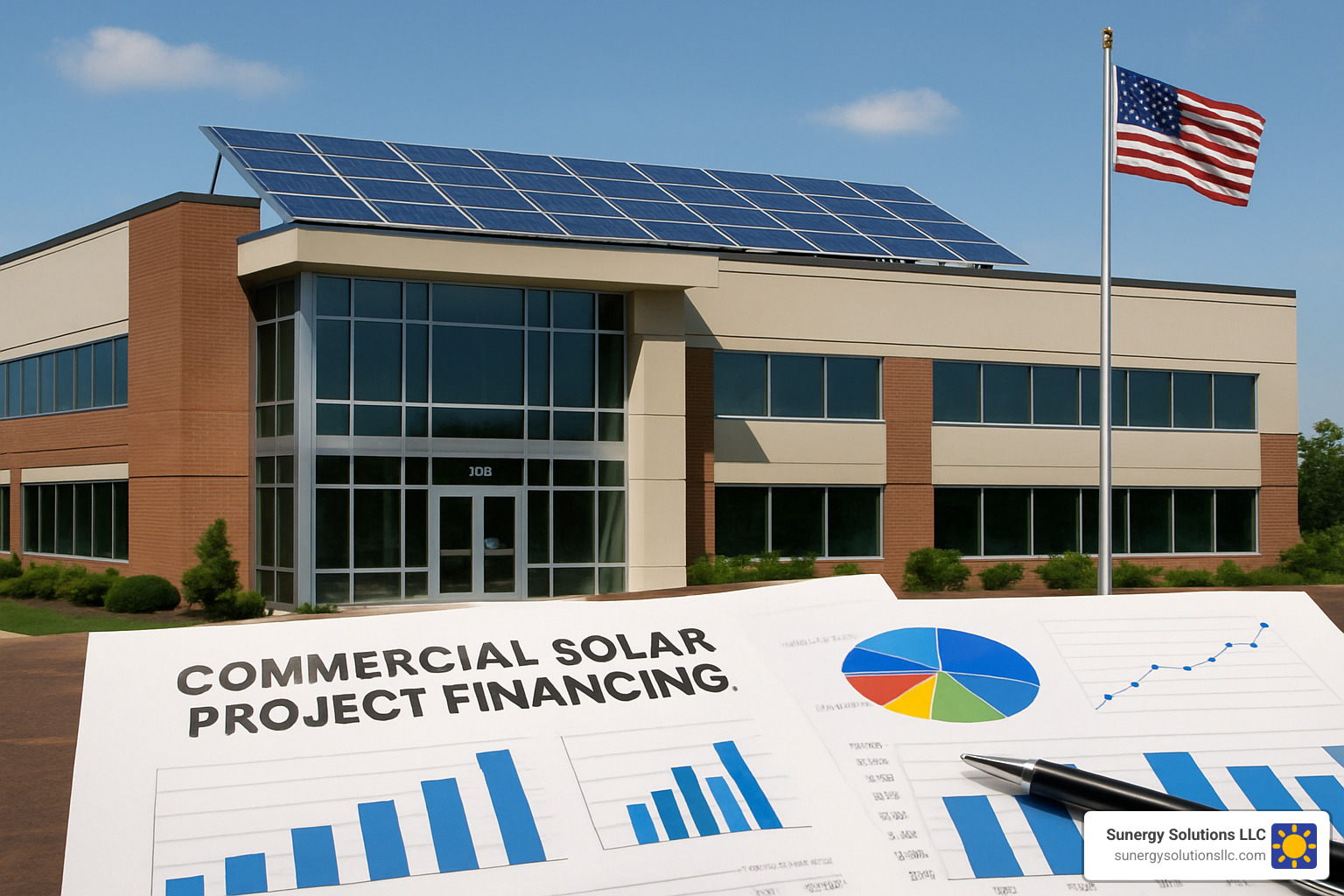
Solar leases work like a car lease – you get immediate solar benefits with predictable monthly payments, but someone else owns the asset. Operating leases keep the solar system off your balance sheet, valuable for businesses managing debt ratios.
The beauty of leasing lies in simplicity and predictability. You know exactly what you’ll pay monthly, maintenance is typically included, and you start saving immediately. The downside? You’ll save less money overall because the leasing company keeps tax benefits.
Power Purchase Agreements have revolutionized commercial solar by making it accessible to organizations that can’t fully use tax credits. A developer installs and owns the solar system, then sells you electricity at rates typically 10-30% below current utility costs.
Most PPAs run 15-25 years with annual rate escalations of 0-3%. The developer handles all maintenance, performance risk, and system monitoring. At contract expiration, you typically have options to renew, purchase the system, or have it removed at no cost.
Commercial Property Assessed Clean Energy (C-PACE) financing treats your solar investment as a property improvement financed through voluntary tax assessments. Available in over 30 states, you can finance up to 100% of project cost with terms extending up to 30 years.
Energy Service Agreements (ESAs) take a pay-for-performance approach where you pay based on actual energy savings rather than system production.
For complete financing partner details, explore our Commercial Solar Financing Companies guide.
Large commercial projects often employ sophisticated tax equity structures. Partnership flip arrangements allow tax equity investors to claim early tax benefits, then “flip” ownership back after achieving target returns.
The most exciting development might be blockchain-based platforms like Reneum that enable fractional ownership of solar assets, representing the future of commercial solar project financing.
Getting your commercial solar project financing approved doesn’t have to feel like navigating a maze. Most lenders have streamlined their processes to help qualified businesses move from application to funding in about 4-5 weeks.
The journey starts with a simple intake form where you’ll share basic project details – your site location, current energy usage, and financing preferences. Don’t worry about having every detail perfect at this stage. Most lenders will give you initial eligibility feedback within just 2 business days, so you’ll know quickly if you’re on the right track.
Once you pass that first hurdle, you’ll move into the documentation phase. This is where having your paperwork organized really pays off. You’ll typically have about a week to submit detailed information including site maps, engineering studies, and financial statements. The good news? Complete applications usually get reviewed within another week.
Next comes the Letter of Interest – think of this as a non-binding proposal that outlines potential financing terms, rates, and conditions. This gives you a chance to evaluate your options before committing to the full underwriting process. No pressure, no commitments yet.
If the terms look good, you’ll move forward with the formal credit application. This involves a deeper dive into your financials and credit history. Most lenders guarantee decisions within 4 weeks for qualified applicants, though many move faster than that.
The commitment letter is where things get real – this is your binding financing agreement with final terms and conditions. Once you sign this, it triggers the final documentation and closing preparations.
Finally, you’ll reach closing and funding day. You’ll execute security agreements and coordinate how funds will be disbursed. Most lenders offer multiple draws that align with construction milestones, so you’re not paying interest on money you haven’t used yet.
Getting your paperwork together upfront can save weeks in the approval process. Think of documentation as falling into three main buckets: technical documents that prove your project makes sense, financial documents that show you can pay back the loan, and legal documents that protect everyone involved.
On the technical side, you’ll need site maps and aerial imagery so lenders can visualize your project. Feasibility studies and energy modeling demonstrate the project’s viability, while engineering specifications and equipment quotes show exactly what you’re building. Don’t forget interconnection agreements and any utility correspondence – these prove you can actually connect to the grid.
Your financial package should include two years of audited financial statements plus current year-to-date financials. Tax returns and IRS transcripts verify your reported income, while bank statements and credit references give lenders confidence in your payment history.
Legal documentation covers property ownership verification, environmental assessments, and insurance certificates. You’ll also need corporate resolutions and signing authority documents to prove the person signing the loan actually has permission to do so.
Commercial solar project financing terms have become increasingly competitive as more lenders enter the market. Loan amounts typically range from $250,000 to over $10 million, making solar accessible for everything from small businesses to large industrial facilities.
Interest rates currently fall between 4.5% to 7.5% for qualified borrowers – often significantly better than traditional bank loans. Terms usually run 5-15 years, though some lenders offer up to 30-year financing for larger projects. Many loans feature longer amortization periods than the actual term, which reduces your monthly payments.
Most lenders require 10-25% down payment, though some offer up to 90% financing for well-qualified borrowers. The exact terms depend on project size, your credit quality, and current market conditions.
Here’s a real-world example: a $500,000 solar loan at 3.49% APR over 15 years saves approximately $190,000 compared to a typical 6% bank loan. That’s the power of specialized solar financing – lenders understand the unique cash flow benefits of solar projects and price their loans accordingly.
Federal tax incentives are the secret sauce that makes commercial solar project financing so attractive. The Investment Tax Credit (ITC) provides 30% credit through 2032 – but that’s just the beginning.
The Inflation Reduction Act introduced bonus credits that can stack like building blocks. For qualifying projects, you could potentially claim up to 70% of your system cost in total incentives.
Here’s how bonus credits work: Domestic Manufacturing adds 10% for Made in USA components. Energy Communities (areas with coal history or high unemployment) qualify for additional 10%. Projects in Low-Income Communities can claim up to 20% more.
The Modified Accelerated Cost Recovery System (MACRS) lets you depreciate your solar system much faster than typical equipment. Combined with ITC bonuses, these incentives can cover 48-62% of total system cost in the first year alone.
When claiming credits, you’ll use IRS Form 3468 to make it official.
Smart businesses don’t stop at federal incentives – they stack multiple programs to maximize returns. State and local programs often provide additional layers. Many states offer their own tax credits or rebates that work alongside federal benefits.
Net metering policies let you sell excess power back to the grid. Some utilities pay premium rates for solar power during peak demand through Clean Peak programs.
Time-of-use rate optimization becomes powerful when solar production aligns with expensive peak electricity periods. Don’t overlook grant opportunities either. The USDA REAP program offers grants up to 50% of project costs for rural businesses.
For maximizing your incentive stack, check out our guide on Solar Tax Credits and Rebates: What You Need to Know.
Choosing commercial solar project financing is like picking the right tool for a job. The decision comes down to understanding your company’s unique situation.
Your cash flow goals matter most – some businesses need every dollar for operations, while others have capital that could work harder in solar investments. Tax appetite often makes the decision for you. If your company generates substantial tax liability, claiming the 30% Investment Tax Credit yourself makes sense. But if you’re a nonprofit or have limited tax obligations, letting a third party capture those credits in exchange for lower energy rates could be smarter.
Start by evaluating your financial capacity. Calculate how much capital you can comfortably invest without straining operations. Next, sit down with your accountant to evaluate your tax position. Can you fully use federal and state credits over the next few years?
Consider your risk tolerance carefully. Operational risks include maintenance responsibilities and performance variations. Some business owners accept these challenges, while others prefer transferring risks to experienced solar companies.
Model the cash flow impact of different structures. Direct purchase might offer highest long-term returns, but could strain short-term cash flow. PPAs provide immediate savings with predictable payments, but lower overall benefits.
Unfortunately, the solar industry has bad actors who prey on businesses eager to go green. Low-ball pricing should raise immediate red flags – quality solar installations cost what they cost, and dramatically low bids often indicate corners being cut.
Unrealistic production estimates are another warning sign. Reputable companies base projections on conservative assumptions and independent modeling software.
Watch out for restrictive buyout clauses in lease and PPA agreements. Some contracts make it prohibitively expensive to purchase the system early. Warranty gaps between equipment manufacturers and installation companies create dangerous coverage holes.
Be cautious about working with lenders or developers without proven solar experience. Commercial solar project financing involves unique risks that generalist financial institutions often misunderstand. Partner with specialists who’ve successfully closed hundreds of solar deals.
When you’re exploring commercial solar project financing, certain questions come up time and again. Let’s tackle the most common concerns we hear from business owners considering solar investments.
Most commercial solar lenders look for minimum credit scores of 650-700 for business owners, though the picture is more nuanced than just a number. Some specialized programs will work with lower scores if you can provide additional collateral or personal guarantees.
The financial requirements go beyond credit scores. Lenders typically want to see two years of profitable operations – they need confidence that your business generates consistent cash flow. Your debt service coverage ratio should be at least 1.25x, meaning your operating income covers debt payments with a comfortable cushion.
A strong balance sheet with adequate liquidity is crucial. Lenders want to see that you can handle additional debt without straining your business operations. Think of it as proving you can walk and chew gum at the same time – manage your existing obligations while taking on solar financing.
These three milestone dates might sound like alphabet soup, but they’re critical to understanding how your commercial solar project financing flows from approval to completion.
Notice to Proceed (NTP) is your green light – it authorizes construction to begin and typically triggers the first funding release for equipment purchases and mobilization costs. This is when things get real and crews start showing up at your site.
Commercial Operation Date (COD) marks when your system starts producing electricity and generating actual savings on your utility bills. Most lenders release their final funding tranches at COD, since this proves the system works as designed.
Placed in Service is the IRS milestone that determines when you can claim tax credits. This date usually aligns with COD and determines which tax year you’ll claim your Investment Tax Credit. Getting this timing right can significantly impact your tax planning strategy.
Understanding these milestones helps you coordinate construction schedules with funding requirements and avoid any surprises in the process.
The short answer is usually yes, but the details matter enormously. Most Power Purchase Agreements include buyout provisions that kick in after year 5-7. The buyout price typically equals either the system’s fair market value or follows a predetermined depreciation schedule outlined in your original contract.
Early buyout can make excellent financial sense in several scenarios. If energy prices rise significantly above your PPA rates, buying out lets you capture those savings directly. You might also want to claim remaining tax benefits that currently go to the system owner, or your business circumstances might change in ways that make system ownership more attractive.
Refinancing your PPA through a buyout and new loan can sometimes offer better overall economics, especially if interest rates have dropped or your business credit has improved since the original agreement.
The key lesson here is to review buyout terms carefully during your initial PPA negotiations. What seems reasonable today might look very different in five years, so ensure you have the flexibility you might need down the road. Think of it as keeping your options open – you never know how your business or the energy market might evolve.
The world of commercial solar project financing offers unprecedented opportunities for businesses. With financing options from traditional loans to innovative C-PACE structures, virtually every business can find a fitting path.
Whether you choose the maximum ROI of direct ownership with its 5-7 year payback, the cash flow benefits of a PPA with immediate savings, or the long-term flexibility of C-PACE financing, solar delivers real value that compounds over decades. Add in the 30% federal tax credit (potentially up to 70% with bonus incentives), and you’re looking at one of the most attractive business investments available today.
Choosing the right partner makes all the difference. Solar financing involves complex interactions between technology, tax policy, and financial structures. You need someone who speaks both languages – solar engineering and sophisticated finance.
At Sunergy Solutions LLC, we’ve built our reputation on this combination. Our CEO’s background as a former investment banker means we approach every project with rigorous financial analysis. But we never forget that behind every spreadsheet is a business owner making smart decisions for their company’s future.
We serve businesses across Maine, Massachusetts, New Hampshire, Rhode Island, Vermont, Montana, and Virginia with one promise: we’ll help you steer the financing maze to find the solution that maximizes returns while minimizing risks.
Ready to stop wondering and start saving? The solar financing options we’ve covered are real solutions helping thousands of businesses reduce energy costs right now. Your only question should be which structure works best for your specific situation.
For comprehensive information about how we can customize a solar solution for your business, visit our Commercial Solar Energy Systems page. Let’s turn your roof into a profit center while building a cleaner energy future.
The sun is shining, the incentives are strong, and the financing is available. The only thing missing is your decision to move forward.
Appointments Available, 7 Days a Week


