
5.0 Rating
Request A Free Estimate
Residential Solar Systems are complete energy solutions that convert sunlight into electricity for your home, offering significant cost savings and environmental benefits. Here’s a quick overview:
Key Components:
Financial Benefits:
Environmental Impact:
As energy costs continue to rise, homeowners are increasingly turning to solar as a hedge against unpredictable utility bills. A successful project depends on proper evaluation: understanding your home’s solar potential, choosing quality equipment, and working with a reputable installer who prioritizes long-term performance.
I’m Robert Raffa, CEO and Founder of Sunergy Solutions LLC. I’ve spent nearly a decade helping homeowners across the Northeast transition to clean energy. My background in investment banking allows me to apply rigorous financial analysis to every solar project, ensuring our solutions deliver both environmental and economic value.
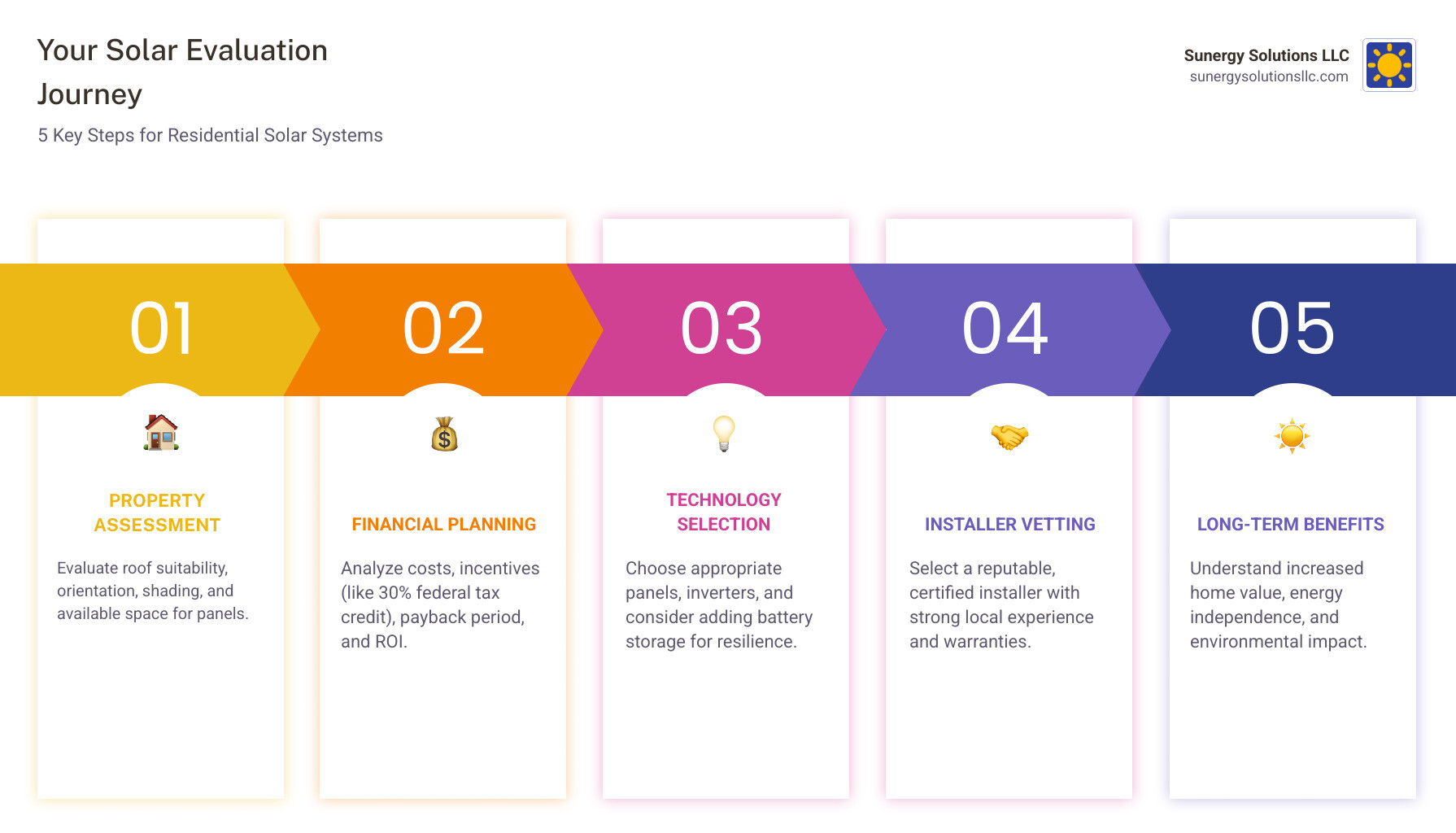
Easy Residential Solar Systems word list:
Starting your solar journey begins with the basics. What exactly are Residential Solar Systems, and how do they harness the sun’s power? It’s a fascinating process that combines modern technology with simple physics.
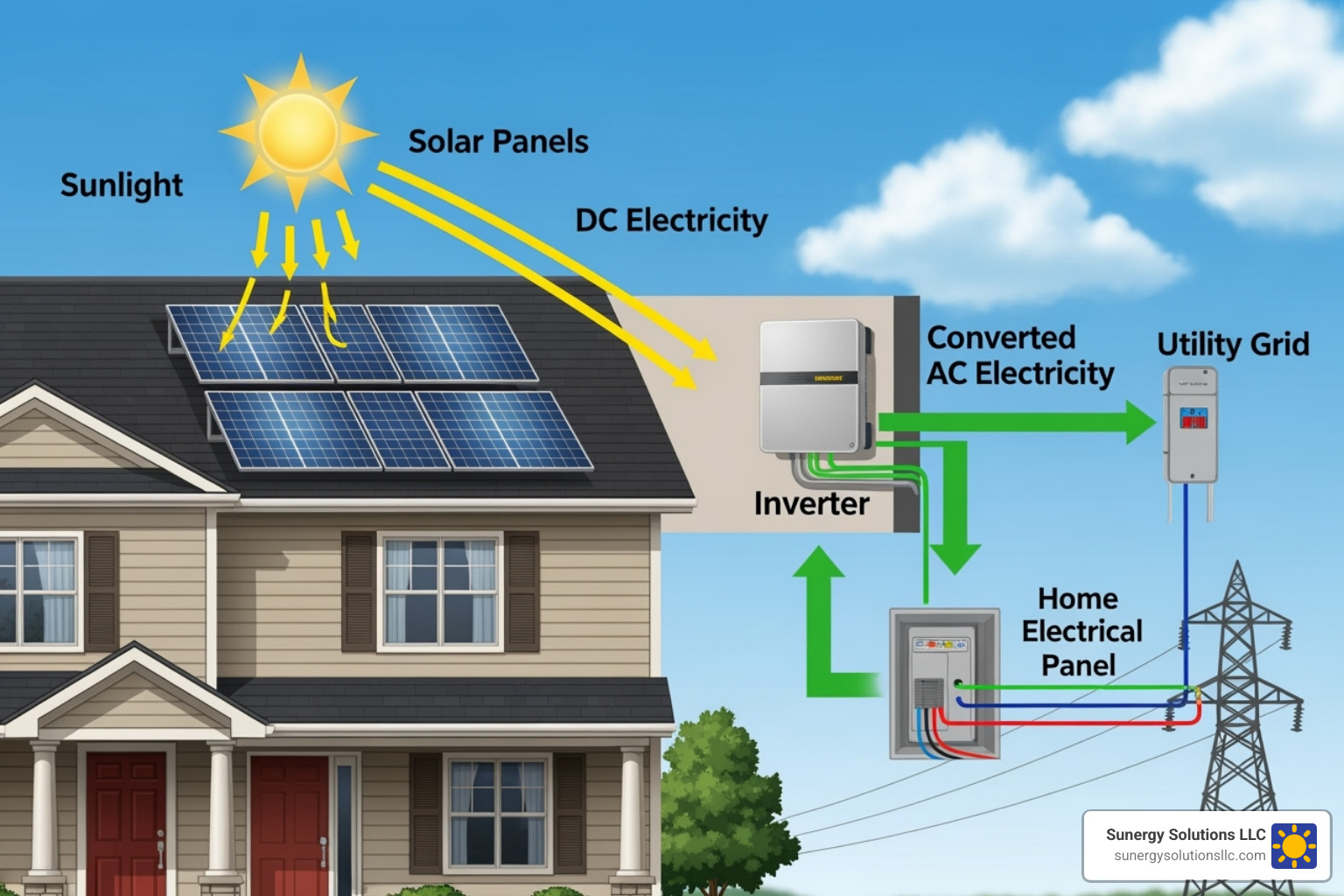
A residential solar system converts sunlight into usable electricity for your home through a few key components working in harmony:
Sunlight hits the panels, is converted to DC electricity, the inverter changes it to AC, and that clean power flows directly into your home.
Beyond financial savings, the environmental advantages of Residential Solar Systems are a compelling reason for homeowners to make the switch to a greener future.
In areas where the grid relies heavily on fossil fuels, like many parts of our service areas in Connecticut, Massachusetts, Maine, New Hampshire, Rhode Island, Vermont, and Virginia, residential solar has a profound positive impact. For more details, you can find more info about residential solar facts.
Let’s talk money. While the environmental benefits are clear, most homeowners want to know the bottom line: what will it cost, and what is the return on investment? Solar is a significant investment, and you deserve clear answers about the financial picture.

The good news is that solar has become much more affordable. Think of your solar system not as an expense, but as an asset that starts paying you back from day one through reduced electricity bills.
The initial investment in Residential Solar Systems is often the first question. System pricing depends on several factors, but powerful incentives can dramatically reduce your out-of-pocket expense.
System size, measured in kilowatts (kW), is the biggest cost driver. An average 7.5 kW solar array might cost around $25,000 before incentives. We’ve installed systems ranging from a 9.02 kW system at $12,368 ($1.40/watt) to a 12.15 kW system at $16,045 ($1.32/watt), showing how larger systems often have better per-watt pricing.
Panel quality and installation complexity also affect pricing. Premium panels may cost more, and complex roofs (like tile or steep pitches) require more labor.
Here’s where it gets exciting: incentives can cut your costs significantly. The Federal Solar Investment Tax Credit (ITC) is the most impactful, allowing you to deduct 30% of your entire system cost from your federal taxes. This is a dollar-for-dollar credit that includes panels, inverters, installation, and even battery storage.
Beyond the federal credit, state and local programs can offer more savings through tax credits, performance-based incentives, and property or sales tax exemptions. We help homeowners across Connecticut, Massachusetts, Maine, New Hampshire, Rhode Island, Vermont, and Virginia steer these programs to maximize their savings. For comprehensive details, check out more info about residential solar tax incentives.
This is where Residential Solar Systems truly shine financially. Your payback period—the time it takes for savings to equal your net investment—depends on several key factors.
Local electricity rates are crucial; the higher your current bill, the faster your payback. We’ve seen payback periods as short as five years in areas with high rates and strong incentives, while other areas might see 15-19 year paybacks.
Sunlight exposure determines how much electricity your system generates. More sun equals more savings. Your system cost after incentives is your true investment—that $25,000 system becomes $17,500 after the 30% federal tax credit, dramatically shortening your payback timeline.
The real magic happens with electricity rate increases. Utility rates historically rise 2-4% annually, but your solar production cost is fixed. This accelerates your savings over time.
The long-term financial benefits are immense. Your home’s value can increase significantly—that’s immediate equity. You’re also hedging against energy price inflation by locking in your electricity costs for the 25-30+ year lifespan of your panels. Once your system is paid off, the electricity it generates is essentially free, providing decades of positive cash flow and energy independence.
For detailed information about financing options, visit more info about residential solar system financing. Solar isn’t just good for the planet—it’s a smart financial move that pays dividends for decades.
Not every home is perfectly suited for solar, but many are excellent candidates. Determining your home’s solar potential is a critical first step in evaluating Residential Solar Systems. Let’s walk through what a solar checkup looks like.
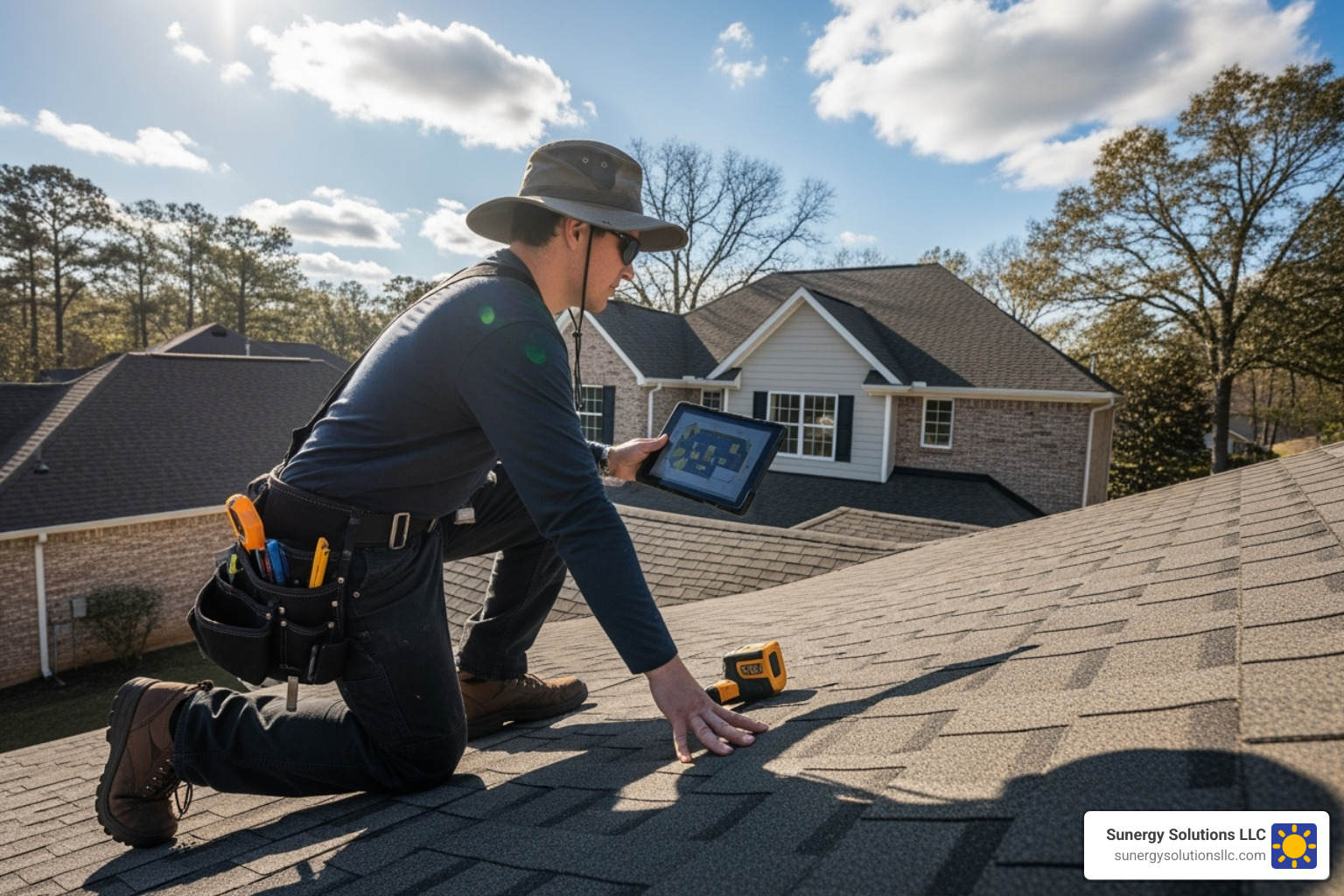
When we assess a property, we’re looking for its potential as a solar powerhouse. Here’s what we evaluate:
Roof condition and age: Your roof should be ready for a 25-30 year commitment. If it has at least 5-10 years of life left, you’re in good shape. If a replacement is needed soon, it’s cost-effective to combine a new roof with a solar installation. As a company offering professional roofing services, we can handle both seamlessly. For a thorough evaluation, see our more info about roof inspection services.
Roof material: Most common materials like asphalt shingles, metal, and many tile roofs work well with solar. Each requires a specific mounting approach that experienced installers have mastered.
Roof orientation and pitch: South-facing roofs are ideal for all-day sun exposure, but east and west-facing roofs are also great, especially for homes that use more energy in the morning or afternoon. Modern solar technology is forgiving, and systems can be designed for various roof angles.
Shading analysis: We conduct detailed assessments to identify shadows from trees, chimneys, or other obstructions. Even with some shading, technologies like power optimizers and microinverters can ensure each panel performs at its best.
Available roof space: We ensure there is enough clear area to install a system that meets your energy goals. With thoughtful planning, even homes with some challenges can benefit from Residential Solar Systems.
The installer you choose makes all the difference. This is a complex electrical system that needs to perform flawlessly for decades.
Experience and local expertise: At Sunergy Solutions LLC, we have years of experience across Connecticut, Massachusetts, Maine, New Hampshire, Rhode Island, Vermont, and Virginia. We understand local building codes, climate challenges, and utility policies.
Professional certifications: Credentials like NABCEP (North American Board of Certified Energy Practitioners) signify a high level of training and competence.
Customer reviews and references: Consistently high ratings and positive customer stories are signs you’ve found the right team.
Comprehensive warranties: We stand behind our work with robust workmanship warranties, including watertight roof guarantees, for your peace of mind.
Transparent communication: We provide detailed explanations, clear quotes, and honest answers without high-pressure tactics.
Be aware of industry pitfalls like hidden loan fees, which can inflate your costs, or tax credit misinformation. Some installers may also oversize systems without explaining potential insurance requirements. Finally, ensure any needed roof repairs are done before installation to avoid future costs. As a dual roofing and solar contractor, we coordinate this perfectly. For more on our process, visit more info about solar installations.
The world of solar technology is constantly evolving. Understanding the differences between panel types, inverter technologies, and battery storage will empower you to make the best choice for your Residential Solar Systems.
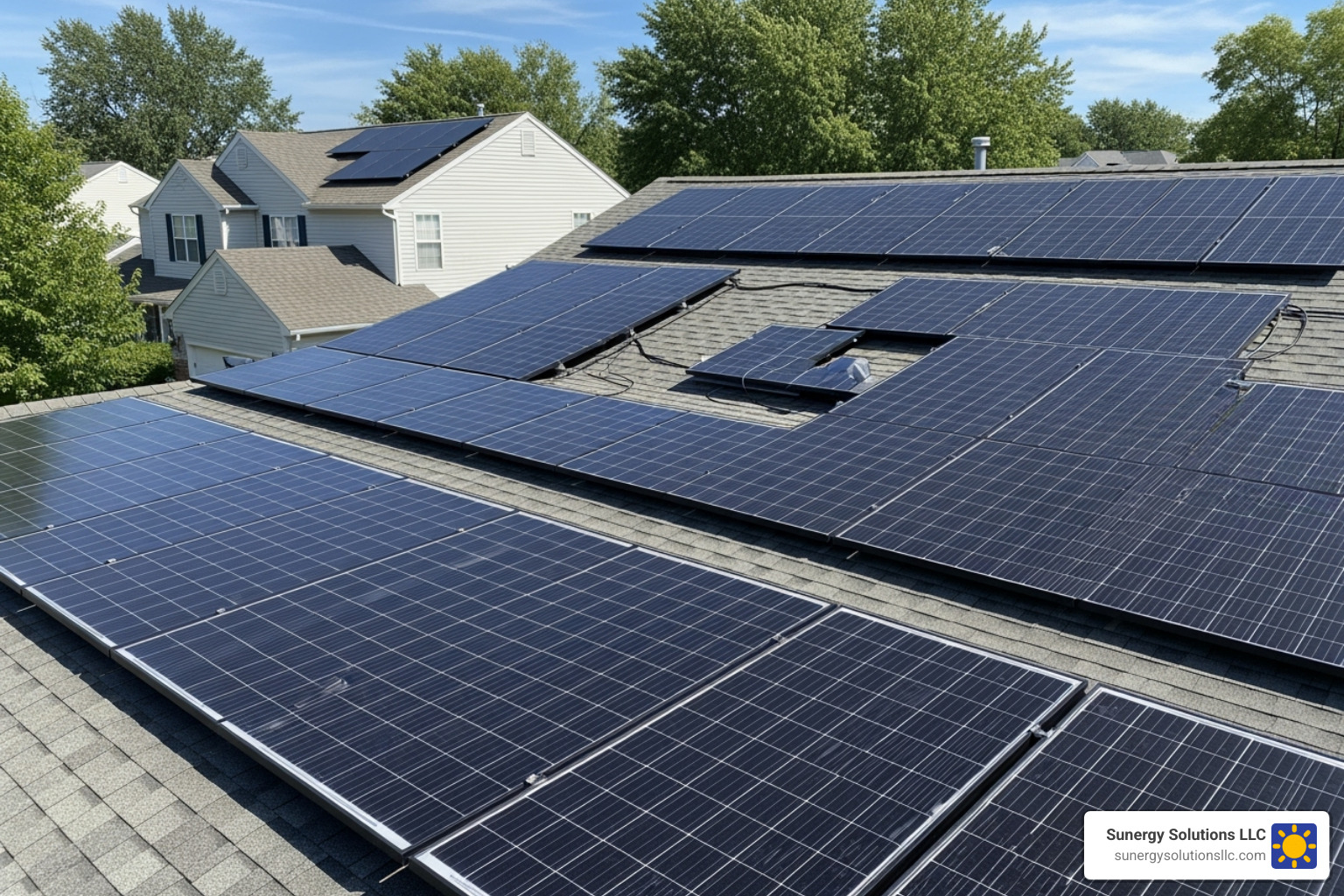
The panels and inverters you choose will determine your system’s performance and your long-term satisfaction.
Understanding Solar Panel Types
You’ll mainly encounter two types: monocrystalline and polycrystalline. Monocrystalline panels are the premium option, made from single silicon crystals for a sleek, uniform black look. They are more efficient (17-22%+), generating more power from less space. Polycrystalline panels have a bluish, mottled look, are less expensive, and slightly less efficient (15-17%). Both types come with excellent 25-30 year performance warranties.
| Feature | Monocrystalline Panels | Polycrystalline Panels |
|---|---|---|
| Efficiency | Higher (17-22%+), more power per square foot | Lower (15-17%), need more space for same output |
| Cost | Generally higher | Generally lower |
| Aesthetics | Uniform, dark black appearance (sleeker) | Bluish, mottled appearance |
| Lifespan | Excellent, typically 25-30 year performance warranty | Excellent, typically 25-30 year performance warranty |
We often recommend premium monocrystalline panels like the REC Alpha Pure series, which offer efficiencies up to 22.2%, maximizing your roof’s potential.
Choosing the Right Inverter Technology
The inverter converts the DC electricity from panels into AC electricity for your home. You have three main options:
String inverters connect all your panels to one central unit. They are cost-effective but can be affected by shading on a single panel, which reduces the output of the entire string.
Microinverters, like those from Enphase, are placed under each panel. This allows each panel to operate independently, so shading on one won’t affect the others. This setup also provides valuable panel-level monitoring.
Power optimizers, from brands like SolarEdge, are a hybrid solution. Each panel gets an optimizer that conditions the power before sending it to a central inverter, providing shading protection and monitoring benefits.
Both SolarEdge and Enphase are excellent options that we frequently install. Most inverters come with warranties of 10-12.5 years, with options to extend to 25 years. For more details, visit more info about residential solar panels.
Adding battery storage to your Residential Solar System is a major step toward energy independence.
Energy storage is the primary benefit. Batteries capture excess solar electricity generated during the day for use at night or on cloudy days.
In the Northeast, backup power during outages is invaluable. When the grid goes down, your home seamlessly switches to battery power, keeping your lights on and essentials running.
Maximizing self-consumption is another key advantage. Instead of sending all excess power to the grid, you use more of the energy you generate, giving you greater control.
Batteries also enable time-of-use bill management. If your utility has peak and off-peak rates, you can use stored energy during expensive peak hours to save money.
Combining solar with storage provides increased energy independence, making you less vulnerable to utility rate hikes and service interruptions. Popular options include the Enphase IQ Energy System and the SolarEdge Home Battery, which integrate perfectly with their respective inverter systems.
Choosing Residential Solar Systems is a big decision, and it’s natural to have questions. Here are answers to some of the most common ones we hear from homeowners.
Think of net metering as a way for your solar system to “bank” electricity. On sunny days, your system often produces more electricity than your home needs. This excess power flows back to the utility grid, and your utility company gives you credits on your bill.
Later, at night or on cloudy days, your home draws power from the grid as usual. The credits you earned are then applied to offset these charges. It’s like having a savings account for electricity.
Net metering policies vary by location and utility. Some offer full retail rate credits, while others credit you at a lower wholesale rate. Understanding your local utility’s policy is crucial for projecting your savings, and it’s something we help every client steer.
Both rooftop solar and large-scale solar farms are vital for a clean energy future, but Residential Solar Systems offer unique advantages.
Environmentally, a recent study found that rooftop systems generate 18 to 59 percent fewer carbon emissions during production and installation compared to utility-scale farms. This is because they require fewer materials and less land disturbance.
While large solar farms benefit from economies of scale, residential solar provides direct savings on your monthly electric bill and increases your home’s value. It also creates a more resilient electrical grid through “distributed generation”—producing power right where it’s consumed, which reduces transmission losses. Meeting national clean energy goals will require a massive expansion of both types of solar. For more details, you can review a recent study on solar emissions.
This is one of our favorite questions because the answer is so reassuring. Residential Solar Systems are built to be incredibly durable and require almost no maintenance.
Solar panels are designed to last 25 to 30 years or more. Manufacturers provide performance warranties guaranteeing they will produce at least 80-85% of their original power after 25 years. Many panels continue producing power long after that.
As for maintenance, it’s refreshingly simple. Rain typically washes away dust and debris. In most cases, you won’t need to do anything. If needed, a gentle rinse with a garden hose from the ground is sufficient.
The most important “maintenance” is simply monitoring your system’s performance through the app we provide. This allows you or our team to spot any potential issues remotely. Inverters typically have 10 to 25-year warranties and are a straightforward replacement if ever needed. Once installed, your system will quietly generate clean energy and savings for decades.
The journey to solar energy doesn’t have to be overwhelming. We’ve walked through everything you need to know about Residential Solar Systems, from how they work to calculating your return on investment.
The path forward is clear:
The financial and environmental rewards are significant. Systems often pay for themselves in 5-18 years and then provide free electricity for another decade or more. You’ll add value to your home while reducing your carbon footprint by several tonnes annually.
With 25-30 year warranties and minimal maintenance, Residential Solar Systems offer predictable energy costs while utility rates continue to climb. At Sunergy Solutions LLC, we’ve helped homeowners across Connecticut, Massachusetts, Maine, New Hampshire, Rhode Island, Vermont, and Virginia make this transition. We understand the local regulations and climate to ensure your investment is sound.
Ready to explore what solar can do for your home? We’re here to provide honest assessments, transparent pricing, and quality installations that stand the test of time.
Learn more about our residential solar solutions

Appointments Available, 7 Days a Week


