
5.0 Rating
Request A Free Estimate
Warehouse and distribution center roofs are some of the best commercial spaces for solar power, thanks to their size, flat shape, and lack of shade.
A typical system costs $1.40 to $1.80 per watt, pays for itself in five to nine years, and can cut electricity bills by 40 to 80 percent.
The biggest question usually isn’t the panels.
It’s whether your roof can support them, which is where a company that handles both roofing and solar has a real advantage.
If you own or manage a warehouse or distribution center, your roof is probably the most underused asset on your property.
It sits empty, exposed to the sun all day, and generates nothing but heat and utility bills.
Solar for warehouse roofs and distribution centers has become one of the fastest-growing segments for commercial solar installations, and the math is easy to see why.
Large flat roofs, high daytime energy use, and long-term ownership make warehouses and distribution centers some of the best-suited buildings in commercial real estate for rooftop solar.
This guide walks through what solar actually costs for a warehouse or distribution center, how long it takes to pay for itself, what your roof needs to be ready, and how current tax incentives affect the numbers.
SEE HOW YOU CAN SAVE WITH SOLAR
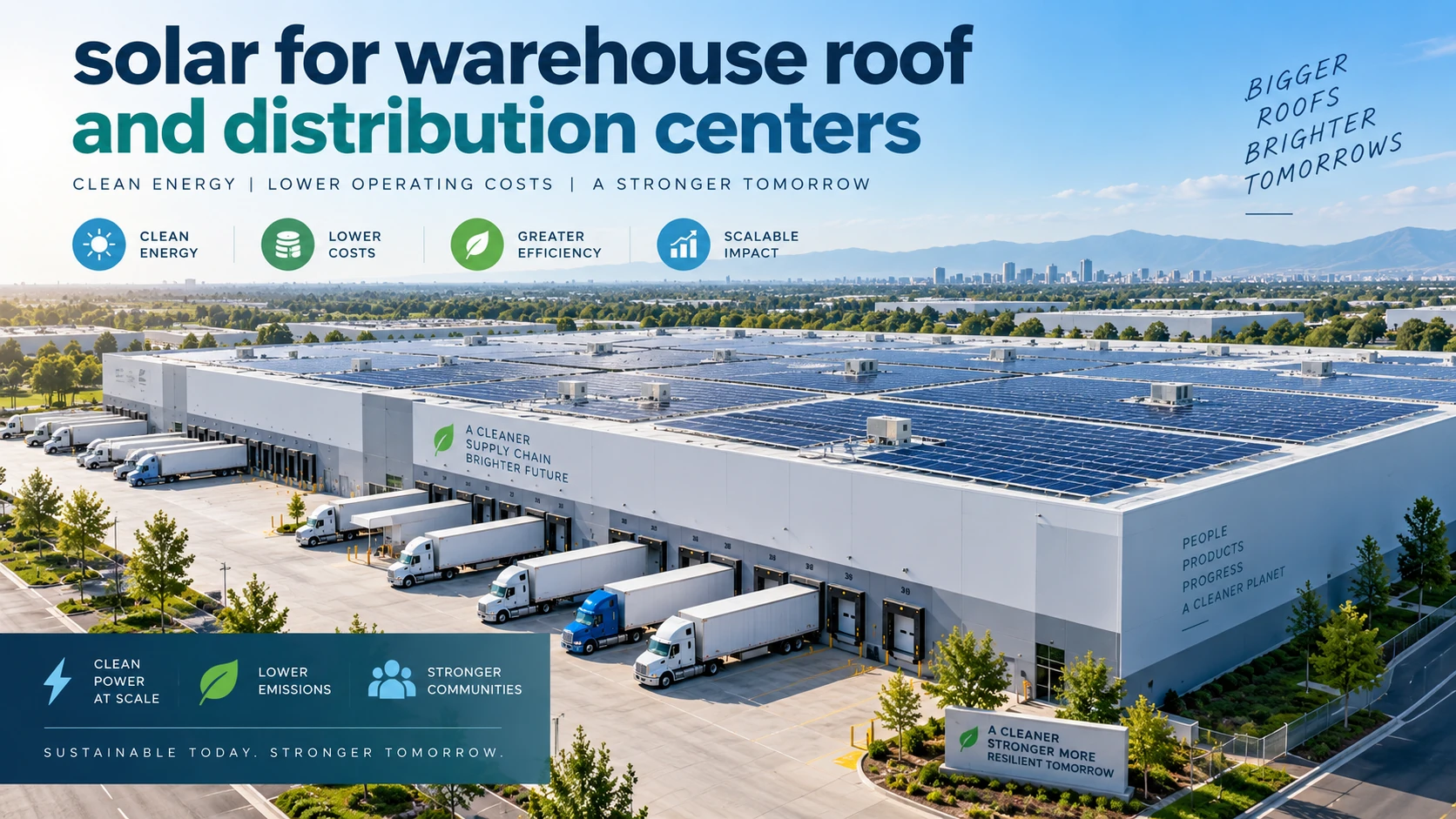
Warehouse and distribution center roofs are ideal for solar because they are large, flat, unshaded, and already built to hold heavy rooftop equipment like HVAC units.
That combination means more usable panel area per square foot and fewer obstacles than almost any other building type.
The scale of this opportunity is bigger than most business owners realize.
The rooftops of American warehouses built before 2019 could generate an estimated 185.6 terawatt-hours of solar electricity a year, enough to power roughly 19.4 million average homes, across more than 450,000 buildings and 16.4 billion square feet of rooftop space.
Warehouses and distribution centers also tend to run heavy loads during the day, when solar production peaks.
Forklifts, conveyor systems, lighting, loading dock equipment, and climate control all draw power during business hours, which lines up almost perfectly with when panels are generating the most electricity.
This matters even more in a region with a strong logistics footprint.
Distribution hubs along the New England corridor, from Hartford and Springfield to Worcester and Manchester, along with the Richmond and Hampton Roads area near the Port of Virginia, are exactly the kind of high-usage, roof-rich properties where warehouse solar performs best.
A few factors move the price up or down for any specific building:
A detailed savings analysis for your specific building is the only way to get real numbers instead of rough ranges.
Most commercial solar systems on warehouses and distribution centers pay for themselves in five to nine years and keep producing electricity for 25 years or more after that.
Average ROI on commercial solar lands between 10 and 18 percent, with ground-mounted commercial systems averaging around 16.45 percent and a typical payback period just over nine years.
Warehouses and distribution centers tend to land on the faster end of that range.
High daytime electricity use means more of the power a system generates gets used immediately on-site, instead of being sold back to the grid at a lower rate.
Buildings with strong daytime loads, including manufacturing, warehousing, and retail distribution, consistently show up among the industries with the best solar returns.
Financing structure changes the payback math too.
A cash purchase gets you the full tax benefits up front but ties up capital.
A solar loan or power purchase agreement spreads out the cost and can mean positive cash flow from month one, since the electricity savings often exceed the loan or lease payment.
A warehouse roof is ready for solar if it has at least 10 to 15 years of remaining life, can structurally support the added weight of panels and racking, and has enough unobstructed, unshaded area to make the system worthwhile.
Roof age is the single biggest factor most business owners overlook.
Installing solar on a roof that needs replacement within a few years creates a costly problem: the panels have to come down, get stored, and go back up when the new roof goes in.
That double labor cost is one of the most common and avoidable mistakes in commercial solar.
Most flat warehouse roofs use ballasted racking, which holds panels in place with weight rather than bolts or screws through the roof membrane.
Ballasted systems typically add less than 5 pounds per square foot of load, and because they don’t penetrate the roof, they’re generally easier on roof warranties and less prone to leaks.
In areas with heavy snow and high wind, like much of New England, the amount of ballast needed can get impractical on its own, which is why many regional installers use a hybrid approach, combining ballast with a limited number of mechanical attachment points.
A qualified engineer needs to run the numbers for your specific roof and climate before deciding which approach fits, which is exactly the kind of detail covered in a proper commercial solar system design process.
Every added pound of ballast, racking, and panel weight has to be checked against what your roof structure was originally engineered to hold, plus local snow and wind load requirements.
This is a structural assessment that has to happen before any solar design work begins, not after.
If your roof inspection turns up significant wear, a roof replacement before installation almost always costs less in the long run than replacing a roof with solar panels already on it.
Pairing the two projects together, instead of treating them as separate decisions years apart, is one of the most practical ways to control long-term costs.
Solar works well for cold storage and refrigerated distribution centers, though it typically offsets 25 to 45 percent of total electricity use without battery storage, since refrigeration often accounts for the majority of a cold storage facility’s power draw.
Adding battery storage can push that offset to 70 to 80 percent while also cutting demand charges from overnight compressor cycles.
Refrigerated warehouses are some of the most energy-intensive buildings in the supply chain, and that high, steady demand is exactly what makes them strong candidates for solar in the first place.
One cold storage case study combining solar with thermal energy storage cut overnight grid-sourced refrigeration by 95 percent and lowered annual refrigeration energy costs by 39 percent.
For a cold storage or refrigerated distribution center, the right system size depends heavily on your specific load profile, compressor schedules, and whether batteries make sense for your operation.
That’s a conversation worth having early, since it changes both the system design and the incentive picture.
Commercial solar projects can still qualify for the 30 percent federal Investment Tax Credit, plus accelerated depreciation, but the timeline has tightened.
The safe harbor deadline to begin construction and lock in the full 30 percent rate passed on July 4, 2026.
Projects that missed that window now need to be placed in service by December 31, 2027 to still qualify for the Section 48E commercial solar tax credit.
Depreciation adds another layer of savings on top of the tax credit.
Businesses can generally recover a portion of a solar system’s cost through accelerated depreciation over the following several years, and when combined with the tax credit, a business in a high tax bracket can often recover a significant share of total project cost within the first year or two.
Because these rules and deadlines shift, getting current, project-specific numbers matters more than relying on a general estimate.
Our commercial solar incentives page breaks down what applies to your business today, including any state-level programs available in Connecticut, Massachusetts, Maine, New Hampshire, Rhode Island, Vermont, and Virginia.
Most solar companies only do solar.
Sunergy Solutions does both roofing and solar, which matters more for warehouses and distribution centers than for almost any other building type, since roof condition is so often the deciding factor in whether a project makes sense.
Our team starts with a real assessment of your roof, not just your electric bill.
If your roof has years of life left, we move straight into commercial solar installation, from custom system design through permitting and utility interconnection.
If it doesn’t, we handle the repair or replacement ourselves, so you’re working with one team and one timeline instead of coordinating between separate roofing and solar contractors.
That combined approach also protects your investment after installation.
A roof and solar system installed by two different companies can create warranty disputes if a leak shows up years later.
When one team handles both, that gap disappears.
We’ve built our business on practical, straightforward service across Connecticut, Massachusetts, Maine, New Hampshire, Rhode Island, Vermont, and Virginia, and warehouse and distribution center solar is a natural extension of the commercial and residential roofing work we’ve done for years.
A quick call with our team is usually enough to tell you whether your building is a strong candidate.
A commercial warehouse solar project generally moves through five stages, from initial site visit to full operation.
Our project management approach keeps one point of contact through all five stages, so you’re not left chasing updates between separate contractors.
Solar for warehouse roofs and distribution centers isn’t a one-size-fits-all decision.
The right system size, mounting type, and financing structure depend on your building’s age, your energy usage, and your timeline.
Sunergy Solutions can walk your property, run the real numbers, and tell you honestly whether your roof is ready today or needs work first.
It depends heavily on roof size, shape, and the number of rooftop obstructions like HVAC units and skylights. A 100,000 square foot warehouse roof can often fit a system in the range of 500 kilowatts to 1 megawatt, though a proper site assessment is the only way to get an exact panel count for your building.
Yes, in most cases. Ballasted racking systems hold panels in place with weight instead of roof penetrations, which is the standard approach on flat commercial roofs and generally preserves existing roof warranties. High wind zones sometimes require a limited number of mechanical attachment points alongside the ballast.
Installation itself typically takes a few weeks for a mid-size system, but the full project timeline, including permitting and utility interconnection, usually runs three to six months from signed contract to system activation.
Yes. Solar loans and power purchase agreements let businesses install a system with little or no money down, with payments typically structured to be lower than the electricity savings the system generates.
It can, but it requires a conversation with your landlord early on. Lease length, who owns the roof improvements, and how utility costs are split between landlord and tenant all affect whether solar makes financial sense for a leased facility.
Most roof warranties stay intact as long as the installation follows the roofing manufacturer’s guidelines, which is one reason ballasted, non-penetrating systems are so common on flat commercial roofs. Having the same company handle both the roof and the solar system removes most of the risk of a warranty dispute later.
Appointments Available, 7 Days a Week


