
5.0 Rating
Request A Free Estimate
For businesses aiming to cut costs and accept sustainability, commercial solar energy rebates offer a powerful path to significant savings. These incentives dramatically reduce the upfront investment in solar energy, making it a smart financial decision.
Here are the primary federal incentives available for commercial solar installations:
Navigating these programs can seem complex, but understanding them is key to open uping the full potential of solar for your business. This guide will explain the various incentives, helping you turn sunshine into long-term savings.
I’m Robert Raffa, CEO and Founder of Sunergy Solutions LLC. My background as an investment banker turned renewable energy entrepreneur helps businesses steer the complexities of commercial solar energy rebates and maximize their return on investment.
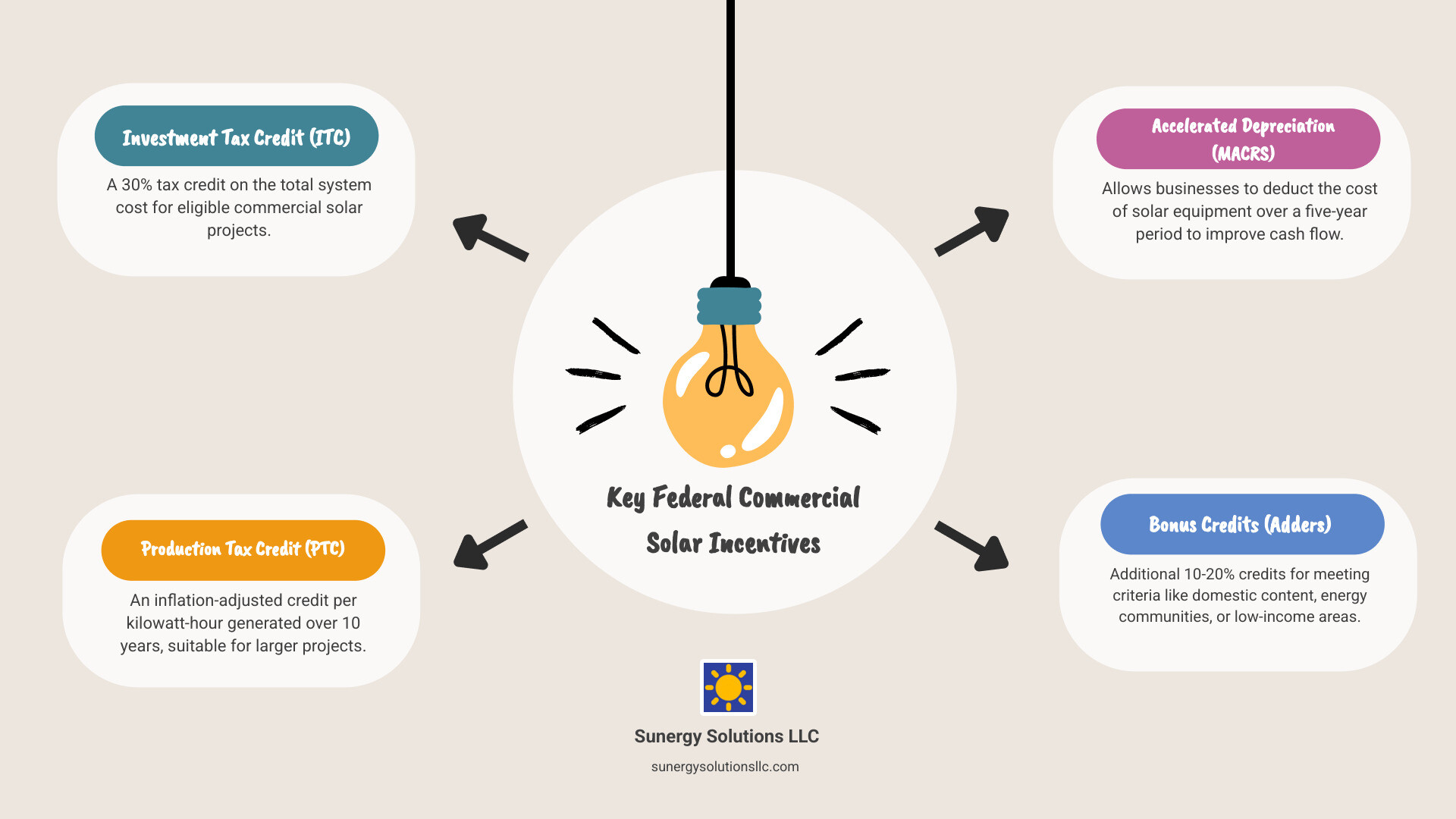
Simple guide to commercial solar energy rebates terms:
The federal government strongly encourages businesses to adopt solar energy. Thanks to the Inflation Reduction Act (IRA) of 2022, commercial solar energy rebates are more generous and accessible than ever. This legislation invested billions in clean energy incentives, making solar a key business investment.
The IRA expanded existing programs with new features, making solar viable for nearly any organization, from large corporations to local nonprofits. The core federal incentives are the Investment Tax Credit (ITC) and the Production Tax Credit (PTC). They are flexible options designed for different business needs, project sizes, and financial situations.
The IRA also introduced game-changing provisions. Tax-exempt entities like nonprofits, schools, and government agencies can now use direct pay to receive cash refunds for credits. Transferability allows businesses to sell tax credits they can’t use. Plus, bonus ‘adders’ can increase the base credits.
The phase-out schedule encourages timely action. The most generous incentives are available now and through the 2020s, tapering in the 2030s, creating a clear window to maximize your savings.

Choosing between the ITC and PTC means deciding between a large upfront discount and steady, long-term cashback. Both significantly reduce solar investment costs but operate differently.
The Investment Tax Credit (ITC) provides immediate savings. It’s a 30% tax credit on your total project cost, applied the year your system is activated. For example, a $100,000 system yields a $30,000 federal tax credit. This upfront cost reduction is ideal for businesses seeking immediate bottom-line impact.
The Production Tax Credit (PTC) is a long-term incentive. You earn 2.6 cents per kilowatt-hour (inflation-adjusted) for electricity your system produces over 10 years. This long-term production incentive rewards consistent clean energy generation.
Which is right for you? The decision hinges on project size and sunlight availability. The ITC is often better for smaller systems or those in areas with moderate sun, as it’s cost-based. The PTC is ideal for large projects in sunny locations that will generate significant electricity.
Here’s the key comparison to help you decide:
| Credit Type | Value (2023/2024) | Duration | Best For | Key Considerations |
|---|---|---|---|---|
| Investment Tax Credit (ITC) | 30% of total project costs | One-time, in year of service | Projects with high upfront costs, smaller-scale systems | Upfront savings, doesn’t depend on performance; available until 2035 (phasedown) |
| Production Tax Credit (PTC) | 2.6 cents per kWh (inflation-adjusted) | 10 years of operation | Large-scale projects in sunny areas | Long-term revenue stream, depends on actual energy production; available until 2036 (phasedown) |
You must choose one per project, but either option offers substantial savings, making solar a smart financial move.
For a deeper dive into how these credits work with different financing arrangements, check out our guide on commercial solar project financing.
The IRA also introduced bonus ‘adders’ that stack on top of the base ITC. These adders can boost your commercial solar energy rebates significantly, potentially pushing the total credit well above 30%. Each adder typically adds 10% to your base ITC, with some qualifying for a 20% adder. This means your total ITC could reach 50% or more.
The domestic content adder rewards using U.S.-made solar equipment (meeting thresholds that increase over time) with an extra 10% credit. This supports American manufacturing while you save.
The energy communities adder is for projects in areas historically dependent on fossil fuels, like former coal regions or sites near retired power plants. This adds a 10% bonus. You can check if your location qualifies using this energy communities map.
The low-income communities adder offers a 10% bonus for projects in qualifying low-income areas, or a 20% bonus for projects directly benefiting low-income households. This competitive program has limited annual capacity but offers substantial rewards.
To claim full credits and adders, projects over 1 MW must meet prevailing wage requirements and apprenticeship requirements. This involves paying fair wages and using apprentices for a percentage of labor hours (increasing to 15% after 2023).
These adders transform good solar deals into exceptional ones. For more details on the equipment that makes these systems work, explore our insights on commercial solar panels.
While tax credits are popular, depreciation benefits are the unsung heroes of solar economics. They allow you to recover investment costs over time, creating tax savings that improve cash flow.
The Modified Accelerated Cost-Recovery System (MACRS) classifies solar as five-year property for tax purposes. This allows you to deduct the cost over just five years, accelerating your tax savings.
Bonus depreciation boosts this benefit even further. For 2025, you can deduct 40% of your system’s cost in the very first year, with the remainder following the regular five-year MACRS schedule. This provides immediate cash flow improvement.
For a $100,000 system with a 30% ITC, your depreciable basis is $85,000 (cost minus half the ITC value). With 40% bonus depreciation in 2025, you could deduct $34,000 in year one alone, plus the remainder over the next four years.
Bonus depreciation is time-sensitive. The first-year bonus drops to 20% in 2026 and is eliminated in 2027. Acting sooner secures larger upfront deductions.
This combination of accelerated and bonus depreciation works alongside your tax credits to minimize the true cost of going solar. For official guidance on these provisions, check the IRS guidance on MACRS.
Understanding how depreciation impacts your long-term financial picture is crucial for maximizing your solar return on investment.
Federal incentives are powerful, but they’re only part of the picture. Many states, municipalities, and utilities offer their own commercial solar energy rebates that can be stacked with federal benefits. This layered approach boosts your return on investment (ROI).
State and local incentives include grants, rebates, performance-based payments, and tax exemptions. Their availability varies by location, as they are custom to regional energy goals. A business in Virginia will find different programs than one in New York. Let’s dig into some of these additional opportunities.

To encourage clean energy adoption, many states have their own incentive programs. These state-level commercial solar energy rebates come in several forms:
The Database of State Incentives for Renewables & Efficiency (DSIRE) is a comprehensive, free resource for exploring federal, state, and local incentives across the U.S.
For example, New York’s NY-Sun program offers incentives through regional “Megawatt Blocks,” where incentive levels decrease as adoption targets are met, encouraging early action.
In Virginia, besides the property tax exclusion, the VirginiaSAVES Green Community Program offers subsidized financing for commercial and non-profit solar projects. Virginia’s Net Metering Program also allows commercial systems up to 3,000 kW to receive credits for excess energy sent to the grid. To fully understand how net metering works, our page on More info about Net Metering is a great resource.
Don’t overlook local government and utility programs. They often offer custom commercial solar energy rebates to meet local needs or renewable energy mandates.
A common local incentive is the Property Tax Abatement (PTA). For example, New York City offers a four-year tax abatement of 7.5% annually (30% total) on the installed cost of a solar system, capped at $250,000 for systems placed in service by January 1, 2034. This significantly reduces your property tax burden.
Performance-Based Incentives (PBI) provide payments based on your system’s actual electricity generation, creating a steady income stream from a local entity or utility.
The USDA Rural Energy for America Program (REAP) Grant is a game-changer for rural businesses. It offers grants covering up to 50% of solar system costs for eligible rural businesses and agricultural producers (typically in areas with populations under 50,000). This grant dramatically reduces upfront costs.
These local and utility programs can significantly sweeten the deal, especially when combined with federal and state incentives. To learn more about the broader advantages of going solar for your business, check out our article on More info about Commercial Solar Energy Benefits.
Ready to claim your commercial solar energy rebates? Navigating the application process and understanding potential pitfalls like recapture rules are crucial to maximizing your solar investment. Careful planning and expert guidance can save you headaches and money.
We’ll walk you through the essential steps for claiming federal credits, explain what recapture means, and touch on how different financing options can play a role.

Claiming federal commercial solar energy rebates requires attention to detail and proper documentation.
First, ensure your project meets eligibility requirements: it must be a new solar energy property in the U.S. To get the full 30% ITC or PTC, projects over 1 MW must also meet prevailing wage and apprenticeship requirements.
The ITC’s “Commence Construction” rule is critical. To qualify for a specific year’s rate, you must either begin significant physical work or incur at least 5% of the total project cost (the 5% Safe Harbor). Once started, you generally have four years to place the system in service.
For the Investment Tax Credit (ITC), you’ll file IRS Form 3468, Investment Credit, with your business’s tax return. You can find IRS Form 3468 for the ITC on the IRS website. For the Production Tax Credit (PTC), you’ll likely use IRS Form 3800, the general business credit form.
Always consult a qualified tax professional. They can confirm your eligibility, steer tax complexities, ensure correct filing, and help you maximize your benefits. This is crucial for properly claiming your commercial solar energy rebates.
If you claim the 30% ITC but sell the property or solar system soon after, recapture rules may apply. The IRS requires the system to remain in service for a set period to justify the full credit.
The ITC has a five-year recapture period. If the system is sold or ceases to be a qualified property within five years, the IRS can recapture a portion of the credit. The credit vests at 20% per year.
If the system is sold or disqualified in Year 1, 100% of the credit is recaptured. The recapture amount decreases by 20% each year: 80% is recaptured in Year 2, 60% in Year 3, 40% in Year 4, and 20% in Year 5. After five full years, the credit is fully vested and nothing is recaptured.
Recapture triggers include selling the system or property within five years, a change in use (e.g., no longer for a qualifying business purpose), or if the system is destroyed and not replaced.
It’s crucial to understand these rules. Consulting your tax advisor is essential to avoid surprises. For more insights into planning your solar project, our guide on More info about Solar Installation for Businesses can be helpful.
Your financing method significantly impacts how you benefit from commercial solar energy rebates, especially the ITC. Structuring the deal correctly is key to maximizing financial returns.
With direct ownership (paying cash or using a loan, i.e., debt financing), your business owns the system and can claim the full ITC and MACRS depreciation. Some financing types may affect the timing of when you can claim the ITC.
For businesses with low or no tax liability, tax equity financing is a great option. An investor provides upfront capital in exchange for the project’s tax benefits (ITC, depreciation). Your business gets the solar system and energy savings, while the investor monetizes the tax credits.
With Power Purchase Agreements (PPAs) or Leases, a third party owns and operates the system on your property. You buy the power at a set rate (PPA) or pay a fixed monthly fee (lease). The third-party owner claims the ITC and depreciation, while your business benefits from lower energy costs with no upfront capital. You do not directly receive the commercial solar energy rebates in this model.
The choice of financing impacts who claims the ITC and thus the overall project viability. It’s a strategic decision that should be made in consultation with financial and solar experts. For more on structuring these deals, dig into More info about Commercial Solar Financing Companies.
We understand that navigating commercial solar energy rebates can be complex. Below, we’ve answered some of the most common questions to provide clarity.
Yes. The Inflation Reduction Act (IRA) introduced “direct pay” (or elective pay). This allows tax-exempt entities like non-profits, schools, and government agencies to receive a direct cash payment from the IRS equal to the value of the tax credit. For example, a project eligible for a $30,000 ITC would result in a $30,000 refund. This makes solar accessible for community-focused organizations. They can also use credit transferability to sell their credits to another taxpayer.
This is a common concern, and the ITC is flexible. For-profit businesses can carry the credit back three years and forward 22 years to apply against tax liabilities. This provides a long window to use the credit as your business grows. Alternatively, two other options exist: tax equity financing, where an investor funds your project in exchange for the tax credits, and credit transferability, an IRA provision that lets you sell your tax credits directly to another taxpayer for cash. Both are excellent ways to monetize the credit without direct tax liability.
No, you don’t have to choose. A key benefit of commercial solar energy rebates is that they are designed to be stacked. You can typically combine federal credits (ITC or PTC) with state, local, and utility incentives. This layered approach is what makes solar a compelling financial investment. Be aware that some grants or rebates that reduce your system’s capital cost may slightly lower the value of your federal ITC, as it’s based on cost. However, the combined benefit of stacking incentives almost always outweighs this adjustment. Always consult a solar expert and tax professional to create the best stacking strategy for your project.
Navigating commercial solar energy rebates can seem complex, but it’s a worthwhile journey. These incentives offer a powerful opportunity for businesses to invest in clean energy, cut operating costs, and demonstrate a commitment to a greener future.
The federal ITC and PTC, combined with bonus ‘adders’ and accelerated depreciation, provide a massive financial boost. When you stack state, local, and utility programs—like property tax breaks, SRECs, and REAP grants—the case for solar becomes unbeatable.
At Sunergy Solutions LLC, we make solar easy and accessible. We provide customized commercial solar installations with top-tier equipment, great warranties, and outstanding customer service. Our goal is to deliver reliable, cost-effective solar solutions for significant energy savings. We are experts on incentives in our service areas, from Maine to Virginia, and will help you claim every benefit you deserve.
Don’t let the details hold you back. It’s time to accept the future of energy, stabilize your costs, and lead in environmental stewardship. Ready to take the next step toward energy independence? If you’re in Virginia, for example, you can Take the next step toward energy independence for your Virginia business. We’re ready to help you turn sunshine into savings.

Appointments Available, 7 Days a Week


