
5.0 Rating
Request A Free Estimate
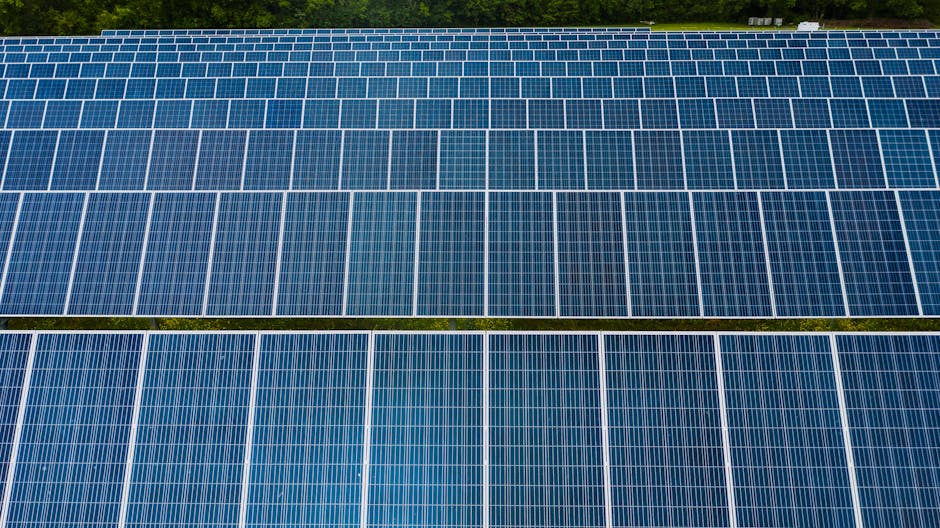
Commercial solar energy savings represent one of the most compelling business investment opportunities available today. Here’s what you need to know:
Key Commercial Solar Savings Benefits:
Rising energy costs are crushing business budgets. Demand is expected to grow by 75% by 2050, while grid electricity rates continue to increase. Meanwhile, solar technology costs have dropped over 80% in a decade, making commercial solar more affordable than ever.
The financial case is clear. A 500kW system can save businesses up to $3 million over 20 years, while a 50kW system saves around $8,000 annually. With many systems achieving cash-flow positive results from day one, commercial solar has evolved from an environmental statement to a strategic financial decision.
As Robert Raffa, CEO and Founder of Sunergy Solutions LLC, I’ve spent nearly a decade helping businesses transition to solar. My background in investment banking provides the financial discipline needed to ensure every project maximizes commercial solar energy savings and long-term ROI.
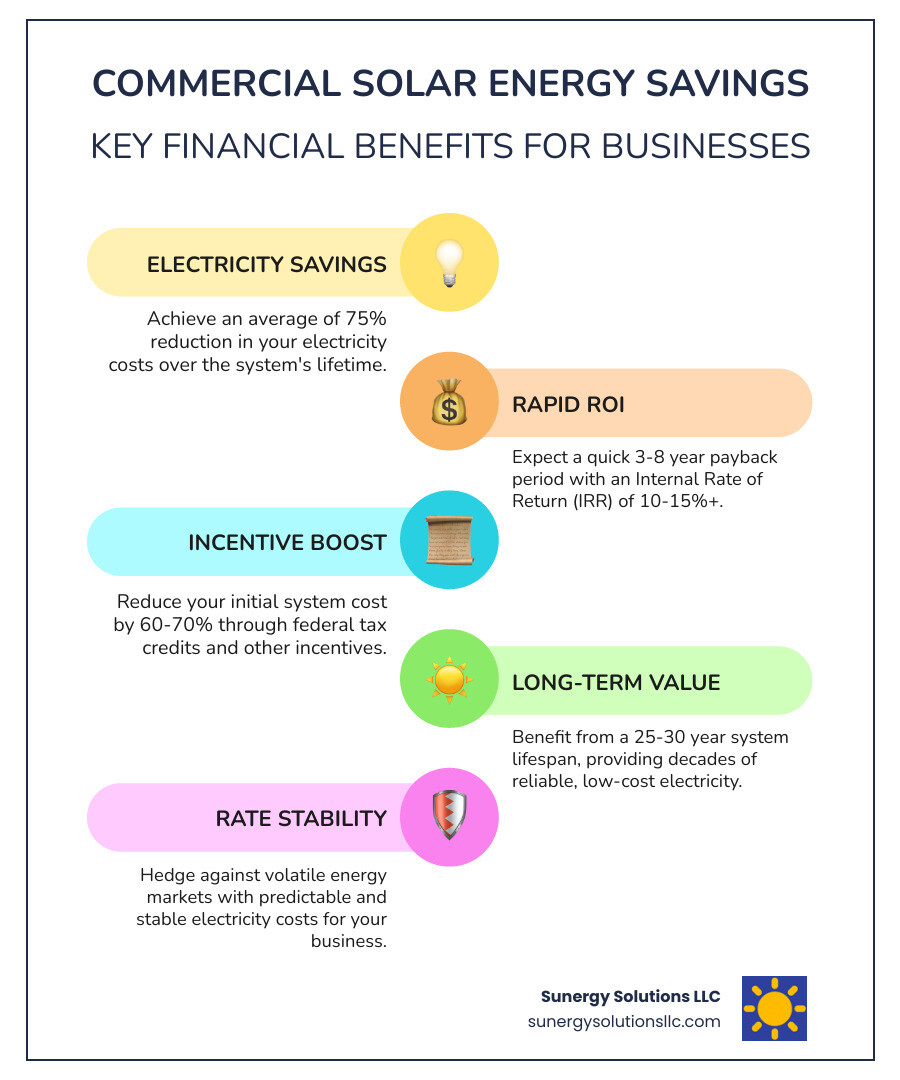
Commercial solar energy savings terms explained:
When businesses ask about commercial solar energy savings, they want to know if it will actually save them money. The answer is a resounding yes—it turns a major operational headache into a predictable expense and your roof into a profit center.
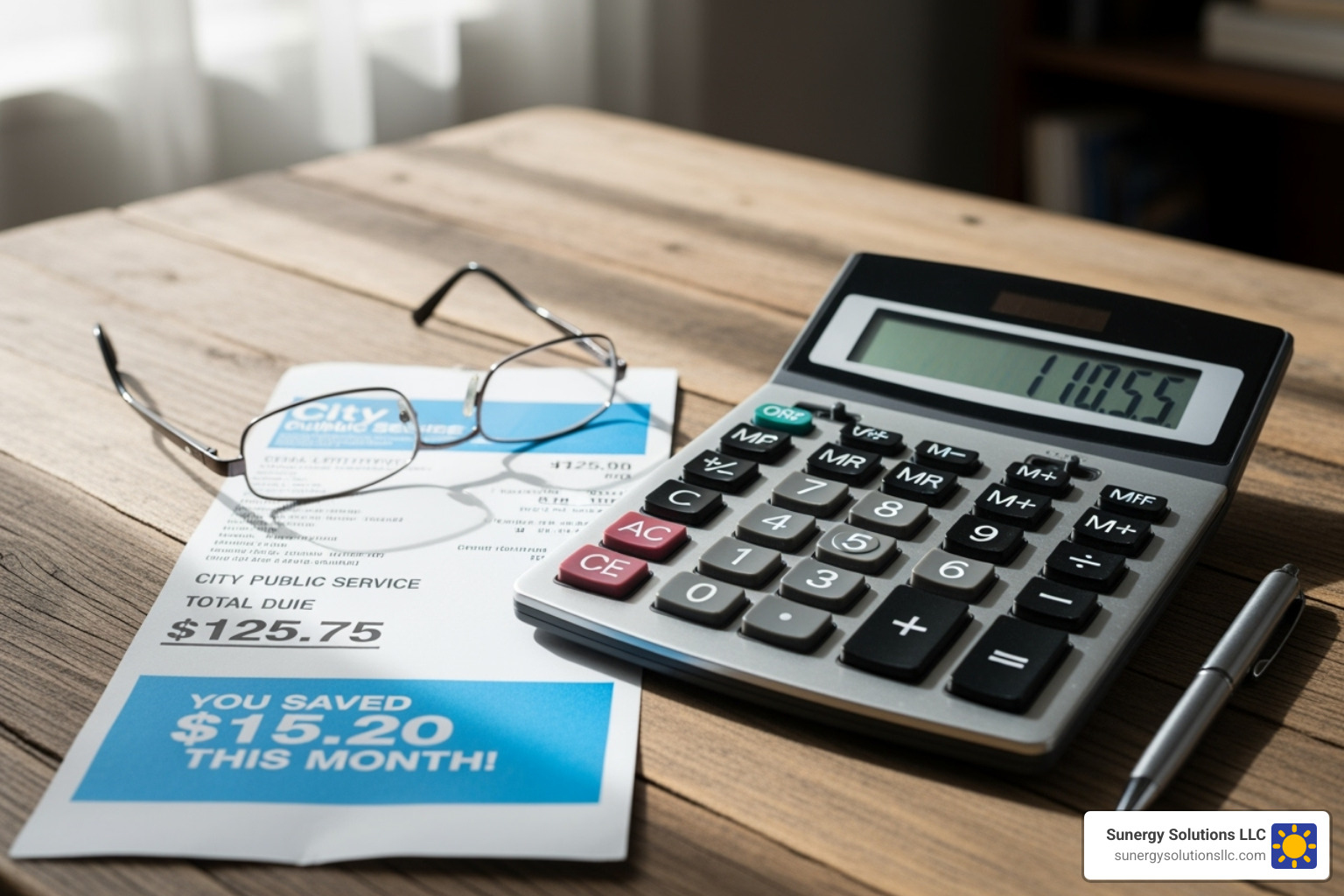
By generating your own electricity, you cut out the utility company, resulting in dramatic reductions in your monthly electricity bills. Most businesses see an average of 75% savings on electricity costs over their system’s lifetime.
In real dollars:
A 50kW system (perfect for smaller businesses) typically saves around $8,000 every year. A 100kW system doubles that to about $16,000 annually. And for larger operations, a 500kW system can deliver up to $80,000 in annual savings.
These savings repeat year after year, adding up to hundreds of thousands—or even millions—in reduced overhead. That’s money you can reinvest in your business. The beauty of Commercial Solar Energy Savings is that they start the moment your system goes live.
Historically, grid electricity rates have seen significant increases, making budgeting a nightmare. Solar changes this game entirely. An installation locks in your energy costs for the next 25-30 years, creating stable, predictable expenses while competitors face volatile rate hikes.
Think of it as a fixed-rate mortgage on your electricity. Your Levelized Cost of Energy (LCoE) becomes predictable, typically ranging from $0.04 to $0.06 per kilowatt-hour. This energy independence provides financial security and a competitive advantage, allowing you to operate with stable expenses while others scramble to absorb rising costs.
Solar panels don’t just save you money—they increase your property’s value. Research shows solar installations increase property premiums, making your building more attractive to buyers or tenants.
Beyond the financial gain, sustainability matters. A solar installation is a visible sign of environmental responsibility, which helps with market differentiation. It can attract higher-quality tenants, eco-conscious customers, and top-tier employees who value sustainability. Whether you plan to sell, lease, or improve your property’s appeal, solar delivers tangible benefits. Our team at Solar Installation for Businesses can help you maximize both the financial and marketing potential of your solar investment.
The typical payback period for commercial solar ranges from 3 to 8 years, with many businesses seeing positive cash flow from month one. Since most systems last 25 to 30 years with minimal efficiency loss (less than 0.5% per year), you get two decades or more of essentially free electricity after the payback period.
The Internal Rate of Return (IRR) typically ranges from 10% to 15% or higher. To put this in perspective, a 500kW system can save a business over $3 million over the next 20 years. These are real numbers based on actual system performance. For a detailed analysis, check out our guide on Solar Return on Investment.
The bottom line is that commercial solar energy savings represent one of the most reliable and profitable investments you can make.
Turning excitement about commercial solar energy savings into reality means understanding the available incentives, financing options, and system design. Combining these elements correctly creates a valuable investment that won’t strain your cash flow.
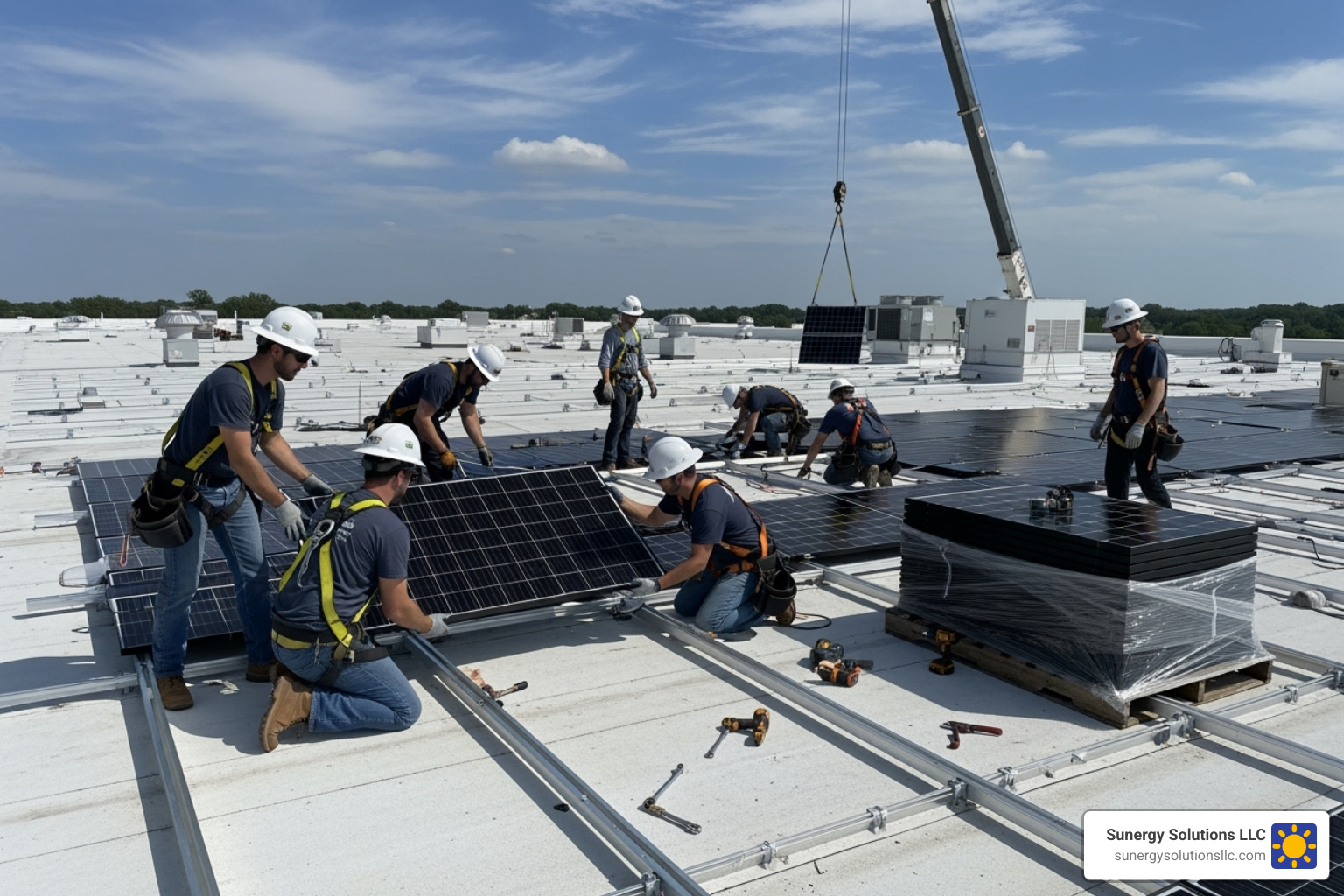
Government incentives can significantly reduce or even eliminate out-of-pocket costs. The primary incentive is the Federal Investment Tax Credit (ITC), which provides a 30% tax credit on your system’s cost. Additional bonuses are available: 10% for using American-made equipment, another 10% for installing in an “Energy Community,” and up to 20% for projects in low-income areas. In some cases, projects can have over 90% of their costs covered by tax credits.
Additionally, MACRS depreciation allows you to deduct up to 85% of your system’s cost over five years, reducing your taxable income. Combined with state and local incentives, these programs can cut your total system cost by 60% to 70%. We’ve helped businesses across our service areas in Maine, Massachusetts, New Hampshire, Rhode Island, Vermont, Montana, and Virginia leverage these savings.
For the complete picture on federal incentives, check out Learn more about Federal Solar Tax Credits for Businesses. And for a deeper dive, visit our guide on Solar Tax Credits and Rebates What You Need to Know.
A common question is about the upfront cost. Thanks to innovative financing, you can often start enjoying commercial solar energy savings from day one with zero capital outlay.
Solar loans work much like any business loan, but your monthly payment is typically less than your electricity savings. This means you’re cash-flow positive from month one while building equity in a valuable asset.
Solar leases offer a different approach. You pay a fixed monthly amount, and the solar company handles everything else: installation, maintenance, and repairs. It’s hassle-free solar that starts saving you money immediately.
Power Purchase Agreements (PPAs) are another great solution. You don’t buy or lease the system—you simply purchase the electricity it produces at a predetermined rate that’s lower than your utility charges.
All three options can deliver immediate commercial solar energy savings, often with zero capital outlay. For detailed comparisons to see which option fits your business, visit our Commercial Solar Project Financing page.
| Feature | Solar Loan | Solar Lease | Power Purchase Agreement (PPA) |
|---|---|---|---|
| Upfront Cost | Varies (can be low or zero) | Often Zero | Often Zero |
| Ownership | Business owns system | Third-party owns system | Third-party owns system |
| Tax Incentives | Business claims ITC & depreciation | Developer claims ITC & depreciation | Developer claims ITC & depreciation |
| Payment Model | Fixed monthly loan payment | Fixed monthly lease payment | Pay per kWh generated (fixed rate) |
| Maintenance | Business responsible (often warrantied) | Developer responsible | Developer responsible |
| Savings | Immediate, significant, long-term | Immediate, predictable monthly savings | Immediate, predictable per-kWh savings |
| Flexibility | Higher long-term ROI, asset on balance sheet | Simpler, no ownership hassle | No ownership, no maintenance, pure cost saving |
Maximizing commercial solar energy savings requires careful, custom design. Key factors include:
Modern systems have low maintenance requirements, built with durable materials and no moving parts. As NREL research confirms, custom design is critical for ROI. Every layout we create is optimized for your building, energy needs, and financial goals. For more insights, explore our Commercial Solar Panel Cost guide.
Battery storage transforms a great investment into an exceptional one, adding layers of commercial solar energy savings and security.
Most importantly, battery storage provides backup power during outages. For businesses where downtime means lost revenue—like hotels, warehouses, or data centers—this energy security is invaluable. The combination of solar and battery storage creates true energy independence, protecting your operations from outages and volatile rates. To learn more about how battery backup can protect your operations, check out our insights on Residential Solar System with Battery Backup.
The benefits of commercial solar energy savings extend beyond the balance sheet. Going solar is a powerful statement about your company’s values that improves your brand, attracts talent, and resonates with an eco-conscious market.
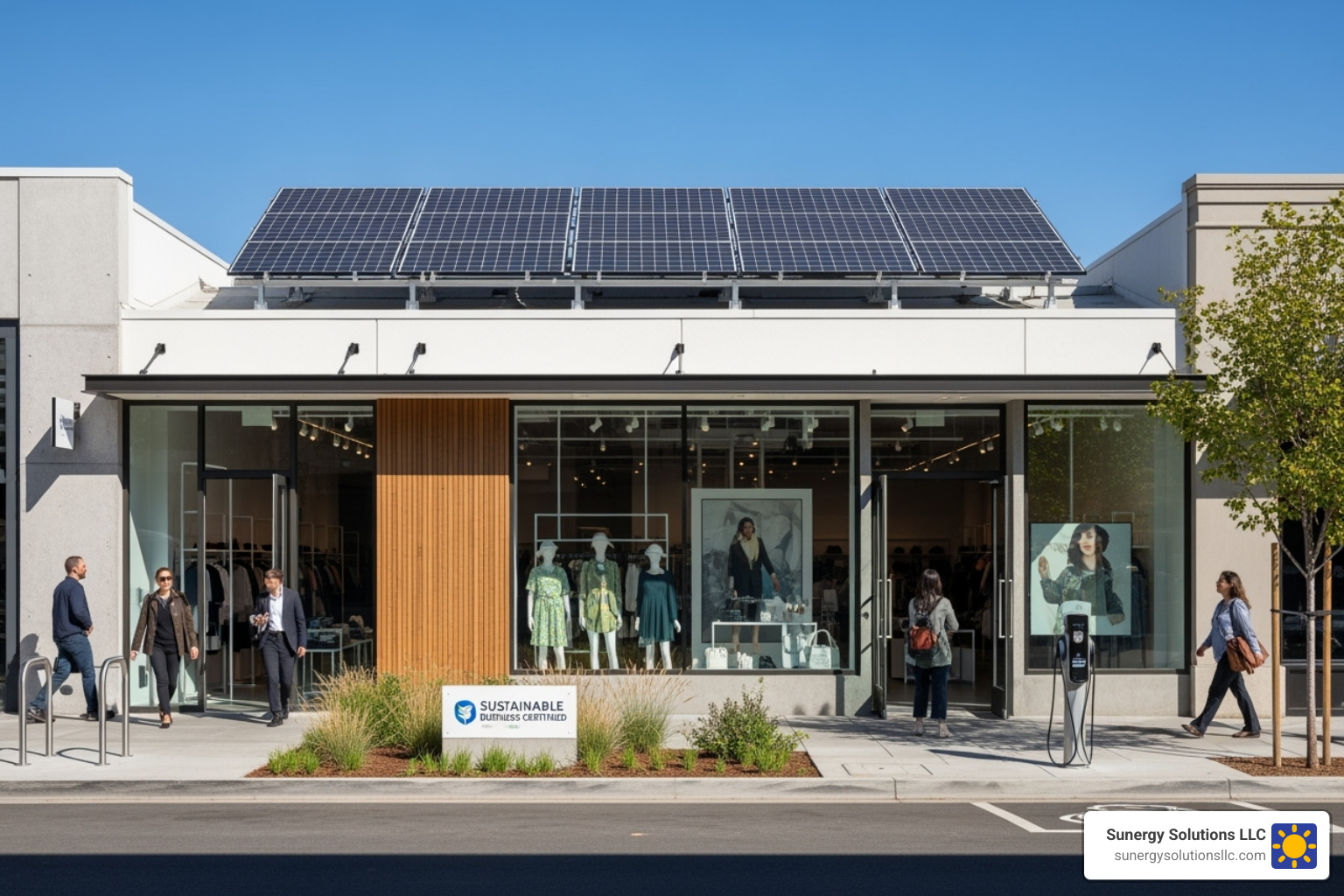
In today’s market, Corporate Social Responsibility (CSR) is a business necessity. A commercial solar system sends a clear message that your company is serious about sustainability. This commitment helps in attracting eco-conscious customers, as studies show consumers favor sustainable companies. It also boosts employee recruitment and retention, as many employees prefer working for companies that share their environmental values. Furthermore, a solar installation provides powerful green marketing advantages. You can share real-time data on clean energy production and carbon footprint reduction, creating authentic marketing material that demonstrates your commitment.
While most businesses with high energy use can benefit from solar, some industries are perfectly positioned to maximize their commercial solar energy savings. Warehouses and logistics companies are ideal due to large, unobstructed rooftops and high energy consumption, leading to substantial bill reductions.
Manufacturing facilities are another perfect match, with high energy demands during daylight hours that align with solar production. Agriculture and farms have vast land suitable for ground-mounted systems to power energy-intensive operations. Hotels and resorts benefit from both cost savings and the marketing advantage of attracting eco-conscious guests.
Large retail stores and data centers also see exceptional returns. Retail stores have the roof space and energy needs, while data centers can achieve significant savings and critical energy security with solar and battery storage. Schools and universities can redirect cost savings to academic programs and use the installations as educational tools.
If your business has a high utility bill and suitable space, you are likely a great candidate for a winning solar investment.
Making the leap to solar brings up questions. Here are answers to the most common ones we hear from business owners.
A typical commercial solar system has a lifespan of 25 to 30 years. These durable systems are designed to withstand decades of weather with minimal efficiency loss (about 0.5% per year), meaning they still produce over 85% of their original power after 25 years. With no moving parts, they require almost no maintenance beyond occasional cleaning. This long-term reliability ensures commercial solar energy savings for decades.
Yes, installing solar on a leased property is common. It requires a long-term lease agreement and the building owner’s consent. Landlords are often receptive because solar increases property value. Financial benefits can be structured to benefit both parties. For example, the tenant gets reduced electricity bills while the landlord gains property value. A Power Purchase Agreement (PPA), where a third party owns the system, can also eliminate capital investment concerns for both. We can help facilitate these conversations to create a win-win scenario.
Net metering is a key driver of commercial solar energy savings. When your solar panels produce more electricity than you need, net metering allows you to send the excess power back to the grid, earning credits on your utility bill. Later, when your system isn’t producing enough power (at night or on cloudy days), you draw from the grid and use those credits. You are only billed for your net consumption—your total usage minus the power you sent to the grid. This can dramatically lower or even eliminate your electricity bill. Net metering policies vary by location, so we analyze local rules to design a system that maximizes your benefits. Understanding this is crucial for optimizing your investment. Net Metering: How it Works and Why it’s Important provides more detail.
Commercial solar energy savings represent one of the smartest investments a business can make. You can slash electricity bills by up to 75%, achieve a 3-8 year payback, and secure decades of predictable energy costs, all while government incentives cut upfront costs by 60-70%. Beyond savings, you gain energy independence from volatile utility rates, boost property value, and improve your brand’s commitment to sustainability.
Flexible financing options like loans, leases, and Power Purchase Agreements (PPAs) often allow businesses to start saving from day one with zero upfront investment. At Sunergy Solutions LLC, we provide customized installations backed by top-tier equipment and exceptional service. Our financial and engineering expertise ensures your system delivers maximum commercial solar energy savings for decades.
The solar industry has matured, costs have dropped, and incentives are at historic highs. Now is the time to lock in predictable energy costs and reduce operational expenses. Your energy future is in your hands. The path to independence and savings starts with a conversation.
Ready to explore your solar potential? Contact us for a free consultation in New Hampshire.
Appointments Available, 7 Days a Week


