
5.0 Rating
Request A Free Estimate
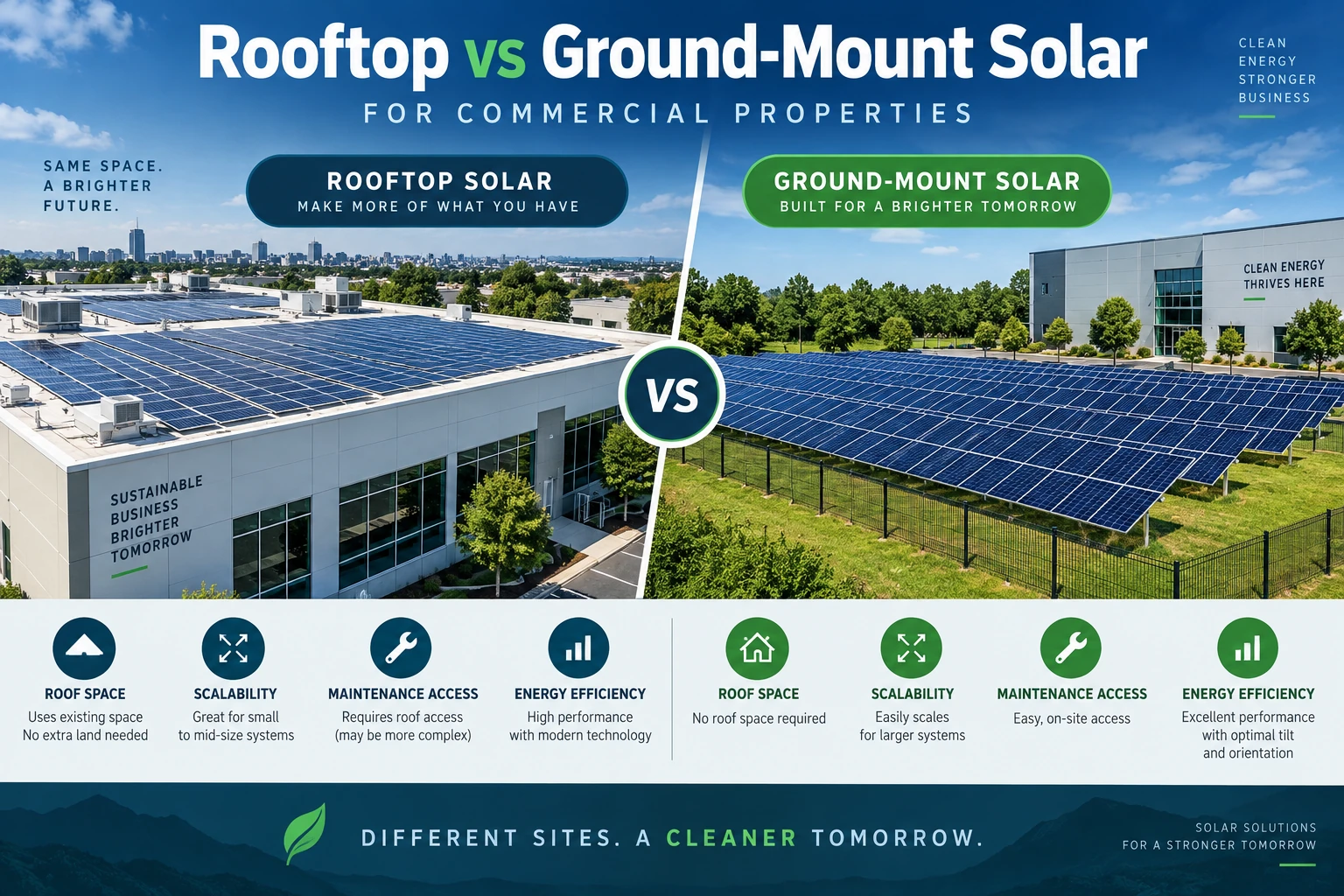
Rooftop solar costs less upfront and works well for businesses with limited land, while ground-mount systems need more space but often produce more energy and offer more room to grow.
The right choice comes down to your roof’s age and condition, how much land you have, your budget, and how the current tax credit rules affect your timeline.
It changes your upfront cost, how much power your system produces, how long solar installation takes, and even whether your roof needs work first.
Get it wrong and you end up with a system that underperforms, a roof that needs to be torn up again in ten years, or a project that stalls in permitting.
This guide walks through how the two options actually compare for a business, not a homeowner, using real numbers instead of vague pros and cons lists.
By the end, you’ll know which questions to ask before you get a quote.
GET HELP INSTALLING YOUR SOLAR SYSTEM
Rooftop solar mounts panels directly on your building’s roof using your existing structure, while ground-mount solar installs panels on a separate racking system anchored in open land on your property.
Rooftop systems make use of space you already own and pay for, while ground-mount systems need dedicated acreage but allow more control over panel angle and orientation.
Both systems use the same solar panels and inverters.
The difference is entirely in the mounting structure, the site prep involved, and what each option demands from your property.
Rooftop solar is still the default choice for most commercial properties, and for good reason.
It uses space that would otherwise sit empty, it typically costs less to install because there’s no racking foundation or land prep required, and it keeps the entire project inside your existing property line.
Rooftop arrays work best on buildings with a large, mostly unshaded roof and a structure that can handle the added weight.
Warehouses, distribution centers, big-box retail, and office parks with flat or low-slope roofs are usually strong candidates, since flat commercial roof space is easy to fill efficiently with panels laid out in rows.
It also tends to be the faster path to power.
Because the array sits on land you already control, there’s usually less site work and fewer land-use approvals to navigate compared to a ground-mount project.
Here’s the part most articles on this topic gloss over: your roof’s age and condition often decide this question before cost or land availability ever come into play.
Roofs under about 10 years old are usually strong solar candidates.
Roofs between 10 and 20 years old need a professional evaluation first, and roofs nearing the end of their service life are almost always better replaced before panels go up, since removing and reinstalling a solar array to redo a failing roof costs far more than coordinating both projects at once.
As a practical rule, your roof needs at least 15 to 20 years of remaining service life to comfortably match the 25-year lifespan of a solar system.
Weight matters too.
A rooftop PV system adds roughly three pounds per square foot of new dead load to your structure, concentrated at specific attachment points, and that load stacks on top of whatever snow and wind load your roof already has to carry.
A structural engineer needs to sign off on that math before a permit gets issued, which is exactly why getting a straight answer on roof inspection findings early saves you from a redesign later.
Ground-mount solar trades convenience for control.
Instead of working around your roof’s shape, slope, and structural limits, you build a dedicated array on open land engineered specifically for solar production.
A fixed-tilt commercial ground-mount system typically needs somewhere between six and eight acres per megawatt of installed capacity, according to land-use research from the National Renewable Energy Laboratory, with single-axis tracking systems needing somewhat less.
For most commercial and industrial businesses, that means anywhere from one to several acres of usable land, depending on how much of your electric load you’re trying to offset.
That acreage isn’t just about panel footprint.
It has to account for access roads, setbacks from property lines, equipment pads, and spacing between rows so one row of panels doesn’t shade the next.
If your building has an older roof, a complex roofline, heavy shading from nearby structures, or simply isn’t large enough to hit your energy goals, and you have open land available, ground-mounted solar panels solve problems rooftop arrays can’t.
You get full control over tilt angle and orientation, easier access for cleaning and maintenance, and a system that can expand later without touching your building at all.
Manufacturing sites, agricultural operations, distribution hubs with surrounding land, and businesses planning significant future growth tend to lean this direction once the numbers are on the table.
A solar carport is a hybrid worth knowing about: panels mounted on an elevated structure over a parking lot instead of a roof or open field.
It turns pavement you’re already paying to maintain into a producing asset, shades employee and customer vehicles, and sidesteps roof condition entirely.
The tradeoff is a higher cost per watt than either rooftop or ground-mount, since you’re building an entirely new structure from scratch.
For properties with large parking lots but a roof or land that doesn’t pencil out, it’s worth asking your installer to model alongside the other two options.
Rooftop solar generally costs less per watt installed than ground-mount because it skips the foundation work, fencing, and land prep a ground system requires.
Ground-mount systems typically run about $0.30 to $0.50 more per watt than a comparable rooftop system once racking, trenching, and site work are factored in, and getting an apples-to-apples look at commercial solar costs for your specific site is the only way to know where your project lands.
For context, commercial solar installations across all mounting types are running roughly $1.10 to $2.55 per watt installed in 2026, with smaller systems landing at the higher end of that range and large-scale rooftop arrays at the lower end.
The gap between rooftop and ground-mount narrows on bigger projects, where the fixed costs of land prep get spread across more panels.
Cost per watt is only half the equation, though.
A system that produces more power over its lifetime can still deliver a better return even at a higher upfront price, which is why the next section matters just as much.
Ground-mount systems generally produce more electricity per panel than rooftop systems, because they can be engineered for the ideal tilt angle and true south orientation instead of working around whatever direction your roof happens to face.
Rooftop arrays are constrained by your roof’s existing pitch, obstructions like HVAC units and vents, and any shading from nearby structures.
The production gap is real, but it isn’t universal.
A south-facing, unshaded, low-slope commercial roof with high-efficiency panels can come close to matching a ground-mount system’s output per panel.
The advantage tends to show up most clearly on roofs with poor orientation or significant shading, where a ground-mount array simply has more design freedom to work with.
Climate plays a bigger role in this decision than most guides mention, and it’s one of the things we weigh on nearly every commercial site visit across Connecticut, Massachusetts, Maine, New Hampshire, Rhode Island, Vermont, and Virginia.
Snow load is the big one.
Massachusetts building code requires roofs to withstand ground snow loads that range from roughly 35 to 50 pounds per square foot depending on the municipality, and neighboring states carry similarly demanding requirements.
Add the dead weight of a rooftop solar array on top of that, and an older or marginal roof structure can end up needing reinforcement before it can safely carry panels at all.
Ground-mount systems sidestep this issue completely, since the racking is engineered on its own foundation rather than tied to your building’s structural capacity.
Freeze-thaw cycles are the other factor.
Repeated freezing and thawing stresses roofing membranes and flashing over time, which is one more reason an aging commercial roof should be evaluated, and possibly replaced, before panels go on top of it rather than after.
Commercial solar projects, rooftop or ground-mount, can qualify for a federal Investment Tax Credit worth up to 30% of total installed cost when the project meets prevailing wage and apprenticeship requirements, according to a 2026 guide to the commercial solar tax credit.
Projects that don’t meet those labor requirements are limited to a 6% base credit, so it’s worth confirming with your installer and tax advisor which tier your project falls under, and reviewing how business solar tax credits apply to your specific project before you finalize a budget.
Timing matters more than usual right now.
The July 4, 2026 deadline that let projects lock in eligibility under a flexible, multi-year completion window has already passed.
For a project that begins construction after that date, current rules require it to be placed in service by December 31, 2027 to still qualify for the credit.
That’s a real deadline, not a soft target, and it applies the same way whether your system goes on the roof or in the ground.
Both mounting types can be financed the same basic ways: an outright cash purchase, a solar lease, or a power purchase agreement (PPA) where you pay for the electricity a third-party-owned system produces rather than the equipment itself.
Under a PPA, the investor typically bears the construction and performance risk, while your business takes on the risk that comes with variable electricity usage.
Where financing gets more interesting is scale.
Ground-mount systems are easier to expand later since there’s no roof size limiting how many panels fit, which makes them a natural fit if you’re planning to add battery storage or grow your system as your energy use increases.
Rooftop systems are usually the simpler, lower-cost entry point if you just need to offset your current load without a major expansion plan.
Run through these questions in order.
The first one that gives you a clear answer usually settles the decision.
GETE HELP WITH YOUR SOLAR INSTALLATION
Most solar contractors can tell you the pros and cons of rooftop versus ground-mount in the abstract.
Fewer can actually walk your roof, evaluate its structural condition, and tell you honestly whether it needs work before solar makes sense, because most solar companies don’t also do roofing.
That combination is exactly what Sunergy Solutions brings to commercial solar systems across Connecticut, Massachusetts, Maine, New Hampshire, Rhode Island, Vermont, and Virginia.
Our licensed team evaluates your roof’s age, structural capacity, and remaining service life alongside your available land and energy goals, so the recommendation you get is based on your actual property, not a generic comparison chart.
From there, we design and install the system, whether that’s a rooftop array, a ground-mount system, or a combination of both, and help you navigate the tax credits, rebates, and financing options that apply to your project.
For manufacturing sites, warehouses, and other larger facilities, our industrial solar solutions team handles the added complexity of higher-capacity systems and multi-building sites.
If your roof needs attention first, we handle that too, under one contract instead of coordinating between separate roofing and solar companies.
Rooftop solar is usually cheaper to install, typically running $0.30 to $0.50 less per watt than ground-mount, because it skips the foundation, fencing, and land preparation a ground system requires. Ground-mount can still deliver a better long-term return if it produces significantly more energy on your site.
Plan on roughly six to eight acres per megawatt of installed capacity for a fixed-tilt system, though the exact number depends on your site’s layout, access roads, and required setbacks. Most commercial properties need a fraction of a megawatt, so the actual footprint is often smaller than businesses expect.
Most commercial roofs can, but it depends on the roof’s age, structural design, and how much snow and wind load the building already has to carry. A structural assessment and a PE-stamped engineering letter are required before permitting, and any roof nearing the end of its service life should be evaluated or replaced first.
Yes. The federal Investment Tax Credit applies the same way regardless of mounting type, offering up to 30% of installed cost when prevailing wage and apprenticeship requirements are met, or a 6% base credit when they aren’t.
Yes, and it’s a common solution for businesses with both a usable roof and available land. Splitting a system across both mounting types can maximize total production without maxing out either your roof space or your acreage.
Rooftop projects typically move faster since they involve less site work and, in many cases, fewer land-use approvals. Ground-mount projects usually take longer due to grading, foundation work, and any additional permitting tied to land use. Either way, roof repairs or replacement ahead of installation will add time to the front end of the project.
Appointments Available, 7 Days a Week


