How Much Does Snow Actually Reduce Solar Production?
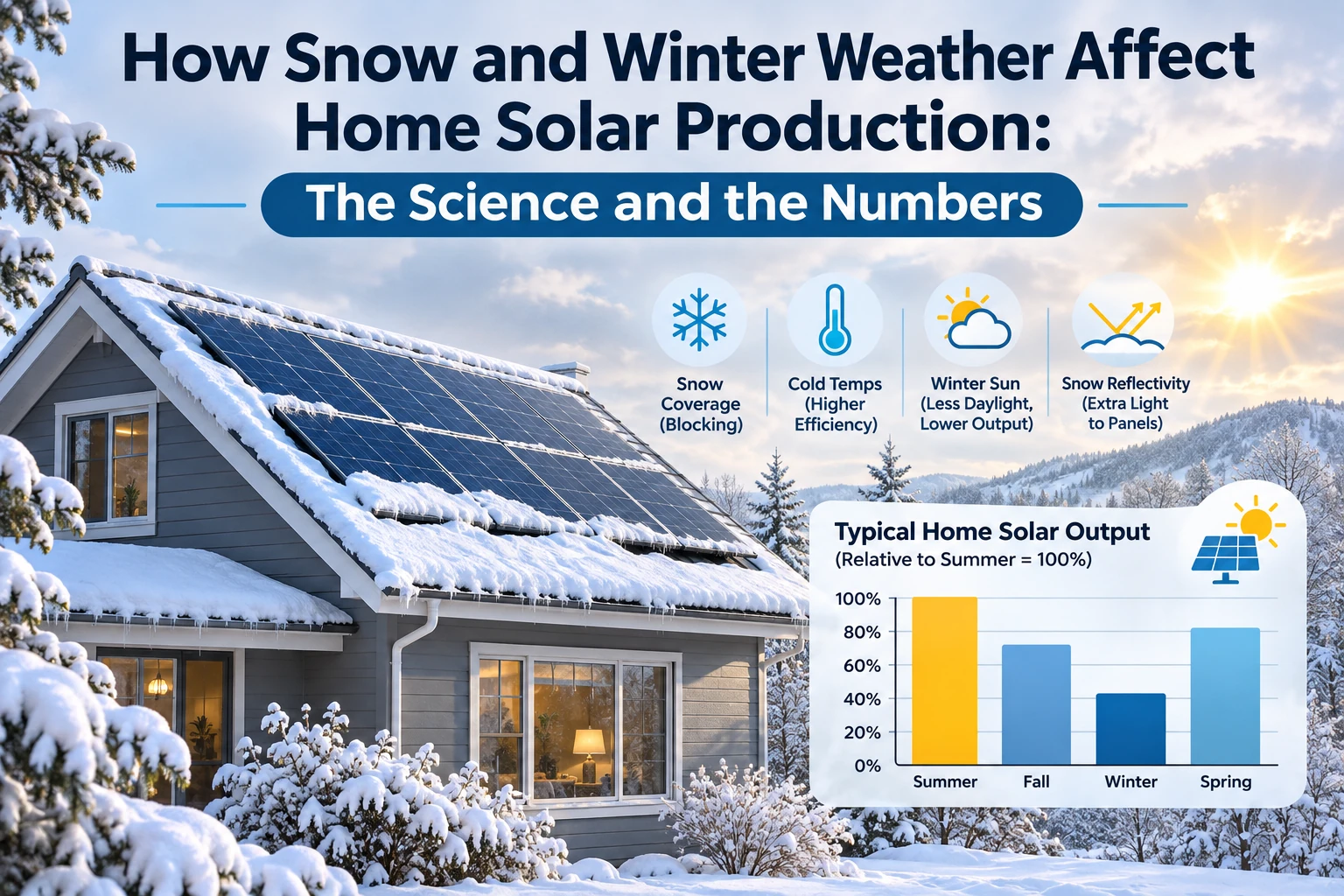
Snow typically reduces a home solar system’s annual production by just 1 to 12 percent, even in regions with heavy winter snowfall.
The loss is smaller than most homeowners expect because panels are mounted at an angle that lets snow slide off, and most of a system’s yearly output happens in the snow-free months anyway.
Researchers at Sandia National Laboratories have found that snow loss averages 1 to 12 percent annually for well-designed systems, with the wide range coming down to tilt angle and local weather patterns.
Flat or low-tilt arrays hold onto snow much longer than steeply angled residential roofs, which is one reason installers lean toward steeper mounting angles in snowy climates.
Monthly numbers can look dramatic during a single storm, with output dropping close to zero for a day or two.
But that short-term dip rarely moves the needle on the system’s performance across a full year.
What Happens to Snow Sitting on a Properly Installed Panel
A solar panel isn’t a passive surface waiting for snow to melt on its own schedule.
The materials and mounting angle both work against accumulation from the moment snow starts to fall.
Why Snow Slides Off Tilted Panels
Most New England roofs already sit at a pitch that works well for solar, and installers typically aim for a 30 to 40 degree tilt where possible.
That angle, combined with the panel’s smooth glass surface, gives snow very little to grip onto.
Dark solar glass also absorbs more heat than the surrounding roof, which speeds up melting at the edges first.
Once that edge layer softens, the rest of the snow often slides off in a single sheet rather than melting inch by inch.
When Snow Actually Sticks Around
Wet, heavy snow behaves differently than light powder, and it can cling to panels for longer, especially during a deep cold snap when little melting happens at all.
Flat roofs and ground mount arrays with a shallow tilt are the most likely to hold snow for days rather than hours.
Even then, the panels underneath aren’t damaged.
They simply sit idle until enough sun and warmth clear the surface, and production picks back up right where it left off.
Does Cold Weather Hurt or Help Solar Panel Efficiency?
Cold weather helps solar panel efficiency rather than hurting it.
Solar cells generate electricity from sunlight, not heat, and most panels carry a temperature coefficient between negative 0.3 and negative 0.5 percent per degree Celsius.
That means output actually climbs as the temperature drops below the standard 25 degree Celsius test rating used on spec sheets.
This is the opposite of what most people expect.
A panel’s output shifts with every degree of temperature change, and electrical resistance inside the cell actually drops as it gets colder, which lets electricity flow more easily.
In practical terms, a panel on a crisp 20 degree day with clear skies can outperform the same panel on a hot, humid July afternoon, even though summer days are longer overall.
Cold is rarely the problem.
Lack of daylight is.
What Is the Albedo Effect, and Can Snow Actually Boost Output?
The albedo effect describes how much sunlight a surface reflects rather than absorbs, and snow is one of the most reflective surfaces on earth.
That reflected light can bounce additional sunlight onto nearby panels and temporarily increase their output.
Fresh snow on the ground, as opposed to snow sitting on the panels themselves, can reflect 80 to 90 percent of sunlight that hits it.
On a bright winter day, that reflected glare adds extra light to panels that are already clear of snow, giving a short-term boost right when daylight hours are already working against the system.
The effect is strongest with bifacial panels, which capture sunlight on both the front and back surfaces, but even standard panels benefit somewhat from a snow-covered yard on a sunny day.
Why Shorter Winter Days Matter More Than Snow Itself
Shorter winter days cut more into solar production than snow does.
At New England’s latitude, daily sunlight hours can drop by roughly 40 percent between summer and winter, and that daylight reduction, not frost or flurries, is the main reason winter output runs lower than summer output.
Think of it this way: a panel can be performing at peak efficiency on a cold, clear December afternoon and still produce less total electricity than it would on a milder June day, simply because the sun is up for fewer hours and sits lower in the sky.
Snow is a visible, easy-to-blame factor.
Daylight is the quieter one doing most of the work.
How Net Metering Protects You From the Winter Dip
Net metering protects homeowners from winter’s lower output by banking the surplus electricity a system generates during long summer days as credit, then applying those credits to cover higher usage once winter production drops.
Utilities handle the swap automatically, so month-to-month swings rarely show up as a surprise charge once you understand how net metering works for your state.
In New Hampshire, for example, Eversource’s net metering program credits banked summer production against winter bills on a rolling basis, which is exactly why annual output matters far more than any single month’s number.
Snowfall by State: What Homeowners in New Hampshire, Vermont, and Maine Actually See
Snow totals vary a lot across your service area, which changes how much snow-related loss any given homeowner should expect.
Vermont averages nearly 96 inches of snow a year statewide, with Maine close behind at just under 87 inches, and New Hampshire around 83 inches.
Mountain towns in all three states see considerably more than those averages, while coastal and valley locations see less.
Despite those totals, the seasonal production curve looks remarkably similar from one state to the next.
Homeowners across Vermont who go solar, Maine’s solar installations, and New Hampshire solar projects all see lower output from December through February and a strong rebound by April, regardless of exactly how much snow fell in between.
Further south and along the coast, Massachusetts, Rhode Island, Connecticut, and Virginia see less total snowfall, but the same seasonal curve still applies, just with a shorter and milder winter dip.
System Design Choices That Minimize Snow and Winter Losses
A system designed with winter in mind performs noticeably better than one that wasn’t.
A handful of design choices make the biggest difference.
Tilt angle matters more than most other variables.
Installers in snowy climates often optimize for a steeper angle than they would in a milder region, balancing year-round production against faster snow shedding.
The same thinking applies to roof pitch and shading, since both affect how much usable sunlight a roof actually receives across the year.
Racking and mounting hardware also need to handle the physical weight of accumulated snow and ice without flexing or loosening over time, the same way equipment needs to resist winter storm damage from hail and ice.
Microinverters or power optimizers add another layer of protection, since they let each panel operate independently.
If one panel is still snow-covered while the rest of the array is clear, the whole string doesn’t get dragged down with it.
How Sunergy Solutions Engineers Systems for New England Winters
Sunergy Solutions designs every system around the specific roof and climate it sits on, not a one-size-fits-all template.
Because we handle solar and roofing under one roof, snow load and structural questions get evaluated together from the start, rather than treated as separate problems after installation.
That starts with an honest look at whether your roof is a good fit for solar, including pitch, condition, and how it has handled past winters.
From there, our team selects tilt angles, racking, and equipment rated for the snow loads your specific town sees, so the system is built to perform through the season rather than just survive it.
We also walk every homeowner through the long-term return on investment before any work begins, factoring in realistic winter output alongside the stronger months, so there are no surprises once the system is up and running.