
5.0 Rating
Request A Free Estimate
Solar energy for homes is one of the fastest-growing energy solutions in America, with nearly 4 million households now generating their own clean electricity. As equipment costs have dropped and efficiency has improved, solar has become an accessible way for homeowners to control their energy costs. This guide covers the benefits, costs, and incentives that make residential solar a smart long-term investment.
Key Benefits of Solar Energy for Homes:
With rising energy prices, solar is more attractive than ever. The average American household spends over $1,400 annually on electricity, and those costs continue to climb. Solar panels can eliminate these bills while protecting against future rate hikes.
I’m Robert Raffa, CEO and Founder of Sunergy Solutions LLC. For nearly a decade, I’ve helped homeowners transition to clean energy. My background in investment banking ensures every solar project we design delivers both environmental benefits and strong financial returns.
Glossary for solar energy for homes:
When homeowners find the benefits of solar energy for homes, they realize it’s one of the smartest financial decisions they can make. At Sunergy Solutions LLC, we’ve seen families across Maine, Massachusetts, New Hampshire, Rhode Island, Vermont, Montana, and Virginia transform their finances by going solar.

The benefits extend beyond cost savings. You gain energy independence, increase your home’s market value, and contribute to environmental sustainability.
Imagine opening your electricity bill and seeing a zero balance. For many homeowners with solar energy for homes, this becomes a reality. The average American household saves between $10,000 to $30,000 over their solar system’s lifespan. This is real money that stays in your pocket, and it isn’t considered taxable income.
Beyond monthly savings, you’re protecting yourself from rising energy rates. Solar panels essentially lock in your energy costs for decades, so you’re no longer at the mercy of utility rate hikes.
Many utilities offer net metering programs, where you earn credits for excess power your system sends back to the grid. These credits offset the electricity you use at night or on cloudy days. Learn more in our guide: Net Metering: How It Works and Why It’s Important.
For ultimate energy independence, add battery storage. This technology stores excess solar energy for use during grid outages, eliminating worries about blackouts. Find out how storage can improve your solar experience: Solar Energy Storage Systems for Your Home: A Bright Future.
Solar energy for homes is a premium upgrade that adds tangible value to your property while reducing monthly expenses. Research consistently shows that homes with solar energy systems sell for approximately 4% more than comparable homes without them.
The Berkeley National Laboratory study found that solar photovoltaic panels are viewed as upgrades that buyers actively seek. Solar panels become a compelling selling point, helping your property stand out with the promise of reduced ongoing energy costs.
The environmental impact of solar energy for homes creates a proud legacy. A typical residential solar system prevents approximately 3 to 4 tons of CO2 emissions annually—equivalent to planting over 100 trees each year.
Interestingly, rooftop solar systems generate fewer carbon emissions than solar farms per kilowatt during production and installation. Solar systems also require minimal water for operation, unlike traditional power plants, reducing strain on local water resources.
Ready to explore these benefits? Learn more about our approach: More info about Sunergy Solutions LLC residential solar services.
Ever wonder how panels on a roof transform sunshine into power for your home? It’s not magic—it’s brilliant engineering. Understanding the technology behind solar energy for homes shows why it’s such an effective solution.
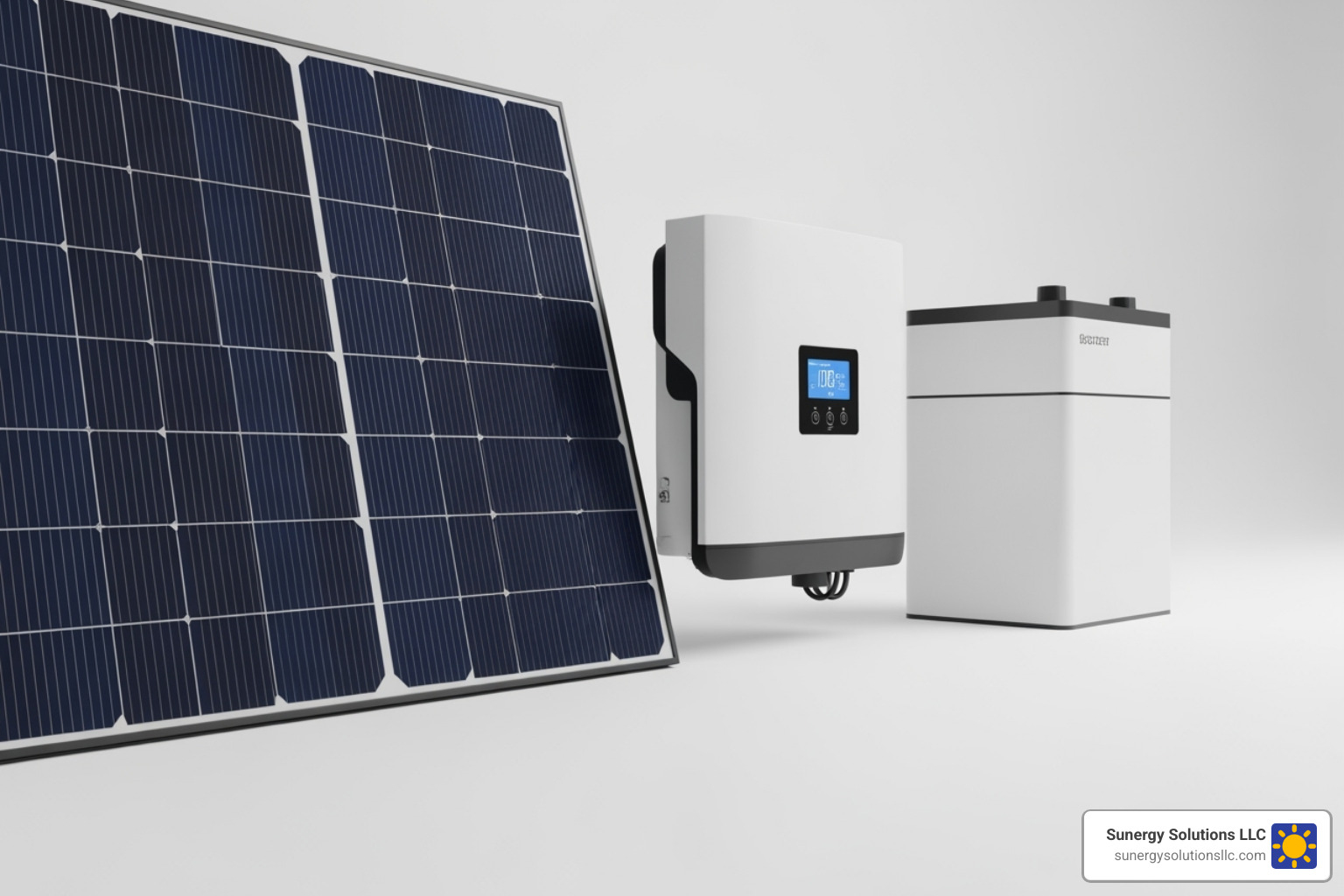
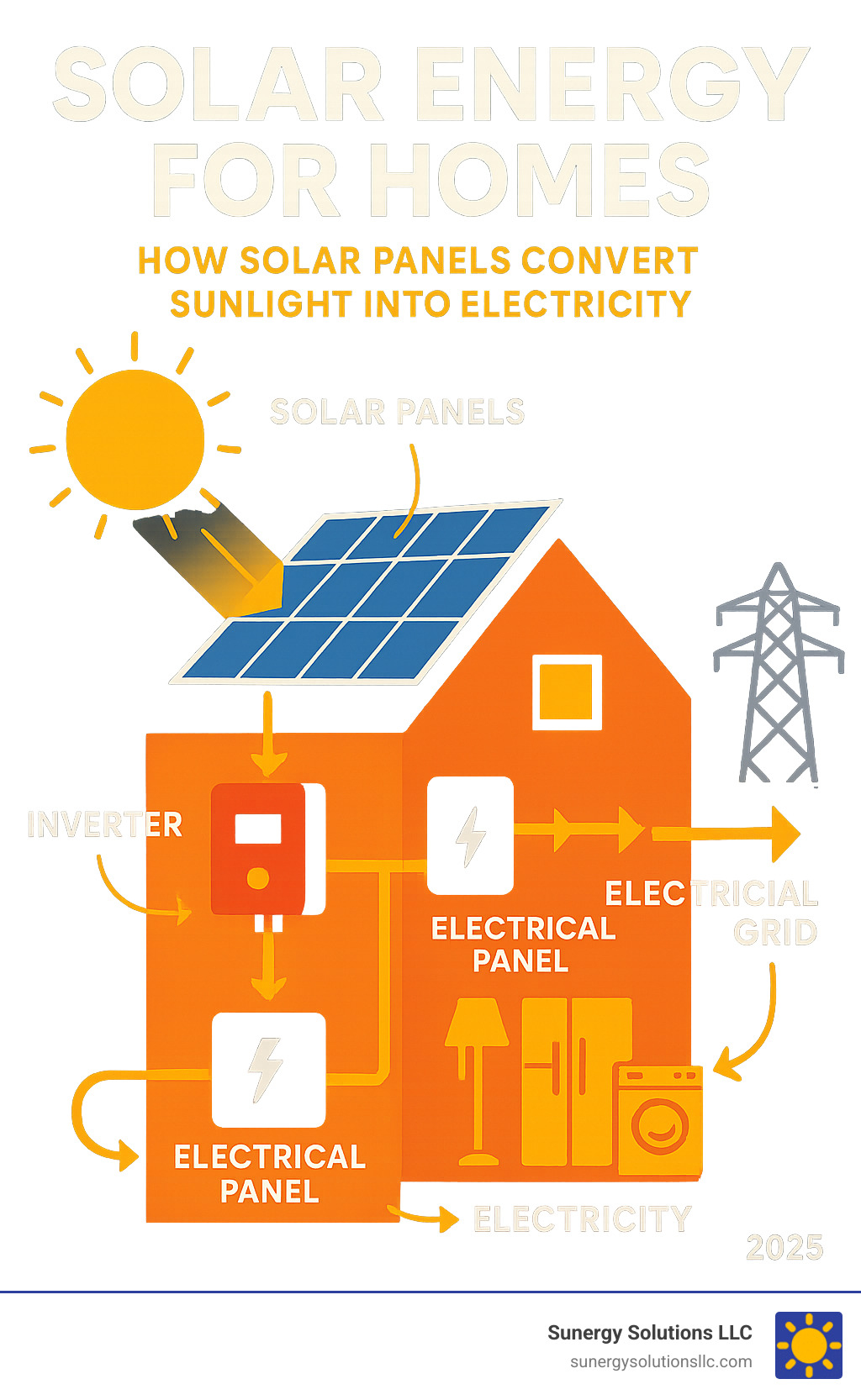
Every solar energy for homes system is a miniature power plant. The fundamental components work together seamlessly.
The journey from sunlight to socket begins with the photovoltaic effect. When photons from the sun strike the silicon cells in your panels, they excite electrons, creating direct current (DC) electricity.
This DC electricity travels to the inverter, which converts it into the alternating current (AC) your home’s appliances use. For more on the technical details, see this explanation of DC voltage to AC voltage conversion.
The new AC electricity flows to your home’s electrical panel, ready to power everything seamlessly.
What happens to excess electricity depends on your system. Grid-tied systems, the most common choice, send surplus power to the utility grid, earning you credits through net metering. Hybrid systems combine a grid connection with battery storage, giving you both grid stability and energy independence during outages.
Understanding these options helps you choose the right solution. Learn more about the different Types of Residential Solar Systems.
For a deeper dive into how solar energy for homes can work for you, visit More info about Sunergy Solutions LLC home solar energy services.
When considering solar energy for homes, the biggest question is often about cost. While there is an upfront investment, generous incentives and long-term savings make solar a smart financial decision. Think of it not as an expense, but as an investment that pays dividends for decades.

The typical residential solar system in America costs between $10,700 and $17,000 before incentives. This price is influenced by system size (based on your energy usage), equipment quality (premium panels and inverters last longer and produce more), and installation complexity (related to your roof’s design and local permitting fees). These systems are built to last 20 to 30 years, making the upfront cost a compelling investment when spread over decades of free electricity. For a detailed breakdown, see The Cost of Installing a Residential Solar System: A Comprehensive Guide.
Government incentives make solar energy for homes truly affordable.
For more details, explore our guide on Residential Solar Tax Incentives.
Multiple financing options make solar energy for homes accessible. The best choice depends on your financial goals.
| Factor | Cash Purchase | Solar Loan | Solar Lease | Power Purchase Agreement (PPA) |
|---|---|---|---|---|
| Ownership | You own the system | You own the system | Third-party owns the system | Third-party owns the system |
| Upfront Cost | 100% upfront | Low to no upfront cost | No upfront cost | No upfront cost |
| Maintenance | Your responsibility | Your responsibility | Third-party responsibility | Third-party responsibility |
| Tax Credit Elig. | Yes | Yes | No (owner claims credit) | No (owner claims credit) |
| Long-Term Savings | Maximize savings, best ROI | Significant savings after loan repayment | Fixed monthly payment, some savings | Fixed electricity rate, some savings |
| Home Value Impact | Increases home value | Increases home value | Neutral (can complicate resale) | Neutral (can complicate resale) |
| Typical Term | N/A | 10-25 years | 20-25 years | 20-25 years |
Cash purchase offers the best ROI, while solar loans let you own the system with little to no money down. With loans, be cautious of hidden dealer fees that are not eligible for the federal tax credit. Solar leases and PPAs have no upfront cost, but a third party owns the system, and you don’t receive the tax credit or full savings. For most homeowners, ownership through a cash purchase or solar loan provides the best financial outcome. Learn more in our guide: Bright Ideas for Residential Solar System Financing.
At Sunergy Solutions LLC, we’re committed to making solar energy for homes affordable. For more information, visit More info about Sunergy Solutions LLC affordable solar panels.
Most properties can work for solar energy for homes with the right approach. The key is understanding your home’s unique characteristics to design a system that delivers the best possible returns. Modern solar technology is flexible, and we’ve installed systems on all kinds of homes.
We assess several factors to ensure your home is ready for a solar power plant.
One of the best features of solar energy for homes is how little maintenance is required. Panels are designed to work quietly for decades.
The quality of the installation is critical for long-term performance. For guidance on this decision, check out How to Find a Reliable Solar System Installer.
Ready to find out if your home is a good candidate? We can provide a personalized assessment: More info about Sunergy Solutions LLC solar estimate services.
While solar energy for homes offers tremendous benefits, being aware of common pitfalls can save you headaches and money. After nearly a decade in the industry, we believe an informed customer is a happy customer.
The solar industry has grown rapidly, and not all companies operate with the same integrity. Here are red flags to watch for:
For more guidance, read our guide on Common Solar System Installation Mistakes to Avoid.
If your roof isn’t suitable for solar due to its age, material, or shading, that doesn’t mean solar energy for homes is off the table.
Ground-mounted solar systems are an excellent alternative if you have available yard space. These systems can often outperform rooftop panels because we can position them at the perfect angle and orientation for maximum sun exposure. They are also easier to access for maintenance or snow removal.
Ground-mounted systems are a great solution for homes with unsuitable roofs or properties where trees shade the house but leave the yard sunny. To see how we can make solar work for your property, visit our solar installations page and learn about Ground Mount Solar Foundations.
We are here to help you find the right solution for your specific situation, ensuring your solar investment delivers the savings and independence you expect.
Savings from solar energy for homes depend on your current electricity rates, energy consumption, system size, and sun exposure. However, homeowners typically save $10,000 to $30,000 over the system’s lifespan. Most systems deliver a return on investment of around 10% annually, paying for themselves in about 10 years. After that, you get free electricity for the remaining 10-20 years of the system’s life.
Yes. Solar panels capture sunlight, not heat, so they still generate power on cloudy days, just less than on a bright, sunny day. In fact, cold, sunny climates are ideal for solar performance. Panels are more efficient at lower temperatures because less energy is lost to heat, making them a great choice for states like Maine and Montana.
For safety, standard grid-tied solar energy for homes systems automatically shut down during a power outage to protect utility workers. However, if you add a solar battery storage system, you can achieve true energy independence. The battery stores excess solar energy and automatically provides backup power to your home during an outage, keeping your lights on and your refrigerator running.
Solar energy for homes is more than a green technology; it’s a powerful financial strategy for American families. It offers dramatic bill reductions, protection from rising utility rates, increased home values, and a meaningful way to reduce your carbon footprint.
With typical savings of $10,000 to $30,000 and a 10% annual return on investment, the financial case is strong. The 30% federal tax credit available through 2032 makes now the perfect time to invest.
At Sunergy Solutions LLC, we are built on transparency, education, and exceptional service. We provide top-tier equipment, extensive warranties, and customer support that treats you like family. We understand the unique markets we serve across Maine, Massachusetts, New Hampshire, Rhode Island, Vermont, Montana, and Virginia.
The solar revolution is here. Every month you wait is another utility bill paid in full. The sun offers free, clean energy every single day. It’s time to capture it.
Ready to make the switch? The future of energy is bright and affordable. Explore your residential solar system financing options today! and find how solar energy for homes can transform your financial future.
Appointments Available, 7 Days a Week


