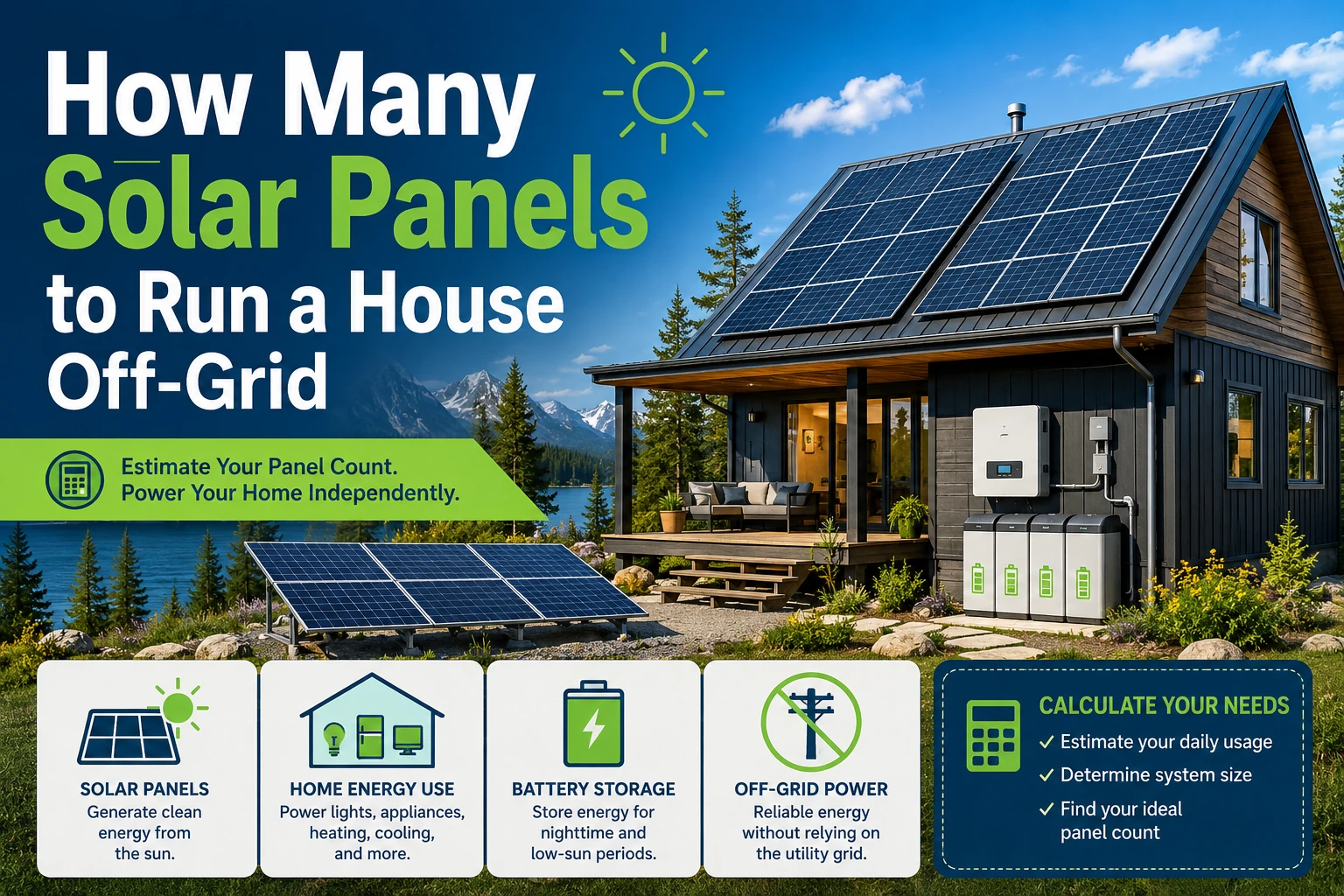
How Many Solar Panels Does an Off-Grid House Actually Need?
Most fully off-grid homes need between 20 and 45 solar panels, though the right number depends heavily on where you live and how much energy you use.
A small, efficient cabin can run on 10 to 15 panels, while a full-size home in a low-sun climate like New England may need 45 or more to stay powered through winter without a generator.
That range is wide because off-grid sizing has to account for your worst month, not your average one.
A system that produces plenty of power in July can still leave you short in December, so the panel count that matters most is the one that gets you through the shortest, cloudiest days of the year.
If you’re planning to stay connected to the grid and just want backup power for outages, the math looks different.
Our guide to how many solar panels a typical home needs walks through that grid-tied calculation separately, since it doesn’t have to account for the same worst-case scenarios.
What’s the Difference Between Off-Grid, Grid-Tied, and Hybrid Solar?
A grid-tied system stays connected to the utility and shuts off automatically during a power outage for safety, unless it’s paired with a battery.
A hybrid system adds a battery to that same grid connection so it can keep running through an outage.
A true off-grid system has no utility connection at all and relies entirely on its own panels and batteries, all the time.
That safety shutoff surprises a lot of homeowners.
Standard grid-tied inverters are built to stop sending power during a blackout so utility crews aren’t working on lines that are still carrying electricity from your roof.
Panels alone, without a battery, don’t keep your lights on when the grid goes down.
Grid-tied homes also get net metering credit for extra power they send back to the utility, which lowers their annual bill.
Off-grid homes give that up entirely, since there’s no utility connection to sell power back to.
Every kilowatt-hour you don’t use gets wasted unless your battery is already full.
Most homeowners in colder climates who look into going fully off-grid end up choosing a hybrid setup instead.
It adds battery backup to a grid-tied system so you keep running during an outage, without the cost and complexity of powering an entire house on batteries alone.
How Do You Calculate Your Home’s Daily Energy Use?
Pull your annual electricity use in kilowatt-hours from a recent utility bill, divide it by 365, and you’ll have your average daily energy use.
That single number is the foundation for every other calculation in an off-grid system, from panel count to battery size.
If you don’t have a bill handy, the U.S. Energy Information Administration reports that the average American household uses about 10,791 kWh a year, or roughly 30 kWh a day.
That’s a reasonable starting point, though off-grid homeowners often trim their real usage below that average once they start paying attention to every appliance a battery bank has to support.
How Many Peak Sun Hours Does Your Location Get?
A peak sun hour is the amount of time the sun delivers a consistent 1,000 watts of energy per square meter, and it’s the number solar installers use to estimate how much power a panel will actually produce in a day.
Most of New England averages around 4 peak sun hours a day, while sunnier regions further south or west can see 5 to 6.
Peak sun hours vary significantly by state, and that variation matters more for off-grid systems than for grid-tied ones, since there’s no utility to lean on when production drops.
Maine and Massachusetts average close to 4.2 peak sun hours annually, and Vermont sits just under that.
The bigger issue is the swing between seasons.
Solar panels in the Northeast can produce 40 to 60 percent less energy in December and January than in July and August, thanks to shorter days, a lower sun angle, and more cloud cover.
For an off-grid system, that drop is the number that actually determines how many panels you need, not the summer average.
Worked Example: Sizing an Off-Grid System for a New England Home
Numbers make this easier to picture.
Here’s how the math plays out for a moderately sized New England home using 400-watt solar panels, which is a common size for residential installations today.
Step 1: Daily Energy Use
Say this household uses about 1,200 kWh a month, which is a little above the national average and typical for a home with electric heat backup or a heat pump.
Divided by 30, that comes out to 40 kWh of energy needed per day.
Step 2: Panel Count
Using an annual average of 4 peak sun hours and accounting for roughly 20 to 25 percent system losses from battery charging and inverter conversion, each 400-watt panel produces about 1.25 kWh a day on average.
Dividing 40 kWh by 1.25 kWh gives you about 32 panels, based on that yearly average alone.
But an off-grid system has to get through December, not just an average month.
If winter production drops by a third, a moderate estimate for the Northeast, each panel only produces about 0.9 kWh a day, and the same home needs closer to 46 panels to stay comfortably powered.
Sizing for the very worst stretches of winter, when production can drop 50 to 60 percent, would push that number past 65 panels, which is why most homeowners size closer to the moderate estimate and lean on a backup generator for the rare extreme week instead.
Step 3: Battery Bank
For 3 days of autonomy at 80 percent depth of discharge, this home’s battery bank would need roughly 150 kWh of usable capacity.
That’s a large, expensive battery bank, and it’s the main reason full off-grid systems cost so much more than grid-tied ones.
How Much Battery Storage Do You Need to Go Off-Grid?
Battery capacity for an off-grid system is calculated as daily energy use, multiplied by the number of days of autonomy you want, divided by your battery’s usable depth of discharge.
Most off-grid homes target 2 to 3 days of autonomy to cover a stretch of cloudy weather without running out of power.
The battery chemistry you choose changes that math.
Lithium batteries typically allow 80 to 95 percent depth of discharge without shortening their lifespan, while older lead-acid batteries should stay under 50 percent to avoid wearing out early.
That difference means a lead-acid bank has to be roughly twice as large as a lithium one to deliver the same usable power.
Batteries need power to charge from somewhere in the first place, which is why panel count and battery size are tied together.
A bigger battery bank without enough panels to recharge it just means a longer recovery time after a cloudy stretch, not more usable power.
What Size Inverter and Charge Controller Does an Off-Grid System Need?
The inverter converts the DC power from your panels and batteries into the AC power your household appliances use, and it needs to be sized for your highest simultaneous load, not just your average one.
A well pump, air conditioner, or refrigerator compressor can draw 3 to 5 times its normal running wattage for a second or two when it starts up, so an inverter sized only for average use can trip or shut down under a real-world load.
The charge controller manages how power flows from your panels into your batteries, and most off-grid systems today use an MPPT (maximum power point tracking) controller instead of an older PWM design.
MPPT controllers typically capture 20 to 30 percent more usable energy from the same panels, which matters even more in a climate where every peak sun hour counts.
Factors That Change How Many Panels You Need
The formulas above give you a starting point, but a handful of real-world factors can push your final panel count up or down.
Winter Sun and Snow Cover
Snow sitting on a panel blocks sunlight almost completely, and even a light dusting can cut production for days until it melts or slides off.
Steeper roof pitches and panels mounted at a sharper angle shed snow faster than flatter solar installations, which matters more in an off-grid system than a grid-tied one, since there’s no utility power to fall back on while panels sit buried.
Roof Space and Shading
A 400-watt panel needs about 18 square feet of space, so a system of 40 or 50 panels needs a large, mostly unshaded roof or enough open ground for a ground-mount array.
Even partial shading from a single tall tree can drag down the output of an entire string of panels, not just the ones directly in the shadow.
Backup Generators
Many off-grid homeowners size their solar and battery system for typical conditions, then add a propane or diesel generator to cover the rare week of heavy snow or extended cloud cover.
That approach can reduce the panel and battery count significantly, since the system no longer has to be built for the absolute worst case.
Appliance and Insulation Efficiency
Every kWh you don’t use is a kWh you don’t have to generate or store.
Switching to a heat pump water heater, upgrading insulation, or replacing older appliances with efficient models can lower daily energy use enough to meaningfully shrink both the panel count and the battery bank.
Is Full Off-Grid Worth It, or Is a Hybrid System Smarter?
For most homeowners in a climate with real winters, a hybrid system, meaning solar panels with battery backup and a grid connection, delivers most of the benefits of off-grid living for a fraction of the cost.
Full off-grid makes the most sense for remote properties where running a utility line isn’t possible or affordable in the first place.
The math from the worked example above shows why.
A 150 kWh battery bank and 45 or more panels sized for winter is a significant investment, and it’s built to handle a worst-case scenario that might only happen a few times a year.
A hybrid battery backup system sized for your typical outage length costs a fraction of that, while net metering keeps chipping away at your bill the rest of the year.
We’ve walked plenty of homeowners through this exact comparison, and once they see the real numbers side by side, most choose the hybrid path.
It’s rarely about giving up on energy independence.
It’s usually about spending that investment where it actually pays off, on a system sized to shorten your payback period rather than one sized to survive a total grid failure that may never happen.
How Sunergy Solutions Helps You Size the Right System
Sizing an off-grid or hybrid solar system correctly takes more than a formula.
It takes a real look at your roof, your energy use, and how much risk you’re comfortable carrying through a New England winter.
We start every project with an on-site assessment of your roof’s orientation, shading, and structural condition, paired with a review of your actual electricity usage rather than a national average.
From there, we design a system, whether that’s fully off-grid, hybrid with battery backup, or standard grid-tied, that matches how you actually live and how much backup power actually makes sense for your property.
Our team has installed solar across Connecticut, Massachusetts, Maine, New Hampshire, Rhode Island, Vermont, and Virginia, so we’ve sized systems for coastal homes, mountain properties, and everything in between.
If you’re weighing full off-grid against a hybrid battery backup setup, we can walk you through the real numbers for your specific property instead of a generic estimate.
Whether you end up with 15 panels or 50, the right system is the one sized for your actual home, your actual roof, and the winters you actually live through.
Sunergy Solutions can help you figure out exactly what that looks like, with a free, no-pressure estimate for your property.