
5.0 Rating
Request A Free Estimate
Incentives for solar panels can cut installation costs by thousands, making clean energy more affordable. These financial benefits—from federal tax credits to state rebates—help homeowners and businesses offset rising energy bills and build long-term value.
Top Solar Incentives Available:
Governments and utilities offer these programs to promote grid stability, job creation, and environmental protection. The federal Investment Tax Credit, a key incentive, is extended at 30% through 2032.
Rising utility rates make solar incentives even more valuable. With electricity costs climbing annually, locking in your energy costs with solar is a smart move. Many systems pay for themselves in 6-10 years, followed by decades of free electricity.
I’m Robert Raffa, CEO of Sunergy Solutions LLC. With a decade in renewable energy and a background in investment banking, I specialize in helping homeowners maximize their financial returns by capturing every available solar incentive.
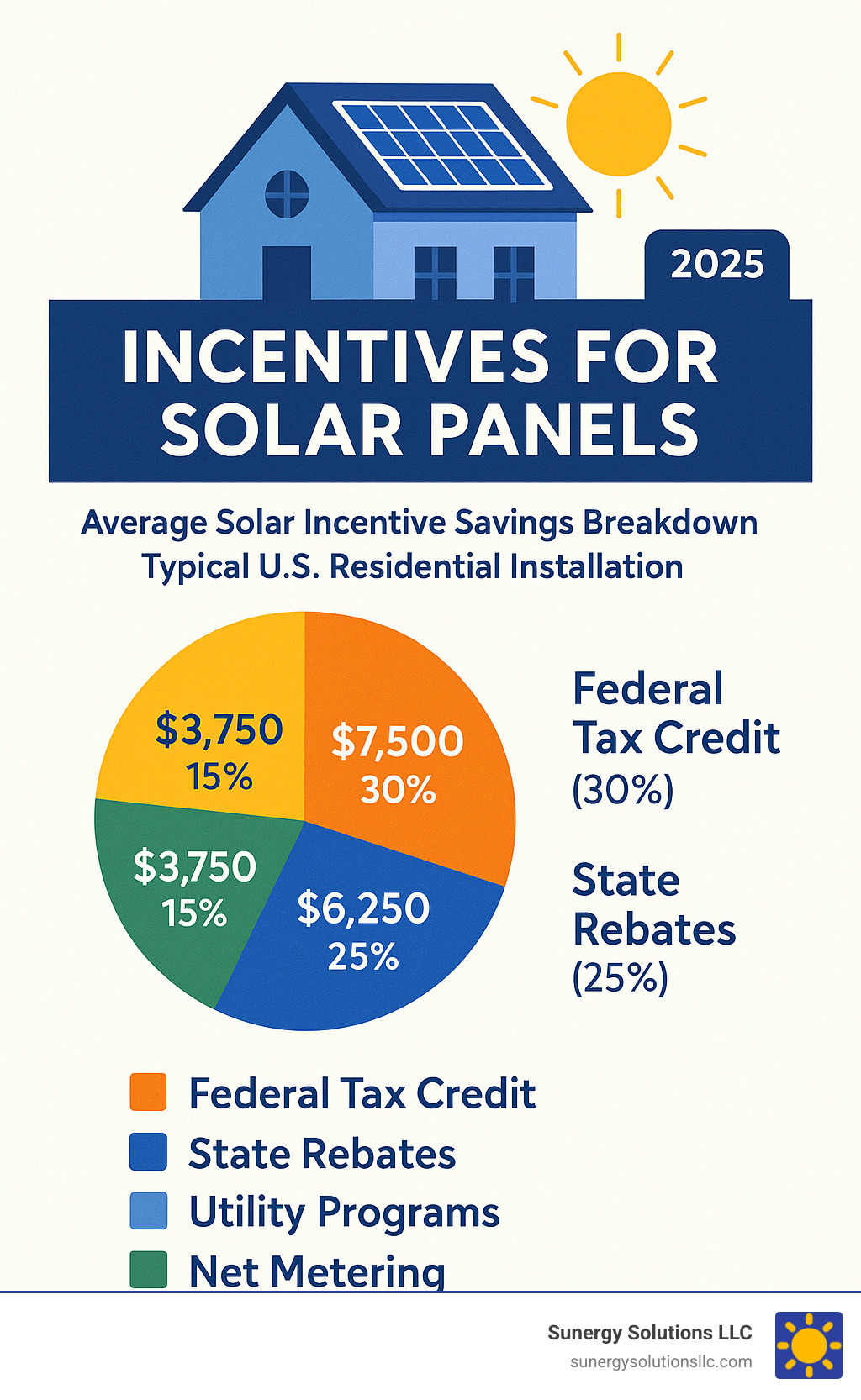
Incentives for solar panels terms to know:
Among incentives for solar panels, the Federal Solar Investment Tax Credit (ITC) is the ultimate game-changer for homeowners. It’s not a small discount but a direct, dollar-for-dollar reduction in your federal income taxes, making solar incredibly affordable.
The ITC lets you claim a significant percentage of your solar energy system’s cost directly from your federal taxes. For systems installed between 2022 and 2032, this credit is a whopping 30% of the total installation cost.
For example, a $25,000 system could earn you a $7,500 tax credit. A tax credit reduces your tax bill, unlike a rebate which is cash back. If you owe $10,000 in taxes, the credit reduces your payment to $2,500. If your tax liability is less than the credit, you can typically roll over the remainder to future years, ensuring you don’t lose any savings.
While the 30% rate is locked in, it won’t last forever. The ITC is set to decrease to 26% for systems installed in 2033, then to 22% for systems installed in 2034, and is scheduled to expire in 2035 unless extended. Going solar sooner means you capture the maximum savings.
For official details, visit The federal solar investment tax credit on the IRS website. You can also learn more at the Solar Energy Industries Association’s Solar Investment Tax Credit page. We also have more insights on Residential Solar Tax Incentives on our site.
The federal ITC is widely available to U.S. homeowners. You are likely eligible if you own your home and install a new solar energy system. This applies to your primary residence, a secondary home, or even new construction, as long as the system is operational by the end of the tax year.
The key is ownership. The tax credit is for the system owner. If you lease or use a Power Purchase Agreement (PPA), the company that owns the system claims the ITC, not you. At Sunergy Solutions LLC, we guide customers toward ownership so you reap the financial benefits.
The equipment must be new and meet specific energy efficiency and safety standards. Our top-tier equipment always meets or exceeds these criteria, ensuring your investment is powerful and compliant. Learn more about the technology at Solar Panels: How They Work and Their Efficiency.
The federal ITC is comprehensive, covering nearly every expense involved in your solar installation, not just the panels.
This includes the actual solar PV panels, inverters, and sturdy mounting equipment. It also covers balance-of-system (BOS) equipment, like wiring and electrical components.
Beyond hardware, the ITC covers labor costs for installation, permitting fees, and inspection costs. Even the sales tax on eligible equipment can be included.
This all-encompassing credit makes switching to solar financially attractive. Costs for a battery backup system can also be included in your ITC calculation, a great idea for energy independence. Learn more about integrated systems at Residential Solar System with Battery Backup.
The federal tax credit is just the beginning. Incentives for solar panels are like a layered cake: the federal ITC is the base, and state and local programs are the frosting that sweetens your investment.
States, cities, and utilities encourage solar adoption because it creates jobs, reduces grid strain, and helps meet clean energy goals. This has led to a treasure chest of local savings opportunities.
State tax credits work like the federal ITC, reducing your state income tax liability.
Local rebates put cash directly back in your pocket, often as a fixed amount per watt or a lump sum.
Property tax exemptions mean that while solar panels increase your home’s value, many states exempt this added value from property taxes.
Sales tax exemptions provide immediate savings by eliminating sales tax on your solar equipment.
Performance-based incentives and Solar Renewable Energy Credits create ongoing revenue, paying you for the clean electricity your system produces.
The beauty of these programs is that they often stack with federal incentives, multiplying your savings. To understand how all these pieces fit together, check out our comprehensive guide on Solar Tax Credits and Rebates: What You Need to Know.
Incentives for solar panels vary dramatically by state, and even by utility and municipality. What’s available in Massachusetts can be completely different from neighboring Rhode Island.
A great starting point is the Database of State Incentives for Renewables & Efficiency, or DSIRE. This comprehensive database catalogs policies and incentives across all 50 states. Just enter your location to find what’s available.
Local utility companies and city/county offices often have their own rebate programs or expedited permitting processes, so be sure to check with them as well.
Understanding the full financial picture helps you make informed decisions. Our guide on The Cost of Installing a Residential Solar System: A Comprehensive Guide breaks down all the numbers so you know exactly what to expect.
Here are real-world examples from states where we’ve helped homeowners maximize their solar savings.
Rhode Island is a solar success story due to generous state support. The state offers residential grants up to $5,000 for installations. Additionally, its Renewable Energy Growth program pays homeowners for every kilowatt-hour produced over 15 years, creating a guaranteed income stream. These combined incentives dramatically reduce payback periods. Explore the details on our Rhode Island Solar Panel Incentives page.
Massachusetts has an impressive multi-pronged approach. It exempts solar equipment from sales tax and offers a 15% state income tax credit (up to $1,000). The SMART program provides monthly payments for 10 years based on production, and the Mass Save 0% Heat Loan offers zero-percent financing for battery storage up to $25,000. Stacking these programs leads to some of the nation’s shortest payback periods.
Maine homeowners have access to various utility-specific programs and state financing options. Local utilities often provide meaningful rebates and streamlined interconnection processes. For detailed information about financing options in the Pine Tree State, visit our page on Financing Options for Maine Solar Installations.
Every state approaches solar incentives differently. We conduct a thorough analysis of every available program to ensure you capture every dollar you’re entitled to.
Your local utility is a key player in making incentives for solar panels work for you. They can be your solar partner, helping turn your roof into a mini power plant that earns you money.
The star of the show is net metering. On a sunny afternoon, your panels often produce more electricity than you use. This excess power flows back to the grid, essentially spinning your meter backward.
Your utility tracks this excess energy and gives you credits on your bill. When you need power from the grid, these credits offset the cost. You only pay for the “net” difference between what you use and produce.
This system allows you to build up credits during bright summer days and use them during darker winter months. It’s like storing sunshine for later.
Many utilities also offer direct rebates or cash incentives for installing solar panels, recognizing that solar customers help reduce strain on the electrical grid. Some offer upfront rebates of $500 to $5,000, while others provide ongoing performance-based payments.
For a deeper dive, check out our guide on Net Metering: How it Works and Why it’s Important. You can also see a real-world example of a utility net metering program from Portland General Electric.
While net metering is straightforward, each utility has its own rules. The basic idea is the same, but the details can vary.
Credit rollover is a key aspect. Some utilities let you bank credits indefinitely, while others have an annual true-up, settling accounts once a year. If you’ve overproduced, they might pay you for the extra credits, usually at a wholesale rate.
Rate structures also differ. Many utilities offer a generous one-to-one credit system, while others offer slightly lower rates for exported electricity.
Most utilities set system size limits for net metering, but these are typically large enough for residential installations. The interconnection process is another key piece, requiring utility approval and a safety inspection before your system can connect to the grid.
Sunergy Solutions LLC handles all paperwork and coordination with utilities in Maine, Massachusetts, New Hampshire, Rhode Island, Vermont, Montana, and Virginia. We know each utility’s policies, so you don’t have to steer the bureaucracy. We ensure your system is set up to maximize savings from day one.
For more information about different solar system configurations, visit our page on Types of Residential Solar Systems.
Maximizing incentives for solar panels means navigating the process like a pro. It’s less intimidating than it seems; once you know the steps, it’s straightforward.
The journey starts with researching incentives for your location. While databases like DSIRE are helpful, Sunergy Solutions LLC conducts a personalized analysis for every customer, uncovering all available programs. We know the incentive landscape in Maine, Massachusetts, New Hampshire, Rhode Island, Vermont, Montana, and Virginia.
Next, get quotes from qualified installers. This is crucial because the total system cost determines your tax credits and rebates. You want detailed quotes that clearly show all eligible expenses.
Choosing a qualified installer is perhaps the most important decision. Many incentive programs require certified professionals. An experienced company ensures your system meets all requirements and performs optimally. We handle the technical complexities so you can focus on the savings.
The paperwork phase involves filing applications and gathering documentation. We guide you through permit applications, incentive forms, and utility interconnection paperwork, a process our team has streamlined over hundreds of installations.
Finally, claiming tax credits happens when you file your annual taxes. We provide all the documentation your tax professional needs. For more insight into financing, check out Solar System Financing Options for Homeowners.
The steps for claiming incentives for solar panels vary by program, but the process is predictable. Understanding what’s ahead helps you prepare and avoid costly delays.
Pre-approval requirements are common for state and utility rebates. Some programs have limited, first-come, first-served funding. Getting pre-approved secures your spot.
Required documentation is where organization pays off. You’ll need detailed invoices, permits, and proof of system commissioning. We maintain meticulous records throughout your project.
Post-installation inspection by local authorities and your utility is standard to verify safety and code compliance.
Submitting tax forms for the federal ITC is done during tax season using IRS Form 5695. We provide all the figures to make this straightforward. You can find IRS Form 5695 here.
Submitting rebate applications to state or utility programs typically happens after your system is operational. Each has its own forms and deadlines.
The key is staying organized and working with professionals who know the process. At Sunergy Solutions LLC, we’re with you from consultation to the final rebate check, ensuring you capture every available incentive. Our customer service means you never have to steer this alone.
We get many questions about incentives for solar panels. Here are some of the most common inquiries with clear, straightforward answers.
Yes, in most cases, you can “stack” federal, state, and local incentives. This means you can benefit from a federal tax credit, a state rebate, and a local utility program all at once.
Typically, the federal Solar Investment Tax Credit (ITC) is applied to the net cost of your system after state or utility rebates are deducted. This layering approach significantly reduces your out-of-pocket expenses.
However, it’s important to check the rules for each program, as some have unique clauses. Our team at Sunergy Solutions LLC specializes in this and will help you build the most advantageous incentive stack to capture every available dollar.
Incentives for solar panels dramatically shorten the “payback period”—the time it takes for your energy savings and incentive benefits to equal your initial investment.
By reducing the upfront cost through tax credits and rebates, and accelerating savings with net metering, incentives cut down this time. For example, a system with a 10-15 year payback period can see it shrink to just 6-10 years with incentives. After that, you enjoy decades of free electricity, turning your system into a money-making asset.
Absolutely! Businesses are huge beneficiaries of incentives for solar panels and clean energy initiatives. Like homeowners, commercial entities can tap into a wealth of financial advantages.
Beyond the federal ITC, businesses often have access to additional powerful programs. These can include:
These incentives make solar an incredibly attractive investment for businesses looking to reduce operating costs, achieve sustainability goals, and improve their bottom line.
It’s clear that incentives for solar panels are your ticket to an energy-independent future. We’ve journeyed through the financial landscape of solar, showing just how accessible clean energy can be.
At the heart is the Federal Solar Investment Tax Credit (ITC), offering a 30% reduction on your system’s cost. This makes solar a smart financial decision for U.S. homeowners.
The savings don’t end there. State and local programs add more benefits, from tax credits and rebates to property and sales tax exemptions. Performance-Based Incentives (PBIs) can pay you for the electricity you produce, while net metering turns your excess solar power into valuable utility bill credits.
Combining these benefits dramatically shortens your solar investment’s payback period, making it an immediate, savvy financial move. Whether you’re in Maine, Massachusetts, New Hampshire, Rhode Island, Vermont, Montana, or Virginia, incredible opportunities are waiting.
At Sunergy Solutions LLC, we’re dedicated to empowering you with reliable, cost-effective solar solutions for significant energy savings. Our commitment to top-tier equipment, extensive warranties, and exceptional customer service ensures your journey to solar is smooth and rewarding, from our first conversation to maximizing every incentive.
Don’t let the details seem daunting. That’s why we’re here. We take the complexity out of the process, guiding you every step of the way. Take the first step towards a brighter, more sustainable, and more affordable future.
Explore your residential solar financing options today!

Appointments Available, 7 Days a Week


