
5.0 Rating
Request A Free Estimate
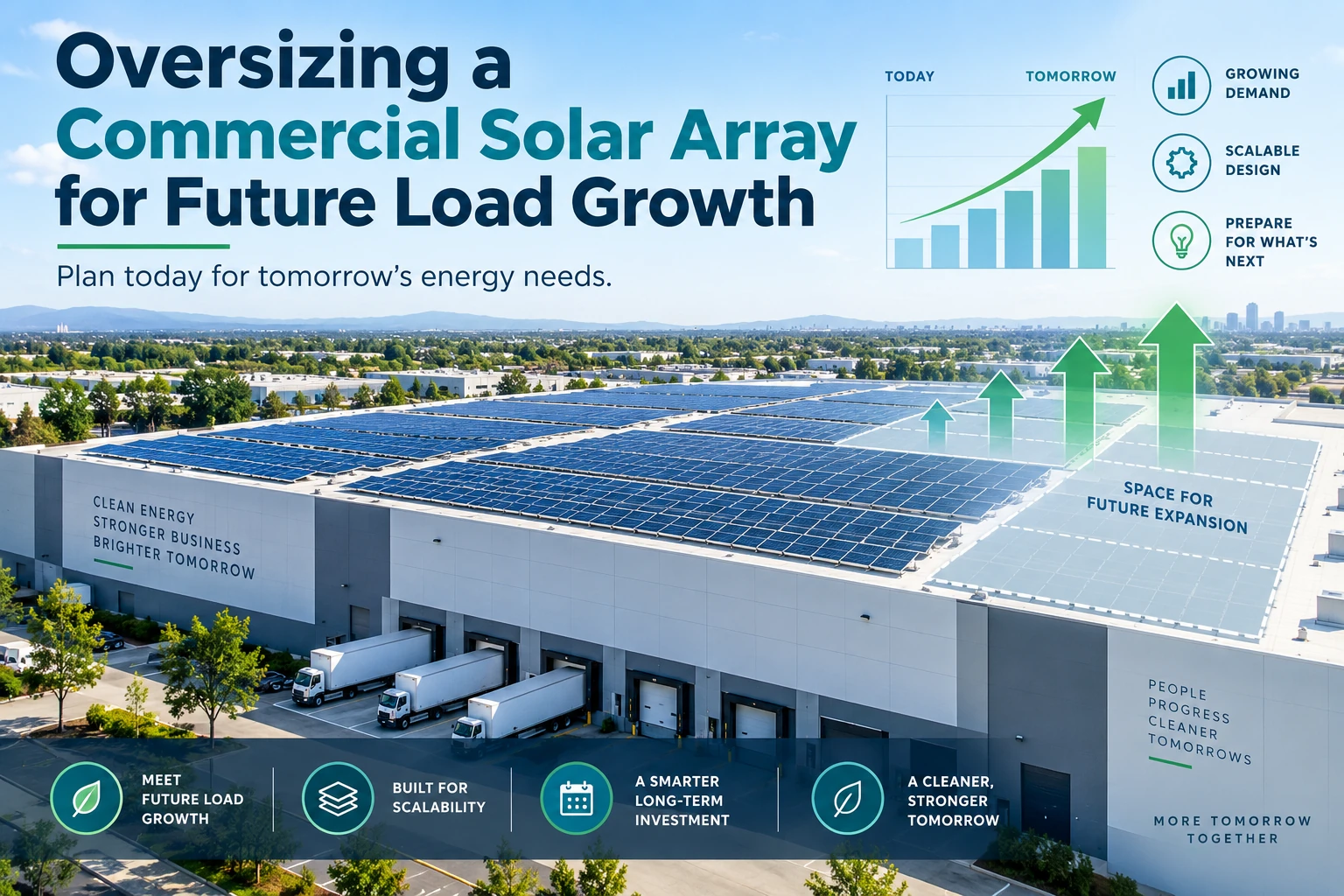
Oversizing a commercial solar array means installing more generation capacity than your business needs today, so the system can absorb EV chargers, heat pumps, or expansion tomorrow without a second construction project.
Done right, it lowers your long-term cost per watt.
Done wrong, it wastes money on capacity you never use.
This guide covers the DC/AC ratios, headroom planning, and payback math that separate a smart oversized system from an expensive one.
Most businesses buy a solar array sized for the electricity bill they have right now.
That’s a mistake if you’re planning to add EV chargers, swap old rooftop units for heat pumps, or simply grow the business over the next ten years.
Oversizing a commercial solar array for future load growth means installing more generation capacity than your current usage requires, so the system can absorb tomorrow’s demand without starting a second permitting and construction cycle.
It sounds simple.
In practice, it involves inverter math, interconnection paperwork, and a payback calculation that changes depending on how your building actually uses power.
This guide breaks down how much extra capacity actually makes sense, what it costs to build in that headroom now versus later, and where oversizing stops paying for itself.
GET THE MOST OUT OF YOUR SOLAR SYSTEM
Oversizing means installing a solar array whose panel capacity, measured in DC watts, exceeds what your inverter can output in AC watts, or building more total generation than your current electrical load needs.
The extra capacity captures more energy during weak sunlight and leaves room for future demand like EV charging or electrification, without a second permitting and construction cycle.
There are actually two different ideas that get lumped together under the same word.
The first is DC/AC oversizing: putting more panel wattage on a given inverter than its rated output, a proven technique used in nearly every modern solar installation.
The second is load-growth oversizing: sizing the whole system, panels, inverter, and interconnection, larger than your building needs today so it can absorb tomorrow’s electricity use.
A well-planned commercial solar system design accounts for both.
Confusing the two is where a lot of oversizing decisions go wrong: a bigger DC/AC ratio costs very little extra, but building headroom into your electrical service and interconnection can cost real money upfront.
Commercial electricity use in the U.S. is climbing at a pace utilities haven’t seen in years.
The U.S. Energy Information Administration projects that commercial electricity sales will grow 3.3% in 2026 alone, pushing commercial demand past 1,545 billion kilowatt-hours, a new record.
Two forces are driving most of that growth for ordinary businesses, not just data centers.
The first is transportation electrification.
A company that adds a handful of electric vehicles to its fleet can see its overnight and midday electricity draw jump substantially, especially if charging happens during business hours to take advantage of onsite solar production.
The second is building electrification.
Businesses replacing aging gas furnaces and rooftop units with heat pumps often see winter electricity use rise even as their gas bill disappears entirely.
If either of these is on your five-year plan, sizing a solar array for today’s meter reading guarantees you’ll be back at the drawing board, and back in a permitting queue, sooner than you’d like.
A good DC/AC ratio for most commercial solar systems falls between 1.2 and 1.4, meaning the panels can produce 20% to 40% more DC power than the inverter can convert to AC at any single moment.
This range captures extra energy during low-light hours without significant inverter clipping.
Every solar panel is rated under lab conditions that real rooftops rarely match.
Heat, dust, cloud cover, and the sun’s low angle in early morning and late afternoon all reduce actual output below the nameplate number.
The National Renewable Energy Laboratory’s PVWatts calculator uses a default system loss of 14% for well-designed installations, meaning real-world output typically runs 80% to 85% of the rated capacity on paper.
Oversizing the DC side relative to the inverter compensates for that gap.
Instead of an inverter that spends most mornings and evenings running far below its capacity, an oversized array feeds it closer to full output for more hours of the day.
When panel output exceeds what the inverter can convert, the inverter simply caps its output at its rated maximum.
Engineers call this clipping, and the “lost” energy only happens during the small number of peak-sun hours when the array would have exceeded the inverter’s ceiling anyway.
Manufacturer guidance backs up how much oversizing is normal.
SolarEdge’s own technical documentation permits up to 135% DC/AC oversizing on standard inverters, with newer hardware supporting more.
On the utility-scale side, SMA’s inverter platform supports oversizing as high as 250% for projects designed specifically to capture more energy during low-irradiance periods.
Independent modeling backs a similar range.
Research published by PV Tech found that ratios closer to 1.6 can sometimes maximize project economics, depending on local sun conditions and equipment costs, though most commercial installers stay closer to 1.2 to 1.4 to keep clipping losses minimal.
Plan for extra capacity by mapping out specific, known changes to your electricity use over the next 5 to 10 years, such as fleet electrification, HVAC replacement, or square footage growth, and sizing the array to that projected load rather than a rough percentage buffer.
Vague oversizing, building 20% bigger just because it sounds safe, tends to either undershoot a real electrification plan or waste money on capacity nobody uses.
A better approach starts with numbers:
Once those numbers exist, they translate into a specific future kilowatt-hour target, which is a far more defensible basis for oversizing than a guess.
The panels themselves are usually the easy part.
The harder constraint is whether your building’s electrical service, and the utility’s grid connection at that service, has room to grow.
Interconnection costs vary enormously depending on where a project connects to the grid.
A site with ample capacity nearby can face a modest utility interconnection fee, while a site on a constrained circuit can face six-figure network upgrade costs to get the same system approved, since network upgrade expenses are driven mostly by how much spare capacity already exists at that point on the grid.
Even without a major grid upgrade, older buildings often need electrical work just to accept a larger system.
This is why the smartest oversizing decisions plan for headroom in the parts that are expensive to redo later, conduit runs, switchgear capacity, and interconnection agreements, even when the panel count itself gets phased in over time.
Whether that headroom lives on the roof or in a ground-mount array depends on how much usable space the property has to begin with.
GET HELP PLANNING YOUR SOLAR SYSTEM
Battery storage can be oversized for many of the same reasons as the solar array: to buffer future EV charging loads, extend equipment cycle life, and capture energy that would otherwise be clipped by the inverter.
But storage carries a steeper cost per kilowatt-hour than panels, so oversizing it needs a tighter financial case.
Commercial-scale lithium iron phosphate systems remain a meaningful investment.
Recent federal benchmarking puts installed utility-scale four-hour battery storage costs at roughly $334 per kilowatt-hour, and smaller commercial systems typically land higher than that on a per-kilowatt-hour basis.
That price tag matters because storage doesn’t benefit from the same “clipping is basically free” logic as panels.
Extra battery capacity sits unused, and still ages, if the load it’s meant to serve, like an overnight EV charging block, doesn’t materialize on the timeline you planned for.
Commercial battery storage tends to make the most sense when a specific future load, not a general hedge, is already on the calendar.
Oversizing typically pays off when the marginal cost of extra panels is cheap relative to the value of the energy they’ll produce, and when a business has a defined future use for that energy within a reasonable payback window.
It typically doesn’t pay off when the extra capacity is speculative and the site would need expensive electrical upgrades to support it.
The economics tilt in oversizing’s favor because adding panel capacity to an already-designed system is far cheaper per watt than a full second installation later.
A second project means new permits, a second interconnection application, and mobilization and labor costs all over again.
Building in capacity now, even if it isn’t fully used for a few years, often beats that math.
Timing matters right now more than usual.
Federal policy changed the rules for the 30% investment tax credit: businesses need to have started construction before July 4, 2026 to lock in the full credit under current law, with the credit phasing out for projects that start later.
That timeline is worth confirming with a tax professional before finalizing system size, since it can shift the payback math for a bigger system built today versus a second phase built later.
Once the array is in place, the cost of the system itself, available financing structures, and any state or utility rebates all factor into the payback period for the oversized portion specifically, not just the system as a whole.
Oversizing stops making sense when there’s no concrete plan for the extra capacity, when the site’s interconnection or electrical service would require expensive upgrades just to accommodate it, or when higher-efficiency panels could deliver the same future output from a smaller, cheaper footprint.
A business with a flat, predictable electricity profile and no electrification or expansion plans on the horizon usually gets better returns from a system sized close to its current load.
Extra capacity built on a guess just sits there generating a return on money that could have gone somewhere else in the business.
Site constraints matter too.
A property with limited roof space or a tight electrical service panel may hit a ceiling on how much oversizing is physically or financially practical, regardless of how attractive the future-load math looks on paper.
In those cases, a right-sized system today, with a clear plan to revisit capacity in a few years, is often the more responsible call than forcing in capacity the site can’t easily support.
Sizing a commercial array for the next decade, not just the next utility bill, is exactly the kind of planning New England and Mid-Atlantic businesses bring to us before breaking ground.
Our team walks through your fleet plans, HVAC replacement timeline, and interconnection situation before recommending a system size, rather than defaulting to the biggest array your roof can physically hold.
That starts with commercial solar panel installation built around where your business is actually headed, backed by a commercial solar energy consultant who can model the electrification scenarios specific to your operation.
Whether you’re in Massachusetts, New Hampshire, Maine, or elsewhere in our service area, interconnection rules and utility incentives vary by state, and getting that part right up front avoids expensive surprises later.
If your business is weighing whether to build bigger now or add on later, Sunergy Solutions can walk through the load-growth math for your specific site and help you land on a system size that actually fits where the business is going.
Oversizing the array means installing more panel capacity than the inverter can convert at once, a standard technique that boosts output during weak sunlight. Oversizing the whole system means sizing the panels, inverter, and electrical service larger than current needs to accommodate future load growth like EV charging or expansion.
It depends on the inverter manufacturer. Many commercial inverters support DC/AC ratios up to 135%, with some manufacturers permitting significantly more on specific product lines. Always check the manufacturer’s published oversizing limits before finalizing a design, since exceeding them can void equipment warranties.
The size of the system doesn’t change the tax credit rate itself, but the construction start date does. Current federal rules require construction to begin before July 4, 2026 to secure the full 30% investment tax credit, so businesses planning a larger system should confirm timing with a tax professional.
Yes, but a second project means a new permitting cycle, a new interconnection application, and paying for site mobilization again. Building headroom into the electrical service and interconnection now, even if the full panel count is phased in, is usually cheaper than a completely separate second installation.
Start with concrete plans rather than a general buffer: how many vehicles will need charging, whether aging HVAC equipment will be replaced with electric heat pumps, and whether the business expects to add square footage or production capacity in the next 5 to 10 years.
Not usually to the same degree. A business with a flat, predictable electricity profile typically gets better returns from a system sized close to current usage, since extra capacity built on a guess ties up capital that could be used elsewhere in the business.
Appointments Available, 7 Days a Week


