
5.0 Rating
Request A Free Estimate
Manufacturing facilities across the states are turning to solar power to fight rising electricity rates and steep demand charges.
This guide walks through real electricity costs the 2026 federal tax credit, roof and structural requirements, typical payback periods, and what to check before you commit to a system.
Running a manufacturing facility means running equipment all day, and that equipment runs on electricity that keeps getting more expensive.
Solar for manufacturing facilities has moved from a nice-to-have sustainability gesture to a straightforward way to cut one of the largest line items on a plant’s budget.
If you manage or own a factory, warehouse, or production plant, you’ve probably already noticed your power bill climbing faster than almost any other cost on your books.
This guide breaks down what solar actually does for a manufacturing operation: how much it saves, how the tax credit works in 2026, whether your roof can handle it, and how long it takes to pay for itself.
SEE IF SOLAR MAKES SENSE FOR YOU
Manufacturing facilities are turning to solar power because electricity is one of the few major operating costs they can actually control.
A solar system generates power on-site during the same daytime hours that production lines, compressors, and HVAC systems draw the most electricity, cutting utility bills while locking in a predictable energy cost for decades.
Reducing industrial energy intensity has become enough of a national priority that the Department of Energy built an entire initiative around it.
The Better Plants program has helped more than 280 manufacturers cut a combined $11.7 billion in energy costs since 2009, working toward a 25% reduction in energy intensity across participating plants.
Solar is one of the tools in that toolkit, and it’s one of the only ones that also shields a plant from future rate hikes.
The DOE has been direct about why efficiency alone isn’t enough.
Efficiency programs can only go so far, and the agency now points manufacturers toward investing directly in on-site renewable generation to meaningfully cut both costs and emissions.
For many plants, that means treating the roof and the parking lot as potential power sources, not just real estate.
Facilities exploring this usually start by reviewing what a commercial solar system actually involves for their specific building and equipment load.
Manufacturing facilities often spend tens of thousands of dollars a month on electricity, and that spending has been rising faster than general inflation.
Industrial electricity rates in the U.S. averaged about 8.89 cents per kilowatt-hour in the first half of 2026, but that number hides enormous regional variation, especially in New England.
Not every state pays the same price for power.
That gap alone can mean a difference of tens of thousands of dollars a year for a mid-size plant.
The trend is also moving in the wrong direction for manufacturers who don’t generate their own power.
For a facility running production equipment, refrigeration, or compressed air systems around the clock, that increase shows up directly on the bottom line.
Electricity isn’t the only fuel a plant uses, but it’s often the most expensive on a per-unit basis.
Natural gas still accounts for roughly 38% of total energy consumed by U.S. manufacturers, but electricity is usually the fuel tied most directly to production output, which is exactly what solar offsets.
A commercial solar system for a manufacturing facility usually combines a few core components: panels, an inverter, racking, and sometimes a battery.
The right combination depends on the building’s roof, available land, and how the facility uses power throughout the day.
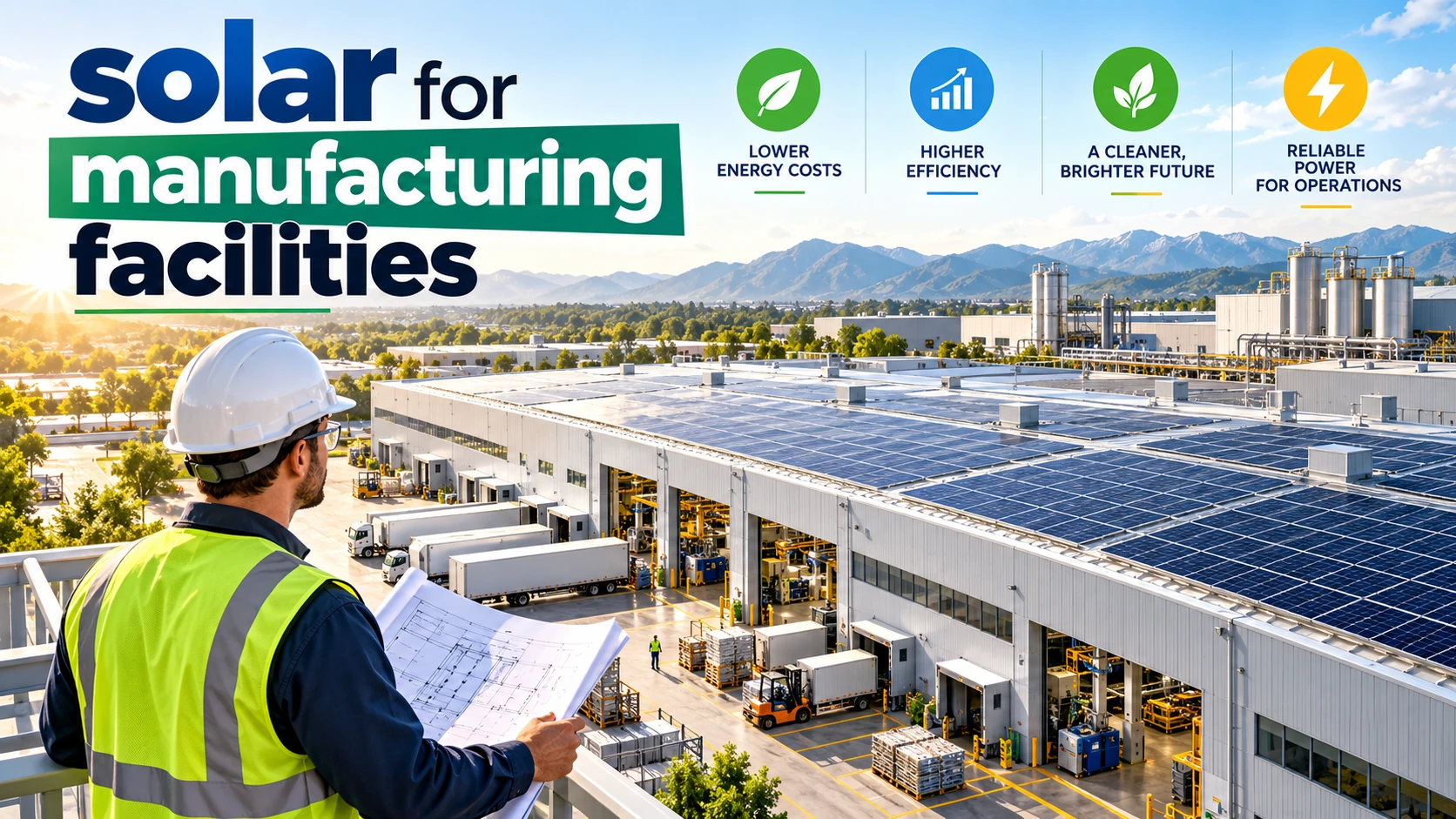
Most manufacturing buildings have large, flat or low-slope roofs, which happen to be close to ideal for solar.
A rooftop array uses space that’s already there and not doing anything else.
Solar panels for industrial buildings typically go on exactly this kind of roof, and the same approach works well for warehouse roofs and distribution centers that share a similar structural layout.
When roof space is limited, aging, or already committed to HVAC equipment, a ground-mount solar array on adjacent land or a solar carport over an employee parking lot can make up the difference.
These systems cost more per watt to install but avoid any roof-related constraints entirely.
Pairing a solar system with battery storage lets a facility store midday solar production and use it during evening shifts or the exact minutes when demand spikes highest.
That stored power is also what keeps critical equipment running if the grid goes down.
Yes.
Demand charges, which bill a facility for its single highest 15-minute spike in electricity use each month, can make up 30% to 70% of a manufacturing plant’s total power bill, and solar reduces them by covering part of that peak with on-site generation instead of pulling it all from the grid.
Demand charges catch a lot of manufacturers off guard.
They’re billed separately from regular electricity use, and depending on the facility, these charges alone can account for anywhere from 30% to 70% of the total energy bill.
A single large piece of equipment starting up at the wrong moment can set an expensive peak that affects the entire month’s bill.
Solar helps most when that peak happens to fall during daylight hours, which is common in plants that run their heaviest equipment during day shifts.
It won’t eliminate demand charges that spike after dark, which is one reason many manufacturers pair solar with battery storage rather than relying on panels alone.
Most manufacturing roofs are a good fit for solar, because a complete solar array typically adds only 3 to 5 pounds per square foot of extra weight, while most commercial roofs are built to handle 20 pounds per square foot or more.
The real question is usually the roof’s remaining lifespan and the location of existing rooftop equipment, not whether it can bear the load.
A proper assessment looks at more than just total weight.
Point loads, the concentrated force at each spot where the racking attaches to the roof, can transfer 80 to 200 pounds through a single connection, so an engineer checks those attachment points specifically, along with wind uplift and snow load for the region.
A commercial solar site assessment covers all of this before a single panel goes up.
Beyond structural capacity, the assessment also looks at how much usable roof area is left once rooftop units, skylights, and vents are accounted for, and which direction that space faces.
When a roof can’t support the full system a facility needs, comparing rooftop and ground-mount options side by side usually settles the question quickly.
Businesses that install commercial solar in 2026 can claim a federal Investment Tax Credit worth up to 30% of the total project cost, covering panels, inverters, racking, and labor, as long as the installer meets prevailing wage and apprenticeship requirements.
On top of that, state-level commercial solar incentives can push total savings even higher.
The federal credit isn’t automatic at the full rate.
The base credit under Section 48 is 6% of qualified costs, and reaching the full 30% requires the installation to meet prevailing wage and registered apprenticeship standards, something an experienced commercial installer handles as part of the project.
Beyond the federal credit, state and utility rebates can add further savings depending on where a facility is located.
New England states have historically offered some of the strongest incentive programs in the country, which matters even more given how high electricity costs already are in the region.
Most industrial solar installations pay for themselves in 3 to 5 years, with facilities that run high electricity costs and heavy daytime operations often recovering their investment in closer to 3 years.
After that, the system keeps producing power at little more than maintenance cost for decades.
Payback time comes down to how much electricity a facility uses, when it uses it, and what it currently pays per kilowatt-hour.
A facility’s exact numbers depend on its utility rate, system size, and available incentives, which is why a return on investment estimate should always be based on the specific building rather than an industry average.
For facilities that don’t want to pay the full cost upfront, financing options can spread the investment out while the system is already generating savings.
Sunergy Solutions works with manufacturing facilities across Connecticut, Maine, Massachusetts, New Hampshire, Rhode Island, and Vermont to design solar systems built around how each plant actually operates, not a generic template.
Every project starts with a full site assessment that checks roof condition, available space, and the facility’s real electricity usage before any equipment gets specified.
From there, our team handles commercial solar installation from permitting through final inspection, whether that means a rooftop array, a ground-mount system, or a combination of both.
Every system we install carries a 25-year manufacturer’s warranty on the equipment and a 20-year workmanship warranty on our installation work, so the investment stays protected well beyond the day the panels go up.
When a facility’s roof needs attention before solar goes on it, our team also handles roofing services directly, so plant managers get one point of contact instead of coordinating between separate roofing and solar contractors.
Before committing to a system, a few questions help determine the right size and setup:
That third question matters more than most manufacturers expect.
Oversizing a commercial solar array to account for future load growth upfront is almost always cheaper than adding a second system later.
Many of the facilities that get the most value from solar also show clear signs of being a good candidate before they ever request a quote, like high daytime usage, a roof with 15-plus years of life left, and consistent year-round production.
Solar for manufacturing facilities isn’t a trend.
It’s a direct response to a cost problem that keeps getting worse for plants that don’t generate their own power.
Between the federal tax credit, state incentives, and electricity rates that show no sign of coming down, the financial case is stronger in 2026 than it’s ever been, especially for manufacturers in New England already paying some of the highest rates in the country.
Sunergy Solutions has spent years helping businesses across Connecticut, Maine, Massachusetts, New Hampshire, Rhode Island, and Vermont turn their roofs and property into a long-term energy asset.
If you’re ready to find out what solar could do for your facility’s bottom line, our team can walk your site and show you real numbers specific to your building.
Installation timelines depend on system size and permitting, but most commercial projects move from site assessment to full operation within a few months. Larger systems or ones that need structural roof work first take longer.
Yes, when the system is sized correctly. A properly designed solar system, often paired with battery storage, can offset a significant share of the power used by compressors, conveyors, and production lines, especially equipment that runs during daylight hours.
Not when the installation is done correctly. A qualified installer uses mounting methods designed to protect the roof membrane, and many roofing manufacturers specifically approve solar installation methods that preserve the existing warranty.
A standard grid-tied solar system shuts off during an outage for safety reasons. Facilities that need power during an outage typically add battery storage, which lets the system keep operating independently of the grid.
Not always, but it depends on when a facility’s demand peaks happen. If peak usage occurs after sunset or a facility needs backup power during outages, battery storage makes the system significantly more valuable.
It depends on the facility’s electricity usage, but a rough guide is about 100 square feet of roof space per kilowatt of system size. A facility looking to offset a large share of its usage typically needs several thousand square feet of usable roof or ground space.
Appointments Available, 7 Days a Week


